Biology  >  QUESTIONS & ANSWERS  >  AQA A-Level Biology – Enzymes Questions and Answers 100% Pass (All)

AQA A-Level Biology – Enzymes Questions and Answers 100% Pass

Document Content and Description Below

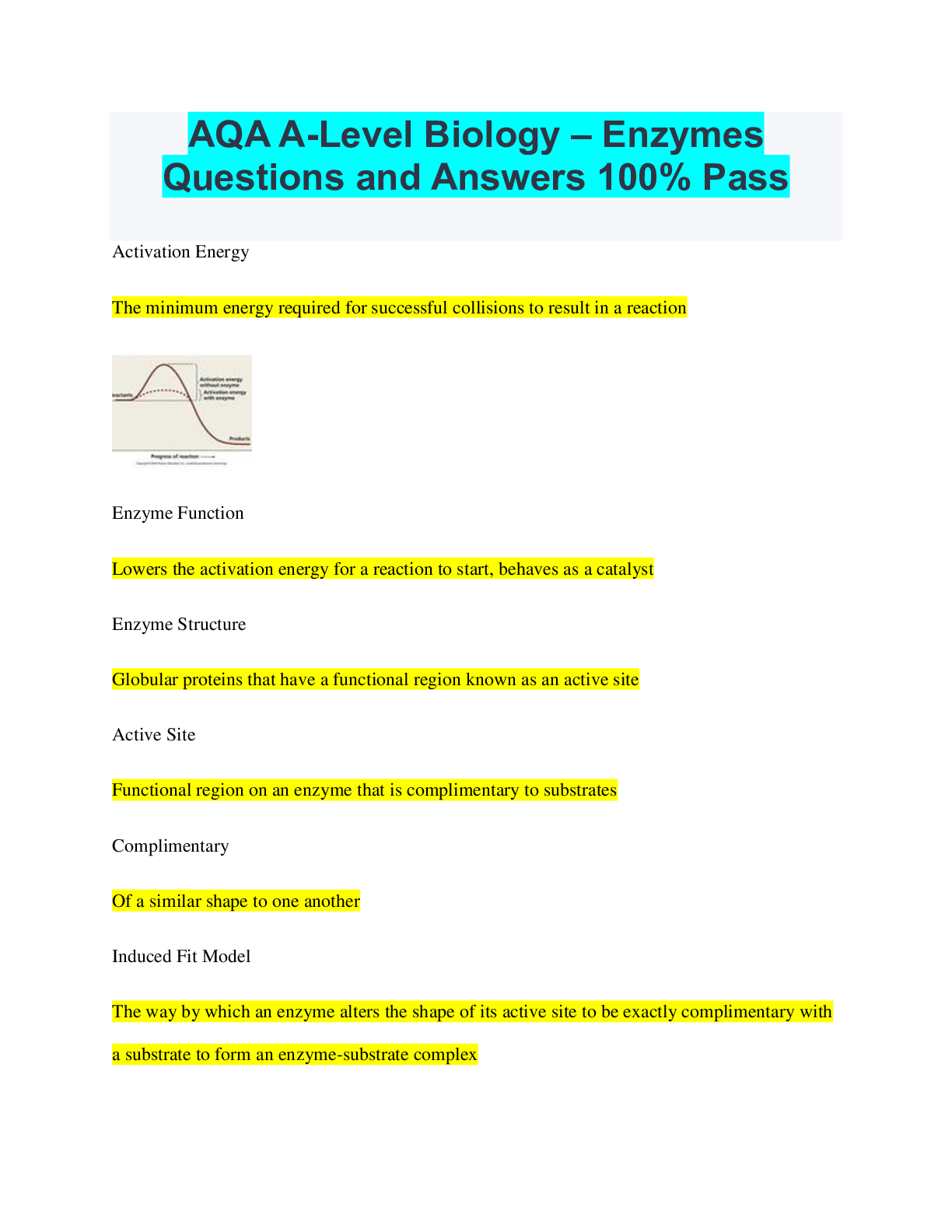
AQA A-Level Biology – Enzymes Questions and Answers 100% Pass Activation Energy The minimum energy required for successful collisions to result in a reaction Enzyme Function Lowers the activati ... on energy for a reaction to start, behaves as a catalyst Enzyme Structure Globular proteins that have a functional region known as an active site Active Site Functional region on an enzyme that is complimentary to substrates Complimentary Of a similar shape to one another Induced Fit Model The way by which an enzyme alters the shape of its active site to be exactly complimentary with a substrate to form an enzyme-substrate complex Lock and Key Theory Older theory suggesting that enzymes have a fixed shape active site that is always complimentary to specific substrates, rather than having an adjustable shaped active site Factors affecting Enzyme Action temperature, pH, concentration of enzyme/substrate How Temperature affects Enzyme Action Low temperature has few ES complexes. Medium temperature has an increase in ES complexes. Optimum temperature has maximum rate of ES complex formation. Above optimum denatures the enzyme which decreases ES complexes How pH affects Enzyme Action Further from optimum causes reversible denaturing but prevents formation of ES complexes. Closer to optimum increases the formation of ES complexes How Concentration affects Enzyme Action Low concentration has excess substrate molecules so enzymes work at an optimum. Medium concentration results in optimum working as all substrates occupy all active sites. High concentration has excess enzyme so not all enzymes work at an optimum. Substrate A region that binds with the active site to catalyse a reaction and make products 00:0401:27 Competitive Inhibition Substrates have a similar tertiary structure so is complimentary to the same active site on an enzyme. This can result in inhibition if one type of substrate forms an enzyme-substrate complex Non-Competitive Inhibition Substrates have a different tertiary structure to one another. Each are complimentary to different active sites on the enzyme. Once one enzyme-substrate complex forms, the shape of the other active site changes due to changes in quarternary structure Inhibitor A substrate that directly or indirectly interferes with the active site of an enzyme, affecting its function Negative Feedback Where the body undergoes a process to restore homeostasis by preventing a certain function [Show More]

Last updated: 2 years ago

Preview 1 out of 4 pages

Buy Now

Instant download

We Accept:

Payment methods accepted on Scholarfriends (We Accept)
Preview image of AQA A-Level Biology – Enzymes Questions and Answers 100% Pass document

Buy this document to get the full access instantly

Instant Download Access after purchase

Buy Now

Instant download

We Accept:

Payment methods accepted on Scholarfriends (We Accept)

Also available in bundle (1)

Click Below to Access Bundle(s)

AQA A-Level Biology Bundled Exams Questions and Answers with Verified Solutions

AQA A-Level Biology Bundled Exams Questions and Answers with Verified Solutions

By Nutmegs 2 years ago

$23

21  

Reviews( 0 )

$8.50

Buy Now

We Accept:

Payment methods accepted on Scholarfriends (We Accept)

Instant download

Can't find what you want? Try our AI powered Search

198
0

Document information


Connected school, study & course


About the document


Uploaded On

Apr 29, 2023

Number of pages

4

Written in

All

Seller


Profile illustration for Nutmegs
Nutmegs

Member since 4 years

606 Documents Sold

Reviews Received
77
14
8
2
21
Additional information

This document has been written for:

Uploaded

Apr 29, 2023

Downloads

 0

Views

 198

Document Keyword Tags


$8.50
What is Scholarfriends

Scholarfriends.com Online Platform by Browsegrades Inc. 651N South Broad St, Middletown DE. United States.

We are here to help

We're available through e-mail, Twitter, Facebook, and live chat.
 FAQ
 Questions? Leave a message!

Follow us on
 Twitter

Copyright © Scholarfriends · High quality services·