BIOL 120 Modern Biology 2. FINAL Questiona and Answers
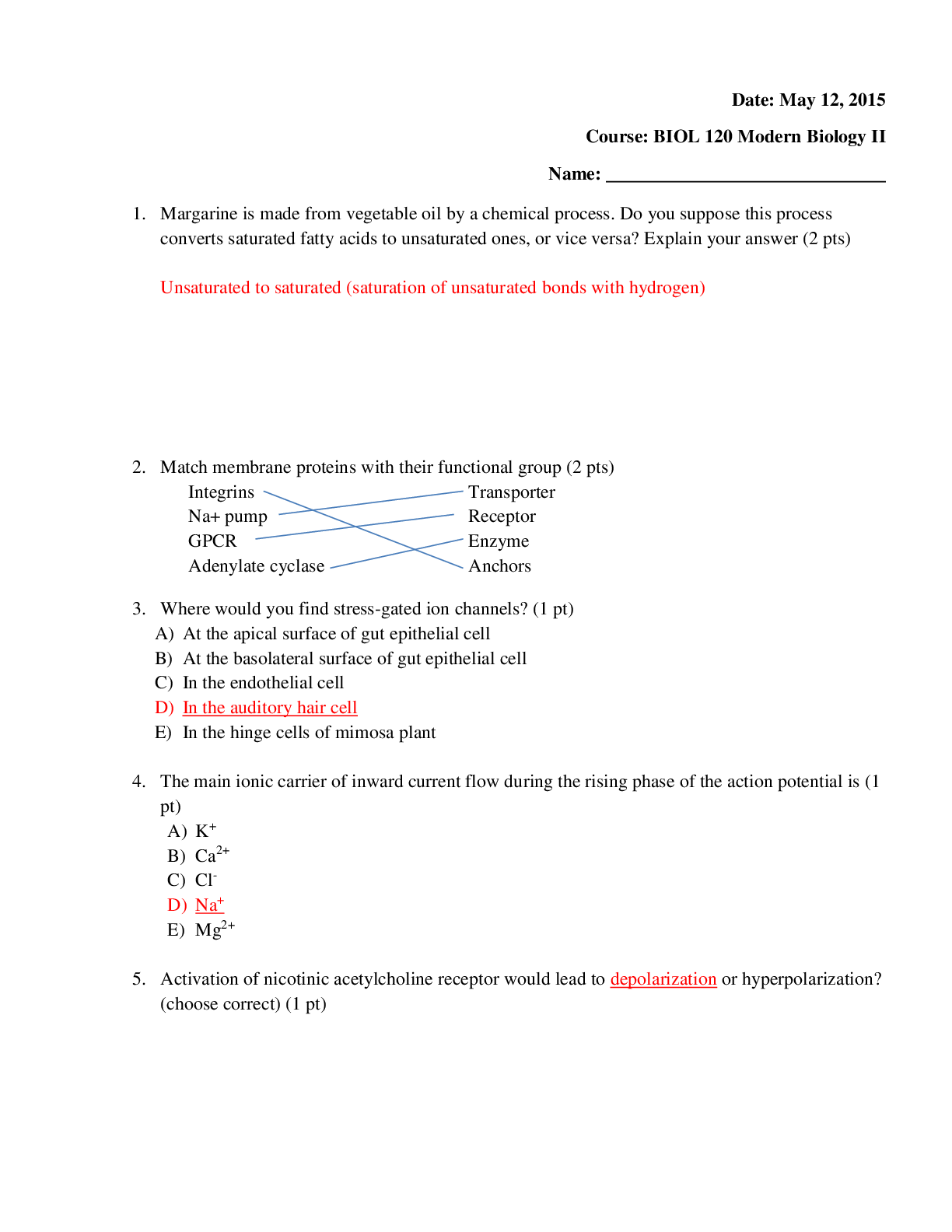
Course: BIOL 120 Modern Biology II
1. Margarine is made from vegetable oil by a chemical process. Do you suppose this process converts saturated fatty acids
...
BIOL 120 Modern Biology 2. FINAL Questiona and Answers
Course: BIOL 120 Modern Biology II
1. Margarine is made from vegetable oil by a chemical process. Do you suppose this process converts saturated fatty acids to unsaturated ones, or vice versa? Explain your answer (2 pts)
Unsaturated to saturated (saturation of unsaturated bonds with hydrogen)
2. Match membrane proteins with their functional group (2 pts)
Integrins Transporter
Na+ pump Receptor
GPCR Enzyme
Adenylate cyclase Anchors
3. Where would you find stress-gated ion channels? (1 pt)
A) At the apical surface of gut epithelial cell
B) At the basolateral surface of gut epithelial cell
C) In the endothelial cell
D) In the auditory hair cell
E) In the hinge cells of mimosa plant
4. The main ionic carrier of inward current flow during the rising phase of the action potential is (1
pt)
A) K+
B) Ca2+
C) ClD) Na+
E) Mg2+
5. Activation of nicotinic acetylcholine receptor would lead to depolarization or hyperpolarization?
(choose correct) (1 pt)
6. Inhibitory neurotransmission is due to activation of GABA or glycine receptors which are
ligand-gated ion channels. To what ions are they permeable? (1 pt)
A) K+
B) Ca2+
C) ClD) Na+
E) All ions listed above
7. Explain why action potential is propagated only in one direction along an axon? (2 pts)
Due to inactivation of voltage-gated sodium channels
8. What step of Krebs cycle leads to GTP formation? (1 pt)
A) Isocitrate to α-ketoglutarate
B) α-ketoglutarate to succinyl-CoA
C) succinyl-CoA to succinate
D) succinate to fumarate
E) malate to oxaloacetate
9. What reactions of glycolysis are irreversible? (3 pts)
1,3,10
10. Explain why NADH produced during Krebs cycle will result in 3 ATP while FADH2 only in 2
ATP? (2 pts)
Less protons are pumped as far as FADH2 delivers its electrons to the Complex II, skipping NADH dehydrogenase
11. Dinitrophenol (DNP) uncouples mitochondrial electron transport from oxidative
phosphorylation by (1 pt)
A) Dissipating the proton gradient
B) Inhibiting cytochrome oxidase
C) Dissociating the F0 and F1 units of ATP synthase complex
D) Binding irreversibly to ubiquinone
E) Blocking the adenine nucleotide carrier (ATP/ADP exchanger)
12. Which signal sequence serves as ER retention signal? Where would you find it in protein (Nterminus or C-terminus)? (2 pts)
KDEL, at the C-terminus
13. What is a function of Ran protein? (1 pt)
A) Activates apoptosis
B) Assists in nuclear transport
C) Pumps cytochrome C from intermembrane space of mitochondria
D) Helps direct transport vesicles to their target membranes
E) Activates Cdk
14. SNARE proteins are found in the membranes of all of the following compartments EXCEPT (1
pt)
(A) Mitochondria
(B) Golgi complex
(C) Early endosome (D) Endoplasmic reticulum (E) Synaptic plasma membrane
15. How is Protein Kinase C (PKC) activated? (2 pts)
By DAG and Calcium
16. Match the target of the G protein with the appropriate signaling outcome. (2pts)
adenylyl cyclase __B A. cleavage of inositol phospholipids
ion channels __C B. increase in cAMP levels
phospholipase C __A C. changes in membrane potential
17. Is the following statement true or false? (1 pt)
Somatic cells leave no progeny and thus, in an evolutionary sense, exist only to help create, sustain, and propagate the germ cells.
18. Which of the following cell compartments is associated with a protein lamin (1 pt)
A) Chloroplast
B) Basal lamina
C) Nucleus
D) Mitochondrion
E) Peroxisome
19. A previously unknown organism that lacks a nuclear membrane and mitochondria has just been
discovered. Which of the following would this organism most likely possess? (1 pt)
(A) Lysosomes
(B) Cilia
(C) Ribosomes
(D) Endoplasmic reticulum (E) Chloroplasts
20. In order for a muscle contraction to occur, myosin head has to bind to actin filament. The transient rise in Ca2+ facilitates this interaction. Where does Ca2+ bind to during muscle contraction? (1 pt)
A) Actin
B) Myosin
C) Troponin
D) Tropomyosin
E) Voltage-gated Ca channels
21. The bond between the actin and myosin head is broken when (1 pt)
A) An ATP molecule binds to the myosin head
B) An ATP molecule binds to the actin molecule
C) An ATP molecule breaks down on the myosin head
D) An ATP molecule breaks down on the actin molecule
E) ADP and phosphate bind to the myosin head
22. The poleward movement of chromosomes and concomitant shortening of kinetochore microtubule is known as A.__; the separation of the poles themselves accompanied by elongation of the polar microtubules is known as B.__ (1 pt)
A) A. metaphase; B. anaphase
B) A. anaphase; B. telophase
C) A. anaphase A; B. anaphase B
D) A. prometaphase; B. metaphase
E) A. anaphase B; B. anaphase A
23. True/False Dephosphorylation of nuclear pore proteins leads to nuclear envelope
disassembly. (1 pt)
24. Which of the following stages are very different for animal and plant cells? (1 pt)
A) Prophase
B) Prometaphase
C) Metaphase
D) Anaphase
E) Cytokinesis
25. The sputum (fluid coughed from the lungs) of many smokers contain cells with mutations in the gene coding p53. The smoking induced mutations serve as an early indicator of lung cancer. What is the likely relationship between early p53 mutation and the development of lung cancer? (1 pt)
A) p53 with a mutation directly stimulates the growth of cancer cells
B) Mutations in p53 would prevent abnormal cells from dying by apoptosis
C) Mutant p53 triggers the M phase of the cell cycle leading to abnormal cell division
D) p53 causes a cell to enter G0, blocking cell division
E) p53 has a telomerase activity, restoring the length of telomeres, enabling cell to divide
multiple times
26. Cyclins are proteins involved in regulation of (1 pt)
A) Cell-cycle protein kinases
B) Circadian rhythms
C) Synthesis of cAMP
D) Membrane circulation via endocytosis and exocytosis
E) The cycling of tubulin subunits through microtubules
27. Some organisms are capable of asexual and sexual reproduction. Under favorable conditions, reproduction proceeds asexually. When conditions become more stressful reproduction switches to a sexual mode. Why? (1 pt)
A) Sexual reproduction is simple and more rapid allowing larger number of offspring to be
produced
B) Sexual reproduction requires two separate individuals, who can mutually provide nutrient
support during stress
C) Asexual reproduction requires more energy
D) Sexual reproduction produces individuals with new combinations of recombinant
chromosomes increasing gene diversity
E) Sexual reproduction requires less energy and resources
28. Which of the following most accurately explains the cause for the abnormal numbers of
chromosomes during human reproduction that can result in Down syndrome? (1 pt)
A) The occurrence of nondisjunction of homologous chromosomes during meiosis
B) The duplicative production of extra chromosomes during DNA replication
C) The abnormal pairing of nonhomologous chromosomes during prophase of meiosis I
D) The selective loss of particular chromosomes from the sex cells after formation of the mature
gametes
E) The fusion of two sperms with one egg to provide an extra set of paternal chromosomes
29. A bacterium is suddenly expelled from a warm human intestine into the cold world outside. Which of the following adjustments might the bacterium make to maintain the same level of membrane fluidity? (1 pt)
A) Produce lipids with hydrocarbon tails that are longer and have fewer double bonds.
B) Produce lipids with hydrocarbon tails that are shorter and have more double bonds.
C) Decrease the amount of cholesterol in the membrane.
D) Decrease the amount of glycolipids in the membrane.
E) Increase the amount of proteoglycans in the membrane.
30. Consider the apical location of a particular protein expressed in epithelial cells, illustrated in Figure 1A. Which type of defect described below is the most likely to cause the redistribution of that protein around the entire cell, shown in Figure 1B? (1 pt)
Figure 1
A) a nonfunctional protein glycosylase
B) the deletion of a junctional protein
C) the truncation of a protein found in the extracellular matrix
D) a nonfunctional flippase
E) the truncation of intermediate filaments
31. On a diet consisting of nothing but protein, which of the following is the most likely outcome?
(1 pt)
A) loss of weight because amino acids cannot be used for the synthesis of fat
B) muscle gain because the amino acids will go directly into building muscle
C) tiredness because amino acids cannot be used to generate energy
D) excretion of more nitrogenous (ammonia-derived) wastes than with a more balanced diet
E) amino acids will be converted into glucose
32. __ stabilize Intermediate filaments (IFs) and link them to other IFs, microtubules, and
microfilaments. (1 pt)
A) actin.
B) plectin.
C) tubulin.
D) integrin
F) lamin
33. Figure 2 represents a cell lining the gut. Draw numbered labeled lines to indicate exactly where
inside a cell the following processes take place. (4 pts)
Figure 2
1. glycolysis
2. citric acid cycle
3. conversion of pyruvate to activated acetyl groups
4. oxidation of fatty acids to acetyl CoA
5. glycogen breakdown
6. release of fatty acids from triacylglycerols
7. oxidative phosphorylation
34. The ATP synthase found in chloroplasts is structurally similar to the ATP synthase in mitochondria. Given that ATP is being synthesized in the stroma, where will the F0 portion of the ATP synthase be located? (1 pt)
A) thylakoid space
B) stroma
C) inner membrane
D) thylakoid membrane
E) cytoplasm
35. Which of the following statement is correct? Kinesins and dyneins __ (1 pt)
A) Have tails that bind to the filaments.
B) Move along both microtubules and actin filaments.
C) Often move in opposite directions to each other.
D) Derive their energy from GTP hydrolysis.
E) Move in the same direction.
36. You engineer yeast cells that express the M cyclin during S phase by replacing the promoter sequence of the M cyclin gene with that of S cyclin. Keeping in mind that yeast cells have one common Cdk that binds to all cyclins, which of the following outcomes is least likely during this experiment? (1 pt)
A) There will be both M cyclin–Cdk and S cyclin–Cdk complexes in the cell during S phase.
B) Some substrates that are normally phosphorylated in M phase will now be phosphorylated in S phase.
C) G1 cyclins will be expressed during S phase.
D) S-Cdk targets will be phosphorylated during S phase.
E) DNA will be replicated during S phase.
37. Irradiated mammalian cells usually stop dividing and arrest at a G1 checkpoint. Place the
following events in the order in which they occur. (2 pts)
A) production of p21
B) DNA damage
C) inhibition of cyclin–Cdk complexes
D) accumulation and activation of p53
B, D, A, C
38. What is the main molecular difference between cells in a G0 state and cells that have simply
paused in G1? (2 pts)
39. Figure 3 shows how normal signaling works with a Ras protein acting downstream of an RTK. You examine a cell line with a constitutively active Ras protein that is always signaling. Which of the following conditions will turn off signaling in this cell line? (1pt)
Figure 3
A) addition of a drug that prevents protein X from activating Ras
B) addition of a drug that increases the affinity of protein Y and Ras
C) addition of a drug that blocks protein Y from interacting with its target
D) addition of a drug that increases the activity of protein Y
40. Apoptosis differs from necrosis in that necrosis _. (1pt)
A) requires the reception of an extracellular signal.
B) causes DNA to fragment.
C) causes cells to swell and burst, whereas apoptotic cells shrink and condense.
D) involves a caspase cascade.
E) necrosis always follows apoptosis
41. Which stage of mitosis in an animal cell does each part of Figure 4 represent? (2 pts)
Figure 4
A - B - C - D –
A—telophase; B—prophase; C—anaphase; D—prometaphase
42. With respect to gene E on the chromosome drawn in Figure 5, which gene is least likely to
behave according to Mendel’s law of independent assortment? Explain your answer. (2pts)
Figure 5
Gene F is least likely to behave according to Mendel’s law of independent assortment because it lies the closest to gene E and is least likely to be separated from gene E by recombination.
43. The toxin of Vibrio cholerae causes diarrhea because it (1pt)
A) modifies a G protein involved in regulating salt and water secretion.
B) decreases the cytosolic concentration of calcium ions, making the cells hypotonic to the intestinal cells.
C) binds with adenylyl cyclase and triggers the formation of cAMP.
D) signals inositol trisphosphate to become a second messenger for the release of calcium.
E) modifies calmodulin and activates a cascade of protein kinases.
44. Match the molecules (list 1) with the cell structures in which they are involved (list 2). A cell
structure may be listed more or less than once. (4 pts)
A—1; B—2; C—5; D—3; E—7; F—7; G—1
45. How do reproductive cloning and therapeutic cloning differ? (1pt)
A) The DNA in the nucleus of cells produced for therapeutic cloning is genetically identical to the donor genome, whereas in cells produced for reproductive cloning it is not.
B) Reproductive cloning requires a supply of fertilized donor egg cells, whereas therapeutic cloning requires unfertilized egg cells.
C) Therapeutic cloning requires nuclear transplantation, whereas reproductive cloning does not.
D) Embryos are placed into foster mothers during reproductive cloning but not during therapeutic cloning.
E) Therapeutic cloning is a part of reproductive cloning.
46. Induced pluripotent stem (iPS) cells _. (1pt)
A) are created by the expression of a set of key genes in cells derived from adult tissues so that these cells can differentiate into a variety of cell types.
B) require a supply of donor egg cells, such as embryonic stem cells.
C) can differentiate into a greater variety of adult tissues than embryonic stem cells.
D) are created by nuclear transplantation.
E) can be purified from blood
47. Ras is a GTP-binding protein that is often defective in cancer cells. A common mutation found in cancer cells causes Ras to behave as though it were bound to GTP all the time, which will cause cells to divide inappropriately. From this description, the normal Ras gene is _. (1 pt)
A) a tumor suppressor.
B) an oncogene.
C) a proto-oncogene.
D) a gain-of-function mutation.
E) a cause of cancer.
48. The general name for an enzyme that transfers phosphate groups from ATP to a protein is (1 pt)
A) phosphorylase
B) phosphatase
C) protein kinase
D) ATPase
E) protease
49. The transmission of nerve impulses between adjacent nerve cells requires the release of a neurotransmitter (a molecule or small peptide). Which of the following would best describe the process by which neurotransmitters are released. (1pt)
A) phagocytosis
B) pinocytosis
C) passive transport (by facilitated diffusion) of the neurotransmitter out of the cell
D) regulated exocytosis
E) active transport of the neurotransmitter via a specific transporter
50. Initiation of mitogenesis by epidermal growth factor and depolarization of the membrane of a skeletal muscle cell by acetylcholine are similar in that each (1 pt)
(A) involves, as an essential early step, an ion flux across the plasma-membrane receptor of the responding cell
(B) requires a ligand-mediated conformational change in a plasma-membrane receptor of the responding cell
(C) requires activation of a G protein on the cytoplasmic face of the plasma membrane in the responding cell
(D) is mediated by phosphorylation of the ligand receptor in the responding cell (E) completes its primary task by direct activation of specific regulatory DNA sequences in the nucleus of the responding cell
51. A cell can crawl through a tissue because of the transmembrane __ proteins that can bind to fibronectin outside of the cell. (1pt)
A) integrin
B) collagen
C) gap junction
D) claudin
E) actin
52. The single-nucleotide polymorphisms found in the human population . (1pt)
A) are important for genetic mapping because they represent mutations in genes important for human disease.
B) are rarely found among blood relatives.
C) can be linked into haplotype blocks.
D) BONUS arose mainly during the past 10,000 years
1. Rho-protein activation (1 pt)
A) Promotes rapid assembly of long, unbranched contractile bundles
B) Causes formation of enormous lamellipodium that extends from the entire circumference
of the cell
C) Stimulates protrusion of many long filopodia at the cell periphery
D) Stimulates activation of caspases
E) Activates JAK/STAT pathway
2. Rhodopsin, β-adrenergic receptors, and muscarinic acetylcholine receptors share which of
the following features? (1 pt)
(A) Each causes an inhibitory intracellular response. (B) Each activates a tyrosine kinase cascade. (C) Each is composed of an dimer.
(D) Each functions through a heterotrimeric G-protein.
(E) Each gates a cation channel.
3. All of the following are known to be part of a signal transduction cascade EXCEPT (1 pt)
(A) phosphorylation of fibronectin
(B) dissociation of the components of a hetero- trimeric G-protein (C) enzymatic breakdown of phosphatidyl inositol bisphosphate (PIP2)
(D) elevation of intracellular [Ca2+] (E) activation of cGMP phosphodiesterase
4. Protein phosphorylation is commonly involved with all of the following except (1 pt)
A) Regulation of transcription by extracellular signal molecules
B) Enzyme activation
C) Activation of G protein-coupled receptors
D) Activation of receptor tyrosine kinases
E) Activation of protein kinase molecules
5. Which of the following will result if the level of potassium ions in a solution bathing a nerve
cell is raised tenfold while the cell is at its resting state? (1 pt)
(A) The decrease in the normal K+ gradient will cause partial depolarization.
(B) The amplification of the normal K+ gradient will cause partial hyperpolarization. (C) The added extracellular K+ will accelerate Na+/K+ pumping and cause partial depolarization.
(D) The added extracellular K+ will cause ligand-gated ion channels to open. (E) The elevated K+ will promote Ca2+ channel opening and produce partial hyperpolarization.
,
[Show More]