A Level Physical Chemistry AQA
(2022/2023) Already Graded A+
relative mass of a proton ✔✔1
relative mass of a neutron ✔✔1
relative mass of an electron ✔✔1/1840
relative charge of a proton ✔✔+1
relative ch
...
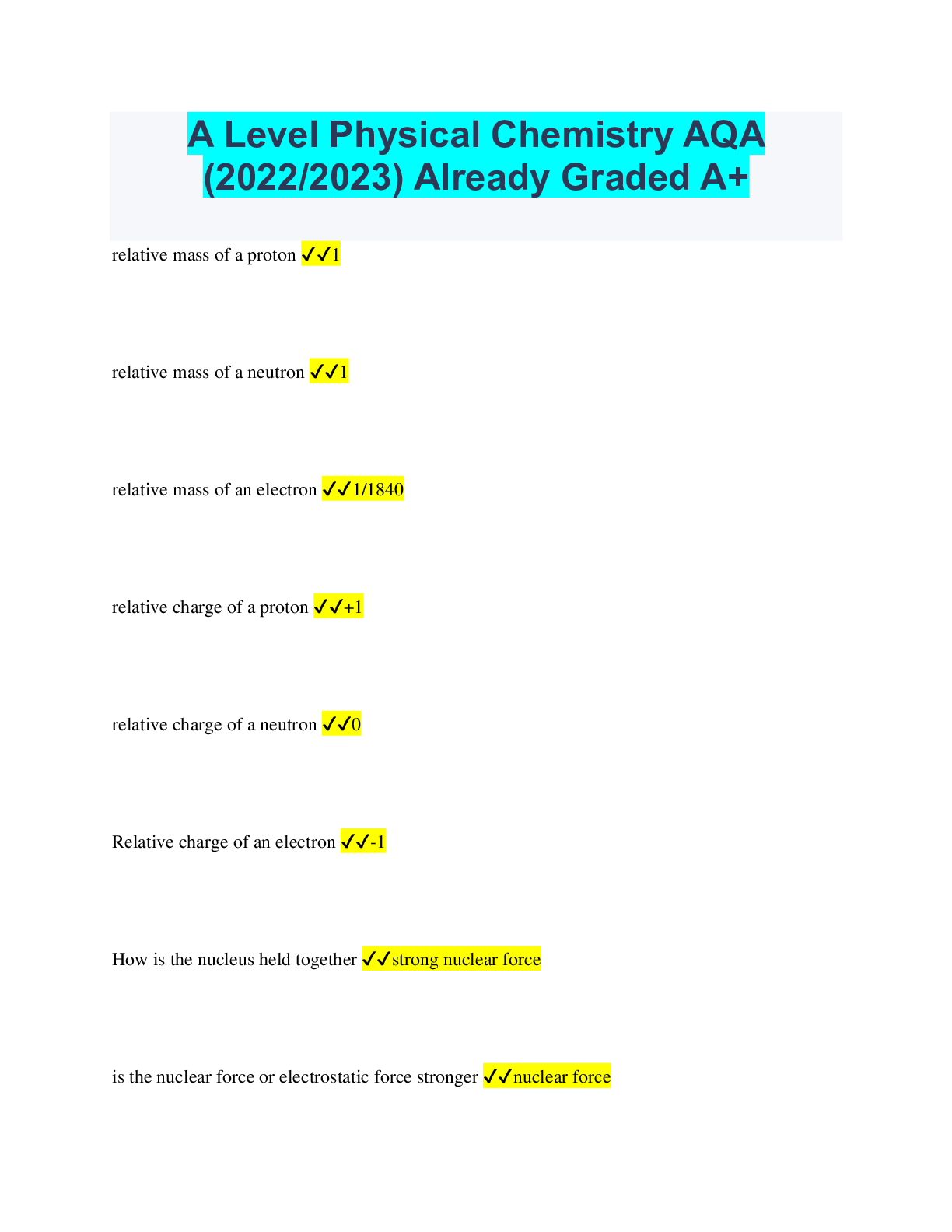
A Level Physical Chemistry AQA
(2022/2023) Already Graded A+
relative mass of a proton ✔✔1
relative mass of a neutron ✔✔1
relative mass of an electron ✔✔1/1840
relative charge of a proton ✔✔+1
relative charge of a neutron ✔✔0
Relative charge of an electron ✔✔-1
How is the nucleus held together ✔✔strong nuclear force
is the nuclear force or electrostatic force stronger ✔✔nuclear force
what does the atomic number represent ✔✔number of protons
the number of protons in an atom ✔✔atomic number z
what does the mass number represent ✔✔number of protons and neutrons
the number of nucleons in an atom ✔✔mass number (A)
atoms of the same element that have different numbers of neutrons ✔✔isotopes
what determines the reactivity of an atom ✔✔electrons
hydrogen isotopes ✔✔H1/H2/H3
Chlorine isotopes ✔✔Cl35/Cl37
Bromine isotopes ✔✔Br79/Br81
Carbon isotope used for carbon dating ✔✔C-14
Number of electrons the first shell can hold ✔✔2
Number of electrons the second shell can hold ✔✔8
Number of electrons the third shell can hold ✔✔18
Ar ✔✔Relative Atomic Mass
average mass of 1 atom/1/12 of 1 atom of C-12 ✔✔Relative Atomic Mass
What does the mass spectrometer do? ✔✔determines the mass of separate atoms
First step of the TOF Spectrometer ✔✔Vacuum
TOF spectrometer full ✔✔Time of Flight Mass spectrometer
Vacuum step (TOF) ✔✔Kept under a high vacuum to avoid collisions with air molecules
Second step of the TOF spectrometer ✔✔Ionisation
First method of ionisation (TOF) ✔✔Dissolved in solvent and passing through needle to a
positive terminal with a high voltage producing positively charged droplets which have lost
electrons
Second method of ionisation (TOF) ✔✔Molecules gain a proton
Third step of the TOF spectrometer ✔✔Acceleration
Acceleration step (TOF) ✔✔Positive ions attached to a negative plate so they accelerate towards
it, faster depending on their m/z ratio
m/z ratio ✔✔mass/charge
Fourth step of the TOF spectrometer ✔✔Ion Drift
Ion Drift step (TOF) ✔✔Ions pass through a hole in the negative plate, forming a beam to travel
along the flight tube to the detector
Fifth step of the TOF spectrometer ✔✔Detection
Detection step (TOF) ✔✔Ions with highest velocities arrive at the detector first and flight times
recorded. Ions pick up an electron which causes a current to flow so they are detected
Sixth step of the TOF spectrometer ✔✔Data Analaysis
Data Analysis step (TOF) ✔✔signal from the detector goes to a computer which generates the
mass spectrum
What can the mass spectrometer do ✔✔Identify the abundance of different isotopes
what does the height of a peak on a mass spectrum give ✔✔abundance
what does the horizontal axis on a mass spectrum give ✔✔m/z
How to work out the Ar of an element from a mass spectrum ✔✔(abundance x m/z) +
(abundance x m/z) all over total abundance
General formula for the maximum number of electrons each energy level can hold ✔✔2n2
four different atomic sub-levels ✔✔s,p,d,f
Which sub-levels does the first shell contain ✔✔s
Which sub-levels does the second shell contain ✔✔s,p
Which sub-levels does the third shell contain ✔✔s,p,d
Number of electrons the s sub-level can hold ✔✔2
Number of electrons the p sub-level can hold ✔✔6
Maximum number of p-orbitals per shell ✔✔3
Number of electrons the d sub-level can hold ✔✔10
Maximum number of d-orbitals per shell ✔✔5
✔✔s-orbital
✔✔p-orbital
A region of space around an atomic nucleus
[Show More]