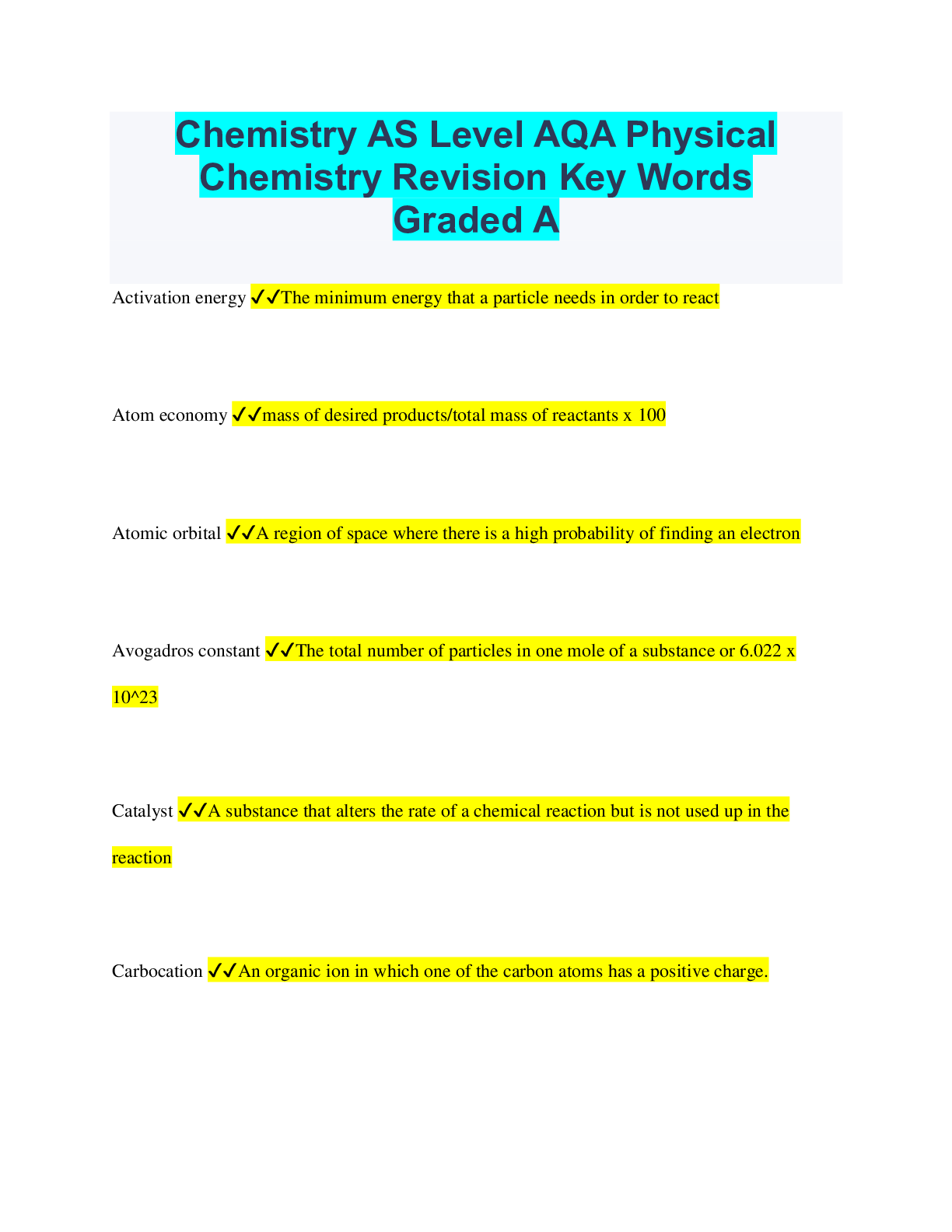
Chemistry AS Level AQA Physical
Chemistry Revision Key Words
Graded A
Activation energy ✔✔The minimum energy that a particle needs in order to react
Atom economy ✔✔mass of desired products/total mass of reactants x 1
...
Chemistry AS Level AQA Physical
Chemistry Revision Key Words
Graded A
Activation energy ✔✔The minimum energy that a particle needs in order to react
Atom economy ✔✔mass of desired products/total mass of reactants x 100
Atomic orbital ✔✔A region of space where there is a high probability of finding an electron
Avogadros constant ✔✔The total number of particles in one mole of a substance or 6.022 x
10^23
Catalyst ✔✔A substance that alters the rate of a chemical reaction but is not used up in the
reaction
Carbocation ✔✔An organic ion in which one of the carbon atoms has a positive charge.
Co-ordinate bonding ✔✔Covalent bonding in which both the electrons in the bond comes from
one of the atoms in the bond.
Covalent bonding ✔✔Describes a chemical bond in which electrons are shared between two
atoms
Delocalised electrons ✔✔Electrons that are spread over several atoms and help to bond them
together
Dipole-dipole forces ✔✔An intermolecular force that results from the attraction between
molecules with permanent dipoles
Displayed formula ✔✔The formula of a compound drawn out so that each atom and each bond is
shown
Electron pair repulsion theory ✔✔Pairs of electrons around a central atom repel each other
equally taking up positions as far away as possible from each other
Electronegativity ✔✔The power of an atom to attract a pair of electrons in a covalent bond
Electrostatic forces ✔✔The forces of attraction and repulsion between electrically charged
particles
Empirical formula ✔✔The simplest whole number ratio in which the atoms in a compound
combine together
Endothermic ✔✔Where heat is taken during a reaction and the temperature drops
Exothermic ✔✔Where heat is given out during a reaction and the temperature rises
Hydrogen bonding ✔✔Where a hydrogen atom covalently bonded to an Nitrogen, Oxygen or
Fluorine atom interacts with another Nitrogen, Oxygen or Fluorine atom
Incomplete Combustion ✔✔A combustion reaction in which there is insufficient oxygen
Ionic bonding ✔✔A chemical bond in which electrons are transferred from atom to another,
forming oppositely charged ions with electrostatic forces of attraction between them
Ionisation energy ✔✔The energy required to remove one mole of electrons from one mole of
gaseous atoms to form one mole unipositive gaseous ions
Lattice ✔✔A regular three dimensional arrangement of atoms, ions or molecules
Lone pair ✔✔A pair of electrons in the outer shell of an atom that is not involved in bonding
Metallic bonding ✔✔A chemical bond in which outer electrons are spread over a lattice of metal
ions in a delocalised system.
Mole ✔✔A quantity of a substance that contains the Avogadro constant (6.022x10^23) of
particles
Molecular formula ✔✔A formula that tells us the numbers of atoms of each different element
that make up a molecule
Molecular ion ✔✔A molecule of the sample which has been ionised but which has not broken up
Nucleons ✔✔Protons and neutrons
Nucleus ✔✔Positively charged centre of an atom composed of protons and neutrons
Percentage yield ✔✔The actual amount of product produced divided by the theoretical amount
expressed as a percentage
Periodicity ✔✔The trends in the periodic table
Polar ✔✔A molecule where one side is slightly positively charged and the other side slightly
negatively charged
Proton number ✔✔The number of protons in the nucleus of an atom
Relative atomic mass ✔✔The weighted average mass of all the isotopes of an element relative to
one twelfth the mass of one atom of carbon-12
Relative formula mass ✔✔The average mass of a compound relative to one twelfth the mass of
one atom of carbon-12
Relative molecular mass ✔✔The average mass of a molecule relative to one twelfth the mass of
one atom of carbon-12
Strong nuclear force ✔✔The force that holds the protons and neutrons together within the
nucleus of an atom
van der Waals force ✔✔a type of intermolecular force of attraction that is caused by
instantaneous dipoles and acts between all atoms and molecules
[Show More]