AQA A Level Psychology –
Schizophrenia (2022/2023) Already
Passed
Schizophrenia ✔✔A mental disorder that affects thought processes and the ability to determine
reality.
Type 1 Schizophrenia ✔✔A form of schizophrenia
...
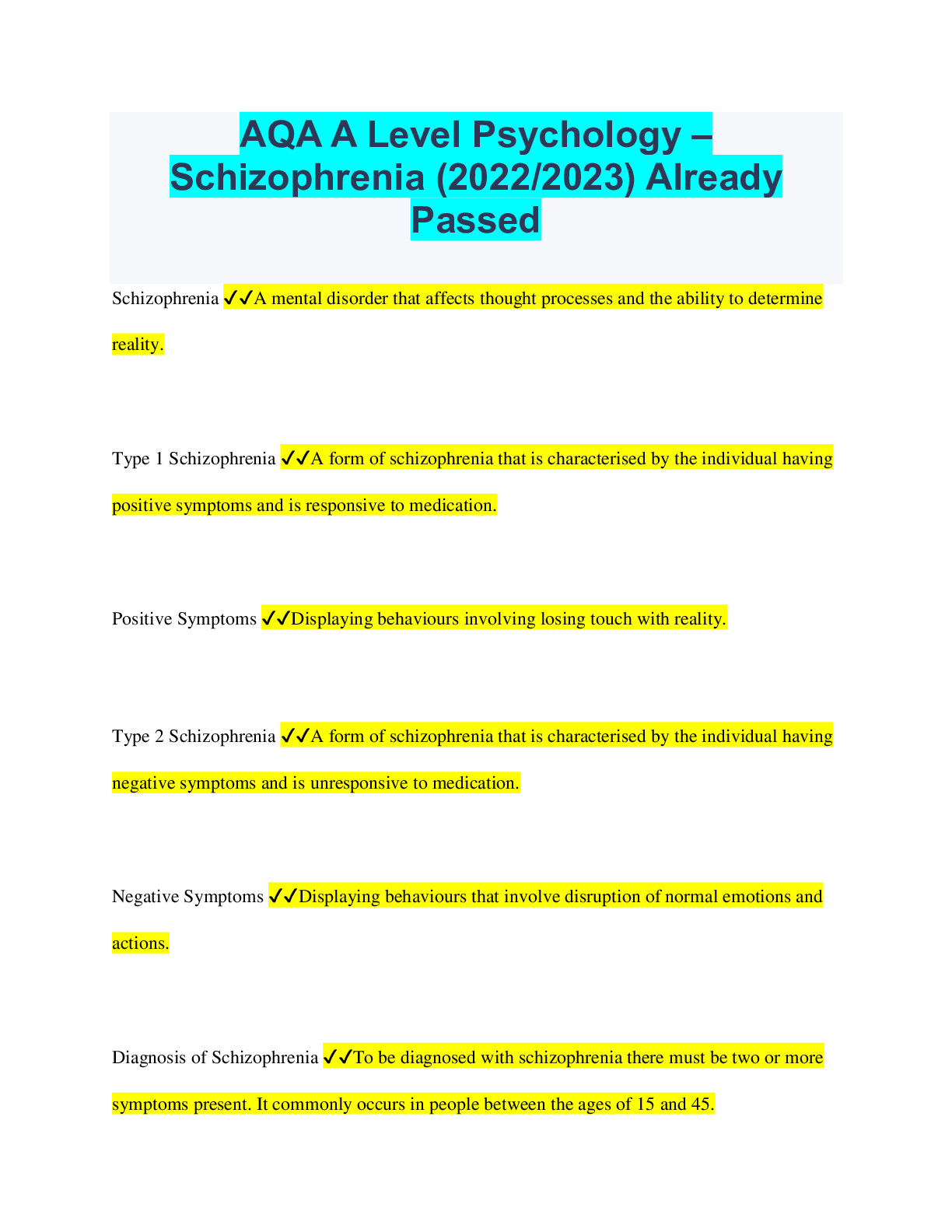
AQA A Level Psychology –
Schizophrenia (2022/2023) Already
Passed
Schizophrenia ✔✔A mental disorder that affects thought processes and the ability to determine
reality.
Type 1 Schizophrenia ✔✔A form of schizophrenia that is characterised by the individual having
positive symptoms and is responsive to medication.
Positive Symptoms ✔✔Displaying behaviours involving losing touch with reality.
Type 2 Schizophrenia ✔✔A form of schizophrenia that is characterised by the individual having
negative symptoms and is unresponsive to medication.
Negative Symptoms ✔✔Displaying behaviours that involve disruption of normal emotions and
actions.
Diagnosis of Schizophrenia ✔✔To be diagnosed with schizophrenia there must be two or more
symptoms present. It commonly occurs in people between the ages of 15 and 45.
Hallucinations ✔✔The perception of something being real that doesn't actually exist.
Delusions ✔✔A false belief that is resistant to confrontation with the truth.
Diagnosis ✔✔Identification of the nature and cause of illness.
DSM-5 ✔✔A diagnostic classification system produced in the USA.
ICD-10 ✔✔A diagnostic classification system produced by the World Health Organisation.
Disorganised Schizophrenia ✔✔A persons behaviour is generally disorganised such as speech.
Symptoms can include loss of interest or mood swings.
Catatonic Schizophrenia ✔✔It is diagnosed if the patient has severe motor abnormalities such as
unusual gestures. They may gesture repeatedly and do the opposite of what they are being asked.
They can be immobile for long periods of time.
Paranoid Schizophrenia ✔✔Involves delusions but the patient stays emotionally responsive.
They can show more argumentative behaviour and are much more alert.
Undifferentiated Schizophrenia ✔✔Includes patients that clearly don't belong within any other
type of schizophrenia category. They display symptoms but do not fit in with other types.
Residual Schizophrenia ✔✔People who have had an episode of schizophrenia in the last 6
months and show some symptoms but these are not as strong.
Co-Morbidity ✔✔The presence of one or more additional disorders that occur simultaneously
with schizophrenia. This could suggest that schizophrenia is not a separate disorder.
Culture Bias ✔✔The tendency to over-diagnose members of other cultures and claiming them to
be suffering from schizophrenia.
Gender Bias ✔✔The tendency for diagnostic criteria to be applied differently to males and
females so there are differences in the classification of the disorder.
Symptom Overlap ✔✔The perception that symptoms of schizophrenia are symptoms of other
mental disorders.
Biological Explanations ✔✔These focus on the possible effects that genetics, dopamine and
neural correlates have on schizophrenia.
Genetic Explanation ✔✔Transmission of abnormality by hereditary means.
Dopamine Hypothesis ✔✔The development of schizophrenia is related to abnormal levels of the
hormone and neurotransmitter dopamine.
Neural Correlates ✔✔The idea that the development of schizophrenia is related to structural and
functional brain abnormalities. fMRI helps to provide a comparison of the brains of
schizophrenics and non-sufferers.
Psychological Explanations for Schizophrenia ✔✔These include family dysfunction, cognitive
explanations and dysfunctional thought processing.
Family Dysfunction ✔✔The idea that dysfunctional family relationships are related to the
development of schizophrenia. Stress and contradictory situations can influence schizophrenia.
Cognitive Explanations ✔✔The idea that the development of schizophrenia is due to
maladaptive thought processes which involve a complex interaction of different factors. They
may experience positive or negative symptoms.
Dysfunctional Thought Processing ✔✔The idea that the development of schizophrenia is related
to abnormal ways of thinking. Some schizophrenics may believe that there ability to use
metacognition are the voices of others in their heads.
Drug Therapies ✔✔Treatment using chemical tablets and other means for abnormality.
Antipsychotic Drugs ✔✔These were introduced in 1952 and helped to dampen the symptoms of
schizophrenia so that an individual can function normally.
Typical Antipsychotics ✔✔These were the original first-generation drugs that were created in
the 1950s.
Atypical Antipsychotics ✔✔Second-generation drugs produced after typical antipsychotics to
treat schizophrenia. They have less side effects and are more effective.
Cognitive Behavioural Therapy ✔✔A psychological treatment used for schizophrenia by
modifying thought patterns to alter behavioural and emotional states.
Family Therapy ✔✔A form of therapy based upon the psychological explanation of family
dysfunction. It attempts to alter the communication systems within families. It involves the
whole family and not just the schizophrenic to work.
Token Economies ✔✔A method of behaviour modification that reinforces target behaviours by
awarding tokens that can be exchanged for material goods. They are used particularly for
negative symptoms.
Interactionist Approach ✔✔The idea that schizophrenia develops as a result of psychological,
biological and social factors.
Diathesis-Stress Model ✔✔The idea that individuals have varying genetic potentials combined
with environmental factors. The idea was proposed by interactionists.
Interactionists Treatments ✔✔Although these can be expensive and take time, combining
treatments are more effective in curing schizophrenia. Antipsychotic drugs are usually given
before to reduce symptoms then psychological treatments are carried out.
[Show More]