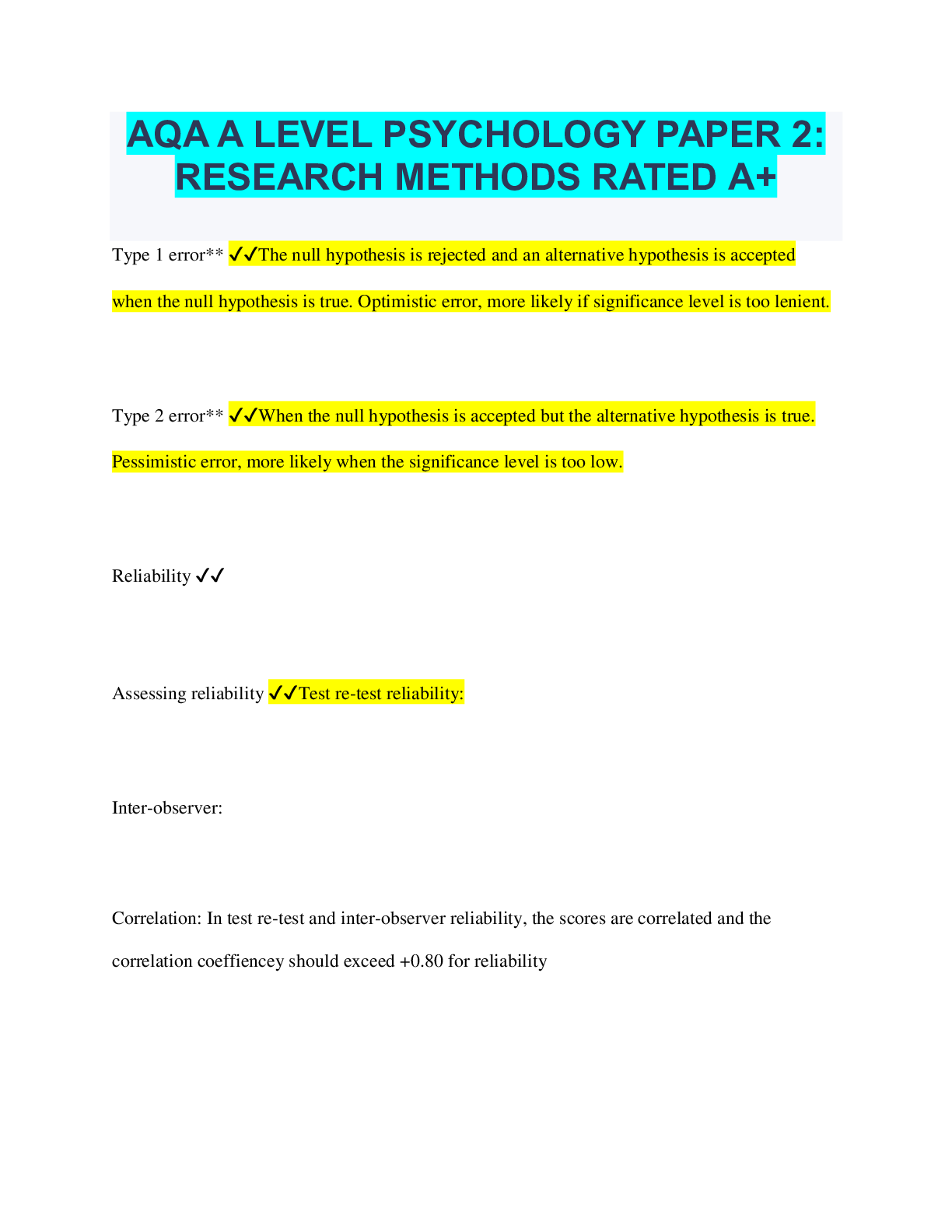
AQA A LEVEL PSYCHOLOGY PAPER 2:
RESEARCH METHODS RATED A+
Type 1 error** ✔✔The null hypothesis is rejected and an alternative hypothesis is accepted
when the null hypothesis is true. Optimistic error, more likely if s
...
AQA A LEVEL PSYCHOLOGY PAPER 2:
RESEARCH METHODS RATED A+
Type 1 error** ✔✔The null hypothesis is rejected and an alternative hypothesis is accepted
when the null hypothesis is true. Optimistic error, more likely if significance level is too lenient.
Type 2 error** ✔✔When the null hypothesis is accepted but the alternative hypothesis is true.
Pessimistic error, more likely when the significance level is too low.
Reliability ✔✔
Assessing reliability ✔✔Test re-test reliability:
Inter-observer:
Correlation: In test re-test and inter-observer reliability, the scores are correlated and the
correlation coeffiencey should exceed +0.80 for reliability
Improving reliability* ✔✔Questionairres- rewrite questions: questionnaires that produce low test
re-test reliability sometimes need to be rewritten. Researcher may replace some open questions
with closed ec.
Interviews- improved training: Best way to ensure reliability is to use the same interviewer each
time, if this is not possible all interviewers must be trained so they avoid leading questions.
Experiments- Standardised procedures:
Observations: operationalisation of behavioural categories- if behavioural categories are
measurable then they are less open to interpretation. categories should not overlap and all
possible behaviours should be included, if this is not the case then the research may end up with
inconsistent findings.
Validity ✔✔
Assessing validity ✔✔
Improving validity ✔✔
Choosing a statistical test ✔✔college meals upset stomaches with tomatoes, crisps, sweets &
Pepsi
Probability ✔✔
Psychological report** ✔✔Abstract summary of study (includes aims and hypothesis, method,
results and conclusions.
Introduction- looks at relevant theories, concepts and studies that are related to the current study
Method- should include sufficient detail so study can be replicated, requires a design, sample,
materials, procedure and ethics.
Results- descriptive summary of key findings including descriptive statistics (graphs, measures
of central tendency etc), inferential statistics (statistical tests and level of significance etc) as well
as any raw data.
Discussion- Summary of findings in verbal rather than statistical form, relationship of results to
previous research, considering limitations of research and real-world implications
Referencing- May include journal articles, books etc. laid out like:
Flanagan, C (2016) Experiments in Psychology, psychology review
Features of science*** ✔✔Paradigms: A set of shared assumptions and methods which
distinguishes scientific disciplines from non-scientific. Kuhn argued that social sciences lack a
universally accepted paradigm. Paradigm shifts occur when there is a scientific revolution,
researchers begin to question the accepted paradigm when there is contradictory evidence.
Theory construction: A theory is a general set of laws that explain behaviours. Testing a theory
depends on being able to make clear and precise predictions on the basis of a theory. A
hypothesis can then be tested using scientific methods to determine whether it will be supported.
Producing a new hypothesis from an existing theory is known as deduction.
Falsifiability: Genuine scientific theories should hold themselves up for hypothesis testing and
possibly being falsified. Popper distinguished between theories which can be challenged and
those which couldn't be falsified were called "pseudosciences". He believed even when a
scientific principle had been successfully repeated and tested, it was not necessarily true, just not
been proven false.
Replicability: If a scientific theory is to be trusted, the findings must be shown repeatable across
a number of different contexts. By repeating we can see the extent of which the findings can be
generalised.
Objectivity: To reduce bias in research, researchers must not let person bias influence the
behaviour of participants. Methods that require the most control such as lab experiments tend to
be the most objective.
Empirical method: Emphasise the importance of data collection based on sensory, direct
experience. Observation method is a good example of the empirical method in psychology.
According to early empiricists, a theory cannot claim to be scientific unless it has been
empirically tested.
Design an experiment ✔✔-Independent groups
-Repeated measures
-Matched pairs
Peer review ✔✔
Ethics*** ✔✔-Informed consent
-Deception
-Protection from harm
-Confidentiality
-Right to withdraw
-Debrief
Peer review** ✔✔Involves a small group assessing the written investigation who are objective.
Aims include:
To allocate research funding, each independent peer evaluation takes place to decide whether
funding should be given to a proposed research project.
Valididate the quality and relevance of research: All elements of respect are assessed for quality
and accuracy.
Suggest amendments: reviewers may suggest minor revisions and thereby improve the work
Evaluate peer review*** ✔✔1)ANOYMITY- Although remaining anonymous is likely to
produce a more honest review, some reviewers may criticise the rival researchers in a
competition for funding.
2)PUBLICATION BIAS: Journals tend to want to publish headline grabbing findings to increase
credibility as well as positive results, which could mean researchers who do not meet the criteria
get ignored.
3)BURYING GROUND BREAKING RESEARCH: Researchers tend to be especially critical
when the research contradicts their own view and vice versa when it matches it. Therefore
findings that go along with the current opinion are more likely to be published which prevents
new innovative research that challenges the current order.
Implications on the economy* ✔✔-Attachment into the role of the father
-Developmeny of treatments for mental illnesses
[Show More]




.png)



![Preview of [SOLVED] EDCO 740 / EDCO740 Quiz 1 (LATES 2021/2022 Graded A)](https://scholarfriends.com/storage/EDCO_740_Quiz_1.png)

