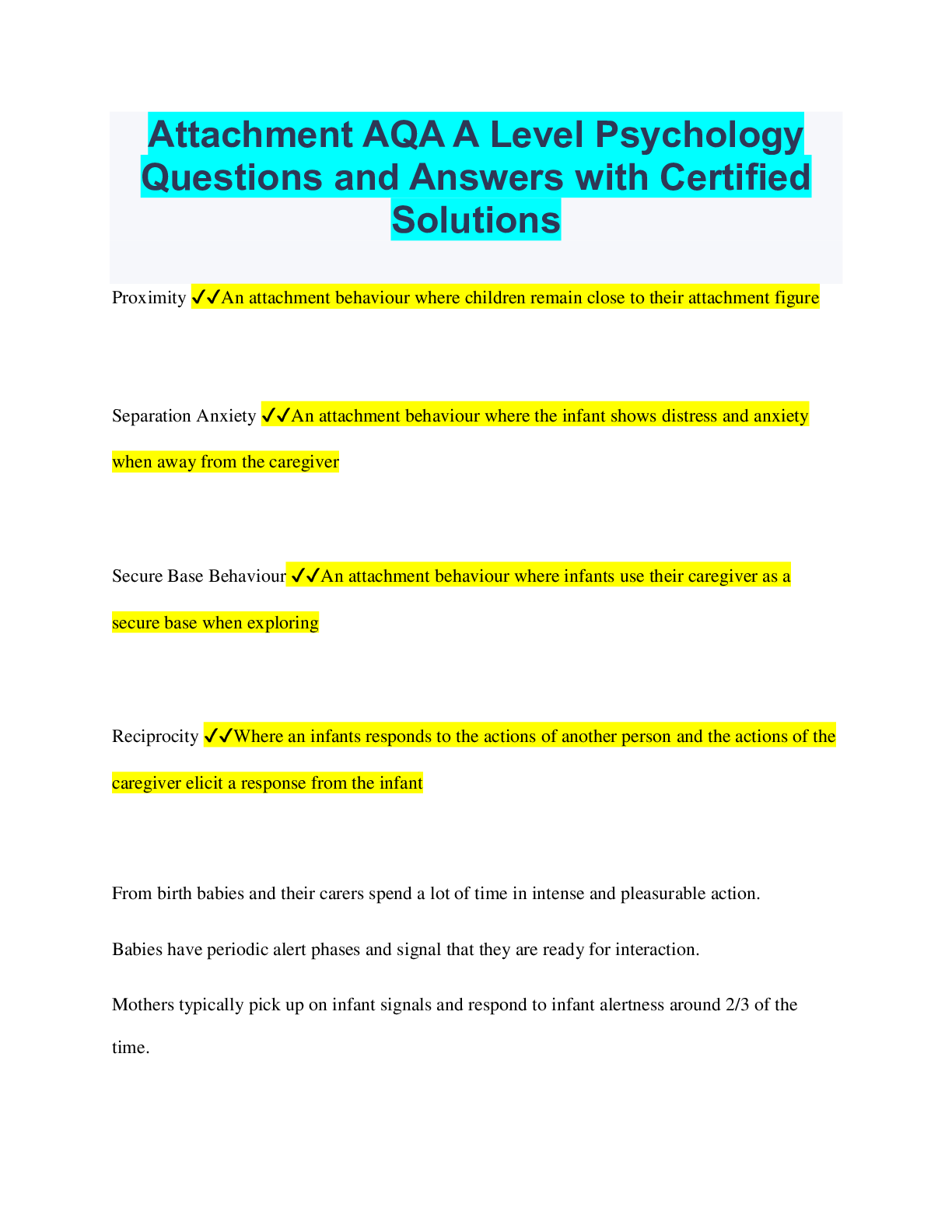
Attachment AQA A Level Psychology
Questions and Answers with Certified
Solutions
Proximity ✔✔An attachment behaviour where children remain close to their attachment figure
Separation Anxiety ✔✔An attachment behaviour
...
Attachment AQA A Level Psychology
Questions and Answers with Certified
Solutions
Proximity ✔✔An attachment behaviour where children remain close to their attachment figure
Separation Anxiety ✔✔An attachment behaviour where the infant shows distress and anxiety
when away from the caregiver
Secure Base Behaviour ✔✔An attachment behaviour where infants use their caregiver as a
secure base when exploring
Reciprocity ✔✔Where an infants responds to the actions of another person and the actions of the
caregiver elicit a response from the infant
From birth babies and their carers spend a lot of time in intense and pleasurable action.
Babies have periodic alert phases and signal that they are ready for interaction.
Mothers typically pick up on infant signals and respond to infant alertness around 2/3 of the
time.
Interactional Synchrony ✔✔When an infant mirrors or copies the actions of another person
Meltzoff and Moore (1977) ✔✔They conducted a study in which they observed the beginnings
of interactional synchrony in infants as young as 2 weeks old.
An adult displayed one of three facial expressions or one of three distinctive gestures and the
child's response was filmed.
An association was found between the expression/gesture and the action of the child
Strength of Meltzoff and Moore's study ✔✔High internal validity
The studies were generally conducted in highly controlled conditions.
The babies also don't display demand characteristics.
The study was filmed so finer details can be captured and later analysed
Weaknesses of Meltzoff and Moore's study ✔✔o Questionable reliability of researching on
infants
A lot of studies have been conducted showing infant caregiver interactions and all have shown
similar patterns for example Gratier(2003). However these studies only observe behaviours like
hand gestures and facial expressions and it is difficult to conclude that these were a result of the
mother-infant interaction
o The study doesn't show the purpose of reciprocity and interactional synchrony. Feldman (2012)
conducted a study to point out that these simply describe behaviours that occur at the same time.
These behaviours are easily observed but the observations may not be particularly useful, as it
doesn't tell us their purpose
Isabella et al. (1989) - Method ✔✔They observed 30 mothers and infants together and assessed
the degree of synchrony and the quality of mother-infant attachment
Isabella et al (1989) - Findings ✔✔The researchers found that high levels of synchrony were
associated with better quality mother-infant attachment (e.g. the emotional intensity of the
relationship)
Limitations of interactional synchrony and reciprocity ✔✔o It is hard to know what is happening
when observing infants - we can't be sure that certain behaviours in mother-infant interaction
have a special meaning
o Observations don't tell us the purpose of synchrony and reciprocity. Feldman (2012) pointed
out that these terms simply describe behaviours that occur at the same time but we don't actually
know their purpose
o Research into mother-infant interactions is socially sensitive - because it suggests that children
may be disadvantaged by particular child-rearing practices
Strengths of interactional synchrony and reciprocity ✔✔It uses well controlled procedures -
often
Stage 1 of Attachment (Schaffer and Emerson) ✔✔Asocial stage (first few weeks) - infant's
behaviour towards inanimate objects and human is the same although there may be a preference
for something with eyes and a mouth
Stage 2 of Attachment (Schaffer and Emerson) ✔✔Indis
[Show More]