MN 552 / MN552 Final Exam Questions and Answers (2021)
In what year did was the Durham-Humphrey Amendment enacted which stated that a physician must prescribe drugs and a pharmacist must dispense them?
Question op
...
MN 552 / MN552 Final Exam Questions and Answers (2021)
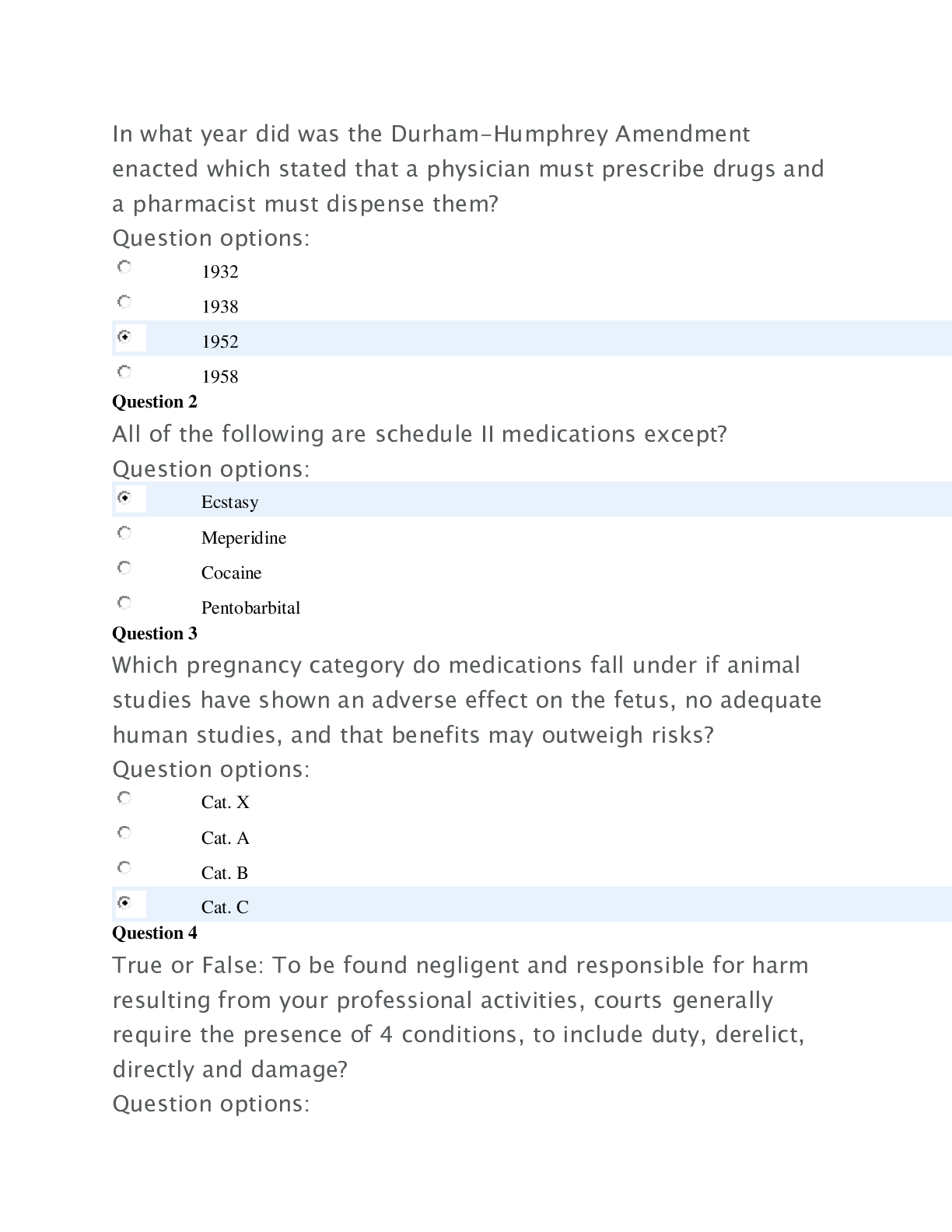
In what year did was the Durham-Humphrey Amendment enacted which stated that a physician must prescribe drugs and a pharmacist must dispense them?
Question options:
1932
1938
1952
1958
Question 2
5 / 5 points
All of the following are schedule II medications except?
Question options:
Ecstasy
Meperidine
Cocaine
Pentobarbital
Question 3
5 / 5 points
Which pregnancy category do medications fall under if animal studies have shown an adverse effect on the fetus, no adequate human studies, and that benefits may outweigh risks?
Question options:
Cat. X
Cat. A
Cat. B
Cat. C
Question 4
5 / 5 points
True or False: To be found negligent and responsible for harm resulting from your professional activities, courts generally require the presence of 4 conditions, to include duty, derelict, directly and damage?
Question options:
True
False
Question 5
5 / 5 points
True or False: Pharmacodynamics is the study of the body’s impact on the drug to include absorption, distribution, metabolism and excretion?
Question options:
True
False
All of the following are variables that affect drug actions except?
Question options:
Height
Weight
Age
Placebo response
Question 2
5 / 5 points
Which medication route has a 100% bioavailability?
Question options:
PO
IM
IV
SQ
Question 3
5 / 5 points
What must be present before a drug exerts its pharmacologic action on body cells?
Question options:
A specified amount of time since administration
The minimum effective concentration
Metabolism has been completed
The medication has been excreted by the kidneys
Question 4
5 / 5 points
True or False: Pharmacodynamics involves drug actions on target cells and the resulting alterations in cellular biochemical reactions?
Question options:
True
False
Question 5
5 / 5 points
True or False: In older adults increased total body water and lean body mass-fat soluble meds stay with the patient longer?
Question options:
True
False
True or False: Zollinger-Ellison Syndrome is the excessive secretion of gastric acid and a high incidence of ulcers. It is caused by gastrin-secreting tumors in pancreas, stomach or duodenum?
Question options:
True
False
Question 2
5 / 5 points
All of the following may cause Gastroesophageal Reflux Disease except?
Question options:
Alcohol
Chocolate
Beta adrenergic blockers
Anticonvulsants
Question 3
5 / 5 points
True or False: The treatment for Helicobacter Pylori requires a combination of two antimicrobials and a PPI or an H2RA?
Question options:
True
False
Question 4
5 / 5 points
All of the following are antiemetic herbal remedies except?
Question options:
Peppermint
Saw palmetto
Cayenne
Meadowsweet
Question 5
5 / 5 points
All of the following are causes of diarrhea except:
Question options:
Laxative abuse
Inflammatory bowel disease
Gastroesophageal reflux disease
Drug therapy
Question options:
Patients with kidney stones
Pregnant patients
Patients with heartburn
Postmenopausal women
Question 2
1 / 1 point
Kelly has diarrhea and is wondering if she can take loperamide (Imodium) for the diarrhea. Loperamide:
Question options:
Can be given to patients of all ages, including infants and children, for viral gastroenteritis
Slows gastric motility and reduces fluid and electrolyte loss from diarrhea
Is the treatment of choice for the diarrhea associated with E. coli 0157
May be used in pregnancy and by lactating women
Question 3
1 / 1 point
Josie is a 5-year-old patient who presents to the clinic with a 48-hour history of nausea, vomiting, and some diarrhea. She is unable to keep fluids down and her weight is 4 pounds less than her last recorded weight. Besides IV fluids, her exam warrants the use of an antinausea medication. Which of the following would be the appropriate drug to order for Josie?
Question options:
Prochlorperazine (Compazine)
Meclizine (Antivert)
Promethazine (Phenergan)
Ondansetron (Zofran) I
Question 4
1 / 1 point
Gastroesophageal reflux disease may be aggravated by the following medication that affects lower esophageal sphincter (LES) tone:
Question options:
Calcium carbonate
Estrogen
Furosemide
Metoclopramide
Question 5
0 / 1 point
Metoclopramide improves gastroesophageal reflux disease symptoms by:
Question options:
Reducing acid secretion
Increasing gastric pH
Increasing lower esophageal tone correct
WRONG Decreasing lower esophageal tone
Question 6
1 / 1 point
Antacids treat gastroesophageal reflux disease by:
Question options:
Increasing lower esophageal tone
Increasing gastric pH
Inhibiting gastric acid secretion
Increasing serum calcium level
Question 7
1 / 1 point
Erik presents with one golden-crusted lesion at the site of an insect bite consistent with impetigo. His parents have limited finances and request the least expensive-treatment. Which medication would be the best choice for treatment?
Question options:
Mupirocin (Bactroban)
Bacitracin and polymixin B (generic double antibiotic ointment)
Retapamulin (Altabax)
Oral cephalexin (Keflex)
Question 8
1 / 1 point
Juakeem is a nasal methicillin resistant staphylococcus aureus (MRSA) carrier. Treatment to eradicate nasal MRSA is mupirocin. Patient education regarding treating nasal MRSA includes:
Question options:
Take the oral medication exactly as prescribed.
Insert one-half of the dose in each nostril twice a day.
Alternate treating one nare in the morning and the other in the evening.
Nasal MRSA eradication requires at least 4 weeks of therapy, with up to 8 weeks needed in some patients.
Question 9
1 / 1 point
When Sam used clotrimazole (Lotrimin AF) for athlete’s foot he developed a red, itchy rash consistent with a hypersensitivity reaction. He now has athlete’s foot again. What would be a good choice of antifungal for Sam?
Question options:
Miconazole (Micatin) powder
Ketoconazole (Nizoral) cream
Terbinafine (Lamisil) cream
Griseofulvin (Grifulvin V) suspension
Question 10
1 / 1 point
Long-term treatment of moderate atopic dermatitis includes:
Question options:
Topical corticosteroids and emollients
Topical corticosteroids alone
Topical antipruritics
Oral corticosteroids for exacerbations of atopic dermatitis
Question 11
1 / 1 point
Josie has severe cystic acne and is requesting treatment with Accutane. The appropriate treatment for her would be:
Question options:
Order a pregnancy test and if it is negative prescribe the isotretinoin (Accutane).
Order Accutane after educating her on the adverse effects.
Recommend she try oral antibiotics (minocycline).
Refer her to a dermatologist for treatment.
Question 12
1 / 1 point
Appropriate initial treatment for psoriasis would be:
Question options:
An immunomodulator (Protopic or Elidel)
Wet soaks with Burrow’s or Domeboro solution
Intermittent therapy with intermediate potency topical corticosteroids
Anthralin (Drithocreme)
Question 13
1 / 1 point
Twenty-year-old Annie comes to the clinic complaining of copious yellow-green eye discharge. Gram stain indicates she most likely has gonococcal conjunctivitis. While awaiting the culture results, the plan of care should be:
Question options:
None, wait for the culture results to determine the course of treatment
Ciprofloxacin (Ciloxan) ophthalmic drops
IM ceftriaxone
High-dose oral amoxicillin
Question 14
1 / 1 point
Sadie was prescribed betaxolol ophthalmic drops by her ophthalmologist to treat her glaucoma. Oral beta blockers should be avoided in patients who use ophthalmic beta blockers because:
Question options:
There may be an antagonistic reaction between the two.
The additive effects may include bradycardia.
They may potentiate each other and cause respiratory depression.
The additive effects may cause metabolic acidosis.
Question 15
1 / 1 point
David presents to the clinic with symptoms of allergic conjunctivitis. He is prescribed cromolyn sodium (Opticrom) eye drops. The education regarding using cromolyn eye drops includes:
Question options:
He should not wear his soft contacts while using the cromolyn eye drops.
Cromolyn drops are instilled once a day to prevent allergy symptoms.
Long-term use may cause glaucoma.
He may experience bradycardia as an adverse effect.
Jim presents with complaints of “heartburn” that is minimally relieved with Tums (calcium carbonate) and is diagnosed with gastroesophageal reflux disease (GERD). An appropriate first-step therapy would be:
Question options:
Omeprazole (Prilosec) twice a day
Ranitidine (Zantac) twice a day
Famotidine (Pepcid) once a day
Metoclopramide (Reglan) four times a day
Question 2
2 / 2 points
An elderly person has been prescribed lactulose for treatment of chronic constipation. Monitoring with long-term treatment would include:
Question options:
Electrolytes, including potassium and chloride
Bone mineral density for osteoporosis
Magnesium level
Liver function
Question 3
2 / 2 points
The next step in treatment when a patient has been on proton pump inhibitors twice daily for 12 weeks and not improving is:
Question options:
Add a prokinetic (metoclopramide)
Referral for endoscopy
Switch to another proton pump inhibitor
Add a cytoprotective drug
Question 4
2 / 2 points
If a patient with H. pylori-positive peptic ulcer disease fails first-line therapy, the second-line treatment is:
Question options:
Proton pump inhibitor bid plus metronidazole plus tetracycline plus bismuth subsalicylate for 14 days
Test H. pylori for resistance to common treatment regimens
Proton pump inhibitor plus clarithromycin plus amoxicillin for 14 days
Proton pump inhibitor and levofloxacin for 14 days
Question 5
2 / 2 points
Erika has been prescribed isotretinoin (Accutane) by her dermatologist and is presenting to her primary care provider with symptoms of sadness and depression. A Beck’s Depression Scale indicates she has mild to moderate depression. What would be the best care for her at this point?
Question options:
Prescribe a select serotonin reuptake inhibitor (SSRI) antidepressant
Refer her to a mental health therapist
Contact her dermatologist about discontinuing the isotretinoin
Reassure her that mood swings are normal and schedule follow up in a week
Question 6
2 / 2 points
Jesse is prescribed tazarotene for his psoriasis. Patient education regarding topical tazarotene includes instructing them:
Question options:
That tazarotene is applied in a thin film to the psoriasis plaque lesions
To apply it liberally to all psoriatic lesions
To apply tazarotene to nonaffected areas to prevent breakout
That tazarotene may cause hypercalcemia if it is overused
Question 7
2 / 2 points
Nicolas is a football player who presents to the clinic with athlete’s foot. Patients with tinea pedis may be treated with:
Question options:
OTC miconazole cream for 4 weeks
Oral ketoconazole for 6 weeks
Mupirocin ointment for 2 weeks
Nystatin cream for 2 weeks
Question 8
2 / 2 points
Vanessa has been diagnosed with scabies. Her education would include:
Question options:
She should apply the scabies treatment cream for an hour and wash it off.
Scabies may need to be retreated in a week after initial treatment.
All members of the household and close personal contacts should be treated.
Malathion is flammable and she should take care until the solution dries.
Question 9
2 / 2 points
Ciprofloxacin otic drops are contraindicated in:
Question options:
Children
Patients with acute otitis externa
Patients with a perforated tympanic membrane
Swimmer’s ear
Question 10
2 / 2 points
Janie presents to the clinic with hard ear wax in both ear canals. Instructions regarding home removal of hard cerumen include:
Question options:
Moisten a cotton swab (Q-tip) and swab the ear canal twice daily.
Instill tap water in both ears while bathing.
Squirt hydrogen peroxide into ears with each bath.
Instill carbamide peroxide (Debrox) twice daily until canals are clear.
Digoxin levels need to be monitored closely when the following medication is started:
Question options:
Loratadine
Diphenhydramine
Ipratropium
Albuterol
Question 2
1 / 1 point
When educating patients who are starting on inhaled corticosteroids, the provider should tell them that:
Question options:
They need to get any live vaccines before starting the medication.
Inhaled corticosteroids need to be used daily during asthma exacerbations to be effective.
Patients should rinse their mouths out after using the inhaled corticosteroid to prevent thrush.
They can triple the dose number of inhalations of medication during colds to prevent
needing systemic steroids.
Question 3
1 / 1 point
Second-generation antihistamines such as loratadine (Claritin) are prescribed for seasonal allergies because they are:
Question options:
More effective than first-generation antihistamines
Less sedating than the first-generation antihistamines
Prescription products, therefore are covered by insurance
Able to be taken with central nervous system (CNS) sedatives, such as alcohol
Question 4
1 / 1 point
Henry presents to clinic with a significantly swollen, painful great toe and is diagnosed with gout. Of the following, which would be the best treatment for Henry?
Question options:
High-dose colchicine
Low-dose colchicine
High-dose aspirin
Acetaminophen with codeine
Question 5
1 / 1 point
Patients whose total dose of prednisone will exceed 1 gram will most likely need a second prescription for:
Question options:
Metformin, a biguanide to prevent diabetes
Omeprazole, a proton pump inhibitor to prevent peptic ulcer disease
Naproxen, an NSAID to treat joint pain
Furosemide, a diuretic to treat fluid retention
Question 6
1 / 1 point
Patients prescribed aspirin therapy require education regarding the signs of aspirin toxicity. An early sign of aspirin toxicity is:
Question options:
Black tarry stools
Vomiting
Tremors
Tinnitus
Question 7
1 / 1 point
Prior to developing a plan for the treatment of asthma, the patient’s asthma should be classified according to the NHLBI Expert Panel 3 guidelines. In adults mild-persistent asthma is classified as asthma symptoms that occur:
Question options:
Daily
Daily and limit physical activity
Less than twice a week
More than twice a week and less than once a day
Question 8
1 / 1 point
Patients with a COPD exacerbation may require:
Question options:
Doubling of inhaled corticosteroid dose
Systemic corticosteroid burst
Continuous inhaled beta-2-agonists
Leukotriene therapy
Question 9
1 / 1 point
Asthma exacerbations at home are managed by the patient by:
Question options:
Increasing frequency of beta-2-agonists and contacting their provider
Doubling inhaled corticosteroid doses
Increasing frequency of beta-2-agonists
Starting montelukast (Singulair)
Question 10
1 / 1 point
The most common bacterial pathogen in community-acquired pneumonia is:
Question options:
Haemophilus influenzae
Staphylococcus aureus
Mycoplasma pneumoniae
Streptococcus pneumonia
Question 11
1 / 1 point
The first-line antibiotic choice for a patient with comorbidities or who is immunosuppressed who has pneumonia and can be treated as an outpatient would be:
Question options:
Levofloxacin
Amoxicillin
Ciprofloxacin
Cephalexin
Question 12
1 / 1 point
Wing-Sing is a 4-year-old patient who has suspected bacterial pneumonia. He has a temperature of 102°F, oxygen saturation level of 95%, and is taking fluids adequately. What would be appropriate initial treatment for his pneumonia?
Question options:
Ceftriaxone
Azithromycin
Cephalexin
Levofloxacin
Question 13
1 / 1 point
Instructions for a patient who is starting nicotine replacement therapy include:
Question options:
Smoke less than 10 cigarettes a day when starting nicotine replacement.
Nicotine replacement will help with the withdrawal cravings associated with quitting tobacco.
Nicotine replacement can be used indefinitely.
Nicotine replacement therapy is generally safe for all patients.
Question 14
1 / 1 point
If prescribing bupropion (Zyban) for tobacco cessation, the instructions to the patient include:
Question options:
Bupropion (Zyban) is started 1 to 2 weeks before the quit date.
Nicotine replacement products should not be used with bupropion.
If they smoke when taking bupropion they may have increased anxiety and insomnia.
Because they are not using bupropion as an antidepressant, they do not need to worry about increased suicide ideation when starting therapy.
Question 15
0 / 1 point
The most appropriate smoking cessation prescription for pregnant women is:
Question options:
A nicotine replacement patch at the lowest dose available
Bupropion (Zyban)incorrect
Varenicline (Chantix)
Nonpharmacologic measures correct
Question 16
1 / 1 point
Drug resistant tuberculosis (TB) is defined as TB that is resistant to:
Question options:
Fluoroquinolones
Rifampin and isoniazid
Amoxicillin
Ceftriaxone
Question 17
1 / 1 point
Kaleb has extensively resistant tuberculosis (TB). Treatment for extensively resistant TB would include:
Question options:
INH, rifampin, pyrazinamide, and ethambutol for at least 12 months
INH, ethambutol, kanamycin, and rifampin
Treatment with at least two drugs to which the TB is susceptible
Levofloxacin
Question 18
1 / 1 point
Ezekiel is a 9-year-old patient who lives in a household with a family member newly diagnosed with tuberculosis (TB). To prevent Ezekiel from developing TB he should be treated with:
Question options:
6 months of Isoniazid (INH) and rifampin
2 months of INH, rifampin, pyrazinamide, and ethambutol, followed by 4 months of INH
9 months of INH
12 months of INH
Question 19
1 / 1 point
Myles is a 2-year-old patient who has been diagnosed with acute otitis media. He is afebrile and has not been treated with antibiotics recently. First-line treatment for his otitis media would include:
Question options:
Azithromycin
Amoxicillin
Ceftriaxone
Trimethoprim/sulfamethoxazole
Question 20
1 / 1 point
Jacob has been diagnosed with sinusitis. He is the parent of a child in daycare. Treatment for sinusitis in an adult who has a child in daycare is:
Question options:
Azithromycin 500 mg q day for 5 days
Amoxicillin-clavulanate 500 mg bid for 7 days
Ciprofloxacin 500 mg bid for 5 days
Cephalexin 500 mg qid for 5 days
Elderly patients who are started on levothyroxine for thyroid replacement should be monitored for:
Question options:
Excessive sedation
Tachycardia and angina
Weight gain
Cold intolerance
Question 2
1 / 1 point
Potentially fatal granulocytopenia has been associated with treatment of hyperthyroidism with propylthiouracil. Patients should be taught to report:
Question options:
Tinnitus and decreased salivation
Fever and sore throat
Hypocalcemia and osteoporosis
Laryngeal edema and difficulty swallowing
Question 3
1 / 1 point
Metformin is a primary choice of drug to treat hyperglycemia in type 2 diabetes because it:
Question options:
Substitutes for insulin usually secreted by the pancreas
Decreases glycogenolysis by the liver
Increases the release of insulin from beta cells
Decreases peripheral glucose utilization
Question 4
1 / 1 point
Hypoglycemia can result from the action of either insulin or an oral hypoglycemic. Signs and symptoms of hypoglycemia include:
Question options:
“Fruity” breath odor and rapid respiration
Diarrhea, abdominal pain, weight loss, and hypertension
Dizziness, confusion, diaphoresis, and tachycardia
Easy bruising, palpitations, cardiac dysrhythmias, and coma
Question 5
1 / 1 point
Sulfonylureas may be added to a treatment regimen for type 2 diabetics when lifestyle modifications and metformin are insufficient to achieve target glucose levels. Sulfonylureas have been moved to Step 2 therapy because they:
Question options:
Increase endogenous insulin secretion
Have a significant risk for hypoglycemia
Address the insulin resistance found in type 2 diabetics
Improve insulin binding to receptors
Question 6
1 / 1 point
Treatment with insulin for type 1 diabetics:
Question options:
Starts with a total daily dose of 0.2 to 0.4 units per kg of body weight
Divides the total doses into three injections based on meal size
Uses a total daily dose of insulin glargine given once daily with no other insulin required
Is based on the level of blood glucose
Question 7
1 / 1 point
The American Heart Association states that people with diabetes have a 2- to 4-fold increase in the risk of dying from cardiovascular disease. Treatments and targets that do not appear to decrease risk for micro- and macro-vascular complications include:
Question options:
Glycemic targets between 7% and 7.5%
Use of insulin in type 2 diabetics
Control of hypertension and hyperlipidemia
Stopping smoking
Question 8
1 / 1 point
Drugs used to treat diabetic peripheral neuropathy include:
Question options:
Metoclopramide
Cholinergic agonists
Cardioselective beta blockers
Gabapentin
Question 9
1 / 1 point
The goals of therapy when prescribing hormone replacement therapy (HRT) include reducing:
Question options:
Cardiovascular risk
Risk of stroke or other thromboembolic event
Breast cancer
Vasomotor symptoms
Question 10
1 / 1 point
Inadequate vitamin D intake can contribute to the development of osteoporosis by:
Question options:
Increasing calcitonin production
Increasing calcium absorption from the intestine
Altering calcium metabolism
Stimulating bone formation
Question 11
1 / 1 point
The drug recommended as primary prevention of osteoporosis in men over age 70 years is:
Question options:
Alendronate (Fosamax)
Ibandronate (Boniva)
Calcium carbonate
Raloxifene (Evista)
Question 12
1 / 1 point
In addition to methimazole, a symptomatic patient with hyperthyroidism may need a prescription for:
Question options:
A calcium channel blocker
A beta blocker
Liothyronine
An alpha blocker
Question 13
1 / 1 point
When starting a patient on levothyroxine for hypothyroidism the patient will need follow-up measurement of thyroid function in:
Question options:
2 weeks
4 weeks
2 months
6 months
Question 14
1 / 1 point
Treatment of a patient with hypothyroidism and cardiovascular disease consists of:
Question options:
Levothyroxine
Liothyronine
Liotrix
Methimazole
Question 15
1 / 1 point
Men who use transdermal testosterone gel (AndroGel) should be advised to avoid:
Question options:
Washing their hands after applying the gel
Wearing occlusive clothing while using the gel
Exposure to estrogens while using the gel
Skin-to-skin contact with pregnant women while using the gel
Question 16
1 / 1 point
A 22-year-old woman receives a prescription for oral contraceptives. Education for this patient includes:
Question options:
Counseling regarding decreasing or not smoking while taking oral contraceptives
Advising a monthly pregnancy test for the first 3 months she is taking the contraceptive
Advising that she may miss two pills in a row and not be concerned about pregnancy
Recommending that her next follow-up visit is in 1 year for a refill and annual exam
Question 17
1 / 1 point
A 56-year-old woman is complaining of vaginal dryness and dyspareunia. To treat her symptoms with the lowest adverse effects she should be prescribed:
Question options:
Low-dose oral estrogen
A low-dose estrogen/progesterone combination
A vaginal estradiol ring
Vaginal progesterone cream
Question 18
1 / 1 point
Ashley comes to the clinic with a request for oral contraceptives. She has successfully used oral contraceptives before and has recently started dating a new boyfriend so would like to restart contraception. She denies recent intercourse and has a negative urine pregnancy test in the clinic. An appropriate plan of care would be:
Question options:
Recommend she return to the clinic at the start of her next menses to get a Depo Provera shot.
Prescribe oral combined contraceptives and recommend she start them at the beginning of her next period and use a back-up method for the first 7 days.
Prescribe oral contraceptives and have her start them the same day as the visit with a back-up method used for the first 7 days.
Discuss the advantages of using the topical birth control patch and recommend she consider using the patch.
Question 19
1 / 1 point
Women who are prescribed progestin-only contraception need education regarding which common adverse drug effects?
Question options:
Increased migraine headaches
Increased risk of developing blood clots
Irregular vaginal bleeding for the first few months
Increased risk for hypercalcemia
Question 20
1 / 1 point
Oral emergency contraception (Plan B) is contraindicated in women who:
Question options:
Had intercourse within the past 72 hours
May be pregnant
Are taking combined oral contraceptives
Are using a diaphragm
When blood glucose levels are difficult to control in type 2 diabetes some form of insulin may be added to the treatment regimen to control blood glucose and limit complication risks. Which of the following statements is accurate based on research?
Question options:
Premixed insulin analogues are better at lowering HbA1C and have less risk for hypoglycemia.
Premixed insulin analogues and the newer premixed insulins are associated with more weight gain than the oral antidiabetic agents.
Newer premixed insulins are better at lowering HbA1C and postprandial glucose levels than long-acting insulins.
Patients who are not controlled on oral agents and have postprandial hyperglycemia can have neutral protamine Hagedorn insulin added at bedtime.
Question 2
2 / 2 points
Prior to prescribing metformin, the provider should:
Question options:
Draw a serum creatinine to assess renal function
Try the patient on insulin
Tell the patient to increase iodine intake
Have the patient stop taking any sulfonylurea to avoid dangerous drug interactions
Question 3
2 / 2 points
Insulin preparations are divided into categories based on onset, duration, and intensity of action following subcutaneous injection. Which of the following insulin preparations has the shortest onset and duration of action?
Question options:
Levemir
Glulisine
Glargine
Detemir
Question 4
2 / 2 points
The drugs recommended for older adults with type 2 diabetes include:
Question options:
Second-generation sulfonylureas
Metformin
Pioglitazone
Third-generation sulfonylureas
Question 5
2 / 2 points
Women with an intact uterus should be treated with both estrogen and progestin due to:
Question options:
Increased risk for endometrial cancer if estrogen alone is used
Combination therapy provides the best relief of menopausal vasomotor symptoms
Reduced risk for colon cancer with combined therapy
Lower risk of developing blood clots with combined therapy
Question 6
2 / 2 points
Bisphosphonate administration education includes:
Question options:
Taking it on a full stomach
Requiring sitting erect for at least 30 minutes afterward
Drinking it with orange juice
Taking it with H2 blockers or proton pump inhibitors (PPI) to protect the stomach
Question 7
2 / 2 points
Long-term use of androgens requires specific laboratory monitoring of:
Question options:
Glucose, calcium, testosterone, and thyroid function
Calcium, testosterone, PSA, and liver function
Calcium, testosterone, PSA, liver function, glucose, and lipids
CBC, testosterone, PSA, and thyroid level
Question 8
2 / 2 points
Patients taking hormonal contraceptives and hormone replacement therapy need to take the drug daily at the same time to prevent:
Question options:
Nausea
Breakthrough bleeding
Breast tenderness
Pregnancy
Question 9
2 / 2 points
The mechanism of action of oral combined contraceptives that prevents pregnancy is:
Question options:
Estrogen prevents the luteinizing hormone surge necessary for ovulation.
Progestins thicken cervical mucus and slow tubal motility.
Estrogen thins the endometrium making implantation difficult.
Progestin suppresses follicle stimulating hormone release.
Question 10
2 / 2 points
When starting a patient with hypothyroidism on thyroid replacement hormones patient education would include:
Question options:
They should feel symptomatic improvement in 1 to 2 weeks.
Drug adverse effects such as lethargy and dry skin may occur.
It may take 4 to 8 weeks to get to euthyroid symptomatically and by laboratory testing.
Because of its short half-life, levothyroxine doses should not be missed.
Jonathan has been diagnosed with strep throat and needs a prescription for an antibiotic. He says the last time he had penicillin he developed a red, blotchy rash. An appropriate antibiotic to prescribe would be:
Question options:
Penicillin VK, because his rash does not sound like a serious rash
Amoxicillin
Cefadroxil (Duricef)
Azithromycin
Question 2
1 / 1 point
Nicholas has been diagnosed with type A influenza. Appropriate prescribing of oseltamivir (Tamiflu) would include:
Question options:
Starting oseltamivir within the first 48 hours of influenza symptoms
Advising the patient he can stop the oseltamivir when his symptoms resolve
Educating the patient that oseltamivir will cure influenza
Prophylactic treatment of all family members
Question 3
1 / 1 point
The drug of choice for treatment of primary or secondary syphilis is:
Question options:
Ceftriaxone IM
Benzathine penicillin G IM
Oral azithromycin
Oral ciprofloxacin
Question 4
1 / 1 point
When treating suspected gonorrhea in a nonpregnant patient, the patient should be concurrently treated for chlamydia with:
Question options:
Azithromycin 1 gram PO x 1
Amoxicillin 500 mg PO x 1
Ciprofloxacin 500 mg PO x 1
Penicillin G 2.4 million units IM x 1
Question 5
1 / 1 point
Lila is 24 weeks pregnant and has been diagnosed with tuberculosis (TB). Treatment regimens for a pregnant patient with TB would include:
Question options:
Streptomycin
Levofloxacin
Kanamycin
Pyridoxine
Question 6
1 / 1 point
The principles of drug therapy for the treatment of tuberculosis include:
Question options:
Patients are treated with a drug to which M. tuberculosis is sensitive.
Drugs need to be taken on a regular basis for a sufficient amount of time.
Treatment continues until the patient’s purified protein derivative is negative.
All of the above
Question 7
1 / 1 point
Jaheem is a 10-year-old low-risk patient with sinusitis. Treatment for a child with sinusitis is:
Question options:
Amoxicillin
Azithromycin
Cephalexin
Levofloxacin
Question 8
1 / 1 point
Alyssa is a 15-month-old patient who has been on amoxicillin for 2 days for acute otitis media. She is still febrile and there is no change in her tympanic membrane examination. What would be the plan of care for her?
Question options:
Continue the amoxicillin for the full 10 days.
Change the antibiotic to azithromycin.
Change the antibiotic to amoxicillin/clavulanate.
Change the antibiotic to trimethoprim/sulfamethoxazole.
Question 9
1 / 1 point
Sally is a 16-year-old female with a urinary tract infection. She is healthy, afebrile, with no use of antibiotics in the previous 6 months and no drug allergies. An appropriate first-line antibiotic choice for her would be:
Question options:
Azithromycin
Trimethoprim/sulfamethoxazole
Ceftriaxone
Levofloxacin
Question 10
1 / 1 point
Jamie is a 24-year-old female with a urinary tract infection. She is healthy, afebrile, and her only drug allergy is sulfa, which gives her a rash. An appropriate first-line antibiotic choice for her would be:
Question options:
Azithromycin
Trimethoprim/sulfamethoxazole
Ceftriaxone
Ciprofloxacin
Pong-tai is a 12-month-old child who is being treated with amoxicillin for acute otitis media. His parents call the clinic and say he has developed diarrhea. The appropriate action would be to:
Question options:
Advise the parents that some diarrhea is normal with amoxicillin and recommend probiotics daily.
Change the antibiotic to one that is less of a gastrointestinal irritant.
Order stool cultures for suspected viral pathogens not treated by the amoxicillin.
Recommend increased fluids and fiber in his diet.
Question 2
2 / 2 points
To prevent further development of antibacterial resistance it is recommended that fluoroquinolones be reserved for treatment of:
Question options:
Urinary tract infections in young women
Upper respiratory infections in adults
Skin and soft tissue infections in adults
Community-acquired pneumonia in patients with comorbidities
Question 3
2 / 2 points
Treatment for suspected gonorrhea is:
Question options:
Ceftriaxone 250 mg IM x 1
Ceftriaxone 2 grams IM x 1
Ciprofloxacin 500 mg PO x 1
Doxycycline 100 mg bid x 7 days
Question 4
2 / 2 points
If a woman presents with recurrent vulvovaginal candidiasis she may be treated with:
Question options:
Weekly intravaginal butoconazole for 3 months
Fluconazole 150 mg PO daily x 7 doses then monthly for 6 months
Weekly fluconazole 150 mg PO x 6 months
Intravaginal tioconazole x 14 days
Question 5
2 / 2 points
Bilal is a 5-year-old patient who has been diagnosed with tuberculosis. His treatment would include:
Question options:
Pyridoxine
Ethambutol
Levofloxacin
Rifabutin
Question 6
2 / 2 points
Isabella has confirmed tuberculosis and is placed on a 6-month treatment regimen. The 6-month regimen consists of:
Question options:
Two months of four-drug therapy (INH, rifampin, pyrazinamide, and ethambutol) followed by Four months of INH and rifampin
Six months of INH with daily pyridoxine throughout therapy
Six months of INH, rifampin, pyrazinamide, and ethambutol
Any of the above
Question 7
2 / 2 points
First-line therapy for a patient with acute otitis externa (swimmer’s ear) and an intact tympanic membrane includes:
Question options:
Swim-Ear drops
Ciprofloxacin and hydrocortisone drops
Amoxicillin
Gentamicin ophthalmic drops
Question 8
2 / 2 points
The length of treatment for sinusitis in a low-risk patient should be:
Question options:
5–7 days
7–10 days
14–21 days
7 days beyond when symptoms cease
Question 9
2 / 2 points
Nicole is a 4-year-old female with a febrile urinary tract infection (UTI). She is generally healthy and has no drug allergies. Appropriate initial therapy for her UTI would be:
Question options:
Azithromycin
Trimethoprim/sulfamethoxazole
Ceftriaxone
Ciprofloxacin
Question 10
2 / 2 points
Juanita is a 28-year-old pregnant woman at 38 weeks’ gestation who is diagnosed with a lower urinary tract infection (UTI). She is healthy with no drug allergies. Appropriate first-line therapy for her UTI would be:
Question options:
Azithromycin
Trimethoprim/sulfamethoxazole
Amoxicillin
Ciprofloxacin
Ray has been diagnosed with hypertension and an angiotensin-converting enzyme inhibitor is determined to be needed. Prior to prescribing this drug, the NP should assess for:
Question options:
Hypokalemia
Impotence
Decreased renal function
Inability to concentrate
Question 2
1 / 1 point
Which of the following create a higher risk for digoxin toxicity? Both the cause and the reason for it must be correct.
Question options:
Older adults because of reduced renal function
Administration of aldosterone antagonist diuretics because of decreased potassium levels
Taking an antacid for gastroesophageal reflux disease because it increases the absorption of digoxin
Doses between 0.25 and 0.5 mg/day
Question 3
1 / 1 point
Juanita had a deep vein thrombosis (DVT) and was on heparin in the hospital and was discharged on warfarin. She asks her primary care provider NP why she was getting both medications while in the hospital. The best response is to:
Question options:
Contact the hospitalist as this is not the normal guideline for prescribing these two medications and she may have had a more complicated case.
Explain that warfarin is often started while a patient is still on heparin because warfarin takes a few days to reach effectiveness.
Encourage the patient to contact the Customer Service department at the hospital as this was most likely a medication error during her admission.
Draw anticoagulation studies to make sure she does not have dangerously high bleeding times.
Question 4
1 / 1 point
Robert, age 51 years, has been told by his primary care provider (PCP) to take an aspirin a day. Why would this be recommended?
Question options:
He has arthritis and this will help with the inflammation and pain.
Aspirin has anti-platelet activity and prevents clots that cause heart attacks.
Aspirin acidifies the urine and he needs this for prostrate health.
He has a history of GI bleed, and one aspirin a day is a safe dosage.
Question 5
1 / 1 point
Education of patients who are taking warfarin includes discussing their diet. Instructions include:
Question options:
Avoiding all vitamin K-containing foods
Avoiding high-vitamin K-containing foods
Increasing intake of iron-containing foods
Making sure they eat 35 grams of fiber daily
Question 6
1 / 1 point
Pernicious anemia is treated with:
Question options:
Folic acid supplements
Thiamine supplements
Vitamin B12
Iron
Question 7
1 / 1 point
Valerie presents to the clinic with menorrhagia. Her hemoglobin is 10.2 and her ferritin is 15 ng/mL. Initial treatment for her anemia would be:
Question options:
18 mg/day of iron supplementation
6 mg/kg per day of iron supplementation
325 mg ferrous sulfate per day
325 mg ferrous sulfate tid
Question 8
1 / 1 point
Kyle has Crohn’s disease and has a documented folate deficiency. Drug therapy for folate deficiency anemia is:
Question options:
Oral folic acid 1 to 2 mg per day
Oral folic acid 1 gram per day
IM folate weekly for at least 6 months
Oral folic acid 400 mcg daily
Question 9
1 / 1 point
Angina is produced by an imbalance between myocardial oxygen supply (MOS) and demand (MOD) in the myocardium. Which of the following drugs help to correct this imbalance by increasing MOS?
Question options:
Calcium channel blockers
Beta blockers
Angiotensin-converting-enzyme (ACE) inhibitors
Aspirin
Question 10
0 / 1 point
The rationale for prescribing calcium blockers for angina can be based on the need for:
Question options:
Increased inotropic effect in the heart wrong it decreases
Increasing peripheral perfusion
Keeping heart rates high enough to ensure perfusion of coronary arteries
Help with rate control correct
Question 11
1 / 1 point
Which of the following drugs has been associated with increased risk for myocardial infarction in women?
Question options:
Aspirin
Beta blockers
Estrogen replacement ***
Lipid-lowering agents
Question 12
1 / 1 point
Increased life expectancy for patients with heart failure has been associated with the use of:
Question options:
ACE inhibitors, especially when started early in the disease process
All beta blockers regardless of selectivity
Thiazide and loop diuretics
Cardiac glycosides
Question 13
1 / 1 point
Digoxin has a very limited role in treatment of heart failure. It is used mainly for patients with:
Question options:
Ejection fractions above 40%
An audible S3
Mitral stenosis as a primary cause for heart failure
Renal insufficiency
Question 14
1 / 1 point
Which of the following classes of drugs is contraindicated in heart failure?
Question options:
Nitrates
Long-acting dihydropyridines
Calcium channel blockers
Alpha-beta blockers
Question 15
1 / 1 point
What is considered the order of statin strength from lowest effect to highest?
Question options:
Lovastatin, Simvastatin, Rosuvastatin
Rosuvastatin, Lovastatin, Atorvastatin
Atorvastatin, Rosuvastatin, Simvastatin
Simvastatin, Atorvastatin, Lovastatin
Question 16
1 / 1 point
First-line therapy for hyperlipidemia is:
Question options:
Statins
Niacin
Lifestyle changes ***
Bile acid-binding resins
Question 17
1 / 1 point
Han is a 48-year-old diabetic with hyperlipidemia and high triglycerides. His LDL is 112 mg/dL and he has not tolerated statins. He warrants a trial of a:
Question options:
Sterol
Niacin
Fibric acid derivative
Bile acid-binding resin
Question 18
1 / 1 point
Hypertensive African Americans are typically listed as not being as responsive to which drug groups?
Question options:
ACE inhibitors
Calcium channel blockers
Diuretics
Bidil (hydralazine family of medications)
Question 19
1 / 1 point
Because of its action on various body systems, the patient taking a thiazide or loop diuretic may also need to receive the following supplement:
Question options:
Potassium
Calcium
Magnesium
Phosphates
Question 20
1 / 1 point
An ACE inhibitor and what other class of drug may reduce proteinuria in patients with diabetes better than either drug alone?
Question options:
Beta blockers
Diuretics
Nondihydropyridine calcium channel blockers
Angiotensin II receptor blockers
Charlie is a 65-year-old male who has been diagnosed with hypertension and benign prostatic hyperplasia. Doxazosin has been chosen to treat his hypertension because it:
Question options:
Increases peripheral vasoconstriction
Decreases detrusor muscle contractility
Lowers supine blood pressure more than standing pressure
Relaxes smooth muscle in the bladder neck
Question 2
1 / 1 point
Which of the following adverse effects are less likely in a beta1-selective blocker?
Question options:
Dysrhythmias
Impaired insulin release
Reflex orthostatic changes
Decreased triglycerides and cholesterol
Question 3
1 / 1 point
Beta blockers have favorable effects on survival and disease progression in heart failure. Treatment should be initiated when the:
Question options:
Symptoms are severe
Patient has not responded to other therapies
Patient has concurrent hypertension
Left ventricular dysfunction is diagnosed
Question 4
1 / 1 point
You are treating a patient with a diagnosis of Alzheimer’s disease. The patient’s wife mentions difficulty with transportation to the clinic. Which medication is the best choice?
Question options:
Donepezil
Tacrine
Doxazosin
Verapamil
Question 5
1 / 1 point
Antonia is a 3-year-old child who has a history of status epilepticus. Along with her routine antiseizure medication, she should also have a home prescription for_________ to be used for an episode of status epilepticus.
Question options:
IV phenobarbital
Rectal diazepam (Diastat)
IV phenytoin (Dilantin)
Oral carbamazepine (Tegretol)
Question 6
1 / 1 point
Dwayne has recently started on carbamazepine to treat seizures. He comes to see you and you note that while his carbamazepine levels had been in the therapeutic range, they are now low. The possible cause for the low carbamazepine levels include:
Question options:
Dwayne hasn’t been taking his carbamazepine because it causes insomnia.
Carbamazepine auto-induces metabolism, leading to lower levels in spite of good compliance.
Dwayne was not originally prescribed the correct amount of carbamazepine.
Carbamazepine is probably not the right antiseizure medication for Dwayne.
Question 7
1 / 1 point
Kasey fractured his ankle in two places and is asking for medication for his pain. The appropriate first-line medication would be:
Question options:
Ibuprofen (Advil)
Acetaminophen with hydrocodone (Vicodin)
Oxycodone (Oxycontin)
Oral morphine (Roxanol)
Question 8
1 / 1 point
Jack, age 8, has attention deficit disorder (ADD) and is prescribed methylphenidate (Ritalin). He and his parents should be educated about the side effects of methylphenidate, which are:
Question options:
Slurred speech and insomnia
Bradycardia and confusion
Dizziness and orthostatic hypotension
Insomnia and decreased appetite
Question 9
1 / 1 point
An appropriate first-line drug to try for mild to moderate generalized anxiety disorder would be:
Question options:
Alprazolam (Xanax)
Diazepam (Valium)
Buspirone (Buspar)
Amitriptyline (Elavil)
Question 10
1 / 1 point
David is a 34-year-old patient who is starting on paroxetine (Paxil) for depression. David’s education regarding his medication would include:
Question options:
Paroxetine may cause intermittent diarrhea.
He may experience sexual dysfunction beginning a month after he starts therapy.
He may have constipation and he should increase fluids and fiber.
Paroxetine has a long half-life so he may occasionally skip a dose.
Question 11
1 / 1 point
An appropriate drug for the treatment of depression with anxiety would be:
Question options:
Alprazolam (Xanax)
Escitalopram (Lexapro)
Buspirone (Buspar)
Amitriptyline (Elavil)
Question 12
1 / 1 point
The longer-term Xanax patient comes in and states they need a higher dose of the medication. They deny any additional, new, or accelerating triggers of their anxiety. What is the probable reason?
Question options:
They have become tolerant of the medication, which is characterized by the need for higher and higher doses.
They are a drug seeker.
They are suicidal.
They only need additional counseling on lifestyle modification.
Question 13
1 / 1 point
A first-line drug for abortive therapy in simple migraine is:
Question options:
Sumatriptan (Imitrex)
Naproxen (Aleve)
Butorphanol nasal spray (Stadol NS)
Butalbital and acetaminophen (Fioricet)
Question 14
1 / 1 point
Xi, a 54-year-old female, has a history of migraines that do not respond well to OTC migraine medication. She is asking to try Maxalt (rizatriptan) because it works well for her friend. Appropriate decision making would be:
Question options:
Prescribe the Maxalt, but only give her four tablets with no refills to monitor the use.
Prescribe Maxalt and arrange to have her observed in the clinic or urgent care with the first dose.
Explain that rizatriptan is not used for postmenopausal migraines and recommend Fiorinal (aspirin and butalbital).
Prescribe sumatriptan (Imitrex) with the explanation that it is the most effective triptan.
Question 15
1 / 1 point
Kelly is a 14-year-old patient who presents to the clinic with a classic migraine. She says she is having a headache two to three times a month. The initial plan would be:
Question options:
Prescribe NSAIDs as abortive therapy and have her keep a headache diary to identify her triggers.
Prescribe zolmitriptan (Zomig) as abortive therapy and recommend relaxation therapy to reduce her stress.
Prescribe acetaminophen with codeine (Tylenol #3) for her to take at the first onset of her migraine.
Prescribe sumatriptan (Imitrex) nasal spray and arrange for her to receive the first dose in the clinic.
Question 16
1 / 1 point
James has been diagnosed with cluster headaches. Appropriate acute therapy would be:
Question options:
Butalbital and aspirin (Fiorinal)
Meperidine IM (Demerol)
Oxygen 100% for 15 to 30 minutes
Indomethacin (Indocin)
Question 17
1 / 1 point
If interventions to resolve the cause of pain (e.g., rest, ice, compression, and elevation) are insufficient, pain medications are given based on the severity of pain. Drugs are given in which order of use?
Question options:
NSAIDs, opiates, corticosteroids
Low-dose opiates, salicylates, increased dose of opiates
Opiates, non-opiates, increased dose of non-opiate
Non-opiate, increased dose of non-opiate, opiate
Question 18
1 / 1 point
Chemical dependency assessment is integral to the initial assessment of chronic pain. Which of the following raises a “red flag” about potential chemical dependency?
Question options:
Use of more than one drug to treat the pain
Multiple times when prescriptions are lost with requests to refill
Preferences for treatments that include alternative medicines
Presence of a family member who has abused drugs
Question 19
1 / 1 point
The Pain Management Contract is appropriate for:
Question options:
Patients with cancer who are taking morphine
Patients with chronic pain who will require long-term use of opiates
Patients who have a complex drug regimen
Patients who see multiple providers for pain control
Question 20
1 / 1 point
Which of the following statements is true about age and pain?
Question options:
Use of drugs that depend heavily on the renal system for excretion may require dosage adjustments in very young children.
Among the NSAIDs, indomethacin is the preferred drug because of lower adverse effects profiles than other NSAIDs.
Older adults who have dementia probably do not experience much pain due to loss of pain receptors in the brain.
Acetaminophen is especially useful in both children and adults because it has no effect on platelets and has fewer adverse effects than NSAIDs.
Up to 21% of Asians are ultra-rapid 2D6 metabolizers, leading to:
Question options:
A need to monitor drugs metabolized by 2D6 for toxicity
Increased dosages needed of drugs metabolized by 2D6, such as the selective serotonin reuptake inhibitors
Decreased conversion of codeine to morphine by CYP 2D6
The need for lowered dosages of drugs, such as beta blockers
Question 2
1 / 1 point
Rifampin is a nonspecific CYP450 inducer that may:
Question options:
Lead to toxic levels of rifampin and must be monitored closely
Cause toxic levels of drugs, such as oral contraceptives, when coadministered
Induce the metabolism of drugs, such as oral contraceptives, leading to therapeutic failure
Cause nonspecific changes in drug metabolism
Question 3
1 / 1 point
Inhibition of P-glycoprotein by a drug such as quinidine may lead to:
Question options:
Decreased therapeutic levels of quinidine
Increased therapeutic levels of quinidine
Decreased levels of a coadministered drug, such as digoxin, that requires P-glycoprotein for absorption and elimination
Increased levels of a coadministered drug, such as digoxin, that requires P-glycoprotein for absorption and elimination
Question 4
1 / 1 point
Warfarin resistance may be seen in patients with VCORC1 mutation, leading to:
Question options:
Toxic levels of warfarin building up
Decreased response to warfarin
Increased risk for significant drug interactions with warfarin
Less risk of drug interactions with warfarin
Question 5
1 / 1 point
Pharmacogenetic testing is required by the U.S. Food and Drug Administration prior to prescribing:
Question options:
Erythromycin
Digoxin
Cetuximab
Rifampin
Question 6
1 / 1 point
Carbamazepine has a Black Box Warning recommending testing for the HLA-B*1502 allele in patients with Asian ancestry prior to starting therapy due to:
Question options:
Decreased effectiveness of carbamazepine in treating seizures in Asian patients with the HLA-B*1502 allele
Increased risk for drug interactions in Asian patients with the HLA-B*1502 allele
Increased risk for Stevens-Johnson syndrome in Asian patients with HLA-B*1502 Allele
Patients who have the HLA-B*1502 allele being more likely to have a resistance to carbamazepine
Question 7
1 / 1 point
A genetic variation in how the metabolite of the cancer drug irinotecan SN-38 is inactivated by the body may lead to:
Question options:
Decreased effectiveness of irinotecan in the treatment of cancer
Increased adverse drug reactions, such as neutropenia
Delayed metabolism of the prodrug irinotecan into the active metabolite SN-38
Increased concerns for irinotecan being carcinogenic
Question 8
1 / 1 point
A good history of herb and supplement use is critical before prescribing because approximately ____ % of patients in the United States are using herbal products.
Question options:
10
5
38
70
Question 9
1 / 1 point
A potential harmful effect on patients who take some herbal medication is:
Question options:
Constipation
Lead poisoning
Diarrhea
Life-threatening rash
Question 10
1 / 1 point
A thorough understanding of herbs is critical to patient safety. An example is the use of cinnamon to treat type II diabetes. It is important the patient uses Ceylon cinnamon, as the commercially available cassia cinnamon contains:
Question options:
Coumadin, which may lead to bleeding problems
Coumarin, which can cause liver and kidney damage
Cinnamic aldehyde, which is toxic to the kidney
Cinnamate eugenol, which is toxic to the liver
Question 11
1 / 1 point
Traditional Chinese medicine utilizes yin (cooling) versus yang (warming) in assessing and treating disease. Menopause is considered a time of imbalance, therefore the Chinese herbalist would prescribe:
Question options:
Herbs which are yang in nature
Herbs that are yin in nature
Ginger
Golden seal
Question 12
1 / 1 point
According to traditional Chinese medicine, if a person who has a fever is given a herb that is yang in nature, such as golden seal, the patient’s illness will:
Question options:
Get worse
Get better
Not be adequately treated
Need additional herbs to treat the yang
Question 13
1 / 1 point
In Ayurvedic medicine, treatment is based on the patient’s dominant dosha, which is referred to as the person’s:
Question options:
Vata
Pitta
Kapha
Prakriti
Question 14
1 / 1 point
When melatonin is used to induce sleep, the recommendation is that the patient:
Question options:
Take 10 mg 30 minutes before bed nightly
Take 1 to 5 mg 30 minutes before bed nightly
Not take melatonin more than three nights a week
Combine melatonin with zolpidem (Ambien) for the greatest impact on sleep
Question 15
1 / 1 point
In the United States, over-the-counter drugs are regulated by:
Question options:
No one. There is no oversight for over-the-counter medications.
The U.S. Food and Drug Administration Center for Drug Evaluation and Research
The U.S. Drug Enforcement Administration
MedWatch
Question 16
1 / 1 point
As drugs near the end of their patent, pharmaceutical companies may apply for the drug to change to over-the-counter status in order to:
Question options:
Get a new patent for the over-the-counter form of the drug
Lower the costs because most prescription benefit plans do not cover generics
Market the drug to a whole new population, as they are able to market to patients instead of just providers
Continue to make large profits from their blockbuster brand-name drug
Question 17
1 / 1 point
The ailment that generates the greatest over-the-counter annual drug sales is:
Question options:
Constipation
Cough and colds
Heartburn
Acute and chronic pain
Question 18
1 / 1 point
Common over-the-counter pain relievers such as acetaminophen or ibuprofen:
Question options:
Are always safer for the patient than prescription pain medication
Are harmful if taken in higher than recommended amounts
Have minimal interaction with prescription medications
Should never be given to children unless recommended by their provider
Question 19
1 / 1 point
When obtaining a drug history from Harold, he gives you a complete list of his prescription medications. He denies taking any other drugs, but you find that he occasionally takes aspirin for his arthritis flare ups. This is an example of:
Question options:
His appropriately only telling you about his regularly prescribed medications
His hiding information regarding his inappropriate use of aspirin from you
A common misconception that intermittently taken over-the counter medications are not an important part of his drug history
A common misuse of over-the-counter aspirin
Question 20
1 / 1 point
Michael asks you about why some drugs are over-the-counter and some are prescription. You explain that in order for a drug to be approved for over-the-counter use the drug must:
Question options:
Be safe and labeled for appropriate use
Have a low potential for abuse or misuse
Be taken for a condition the patient can reliably self-diagnose
All of the above
There is often cross-sensitivity and cross-resistance between penicillins and cephalosporins because:
Question options:
Renal excretion is similar in both classes of drugs.
When these drug classes are metabolized in the liver they both produce resistant enzymes.
Both drug classes contain a beta-lactam ring that is vulnerable to beta-lactamase-producing organisms.
There is not an issue with cross-resistance between the penicillins and cephalosporins.
Question 2
4 / 4 points
The New York Heart Association and the Canadian Cardiovascular Society have described grading criteria for levels of angina. Angina that occurs with unusually strenuous activity or on walking or climbing stair after meals is class:
Question options:
I
II
III
IV
Question 3
4 / 4 points
Class I recommendations for stage A heart failure include:
Question options:
Aerobic exercise within tolerance levels to prevent the development of heart failure
Reduction of sodium intake to less than 2,000 mg/day to prevent fluid retention
Beta blockers for all patients regardless of cardiac history
Treatment of thyroid disorders, especially if they are associated with Tachyarrhythmias
Question 4
4 / 4 points
Patient education regarding taking iron replacements includes:
Question options:
Doubling the dose if they miss a dose to maintain therapeutic levels
Taking the iron with milk or crackers if it upsets their stomach
Iron is best taken on an empty stomach with juice
Antacids such as Tums may help the upset stomach caused by iron therapy
Question 5
0 / 4 points
Several classes of drugs have interactions with cholinergic blockers. Which of the following is true about these interactions?
Question options:
Drugs with a narrow therapeutic range given orally may not stay in the GI tract long enough to produce an action.
Additive antimuscarinic effects may occur with antihistamines.WRONG
Cholinergic blockers may decrease the sedative effects of hypnotics.
Cholinergic blockers are contraindicated with antipsychotics.
Question 6
4 / 4 points
What is the role of calcium supplements when patients take bisphosphonates?
Question options:
They must be restricted to allow the medication to work.
They must be taken in sufficient amounts to provide foundational elements for bone growth.
They must be taken at the same time as the bisphosphonates.
They only work with bisphosphonates if daily intake is restricted.
Question 7
4 / 4 points
Laboratory values are actually different for TSH when screening for thyroid issues and when used for medication management. Which of the follow holds true?
Question options:
Screening TSH has a wider range of normal values 0.02-5.0; therapeutic levels need to remain above 5.0.
Screening values are much narrower than the acceptable range used to keep a person stable on hormone replacement.
Therapeutic values are kept between 0.05 and 3.0 ideally. Screening values are considered acceptable up to 10.
Screening values are between 5 and 10, and therapeutic values are greater than 10.
Question 8
4 / 4 points
Preventative therapy for cluster headaches includes:
Question options:
Massage or relaxation therapy
Ergotamine nightly before bed
Intranasal lidocaine four times a day during “clusters” of headaches
Propranolol (Inderal) daily
Question 9
4 / 4 points
Azithromycin dosing requires that the first day’s dosage be twice those of the other 4 days of the prescription. This is considered a loading dose. A loading dose:
Question options:
Rapidly achieves drug levels in the therapeutic range
Requires four- to five-half-lives to attain
Is influenced by renal function
Is directly related to the drug circulating to the target tissues
Question 10
4 / 4 points
The dosage of Vitamin B12 to initially treat pernicious anemia is:
Question options:
Nasal cyanocobalamin 1 gram spray in each nostril daily x 1 week then weekly x 1 month
Vitamin B12 IM monthly
Vitamin B12 1,000 mcg IM daily x 1 week then 1,000 mg IM weekly for a month
Oral cobalamin 1,000 mcg daily
Question 11
4 / 4 points
The reason that two MMR vaccines at least a month apart are recommended is:
Question options:
The second dose of MMR “boosts” the immunity built from the first dose.
Two vaccines 1 month apart is the standard dosing for all live virus vaccines.
If the two MMR vaccine doses are given too close together there is a greater likelihood of severe localized reaction to the vaccine.
Only 95% of patients are fully immunized for measles after the first vaccine, with 99% having immunity after two doses of MMR.
Question 12
0 / 4 points
Rabi is being prescribed phenytoin for seizures. Monitoring includes assessing:
Question options:
For phenytoin hypersensitivity syndrome 3 to 8 weeks after starting treatmentWRONG
For pedal edema throughout therapy
Heart rate at each visit and consider altering therapy if heart rate is less than 60 bpm
For vision changes, such as red-green blindness, at least annually
Question 13
4 / 4 points
Isosorbide dinitrate is prescribed for a patient with chronic stable angina. This drug is administered twice daily, but the schedule is 7 a.m. and 2 p.m. because:
Question options:
It is a long-acting drug with potential for toxicity.
Nitrate tolerance can develop.
Orthostatic hypotension is a common adverse effect.
It must be taken with milk or food.
Question 14
4 / 4 points
Leonard is completing a 6-month regimen to treat tuberculosis (TB). Monitoring of a patient on TB therapy includes:
Question options:
Monthly sputum cultures
Monthly chest x-ray
Bronchoscopy every 3 months
All of the above
Question 15
4 / 4 points
Allison is an 18-year-old college student with type 1 diabetes. She is on NPH twice daily and Novolog before meals. She usually walks for 40 minutes each evening as part of her exercise regimen. She is beginning a 30-minute swimming class three times a week at 1 p.m. What is important for her to do with this change in routine?
Question options:
Delay eating the midday meal until after the swimming class.
Increase the morning dose of NPH insulin on days of the swimming class.
Adjust the morning insulin injection so that the peak occurs while swimming.
Check glucose level before, during, and after swimming.
Question 16
4 / 4 points
First-line therapy for treating topical fungal infections such as tinea corporis (ringworm) or tinea pedis (athlete’s foot) would be:
Question options:
OTC topical azole (clotrimazole, miconazole)
Oral terbinafine
Oral griseofulvin microsize
Nystatin cream or ointment
Question 17
4 / 4 points
Rose is a 3-year-old patient with an upper respiratory infection (URI). Treatment for her URI would include:
Question options:
Amoxicillin
Diphenhydramine
Pseudoephedrine
Nasal saline spray
Question 18
4 / 4 points
Conjunctivitis in a child that is accompanied by acute otitis media is treated with:
Question options:
Sulfacetamide 10% ophthalmic solution (Bleph-10)
Bacitracin/polymyxin B (Polysporin) ophthalmic drops
Ciprofloxacin (Ciloxan) ophthalmic drops
High-dose oral amoxicillin
Question 19
4 / 4 points
The first-line drug choice for a previously healthy adult patient diagnosed with community-acquired pneumonia would be:
Question options:
Ciprofloxacin
Azithromycin
Amoxicillin
Doxycycline
Question 20
4 / 4 points
Elena Vasquez’s primary language is Spanish, and she speaks very limited English. Which technique would be appropriate to use in teaching her about a new drug you have just prescribed?
Question options:
Use correct medical terminology because Spanish has a Latin base.
Use a family member who speaks more English to act as an interpreter.
Use a professional interpreter or a reliable staff member who can act as an interpreter.
Use careful, detailed explanations.
Question 21
4 / 4 points
Male patients who should not be prescribed phosphodiesterase type 5 (PDE-5) inhibitors include:
Question options:
Diabetics
Those who have had an acute myocardial infarction in the past 6 months
Patients who are deaf
Patients under age 60 years of age
Question 22
4 / 4 points
Education of women who are being treated with ophthalmic antibiotics for conjunctivitis includes:
Question options:
Throwing away eye makeup and purchasing new
Redness and intense burning is normal with ophthalmic antibiotics
When applying eye ointment, set the tip of the tube on the lower lid and squeeze in inch
Use a cotton swab to apply ointment, spreading the ointment all over the lid and in the conjunctival sac
Question 23
4 / 4 points
Clinical judgment in prescribing includes:
Question options:
Factoring in the cost to the patient of the medication prescribed
Always prescribing the newest medication available for the disease process
Handing out drug samples to poor patients
Prescribing all generic medications to cut costs
Question 24
4 / 4 points
Goals when treating tuberculosis include:
Question options:
Completion of recommended therapy
Negative purified protein derivative at the end of therapy
Completely normal chest x-ray
All of the above
Question 25
4 / 4 points
When determining drug treatment the NP prescriber should:
Question options:
Always use evidence-based guidelines
Individualize the drug choice for the specific patient
Rely on his or her experience when prescribing for complex patients
Use the newest drug on the market for the condition being treated
Question 26
4 / 4 points
Which diuretic agents typically do not need potassium supplementation?
Question options:
The loop diuretics
The thiazide diuretics
The aldosterone inhibitors
They all need supplementation
Question 27
4 / 4 points
Howard is a 72-year-old male who occasionally takes diphenhydramine for his seasonal allergies. Monitoring for this patient taking diphenhydramine would include assessing for:
Question options:
Urinary retention
Cardiac output
Peripheral edema
Skin rash
Question 28
4 / 4 points
Which of the following holds true for the pharmacokinetics of women?
Question options:
Gastric emptying is faster than that of men.
Organ blood flow is the same as that of men.
Evidence is strong concerning renal differences in elimination.
Medications that involve binding globulins are impacted by estrogen levels.
Question 29
4 / 4 points
Severe contact dermatitis caused by poison ivy or poison oak exposure often requires treatment with:
Question options:
Topical antipruritics
Oral corticosteroids for 2 to 3 weeks
Thickly applied topical intermediate-dose corticosteroids
Isolation of the patient to prevent spread of the dermatitis
Question 30
4 / 4 points
To improve actual effectiveness of oral contraceptives women should be educated regarding:
Question options:
Use of a back-up method if they have vomiting or diarrhea during a pill packet
Doubling pills if they have diarrhea during the middle of a pill pack
The fact that they will have a normal menstrual cycle if they miss two pills
The fact that mid-cycle spotting is not normal and the provider should be contacted immediately
Question 31
4 / 4 points
Which of the following patients may be treated with a 3-day course of therapy for their urinary tract infection?
Question options:
Juanita, a 28-year-old pregnant woman
Sally, a 16-year-old healthy adolescent
Jamie, a 24-year-old female
Suzie, a 26-year-old diabetic
Question 32
4 / 4 points
A laboratory result indicates that the peak level for a drug is above the minimum toxic concentration. This means that the:
Question options:
Concentration will produce therapeutic effects
Concentration will produce an adverse response
Time between doses must be shortened
Duration of action of the drug is too long
Question 33
4 / 4 points
The action of “gliptins” is different from other antidiabetic agents because they:
Question options:
Have a low risk for hypoglycemia
Are not associated with weight gain
Close ATP-dependent potassium channels in the beta cell
Act on the incretin system to indirectly increase insulin production
Question 34
4 / 4 points
The benefits to the patient of having an Advanced Practice Registered Nurse (APRN) prescriber include:
Question options:
Nurses know more about Pharmacology than other prescribers because they take it both in their basic nursing program and in their APRN program.
Nurses care for the patient from a holistic approach and include the patient in decision making regarding their care.
APRNs are less likely to prescribe narcotics and other controlled substances.
APRNs are able to prescribe independently in all states, whereas a physician’s assistant needs to have a physician supervising their practice.
Question 35
4 / 4 points
Which of the following is a primary benefit of the use of computerized provider order entry for patient medications?
Question options:
Reduces time that prescribing drugs takes
Eliminates the need to chart drugs prescribed
Decreases prescribing and transcription errors
Helps keep the number of drugs prescribed to a minimum
Question 36
4 / 4 points
Chee is a 15-month-old male whose screening hemoglobin is 10.4 g/dL. Treatment for his anemia would be:
Question options:
18 mg/day of iron supplementation
6 mg/kg per day of elemental iron
325 mg ferrous sulfate per day
325 mg ferrous sulfate tid
Question 37
4 / 4 points
Medications are typically started for angina patients when:
Question options:
The first permanent EKG changes occur
The start of class I or II symptoms
The events trigger a trip to the emergency department
When troponin levels become altered
Question 38
4 / 4 points
When a pharmacoeconomic analysis looks at two or more treatment alternatives that are considered equal in efficacy and compares the costs of each it is referred to as:
Question options:
Cost-minimization analysis
Cost-of-illness analysis
Cost-effectiveness analysis
Cost-benefit analysis
Question 39
4 / 4 points
Sally has been prescribed aspirin 320 mg per day for her atrial fibrillation. She also takes aspirin four or more times a day for arthritis pain. What are the symptoms of aspirin toxicity for which she would need to be evaluated?
Question options:
Tinnitus
Diarrhea
Hearing loss
Photosensitivity
Question 40
4 / 4 points
Gender differences between men and women in pharmacokinetics include:
Question options:
More rapid gastric emptying so that drugs absorbed in the stomach have less exposure to absorption sites
Higher proportion of body fat so that lipophilic drugs have relatively greater volumes of distribution
Increased levels of bile acids so that drugs metabolized in the intestine have higher concentrations
Slower organ blood flow rates so drugs tend to take longer to be excreted
Question 41
4 / 4 points
Monitoring for patients who are on long-term antifungal therapy with ketoconazole includes:
Question options:
Platelet count
BUN and creatinine
White blood cell count
AST, ALT, alkaline phosphatase, and bilirubin
Question 42
4 / 4 points
The role of the NP in the use of herbal medication is to:
Question options:
Maintain competence in the prescribing of common herbal remedies
Recommend common over-the-counter herbs to patients
Educate patients and guide them to appropriate sources of care
Encourage patients to not use herbal therapy due to the documented dangers
Question 43
4 / 4 points
The drug of choice for type 2 diabetics is metformin. Metformin:
Question options:
Decreases glycogenolysis by the liver
Increases the release of insulin from beta cells
Increases intestinal uptake of glucose
Prevents weight gain associated with hyperglycemia
Question 44
4 / 4 points
The drug of choice for treatment of early latent or tertiary syphilis is:
Question options:
Ceftriaxone IM
Benzathine penicillin G IM
Oral azithromycin
Oral ciprofloxacin
Question 45
4 / 4 points
If an adult patient with comorbidities cannot reliably take oral antibiotics to treat pneumonia, an appropriate initial treatment option would be:
Question options:
IV or IM gentamicin
IV or IM ceftriaxone
IV amoxicillin
IV ciprofloxacin
Question 46
4 / 4 points
Being competent in the use of information technology in clinical practice is expected in professional nurses. Advanced practice competence includes the ability to:
Question options:
Search for information using the most common search engines
Serve as content experts in developing, implementing, and evaluating information Systems
Write programs to assure the integrity of health information
Use information technology to prescribe drugs
Question 47
4 / 4 points
ACE inhibitors are contraindicated in pregnancy. While treatment of heart failure during pregnancy is best done by a specialist, which of the following drug classes is considered to be safe, at least in the later parts of pregnancy?
Question options:
Diuretics
ARBs
Beta blockers
Nitrates
Question 48
4 / 4 points
Henry is 82 years old and takes two aspirin every morning to treat the arthritis pain in his back. He states the aspirin helps him to “get going” each day. Lately he has had some heartburn from the aspirin. After ruling out an acute GI bleed, what would be an appropriate course of treatment for Henry?
Question options:
Add an H2 blocker such as ranitidine to his therapy.
Discontinue the aspirin and switch him to Vicodin for the pain.
Decrease the aspirin dose to one tablet daily.
Have Henry take an antacid 15 minutes before taking the aspirin each day.
Question 49
4 / 4 points
Developmental variation in renal function has what impact on prescribing for infants and children?
Question options:
Lower doses of renally excreted drugs may be prescribed to infants younger than age 6 months.
Higher doses of water soluble drugs may need to be prescribed because of increased renal excretion.
Renal excretion rates have no impact on prescribing.
Parents need to be instructed on whether drugs are renally excreted or not.
Question 50
4 / 4 points
True contraindications to diphtheria, tetanus, and acellular pertussis (DTaP or Tdap) vaccine include:
Question options:
Fever up to 104oF (40.5oC) after previous DTaP vaccine
Family history of seizures after DTaP vaccine
Adolescent pregnancy
Anaphylactic reaction with a previous dose
Question 51
4 / 4 points
If a patient with symptoms of gastroesophageal reflux disease states that he has been self-treating at home with OTC ranitidine daily, the appropriate treatment would be:
Question options:
Prokinetic (metoclopramide) for 4 to 8 weeks
Proton pump inhibitor (omeprazole) for 12 weeks
Histamine2 receptor antagonist (ranitidine) for 4 to 8 weeks
Cytoprotective drug (misoprostol) for 2 weeks
Question 52
4 / 4 points
Patients who are prescribed exogenous androgens need to be warned that decreased libido:
Question options:
Is an unusual side effect of androgens and should be reported to the provider
Is treated with increased doses of androgens, so the patient should let the provider know if he is having problems
May be a sign of early prostate cancer and he should make an appointment for a prostate screening exam
May occur with androgen therapy
Question 53
4 / 4 points
Opiates are used mainly to treat moderate to severe pain. Which of the following is NOT true about these drugs?
Question options:
All opiates are scheduled drugs which require a DEA license to prescribe.
Opiates stimulate only mu receptors for the control of pain.
Most of the adverse effects of opiates are related to mu receptor stimulation.
Naloxone is an antagonist to opiates.
Question 54
4 / 4 points
Sophie presents to the clinic with a malodorous vaginal discharge and is confirmed to have Trichomonas infection. Treatment for her would include:
Question options:
Metronidazole 2 grams PO x 1 dose
Topical intravaginal metronidazole daily x 7 days
Intravaginal clindamycin daily x 7 days
Azithromycin 2 grams PO x 1 dose
Question 55
4 / 4 points
Drugs that have a significant first-pass effect:
Question options:
Must be given by the enteral (oral) route only
Bypass the hepatic circulation
Are rapidly metabolized by the liver and may have little if any desired action
Are converted by the liver to more active and fat-soluble forms
Question 56
4 / 4 points
Sadie is a 90-year-old patient who requires a new prescription. What changes in drug distribution with aging would influence prescribing for Sadie?
Question options:
Increased volume of distribution
Decreased lipid solubility
Decreased plasma proteins
Increased muscle-to-fat ratio
Question 57
4 / 4 points
A potentially life-threatening adverse response to angiotensin-converting enzyme inhibitors is angioedema. Which of the following statements is true about this adverse response?
Question options:
Swelling of the tongue or hoarseness are the most common symptoms.
It appears to be related to the decrease in aldosterone production.
Presence of a dry, hacky cough indicates a high risk for this adverse response.
Because it takes time to build up a blood level, it occurs after being on the drug for about 1 week.
Question 58
4 / 4 points
The first-line therapy for mild-persistent asthma is:
Question options:
High-dose montelukast
Theophylline
Low-dose inhaled corticosteroids
Long-acting beta-2-agonists
Question 59
4 / 4 points
IV forms of bisphosphonates are used for all the following except:
Question options:
Severe gastric irritation with oral forms
Known cancer mets into the bone
Persons with advancing renal dysfunction
Progression of bone loss on oral formulations
Question 60
4 / 4 points
When prescribing a tetracycline or quinolone antibiotic it is critical to instruct the patient:
Question options:
Not to take their regularly prescribed medications while on these antibiotics
Regarding the need for lots of acidic foods and juices, such as orange juice, to enhance absorption
Not to take antacids while on these medications, as the antacid decreases absorption
That there are no drug interactions with these antibiotics
Question 61
4 / 4 points
While on testosterone replacement, hemoglobin and hematocrit levels should be monitored. Levels suggestive of excessive erythrocytosis or abuse are:
Question options:
Hemoglobin 14 g/dl or hematocrit 39%
Hemoglobin 11.5 g/dl or hematocrit 31%
Hemoglobin 13 g/dl or hematocrit 38%
Hemoglobin 17.5 g/dl or hematocrit 54%
Question 62
4 / 4 points
Instructions for the use of nicotine gum include:
Question options:
Chew the gum quickly to get a peak effect.
The gum should be “parked” in the buccal space between chewing.
Acidic drinks such as coffee help with the absorption of the nicotine.
The highest abstinence rates occur if the patient chews the gum when he or she is having cravings.
Question 63
4 / 4 points
Patients who are on chronic long-term proton pump inhibitor therapy require monitoring for:
Question options:
Iron deficiency anemia, vitamin B12 and calcium deficiency
Folate and magnesium deficiency
Elevated uric acid levels leading to gout
Hypokalemia and hypocalcemia
Question 64
4 / 4 points
Precautions that should be taken when prescribing controlled substances include:
Question options:
Faxing the prescription for a Schedule II drug directly to the pharmacy
Using tamper-proof paper for all prescriptions written for controlled drugs
Keeping any pre-signed prescription pads in a locked drawer in the clinic
Using only numbers to indicate the amount of drug to be prescribed
Question 65
4 / 4 points
Which the following persons should not have a statin medication ordered?
Question options:
Someone with 3 first- or second-degree family members with history of muscle issues when started on statins
Someone with high lipids, but low BMI
Premenopausal woman with recent history of hysterectomy
Prediabetic male with known metabolic syndrome
Question 66
4 / 4 points
Harold, a 42-year-old African American, has moderate persistent asthma. Which of the following asthma medications should be used cautiously, if at all?
Question options:
Betamethasone, an inhaled corticosteroid
Salmeterol, an inhaled long-acting beta-agonist
Albuterol, a short-acting beta-agonist
Montelukast, a leukotriene modifier
Question 67
4 / 4 points
Vicky, age 56 years, comes to the clinic requesting a refill of her Fiorinal (aspirin and butalbital) that she takes for migraines. She has been taking this medication for over 2 years for migraines and states one dose usually works to abort her migraine. What is the best care for her?
Question options:
Switch her to sumatriptan (Imitrex) to treat her migraines.
Assess how often she is using Fiorinal and refill her medication.
Switch her to a beta blocker such as propranolol to prevent her migraine.
Request she return to the original prescriber of Fiorinal as you do not prescribe butalbital for migraines.
Question 68
0 / 4 points
Ginseng, which is taken to assist with memory, may potentiate:
Question options:
Aricept
Insulin
DigoxinWRONG
Propranolol
Question 69
4 / 4 points
When considering which cholesterol-lowering drug to prescribe, which factor determines the type and intensity of treatment?
Question options:
Total LDL
Fasting HDL
Coronary artery disease risk level
Fasting total cholesterol
Question 70
4 / 4 points
Patrick is a 10-year-old patient who presents with uncomfortable constipation. Along with diet changes, a laxative is ordered to provide more rapid relief of constipation. An appropriate choice of medication for a 10-year-old child would be:
Question options:
PEG 3350 (Miralax)
Bisacodyl (Dulcolax) suppository
Docusate (Colace) suppository
Polyethylene glycol electrolyte solution
Question 71
0 / 4 points
Absolute contraindications that clinicians must consider when initiating estrogen therapy include:
Question options:
Undiagnosed dysfunctional uterine bleeding
Deep vein or arterial thromboemboli within the prior year
Endometriosis
Both a. and b.
All of the aboveWRONG
Question 72
0 / 4 points
When discussing with a patient the different start methods used for oral combined contraceptives, the advantage of a Sunday start over the other start methods is:
Question options:
Immediate protection against pregnancy the first week of using the pillWRONG
No back-up method is needed when starting
Menses occur during the week
They can start the pill on the Sunday after the office visit
Question 73
4 / 4 points
Nurse practitioner prescriptive authority is regulated by:
Question options:
The National Council of State Boards of Nursing
The U.S. Drug Enforcement Administration
The State Board of Nursing for each state
The State Board of Pharmacy
Question 74
4 / 4 points
The Combat Methamphetamine Epidemic Act, which is part of the 2006 U.S. Patriot Act:
Question options:
Requires all providers to screen their patients for methamphetamine use
Restricts the prescribing of amphetamines to U.S. citizens
Requires a prescription be written for all methamphetamine precursors in all states
Restricts the sales of drugs that contain methamphetamine precursors, including a daily and 30-day limit on sales
Question 75
0 / 4 points
Patients who have a poor metabolism phenotype will have:
Question options:
Slowed metabolism of a prodrug into an active drug, leading to accumulation of Prodrug
Accumulation of inactive metabolites of drugsWRONG
A need for increased dosages of medications
Increased elimination of an active drug
Question 76
4 / 4 points
A provider may consider testing for CYP2D6 variants prior to starting tamoxifen for breast cancer to:
Question options:
Ensure the patient will not have increased adverse drug reactions to the tamoxifen
Identify potential drug-drug interactions that may occur with tamoxifen
Reduce the likelihood of therapeutic failure with tamoxifen treatment
Identify poor metabolizers of tamoxifen
Question 77
4 / 4 points
Patient education for a patient who is prescribed antibiotics for sinusitis includes:
Question options:
Use of nasal saline washes
Use of inhaled corticosteroids
Avoiding the use of ibuprofen while ill
Use of laxatives to treat constipation
Question 78
4 / 4 points
Why is the consistency of taking paroxetine (Paxil) and never running out of medication more important than with most other selective serotonin reuptake inhibitors (SSRIs)?
Question options:
It has a shorter half-life and withdrawal syndrome has a faster onset without taper.
It has the longest half-life and the withdrawal syndrome has a faster onset.
It is quasi-addictive in the dopaminergic reward system.
It is the most activating of SSRI medications and will cause the person to have sudden deep sadness.
Question 79
4 / 4 points
Disease states in addition to hypertension in which beta blockade is a compelling indication for the use of beta blockers include:
Question options:
Heart failure
Angina
Myocardial infarction
Dyslipidemia
Question 80
4 / 4 points
Alterations in drug metabolism among Asians may lead to:
Question options:
Slower metabolism of antidepressants, requiring lower doses
Faster metabolism of neuroleptics, requiring higher doses
Altered metabolism of omeprazole, requiring higher doses
Slower metabolism of alcohol, requiring higher doses
Question 81
0 / 4 points
Which of the following statements is true about acute pain?
Question options:
Somatic pain comes from body surfaces and is only sharp and well-localized.
WRONG
Visceral pain comes from the internal organs and is most responsive to acetaminophen and opiates.
Referred pain is present in a distant site for the pain source and is based on activation of the same spinal segment as the actual pain site.
Acute neuropathic pain is caused by lack of blood supply to the nerves in a given area.
Question 82
4 / 4 points
Jamison has been prescribed citalopram (Celexa) to treat his depression. Education regarding how quickly selective serotonin reuptake inhibitor (SSRI) antidepressants work would be:
Question options:
Appetite and concentration improve in the first 1 to 2 weeks.
Sleep should improve almost immediately upon starting citalopram.
Full response to the SSRI may take 2 to 4 months after he reaches the full therapeutic dose.
His dysphoric mood will improve in 1 to 2 weeks.
Question 83
0 / 4 points
Pharmacoeconomics is:
Question options:
The study of the part of the U.S. economy devoted to drug use
The study of the impact of prescription drug costs on the overall economyWRONG
The analysis of the costs and consequences of any health-care-related treatment or service
The analysis of the clinical efficacy of the drug
Question 84
4 / 4 points
Larry is taking allopurinol to prevent gout. Monitoring of a patient who is taking allopurinol includes:
Question options:
Complete blood count
Blood glucose
C-reactive protein
BUN, creatinine, and creatinine clearance
Question 85
4 / 4 points
The Best Pharmaceuticals for Children Act:
Question options:
Includes a pediatric exclusivity rule which extends the patent on drugs studied in children
Establishes a committee that writes guidelines for pediatric prescribing
Provides funding for new drug development aimed at children
Encourages manufacturers specifically to develop pediatric formulations
Question 86
4 / 4 points
All of the following statements about the Beer’s List are true except:
Question options:
It is a list of medications or medication classes that should generally be avoided in persons 65 years or older because they are either ineffective or they pose unnecessarily high risk for older persons and a safer alternative is available.
It is derived from the expert opinion of one geriatrician and is not evidence-based.
These criteria have been adopted by the Centers for Medicare and Medicaid Services for regulation of long-term care facilities.
These criteria are directed at the general population of patients over 65 years of age and do not take disease states into consideration.
Question 87
4 / 4 points
Nonadherence is especially common in drugs that treat asymptomatic conditions, such as hypertension. One way to reduce the likelihood of nonadherence to these drugs is to prescribe a drug that:
Question options:
Has a short half-life so that missing one dose has limited effect
Requires several dosage titrations so that missed doses can be replaced with lower doses to keep costs down
Has a tolerability profile with fewer of the adverse effects that are considered “irritating,” such as nausea and dizziness
Must be taken no more than twice a day
Question 88
4 / 4 points
According to the U.S. Office of Minority Health, poor health outcomes among African Americans are attributed to:
Question options:
The belief among African Americans that prayer is more powerful than drugs
Poor compliance on the part of the African American patient
The genetic predisposition for illness found among African Americans
Discrimination, cultural barriers, and lack of access to health care
Question 89
4 / 4 points
Varenicline (Chantix) may be prescribed for tobacco cessation. Instructions to the patient who is starting varenicline include:
Question options:
The maximum time varenicline can be used is 12 weeks.
Nausea is a sign of varenicline toxicity and should be reported to the provider.
The starting regimen for varenicline is start taking 1 mg twice a day a week before the quit date.
Neuropsychiatric symptoms may occur.
Question 90
4 / 4 points
Lisa is a healthy nonpregnant adult woman who recently had a urinary tract infection (UTI). She is asking about drinking cranberry juice to prevent a recurrence of the UTI. The correct answer to give her would be:
Question options:
Sixteen ounces per day of cranberry juice cocktail will prevent UTIs.
100% cranberry juice or cranberry juice extract may decrease UTIs in some patients.
There is no evidence that cranberry juice helps prevent UTIs.
Cranberry juice only works to prevent UTIs in children.
Question 91
4 / 4 points
Patients who are treated with greater than 100 grams per week of topical calcipotriene for psoriasis need to be monitored for:
Question options:
High vitamin D levels
Hyperkalemia
Hypercalcemia
Hyperuricemia
Question 92
0 / 4 points
A woman who is pregnant and has hyperthyroidism is best managed by a specialty team who will most likely treat her with:
Question options:
Methimazole
Propylthiouracil (PTU)WRONG
Radioactive iodine
Nothing, treatment is best delayed until after her pregnancy ends
Question 93
4 / 4 points
An Investigational New Drug is filed with the U.S. Food and Drug Administration:
Question options:
When the manufacturer has completed phase III trials
When a new drug is discovered
Prior to animal testing of any new drug entity
Prior to human testing of any new drug entity
Question 94
4 / 4 points
Jim is being treated for hypertension. Because he has a history of heart attack, the drug chosen is atenolol. Beta blockers treat hypertension by:
Question options:
Increasing heart rate to improve cardiac output
Reducing vascular smooth muscle tone
Increasing aldosterone-mediated volume activity
Reducing aqueous humor production
Question 95
4 / 4 points
The most cost-effective treatment for two or three impetigo lesions on the face is:
Question options:
Mupirocin ointment
Retapamulin (Altabax) ointment
Topical clindamycin solution
Oral amoxicillin/clavulanate (Augmentin)
Question 96
4 / 4 points
An acceptable first-line treatment for peptic ulcer disease with positive H. pylori test is:
Question options:
Histamine2 receptor antagonists for 4 to 8 weeks
Proton pump inhibitor bid for 12 weeks until healing is complete
Proton pump inhibitor bid plus clarithromycin plus amoxicillin for 14 days
Proton pump inhibitor bid and levofloxacin for 14 days
Question 97
4 / 4 points
A client asks the NP about the differences in drug effects between men and women. What is known about the differences between the pharmacokinetics of men and women?
Question options:
Body temperature varies between men and women.
Muscle mass is greater in women.
Percentage of fat differs between genders.
Proven subjective factors exist between the genders.
Question 98
4 / 4 points
Sook has been prescribed gabapentin to treat neuropathic pain and is complaining of feeling depressed and having “strange” thoughts. The appropriate initial action would be:
Question options:
Increase her dose
Assess for suicidal ideation
Discontinue the medication immediately
Decrease her dose to half then slowly titrate up the dose
Question 99
4 / 4 points
The optimal maximum time frame for HRT or estrogen replacement therapy (ERT) is:
Question options:
2 years
5 years
10 years
15 years
Question 100
4 / 4 points
Education for patients who use an inhaled beta-agonist and an inhaled corticosteroid includes:
Question options:
Use the inhaled corticosteroid first, followed by the inhaled beta-agonists.
Use the inhaled beta-agonist first, followed by the inhaled corticosteroid.
Increase fluid intake to 3 liters per day.
Avoid use of aspirin or ibuprofen while using inhaled medications.
Attempt Score:
364 / 400 - 91 %
Overall Grade (highest attempt):
364 / 400 - 91 %
Done
In what year did was the Durham-Humphrey Amendment enacted which stated that a physician must prescribe drugs and a pharmacist must dispense them?
Question options:
1932
1938
1952
1958
Question 2
5 / 5 points
All of the following are schedule II medications except?
Question options:
Ecstasy
Meperidine
Cocaine
Pentobarbital
Question 3
5 / 5 points
Which pregnancy category do medications fall under if animal studies have shown an adverse effect on the fetus, no adequate human studies, and that benefits may outweigh risks?
Question options:
Cat. X
Cat. A
Cat. B
Cat. C
Question 4
5 / 5 points
True or False: To be found negligent and responsible for harm resulting from your professional activities, courts generally require the presence of 4 conditions, to include duty, derelict, directly and damage?
Question options:
True
False
Question 5
5 / 5 points
True or False: Pharmacodynamics is the study of the body’s impact on the drug to include absorption, distribution, metabolism and excretion?
Question options:
True
False
All of the following are variables that affect drug actions except?
Question options:
Height
Weight
Age
Placebo response
Question 2
5 / 5 points
Which medication route has a 100% bioavailability?
Question options:
PO
IM
IV
SQ
Question 3
5 / 5 points
What must be present before a drug exerts its pharmacologic action on body cells?
Question options:
A specified amount of time since administration
The minimum effective concentration
Metabolism has been completed
The medication has been excreted by the kidneys
Question 4
5 / 5 points
True or False: Pharmacodynamics involves drug actions on target cells and the resulting alterations in cellular biochemical reactions?
Question options:
True
False
Question 5
5 / 5 points
True or False: In older adults increased total body water and lean body mass-fat soluble meds stay with the patient longer?
Question options:
True
False
True or False: Zollinger-Ellison Syndrome is the excessive secretion of gastric acid and a high incidence of ulcers. It is caused by gastrin-secreting tumors in pancreas, stomach or duodenum?
Question options:
True
False
Question 2
5 / 5 points
All of the following may cause Gastroesophageal Reflux Disease except?
Question options:
Alcohol
Chocolate
Beta adrenergic blockers
Anticonvulsants
Question 3
5 / 5 points
True or False: The treatment for Helicobacter Pylori requires a combination of two antimicrobials and a PPI or an H2RA?
Question options:
True
False
Question 4
5 / 5 points
All of the following are antiemetic herbal remedies except?
Question options:
Peppermint
Saw palmetto
Cayenne
Meadowsweet
Question 5
5 / 5 points
All of the following are causes of diarrhea except:
Question options:
Laxative abuse
Inflammatory bowel disease
Gastroesophageal reflux disease
Drug therapy
Question options:
Patients with kidney stones
Pregnant patients
Patients with heartburn
Postmenopausal women
Question 2
1 / 1 point
Kelly has diarrhea and is wondering if she can take loperamide (Imodium) for the diarrhea. Loperamide:
Question options:
Can be given to patients of all ages, including infants and children, for viral gastroenteritis
Slows gastric motility and reduces fluid and electrolyte loss from diarrhea
Is the treatment of choice for the diarrhea associated with E. coli 0157
May be used in pregnancy and by lactating women
Question 3
1 / 1 point
Josie is a 5-year-old patient who presents to the clinic with a 48-hour history of nausea, vomiting, and some diarrhea. She is unable to keep fluids down and her weight is 4 pounds less than her last recorded weight. Besides IV fluids, her exam warrants the use of an antinausea medication. Which of the following would be the appropriate drug to order for Josie?
Question options:
Prochlorperazine (Compazine)
Meclizine (Antivert)
Promethazine (Phenergan)
Ondansetron (Zofran) I
Question 4
1 / 1 point
Gastroesophageal reflux disease may be aggravated by the following medication that affects lower esophageal sphincter (LES) tone:
Question options:
Calcium carbonate
Estrogen
Furosemide
Metoclopramide
Question 5
0 / 1 point
Metoclopramide improves gastroesophageal reflux disease symptoms by:
Question options:
Reducing acid secretion
Increasing gastric pH
Increasing lower esophageal tone correct
WRONG Decreasing lower esophageal tone
Question 6
1 / 1 point
Antacids treat gastroesophageal reflux disease by:
Question options:
Increasing lower esophageal tone
Increasing gastric pH
Inhibiting gastric acid secretion
Increasing serum calcium level
Question 7
1 / 1 point
Erik presents with one golden-crusted lesion at the site of an insect bite consistent with impetigo. His parents have limited finances and request the least expensive-treatment. Which medication would be the best choice for treatment?
Question options:
Mupirocin (Bactroban)
Bacitracin and polymixin B (generic double antibiotic ointment)
Retapamulin (Altabax)
Oral cephalexin (Keflex)
Question 8
1 / 1 point
Juakeem is a nasal methicillin resistant staphylococcus aureus (MRSA) carrier. Treatment to eradicate nasal MRSA is mupirocin. Patient education regarding treating nasal MRSA includes:
Question options:
Take the oral medication exactly as prescribed.
Insert one-half of the dose in each nostril twice a day.
Alternate treating one nare in the morning and the other in the evening.
Nasal MRSA eradication requires at least 4 weeks of therapy, with up to 8 weeks needed in some patients.
Question 9
1 / 1 point
When Sam used clotrimazole (Lotrimin AF) for athlete’s foot he developed a red, itchy rash consistent with a hypersensitivity reaction. He now has athlete’s foot again. What would be a good choice of antifungal for Sam?
Question options:
Miconazole (Micatin) powder
Ketoconazole (Nizoral) cream
Terbinafine (Lamisil) cream
Griseofulvin (Grifulvin V) suspension
Question 10
1 / 1 point
Long-term treatment of moderate atopic dermatitis includes:
Question options:
Topical corticosteroids and emollients
Topical corticosteroids alone
Topical antipruritics
Oral corticosteroids for exacerbations of atopic dermatitis
Question 11
1 / 1 point
Josie has severe cystic acne and is requesting treatment with Accutane. The appropriate treatment for her would be:
Question options:
Order a pregnancy test and if it is negative prescribe the isotretinoin (Accutane).
Order Accutane after educating her on the adverse effects.
Recommend she try oral antibiotics (minocycline).
Refer her to a dermatologist for treatment.
Question 12
1 / 1 point
Appropriate initial treatment for psoriasis would be:
Question options:
An immunomodulator (Protopic or Elidel)
Wet soaks with Burrow’s or Domeboro solution
Intermittent therapy with intermediate potency topical corticosteroids
Anthralin (Drithocreme)
Question 13
1 / 1 point
Twenty-year-old Annie comes to the clinic complaining of copious yellow-green eye discharge. Gram stain indicates she most likely has gonococcal conjunctivitis. While awaiting the culture results, the plan of care should be:
Question options:
None, wait for the culture results to determine the course of treatment
Ciprofloxacin (Ciloxan) ophthalmic drops
IM ceftriaxone
High-dose oral amoxicillin
Question 14
1 / 1 point
Sadie was prescribed betaxolol ophthalmic drops by her ophthalmologist to treat her glaucoma. Oral beta blockers should be avoided in patients who use ophthalmic beta blockers because:
Question options:
There may be an antagonistic reaction between the two.
The additive effects may include bradycardia.
They may potentiate each other and cause respiratory depression.
The additive effects may cause metabolic acidosis.
Question 15
1 / 1 point
David presents to the clinic with symptoms of allergic conjunctivitis. He is prescribed cromolyn sodium (Opticrom) eye drops. The education regarding using cromolyn eye drops includes:
Question options:
He should not wear his soft contacts while using the cromolyn eye drops.
Cromolyn drops are instilled once a day to prevent allergy symptoms.
Long-term use may cause glaucoma.
He may experience bradycardia as an adverse effect.
Jim presents with complaints of “heartburn” that is minimally relieved with Tums (calcium carbonate) and is diagnosed with gastroesophageal reflux disease (GERD). An appropriate first-step therapy would be:
Question options:
Omeprazole (Prilosec) twice a day
Ranitidine (Zantac) twice a day
Famotidine (Pepcid) once a day
Metoclopramide (Reglan) four times a day
Question 2
2 / 2 points
An elderly person has been prescribed lactulose for treatment of chronic constipation. Monitoring with long-term treatment would include:
Question options:
Electrolytes, including potassium and chloride
Bone mineral density for osteoporosis
Magnesium level
Liver function
Question 3
2 / 2 points
The next step in treatment when a patient has been on proton pump inhibitors twice daily for 12 weeks and not improving is:
Question options:
Add a prokinetic (metoclopramide)
Referral for endoscopy
Switch to another proton pump inhibitor
Add a cytoprotective drug
Question 4
2 / 2 points
If a patient with H. pylori-positive peptic ulcer disease fails first-line therapy, the second-line treatment is:
Question options:
Proton pump inhibitor bid plus metronidazole plus tetracycline plus bismuth subsalicylate for 14 days
Test H. pylori for resistance to common treatment regimens
Proton pump inhibitor plus clarithromycin plus amoxicillin for 14 days
Proton pump inhibitor and levofloxacin for 14 days
Question 5
2 / 2 points
Erika has been prescribed isotretinoin (Accutane) by her dermatologist and is presenting to her primary care provider with symptoms of sadness and depression. A Beck’s Depression Scale indicates she has mild to moderate depression. What would be the best care for her at this point?
Question options:
Prescribe a select serotonin reuptake inhibitor (SSRI) antidepressant
Refer her to a mental health therapist
Contact her dermatologist about discontinuing the isotretinoin
Reassure her that mood swings are normal and schedule follow up in a week
Question 6
2 / 2 points
Jesse is prescribed tazarotene for his psoriasis. Patient education regarding topical tazarotene includes instructing them:
Question options:
That tazarotene is applied in a thin film to the psoriasis plaque lesions
To apply it liberally to all psoriatic lesions
To apply tazarotene to nonaffected areas to prevent breakout
That tazarotene may cause hypercalcemia if it is overused
Question 7
2 / 2 points
Nicolas is a football player who presents to the clinic with athlete’s foot. Patients with tinea pedis may be treated with:
Question options:
OTC miconazole cream for 4 weeks
Oral ketoconazole for 6 weeks
Mupirocin ointment for 2 weeks
Nystatin cream for 2 weeks
Question 8
2 / 2 points
Vanessa has been diagnosed with scabies. Her education would include:
Question options:
She should apply the scabies treatment cream for an hour and wash it off.
Scabies may need to be retreated in a week after initial treatment.
All members of the household and close personal contacts should be treated.
Malathion is flammable and she should take care until the solution dries.
Question 9
2 / 2 points
Ciprofloxacin otic drops are contraindicated in:
Question options:
Children
Patients with acute otitis externa
Patients with a perforated tympanic membrane
Swimmer’s ear
Question 10
2 / 2 points
Janie presents to the clinic with hard ear wax in both ear canals. Instructions regarding home removal of hard cerumen include:
Question options:
Moisten a cotton swab (Q-tip) and swab the ear canal twice daily.
Instill tap water in both ears while bathing.
Squirt hydrogen peroxide into ears with each bath.
Instill carbamide peroxide (Debrox) twice daily until canals are clear.
Digoxin levels need to be monitored closely when the following medication is started:
Question options:
Loratadine
Diphenhydramine
Ipratropium
Albuterol
Question 2
1 / 1 point
When educating patients who are starting on inhaled corticosteroids, the provider should tell them that:
Question options:
They need to get any live vaccines before starting the medication.
Inhaled corticosteroids need to be used daily during asthma exacerbations to be effective.
Patients should rinse their mouths out after using the inhaled corticosteroid to prevent thrush.
They can triple the dose number of inhalations of medication during colds to prevent
needing systemic steroids.
Question 3
1 / 1 point
Second-generation antihistamines such as loratadine (Claritin) are prescribed for seasonal allergies because they are:
Question options:
More effective than first-generation antihistamines
Less sedating than the first-generation antihistamines
Prescription products, therefore are covered by insurance
Able to be taken with central nervous system (CNS) sedatives, such as alcohol
Question 4
1 / 1 point
Henry presents to clinic with a significantly swollen, painful great toe and is diagnosed with gout. Of the following, which would be the best treatment for Henry?
Question options:
High-dose colchicine
Low-dose colchicine
High-dose aspirin
Acetaminophen with codeine
Question 5
1 / 1 point
Patients whose total dose of prednisone will exceed 1 gram will most likely need a second prescription for:
Question options:
Metformin, a biguanide to prevent diabetes
Omeprazole, a proton pump inhibitor to prevent peptic ulcer disease
Naproxen, an NSAID to treat joint pain
Furosemide, a diuretic to treat fluid retention
Question 6
1 / 1 point
Patients prescribed aspirin therapy require education regarding the signs of aspirin toxicity. An early sign of aspirin toxicity is:
Question options:
Black tarry stools
Vomiting
Tremors
Tinnitus
Question 7
1 / 1 point
Prior to developing a plan for the treatment of asthma, the patient’s asthma should be classified according to the NHLBI Expert Panel 3 guidelines. In adults mild-persistent asthma is classified as asthma symptoms that occur:
Question options:
Daily
Daily and limit physical activity
Less than twice a week
More than twice a week and less than once a day
Question 8
1 / 1 point
Patients with a COPD exacerbation may require:
Question options:
Doubling of inhaled corticosteroid dose
Systemic corticosteroid burst
Continuous inhaled beta-2-agonists
Leukotriene therapy
Question 9
1 / 1 point
Asthma exacerbations at home are managed by the patient by:
Question options:
Increasing frequency of beta-2-agonists and contacting their provider
Doubling inhaled corticosteroid doses
Increasing frequency of beta-2-agonists
Starting montelukast (Singulair)
Question 10
1 / 1 point
The most common bacterial pathogen in community-acquired pneumonia is:
Question options:
Haemophilus influenzae
Staphylococcus aureus
Mycoplasma pneumoniae
Streptococcus pneumonia
Question 11
1 / 1 point
The first-line antibiotic choice for a patient with comorbidities or who is immunosuppressed who has pneumonia and can be treated as an outpatient would be:
Question options:
Levofloxacin
Amoxicillin
Ciprofloxacin
Cephalexin
Question 12
1 / 1 point
Wing-Sing is a 4-year-old patient who has suspected bacterial pneumonia. He has a temperature of 102°F, oxygen saturation level of 95%, and is taking fluids adequately. What would be appropriate initial treatment for his pneumonia?
Question options:
Ceftriaxone
Azithromycin
Cephalexin
Levofloxacin
Question 13
1 / 1 point
Instructions for a patient who is starting nicotine replacement therapy include:
Question options:
Smoke less than 10 cigarettes a day when starting nicotine replacement.
Nicotine replacement will help with the withdrawal cravings associated with quitting tobacco.
Nicotine replacement can be used indefinitely.
Nicotine replacement therapy is generally safe for all patients.
Question 14
1 / 1 point
If prescribing bupropion (Zyban) for tobacco cessation, the instructions to the patient include:
Question options:
Bupropion (Zyban) is started 1 to 2 weeks before the quit date.
Nicotine replacement products should not be used with bupropion.
If they smoke when taking bupropion they may have increased anxiety and insomnia.
Because they are not using bupropion as an antidepressant, they do not need to worry about increased suicide ideation when starting therapy.
Question 15
0 / 1 point
The most appropriate smoking cessation prescription for pregnant women is:
Question options:
A nicotine replacement patch at the lowest dose available
Bupropion (Zyban)incorrect
Varenicline (Chantix)
Nonpharmacologic measures correct
Question 16
1 / 1 point
Drug resistant tuberculosis (TB) is defined as TB that is resistant to:
Question options:
Fluoroquinolones
Rifampin and isoniazid
Amoxicillin
Ceftriaxone
Question 17
1 / 1 point
Kaleb has extensively resistant tuberculosis (TB). Treatment for extensively resistant TB would include:
Question options:
INH, rifampin, pyrazinamide, and ethambutol for at least 12 months
INH, ethambutol, kanamycin, and rifampin
Treatment with at least two drugs to which the TB is susceptible
Levofloxacin
Question 18
1 / 1 point
Ezekiel is a 9-year-old patient who lives in a household with a family member newly diagnosed with tuberculosis (TB). To prevent Ezekiel from developing TB he should be treated with:
Question options:
6 months of Isoniazid (INH) and rifampin
2 months of INH, rifampin, pyrazinamide, and ethambutol, followed by 4 months of INH
9 months of INH
12 months of INH
Question 19
1 / 1 point
Myles is a 2-year-old patient who has been diagnosed with acute otitis media. He is afebrile and has not been treated with antibiotics recently. First-line treatment for his otitis media would include:
Question options:
Azithromycin
Amoxicillin
Ceftriaxone
Trimethoprim/sulfamethoxazole
Question 20
1 / 1 point
Jacob has been diagnosed with sinusitis. He is the parent of a child in daycare. Treatment for sinusitis in an adult who has a child in daycare is:
Question options:
Azithromycin 500 mg q day for 5 days
Amoxicillin-clavulanate 500 mg bid for 7 days
Ciprofloxacin 500 mg bid for 5 days
Cephalexin 500 mg qid for 5 days
Elderly patients who are started on levothyroxine for thyroid replacement should be monitored for:
Question options:
Excessive sedation
Tachycardia and angina
Weight gain
Cold intolerance
Question 2
1 / 1 point
Potentially fatal granulocytopenia has been associated with treatment of hyperthyroidism with propylthiouracil. Patients should be taught to report:
Question options:
Tinnitus and decreased salivation
Fever and sore throat
Hypocalcemia and osteoporosis
Laryngeal edema and difficulty swallowing
Question 3
1 / 1 point
Metformin is a primary choice of drug to treat hyperglycemia in type 2 diabetes because it:
Question options:
Substitutes for insulin usually secreted by the pancreas
Decreases glycogenolysis by the liver
Increases the release of insulin from beta cells
Decreases peripheral glucose utilization
Question 4
1 / 1 point
Hypoglycemia can result from the action of either insulin or an oral hypoglycemic. Signs and symptoms of hypoglycemia include:
Question options:
“Fruity” breath odor and rapid respiration
Diarrhea, abdominal pain, weight loss, and hypertension
Dizziness, confusion, diaphoresis, and tachycardia
Easy bruising, palpitations, cardiac dysrhythmias, and coma
Question 5
1 / 1 point
Sulfonylureas may be added to a treatment regimen for type 2 diabetics when lifestyle modifications and metformin are insufficient to achieve target glucose levels. Sulfonylureas have been moved to Step 2 therapy because they:
Question options:
Increase endogenous insulin secretion
Have a significant risk for hypoglycemia
Address the insulin resistance found in type 2 diabetics
Improve insulin binding to receptors
Question 6
1 / 1 point
Treatment with insulin for type 1 diabetics:
Question options:
Starts with a total daily dose of 0.2 to 0.4 units per kg of body weight
Divides the total doses into three injections based on meal size
Uses a total daily dose of insulin glargine given once daily with no other insulin required
Is based on the level of blood glucose
Question 7
1 / 1 point
The American Heart Association states that people with diabetes have a 2- to 4-fold increase in the risk of dying from cardiovascular disease. Treatments and targets that do not appear to decrease risk for micro- and macro-vascular complications include:
Question options:
Glycemic targets between 7% and 7.5%
Use of insulin in type 2 diabetics
Control of hypertension and hyperlipidemia
Stopping smoking
Question 8
1 / 1 point
Drugs used to treat diabetic peripheral neuropathy include:
Question options:
Metoclopramide
Cholinergic agonists
Cardioselective beta blockers
Gabapentin
Question 9
1 / 1 point
The goals of therapy when prescribing hormone replacement therapy (HRT) include reducing:
Question options:
Cardiovascular risk
Risk of stroke or other thromboembolic event
Breast cancer
Vasomotor symptoms
Question 10
1 / 1 point
Inadequate vitamin D intake can contribute to the development of osteoporosis by:
Question options:
Increasing calcitonin production
Increasing calcium absorption from the intestine
Altering calcium metabolism
Stimulating bone formation
Question 11
1 / 1 point
The drug recommended as primary prevention of osteoporosis in men over age 70 years is:
Question options:
Alendronate (Fosamax)
Ibandronate (Boniva)
Calcium carbonate
Raloxifene (Evista)
Question 12
1 / 1 point
In addition to methimazole, a symptomatic patient with hyperthyroidism may need a prescription for:
Question options:
A calcium channel blocker
A beta blocker
Liothyronine
An alpha blocker
Question 13
1 / 1 point
When starting a patient on levothyroxine for hypothyroidism the patient will need follow-up measurement of thyroid function in:
Question options:
2 weeks
4 weeks
2 months
6 months
Question 14
1 / 1 point
Treatment of a patient with hypothyroidism and cardiovascular disease consists of:
Question options:
Levothyroxine
Liothyronine
Liotrix
Methimazole
Question 15
1 / 1 point
Men who use transdermal testosterone gel (AndroGel) should be advised to avoid:
Question options:
Washing their hands after applying the gel
Wearing occlusive clothing while using the gel
Exposure to estrogens while using the gel
Skin-to-skin contact with pregnant women while using the gel
Question 16
1 / 1 point
A 22-year-old woman receives a prescription for oral contraceptives. Education for this patient includes:
Question options:
Counseling regarding decreasing or not smoking while taking oral contraceptives
Advising a monthly pregnancy test for the first 3 months she is taking the contraceptive
Advising that she may miss two pills in a row and not be concerned about pregnancy
Recommending that her next follow-up visit is in 1 year for a refill and annual exam
Question 17
1 / 1 point
A 56-year-old woman is complaining of vaginal dryness and dyspareunia. To treat her symptoms with the lowest adverse effects she should be prescribed:
Question options:
Low-dose oral estrogen
A low-dose estrogen/progesterone combination
A vaginal estradiol ring
Vaginal progesterone cream
Question 18
1 / 1 point
Ashley comes to the clinic with a request for oral contraceptives. She has successfully used oral contraceptives before and has recently started dating a new boyfriend so would like to restart contraception. She denies recent intercourse and has a negative urine pregnancy test in the clinic. An appropriate plan of care would be:
Question options:
Recommend she return to the clinic at the start of her next menses to get a Depo Provera shot.
Prescribe oral combined contraceptives and recommend she start them at the beginning of her next period and use a back-up method for the first 7 days.
Prescribe oral contraceptives and have her start them the same day as the visit with a back-up method used for the first 7 days.
Discuss the advantages of using the topical birth control patch and recommend she consider using the patch.
Question 19
1 / 1 point
Women who are prescribed progestin-only contraception need education regarding which common adverse drug effects?
Question options:
Increased migraine headaches
Increased risk of developing blood clots
Irregular vaginal bleeding for the first few months
Increased risk for hypercalcemia
Question 20
1 / 1 point
Oral emergency contraception (Plan B) is contraindicated in women who:
Question options:
Had intercourse within the past 72 hours
May be pregnant
Are taking combined oral contraceptives
Are using a diaphragm
When blood glucose levels are difficult to control in type 2 diabetes some form of insulin may be added to the treatment regimen to control blood glucose and limit complication risks. Which of the following statements is accurate based on research?
Question options:
Premixed insulin analogues are better at lowering HbA1C and have less risk for hypoglycemia.
Premixed insulin analogues and the newer premixed insulins are associated with more weight gain than the oral antidiabetic agents.
Newer premixed insulins are better at lowering HbA1C and postprandial glucose levels than long-acting insulins.
Patients who are not controlled on oral agents and have postprandial hyperglycemia can have neutral protamine Hagedorn insulin added at bedtime.
Question 2
2 / 2 points
Prior to prescribing metformin, the provider should:
Question options:
Draw a serum creatinine to assess renal function
Try the patient on insulin
Tell the patient to increase iodine intake
Have the patient stop taking any sulfonylurea to avoid dangerous drug interactions
Question 3
2 / 2 points
Insulin preparations are divided into categories based on onset, duration, and intensity of action following subcutaneous injection. Which of the following insulin preparations has the shortest onset and duration of action?
Question options:
Levemir
Glulisine
Glargine
Detemir
Question 4
2 / 2 points
The drugs recommended for older adults with type 2 diabetes include:
Question options:
Second-generation sulfonylureas
Metformin
Pioglitazone
Third-generation sulfonylureas
Question 5
2 / 2 points
Women with an intact uterus should be treated with both estrogen and progestin due to:
Question options:
Increased risk for endometrial cancer if estrogen alone is used
Combination therapy provides the best relief of menopausal vasomotor symptoms
Reduced risk for colon cancer with combined therapy
Lower risk of developing blood clots with combined therapy
Question 6
2 / 2 points
Bisphosphonate administration education includes:
Question options:
Taking it on a full stomach
Requiring sitting erect for at least 30 minutes afterward
Drinking it with orange juice
Taking it with H2 blockers or proton pump inhibitors (PPI) to protect the stomach
Question 7
2 / 2 points
Long-term use of androgens requires specific laboratory monitoring of:
Question options:
Glucose, calcium, testosterone, and thyroid function
Calcium, testosterone, PSA, and liver function
Calcium, testosterone, PSA, liver function, glucose, and lipids
CBC, testosterone, PSA, and thyroid level
Question 8
2 / 2 points
Patients taking hormonal contraceptives and hormone replacement therapy need to take the drug daily at the same time to prevent:
Question options:
Nausea
Breakthrough bleeding
Breast tenderness
Pregnancy
Question 9
2 / 2 points
The mechanism of action of oral combined contraceptives that prevents pregnancy is:
Question options:
Estrogen prevents the luteinizing hormone surge necessary for ovulation.
Progestins thicken cervical mucus and slow tubal motility.
Estrogen thins the endometrium making implantation difficult.
Progestin suppresses follicle stimulating hormone release.
Question 10
2 / 2 points
When starting a patient with hypothyroidism on thyroid replacement hormones patient education would include:
Question options:
They should feel symptomatic improvement in 1 to 2 weeks.
Drug adverse effects such as lethargy and dry skin may occur.
It may take 4 to 8 weeks to get to euthyroid symptomatically and by laboratory testing.
Because of its short half-life, levothyroxine doses should not be missed.
Jonathan has been diagnosed with strep throat and needs a prescription for an antibiotic. He says the last time he had penicillin he developed a red, blotchy rash. An appropriate antibiotic to prescribe would be:
Question options:
Penicillin VK, because his rash does not sound like a serious rash
Amoxicillin
Cefadroxil (Duricef)
Azithromycin
Question 2
1 / 1 point
Nicholas has been diagnosed with type A influenza. Appropriate prescribing of oseltamivir (Tamiflu) would include:
Question options:
Starting oseltamivir within the first 48 hours of influenza symptoms
Advising the patient he can stop the oseltamivir when his symptoms resolve
Educating the patient that oseltamivir will cure influenza
Prophylactic treatment of all family members
Question 3
1 / 1 point
The drug of choice for treatment of primary or secondary syphilis is:
Question options:
Ceftriaxone IM
Benzathine penicillin G IM
Oral azithromycin
Oral ciprofloxacin
Question 4
1 / 1 point
When treating suspected gonorrhea in a nonpregnant patient, the patient should be concurrently treated for chlamydia with:
Question options:
Azithromycin 1 gram PO x 1
Amoxicillin 500 mg PO x 1
Ciprofloxacin 500 mg PO x 1
Penicillin G 2.4 million units IM x 1
Question 5
1 / 1 point
Lila is 24 weeks pregnant and has been diagnosed with tuberculosis (TB). Treatment regimens for a pregnant patient with TB would include:
Question options:
Streptomycin
Levofloxacin
Kanamycin
Pyridoxine
Question 6
1 / 1 point
The principles of drug therapy for the treatment of tuberculosis include:
Question options:
Patients are treated with a drug to which M. tuberculosis is sensitive.
Drugs need to be taken on a regular basis for a sufficient amount of time.
Treatment continues until the patient’s purified protein derivative is negative.
All of the above
Question 7
1 / 1 point
Jaheem is a 10-year-old low-risk patient with sinusitis. Treatment for a child with sinusitis is:
Question options:
Amoxicillin
Azithromycin
Cephalexin
Levofloxacin
Question 8
1 / 1 point
Alyssa is a 15-month-old patient who has been on amoxicillin for 2 days for acute otitis media. She is still febrile and there is no change in her tympanic membrane examination. What would be the plan of care for her?
Question options:
Continue the amoxicillin for the full 10 days.
Change the antibiotic to azithromycin.
Change the antibiotic to amoxicillin/clavulanate.
Change the antibiotic to trimethoprim/sulfamethoxazole.
Question 9
1 / 1 point
Sally is a 16-year-old female with a urinary tract infection. She is healthy, afebrile, with no use of antibiotics in the previous 6 months and no drug allergies. An appropriate first-line antibiotic choice for her would be:
Question options:
Azithromycin
Trimethoprim/sulfamethoxazole
Ceftriaxone
Levofloxacin
Question 10
1 / 1 point
Jamie is a 24-year-old female with a urinary tract infection. She is healthy, afebrile, and her only drug allergy is sulfa, which gives her a rash. An appropriate first-line antibiotic choice for her would be:
Question options:
Azithromycin
Trimethoprim/sulfamethoxazole
Ceftriaxone
Ciprofloxacin
Pong-tai is a 12-month-old child who is being treated with amoxicillin for acute otitis media. His parents call the clinic and say he has developed diarrhea. The appropriate action would be to:
Question options:
Advise the parents that some diarrhea is normal with amoxicillin and recommend probiotics daily.
Change the antibiotic to one that is less of a gastrointestinal irritant.
Order stool cultures for suspected viral pathogens not treated by the amoxicillin.
Recommend increased fluids and fiber in his diet.
Question 2
2 / 2 points
To prevent further development of antibacterial resistance it is recommended that fluoroquinolones be reserved for treatment of:
Question options:
Urinary tract infections in young women
Upper respiratory infections in adults
Skin and soft tissue infections in adults
Community-acquired pneumonia in patients with comorbidities
Question 3
2 / 2 points
Treatment for suspected gonorrhea is:
Question options:
Ceftriaxone 250 mg IM x 1
Ceftriaxone 2 grams IM x 1
Ciprofloxacin 500 mg PO x 1
Doxycycline 100 mg bid x 7 days
Question 4
2 / 2 points
If a woman presents with recurrent vulvovaginal candidiasis she may be treated with:
Question options:
Weekly intravaginal butoconazole for 3 months
Fluconazole 150 mg PO daily x 7 doses then monthly for 6 months
Weekly fluconazole 150 mg PO x 6 months
Intravaginal tioconazole x 14 days
Question 5
2 / 2 points
Bilal is a 5-year-old patient who has been diagnosed with tuberculosis. His treatment would include:
Question options:
Pyridoxine
Ethambutol
Levofloxacin
Rifabutin
Question 6
2 / 2 points
Isabella has confirmed tuberculosis and is placed on a 6-month treatment regimen. The 6-month regimen consists of:
Question options:
Two months of four-drug therapy (INH, rifampin, pyrazinamide, and ethambutol) followed by Four months of INH and rifampin
Six months of INH with daily pyridoxine throughout therapy
Six months of INH, rifampin, pyrazinamide, and ethambutol
Any of the above
Question 7
2 / 2 points
First-line therapy for a patient with acute otitis externa (swimmer’s ear) and an intact tympanic membrane includes:
Question options:
Swim-Ear drops
Ciprofloxacin and hydrocortisone drops
Amoxicillin
Gentamicin ophthalmic drops
Question 8
2 / 2 points
The length of treatment for sinusitis in a low-risk patient should be:
Question options:
5–7 days
7–10 days
14–21 days
7 days beyond when symptoms cease
Question 9
2 / 2 points
Nicole is a 4-year-old female with a febrile urinary tract infection (UTI). She is generally healthy and has no drug allergies. Appropriate initial therapy for her UTI would be:
Question options:
Azithromycin
Trimethoprim/sulfamethoxazole
Ceftriaxone
Ciprofloxacin
Question 10
2 / 2 points
Juanita is a 28-year-old pregnant woman at 38 weeks’ gestation who is diagnosed with a lower urinary tract infection (UTI). She is healthy with no drug allergies. Appropriate first-line therapy for her UTI would be:
Question options:
Azithromycin
Trimethoprim/sulfamethoxazole
Amoxicillin
Ciprofloxacin
Ray has been diagnosed with hypertension and an angiotensin-converting enzyme inhibitor is determined to be needed. Prior to prescribing this drug, the NP should assess for:
Question options:
Hypokalemia
Impotence
Decreased renal function
Inability to concentrate
Question 2
1 / 1 point
Which of the following create a higher risk for digoxin toxicity? Both the cause and the reason for it must be correct.
Question options:
Older adults because of reduced renal function
Administration of aldosterone antagonist diuretics because of decreased potassium levels
Taking an antacid for gastroesophageal reflux disease because it increases the absorption of digoxin
Doses between 0.25 and 0.5 mg/day
Question 3
1 / 1 point
Juanita had a deep vein thrombosis (DVT) and was on heparin in the hospital and was discharged on warfarin. She asks her primary care provider NP why she was getting both medications while in the hospital. The best response is to:
Question options:
Contact the hospitalist as this is not the normal guideline for prescribing these two medications and she may have had a more complicated case.
Explain that warfarin is often started while a patient is still on heparin because warfarin takes a few days to reach effectiveness.
Encourage the patient to contact the Customer Service department at the hospital as this was most likely a medication error during her admission.
Draw anticoagulation studies to make sure she does not have dangerously high bleeding times.
Question 4
1 / 1 point
Robert, age 51 years, has been told by his primary care provider (PCP) to take an aspirin a day. Why would this be recommended?
Question options:
He has arthritis and this will help with the inflammation and pain.
Aspirin has anti-platelet activity and prevents clots that cause heart attacks.
Aspirin acidifies the urine and he needs this for prostrate health.
He has a history of GI bleed, and one aspirin a day is a safe dosage.
Question 5
1 / 1 point
Education of patients who are taking warfarin includes discussing their diet. Instructions include:
Question options:
Avoiding all vitamin K-containing foods
Avoiding high-vitamin K-containing foods
Increasing intake of iron-containing foods
Making sure they eat 35 grams of fiber daily
Question 6
1 / 1 point
Pernicious anemia is treated with:
Question options:
Folic acid supplements
Thiamine supplements
Vitamin B12
Iron
Question 7
1 / 1 point
Valerie presents to the clinic with menorrhagia. Her hemoglobin is 10.2 and her ferritin is 15 ng/mL. Initial treatment for her anemia would be:
Question options:
18 mg/day of iron supplementation
6 mg/kg per day of iron supplementation
325 mg ferrous sulfate per day
325 mg ferrous sulfate tid
Question 8
1 / 1 point
Kyle has Crohn’s disease and has a documented folate deficiency. Drug therapy for folate deficiency anemia is:
Question options:
Oral folic acid 1 to 2 mg per day
Oral folic acid 1 gram per day
IM folate weekly for at least 6 months
Oral folic acid 400 mcg daily
Question 9
1 / 1 point
Angina is produced by an imbalance between myocardial oxygen supply (MOS) and demand (MOD) in the myocardium. Which of the following drugs help to correct this imbalance by increasing MOS?
Question options:
Calcium channel blockers
Beta blockers
Angiotensin-converting-enzyme (ACE) inhibitors
Aspirin
Question 10
0 / 1 point
The rationale for prescribing calcium blockers for angina can be based on the need for:
Question options:
Increased inotropic effect in the heart wrong it decreases
Increasing peripheral perfusion
Keeping heart rates high enough to ensure perfusion of coronary arteries
Help with rate control correct
Question 11
1 / 1 point
Which of the following drugs has been associated with increased risk for myocardial infarction in women?
Question options:
Aspirin
Beta blockers
Estrogen replacement ***
Lipid-lowering agents
Question 12
1 / 1 point
Increased life expectancy for patients with heart failure has been associated with the use of:
Question options:
ACE inhibitors, especially when started early in the disease process
All beta blockers regardless of selectivity
Thiazide and loop diuretics
Cardiac glycosides
Question 13
1 / 1 point
Digoxin has a very limited role in treatment of heart failure. It is used mainly for patients with:
Question options:
Ejection fractions above 40%
An audible S3
Mitral stenosis as a primary cause for heart failure
Renal insufficiency
Question 14
1 / 1 point
Which of the following classes of drugs is contraindicated in heart failure?
Question options:
Nitrates
Long-acting dihydropyridines
Calcium channel blockers
Alpha-beta blockers
Question 15
1 / 1 point
What is considered the order of statin strength from lowest effect to highest?
Question options:
Lovastatin, Simvastatin, Rosuvastatin
Rosuvastatin, Lovastatin, Atorvastatin
Atorvastatin, Rosuvastatin, Simvastatin
Simvastatin, Atorvastatin, Lovastatin
Question 16
1 / 1 point
First-line therapy for hyperlipidemia is:
Question options:
Statins
Niacin
Lifestyle changes ***
Bile acid-binding resins
Question 17
1 / 1 point
Han is a 48-year-old diabetic with hyperlipidemia and high triglycerides. His LDL is 112 mg/dL and he has not tolerated statins. He warrants a trial of a:
Question options:
Sterol
Niacin
Fibric acid derivative
Bile acid-binding resin
Question 18
1 / 1 point
Hypertensive African Americans are typically listed as not being as responsive to which drug groups?
Question options:
ACE inhibitors
Calcium channel blockers
Diuretics
Bidil (hydralazine family of medications)
Question 19
1 / 1 point
Because of its action on various body systems, the patient taking a thiazide or loop diuretic may also need to receive the following supplement:
Question options:
Potassium
Calcium
Magnesium
Phosphates
Question 20
1 / 1 point
An ACE inhibitor and what other class of drug may reduce proteinuria in patients with diabetes better than either drug alone?
Question options:
Beta blockers
Diuretics
Nondihydropyridine calcium channel blockers
Angiotensin II receptor blockers
Charlie is a 65-year-old male who has been diagnosed with hypertension and benign prostatic hyperplasia. Doxazosin has been chosen to treat his hypertension because it:
Question options:
Increases peripheral vasoconstriction
Decreases detrusor muscle contractility
Lowers supine blood pressure more than standing pressure
Relaxes smooth muscle in the bladder neck
Question 2
1 / 1 point
Which of the following adverse effects are less likely in a beta1-selective blocker?
Question options:
Dysrhythmias
Impaired insulin release
Reflex orthostatic changes
Decreased triglycerides and cholesterol
Question 3
1 / 1 point
Beta blockers have favorable effects on survival and disease progression in heart failure. Treatment should be initiated when the:
Question options:
Symptoms are severe
Patient has not responded to other therapies
Patient has concurrent hypertension
Left ventricular dysfunction is diagnosed
Question 4
1 / 1 point
You are treating a patient with a diagnosis of Alzheimer’s disease. The patient’s wife mentions difficulty with transportation to the clinic. Which medication is the best choice?
Question options:
Donepezil
Tacrine
Doxazosin
Verapamil
Question 5
1 / 1 point
Antonia is a 3-year-old child who has a history of status epilepticus. Along with her routine antiseizure medication, she should also have a home prescription for_________ to be used for an episode of status epilepticus.
Question options:
IV phenobarbital
Rectal diazepam (Diastat)
IV phenytoin (Dilantin)
Oral carbamazepine (Tegretol)
Question 6
1 / 1 point
Dwayne has recently started on carbamazepine to treat seizures. He comes to see you and you note that while his carbamazepine levels had been in the therapeutic range, they are now low. The possible cause for the low carbamazepine levels include:
Question options:
Dwayne hasn’t been taking his carbamazepine because it causes insomnia.
Carbamazepine auto-induces metabolism, leading to lower levels in spite of good compliance.
Dwayne was not originally prescribed the correct amount of carbamazepine.
Carbamazepine is probably not the right antiseizure medication for Dwayne.
Question 7
1 / 1 point
Kasey fractured his ankle in two places and is asking for medication for his pain. The appropriate first-line medication would be:
Question options:
Ibuprofen (Advil)
Acetaminophen with hydrocodone (Vicodin)
Oxycodone (Oxycontin)
Oral morphine (Roxanol)
Question 8
1 / 1 point
Jack, age 8, has attention deficit disorder (ADD) and is prescribed methylphenidate (Ritalin). He and his parents should be educated about the side effects of methylphenidate, which are:
Question options:
Slurred speech and insomnia
Bradycardia and confusion
Dizziness and orthostatic hypotension
Insomnia and decreased appetite
Question 9
1 / 1 point
An appropriate first-line drug to try for mild to moderate generalized anxiety disorder would be:
Question options:
Alprazolam (Xanax)
Diazepam (Valium)
Buspirone (Buspar)
Amitriptyline (Elavil)
Question 10
1 / 1 point
David is a 34-year-old patient who is starting on paroxetine (Paxil) for depression. David’s education regarding his medication would include:
Question options:
Paroxetine may cause intermittent diarrhea.
He may experience sexual dysfunction beginning a month after he starts therapy.
He may have constipation and he should increase fluids and fiber.
Paroxetine has a long half-life so he may occasionally skip a dose.
Question 11
1 / 1 point
An appropriate drug for the treatment of depression with anxiety would be:
Question options:
Alprazolam (Xanax)
Escitalopram (Lexapro)
Buspirone (Buspar)
Amitriptyline (Elavil)
Question 12
1 / 1 point
The longer-term Xanax patient comes in and states they need a higher dose of the medication. They deny any additional, new, or accelerating triggers of their anxiety. What is the probable reason?
Question options:
They have become tolerant of the medication, which is characterized by the need for higher and higher doses.
They are a drug seeker.
They are suicidal.
They only need additional counseling on lifestyle modification.
Question 13
1 / 1 point
A first-line drug for abortive therapy in simple migraine is:
Question options:
Sumatriptan (Imitrex)
Naproxen (Aleve)
Butorphanol nasal spray (Stadol NS)
Butalbital and acetaminophen (Fioricet)
Question 14
1 / 1 point
Xi, a 54-year-old female, has a history of migraines that do not respond well to OTC migraine medication. She is asking to try Maxalt (rizatriptan) because it works well for her friend. Appropriate decision making would be:
Question options:
Prescribe the Maxalt, but only give her four tablets with no refills to monitor the use.
Prescribe Maxalt and arrange to have her observed in the clinic or urgent care with the first dose.
Explain that rizatriptan is not used for postmenopausal migraines and recommend Fiorinal (aspirin and butalbital).
Prescribe sumatriptan (Imitrex) with the explanation that it is the most effective triptan.
Question 15
1 / 1 point
Kelly is a 14-year-old patient who presents to the clinic with a classic migraine. She says she is having a headache two to three times a month. The initial plan would be:
Question options:
Prescribe NSAIDs as abortive therapy and have her keep a headache diary to identify her triggers.
Prescribe zolmitriptan (Zomig) as abortive therapy and recommend relaxation therapy to reduce her stress.
Prescribe acetaminophen with codeine (Tylenol #3) for her to take at the first onset of her migraine.
Prescribe sumatriptan (Imitrex) nasal spray and arrange for her to receive the first dose in the clinic.
Question 16
1 / 1 point
James has been diagnosed with cluster headaches. Appropriate acute therapy would be:
Question options:
Butalbital and aspirin (Fiorinal)
Meperidine IM (Demerol)
Oxygen 100% for 15 to 30 minutes
Indomethacin (Indocin)
Question 17
1 / 1 point
If interventions to resolve the cause of pain (e.g., rest, ice, compression, and elevation) are insufficient, pain medications are given based on the severity of pain. Drugs are given in which order of use?
Question options:
NSAIDs, opiates, corticosteroids
Low-dose opiates, salicylates, increased dose of opiates
Opiates, non-opiates, increased dose of non-opiate
Non-opiate, increased dose of non-opiate, opiate
Question 18
1 / 1 point
Chemical dependency assessment is integral to the initial assessment of chronic pain. Which of the following raises a “red flag” about potential chemical dependency?
Question options:
Use of more than one drug to treat the pain
Multiple times when prescriptions are lost with requests to refill
Preferences for treatments that include alternative medicines
Presence of a family member who has abused drugs
Question 19
1 / 1 point
The Pain Management Contract is appropriate for:
Question options:
Patients with cancer who are taking morphine
Patients with chronic pain who will require long-term use of opiates
Patients who have a complex drug regimen
Patients who see multiple providers for pain control
Question 20
1 / 1 point
Which of the following statements is true about age and pain?
Question options:
Use of drugs that depend heavily on the renal system for excretion may require dosage adjustments in very young children.
Among the NSAIDs, indomethacin is the preferred drug because of lower adverse effects profiles than other NSAIDs.
Older adults who have dementia probably do not experience much pain due to loss of pain receptors in the brain.
Acetaminophen is especially useful in both children and adults because it has no effect on platelets and has fewer adverse effects than NSAIDs.
Up to 21% of Asians are ultra-rapid 2D6 metabolizers, leading to:
Question options:
A need to monitor drugs metabolized by 2D6 for toxicity
Increased dosages needed of drugs metabolized by 2D6, such as the selective serotonin reuptake inhibitors
Decreased conversion of codeine to morphine by CYP 2D6
The need for lowered dosages of drugs, such as beta blockers
Question 2
1 / 1 point
Rifampin is a nonspecific CYP450 inducer that may:
Question options:
Lead to toxic levels of rifampin and must be monitored closely
Cause toxic levels of drugs, such as oral contraceptives, when coadministered
Induce the metabolism of drugs, such as oral contraceptives, leading to therapeutic failure
Cause nonspecific changes in drug metabolism
Question 3
1 / 1 point
Inhibition of P-glycoprotein by a drug such as quinidine may lead to:
Question options:
Decreased therapeutic levels of quinidine
Increased therapeutic levels of quinidine
Decreased levels of a coadministered drug, such as digoxin, that requires P-glycoprotein for absorption and elimination
Increased levels of a coadministered drug, such as digoxin, that requires P-glycoprotein for absorption and elimination
Question 4
1 / 1 point
Warfarin resistance may be seen in patients with VCORC1 mutation, leading to:
Question options:
Toxic levels of warfarin building up
Decreased response to warfarin
Increased risk for significant drug interactions with warfarin
Less risk of drug interactions with warfarin
Question 5
1 / 1 point
Pharmacogenetic testing is required by the U.S. Food and Drug Administration prior to prescribing:
Question options:
Erythromycin
Digoxin
Cetuximab
Rifampin
Question 6
1 / 1 point
Carbamazepine has a Black Box Warning recommending testing for the HLA-B*1502 allele in patients with Asian ancestry prior to starting therapy due to:
Question options:
Decreased effectiveness of carbamazepine in treating seizures in Asian patients with the HLA-B*1502 allele
Increased risk for drug interactions in Asian patients with the HLA-B*1502 allele
Increased risk for Stevens-Johnson syndrome in Asian patients with HLA-B*1502 Allele
Patients who have the HLA-B*1502 allele being more likely to have a resistance to carbamazepine
Question 7
1 / 1 point
A genetic variation in how the metabolite of the cancer drug irinotecan SN-38 is inactivated by the body may lead to:
Question options:
Decreased effectiveness of irinotecan in the treatment of cancer
Increased adverse drug reactions, such as neutropenia
Delayed metabolism of the prodrug irinotecan into the active metabolite SN-38
Increased concerns for irinotecan being carcinogenic
Question 8
1 / 1 point
A good history of herb and supplement use is critical before prescribing because approximately ____ % of patients in the United States are using herbal products.
Question options:
10
5
38
70
Question 9
1 / 1 point
A potential harmful effect on patients who take some herbal medication is:
Question options:
Constipation
Lead poisoning
Diarrhea
Life-threatening rash
Question 10
1 / 1 point
A thorough understanding of herbs is critical to patient safety. An example is the use of cinnamon to treat type II diabetes. It is important the patient uses Ceylon cinnamon, as the commercially available cassia cinnamon contains:
Question options:
Coumadin, which may lead to bleeding problems
Coumarin, which can cause liver and kidney damage
Cinnamic aldehyde, which is toxic to the kidney
Cinnamate eugenol, which is toxic to the liver
Question 11
1 / 1 point
Traditional Chinese medicine utilizes yin (cooling) versus yang (warming) in assessing and treating disease. Menopause is considered a time of imbalance, therefore the Chinese herbalist would prescribe:
Question options:
Herbs which are yang in nature
Herbs that are yin in nature
Ginger
Golden seal
Question 12
1 / 1 point
According to traditional Chinese medicine, if a person who has a fever is given a herb that is yang in nature, such as golden seal, the patient’s illness will:
Question options:
Get worse
Get better
Not be adequately treated
Need additional herbs to treat the yang
Question 13
1 / 1 point
In Ayurvedic medicine, treatment is based on the patient’s dominant dosha, which is referred to as the person’s:
Question options:
Vata
Pitta
Kapha
Prakriti
Question 14
1 / 1 point
When melatonin is used to induce sleep, the recommendation is that the patient:
Question options:
Take 10 mg 30 minutes before bed nightly
Take 1 to 5 mg 30 minutes before bed nightly
Not take melatonin more than three nights a week
Combine melatonin with zolpidem (Ambien) for the greatest impact on sleep
Question 15
1 / 1 point
In the United States, over-the-counter drugs are regulated by:
Question options:
No one. There is no oversight for over-the-counter medications.
The U.S. Food and Drug Administration Center for Drug Evaluation and Research
The U.S. Drug Enforcement Administration
MedWatch
Question 16
1 / 1 point
As drugs near the end of their patent, pharmaceutical companies may apply for the drug to change to over-the-counter status in order to:
Question options:
Get a new patent for the over-the-counter form of the drug
Lower the costs because most prescription benefit plans do not cover generics
Market the drug to a whole new population, as they are able to market to patients instead of just providers
Continue to make large profits from their blockbuster brand-name drug
Question 17
1 / 1 point
The ailment that generates the greatest over-the-counter annual drug sales is:
Question options:
Constipation
Cough and colds
Heartburn
Acute and chronic pain
Question 18
1 / 1 point
Common over-the-counter pain relievers such as acetaminophen or ibuprofen:
Question options:
Are always safer for the patient than prescription pain medication
Are harmful if taken in higher than recommended amounts
Have minimal interaction with prescription medications
Should never be given to children unless recommended by their provider
Question 19
1 / 1 point
When obtaining a drug history from Harold, he gives you a complete list of his prescription medications. He denies taking any other drugs, but you find that he occasionally takes aspirin for his arthritis flare ups. This is an example of:
Question options:
His appropriately only telling you about his regularly prescribed medications
His hiding information regarding his inappropriate use of aspirin from you
A common misconception that intermittently taken over-the counter medications are not an important part of his drug history
A common misuse of over-the-counter aspirin
Question 20
1 / 1 point
Michael asks you about why some drugs are over-the-counter and some are prescription. You explain that in order for a drug to be approved for over-the-counter use the drug must:
Question options:
Be safe and labeled for appropriate use
Have a low potential for abuse or misuse
Be taken for a condition the patient can reliably self-diagnose
All of the above
There is often cross-sensitivity and cross-resistance between penicillins and cephalosporins because:
Question options:
Renal excretion is similar in both classes of drugs.
When these drug classes are metabolized in the liver they both produce resistant enzymes.
Both drug classes contain a beta-lactam ring that is vulnerable to beta-lactamase-producing organisms.
There is not an issue with cross-resistance between the penicillins and cephalosporins.
Question 2
4 / 4 points
The New York Heart Association and the Canadian Cardiovascular Society have described grading criteria for levels of angina. Angina that occurs with unusually strenuous activity or on walking or climbing stair after meals is class:
Question options:
I
II
III
IV
Question 3
4 / 4 points
Class I recommendations for stage A heart failure include:
Question options:
Aerobic exercise within tolerance levels to prevent the development of heart failure
Reduction of sodium intake to less than 2,000 mg/day to prevent fluid retention
Beta blockers for all patients regardless of cardiac history
Treatment of thyroid disorders, especially if they are associated with Tachyarrhythmias
Question 4
4 / 4 points
Patient education regarding taking iron replacements includes:
Question options:
Doubling the dose if they miss a dose to maintain therapeutic levels
Taking the iron with milk or crackers if it upsets their stomach
Iron is best taken on an empty stomach with juice
Antacids such as Tums may help the upset stomach caused by iron therapy
Question 5
0 / 4 points
Several classes of drugs have interactions with cholinergic blockers. Which of the following is true about these interactions?
Question options:
Drugs with a narrow therapeutic range given orally may not stay in the GI tract long enough to produce an action.
Additive antimuscarinic effects may occur with antihistamines.WRONG
Cholinergic blockers may decrease the sedative effects of hypnotics.
Cholinergic blockers are contraindicated with antipsychotics.
Question 6
4 / 4 points
What is the role of calcium supplements when patients take bisphosphonates?
Question options:
They must be restricted to allow the medication to work.
They must be taken in sufficient amounts to provide foundational elements for bone growth.
They must be taken at the same time as the bisphosphonates.
They only work with bisphosphonates if daily intake is restricted.
Question 7
4 / 4 points
Laboratory values are actually different for TSH when screening for thyroid issues and when used for medication management. Which of the follow holds true?
Question options:
Screening TSH has a wider range of normal values 0.02-5.0; therapeutic levels need to remain above 5.0.
Screening values are much narrower than the acceptable range used to keep a person stable on hormone replacement.
Therapeutic values are kept between 0.05 and 3.0 ideally. Screening values are considered acceptable up to 10.
Screening values are between 5 and 10, and therapeutic values are greater than 10.
Question 8
4 / 4 points
Preventative therapy for cluster headaches includes:
Question options:
Massage or relaxation therapy
Ergotamine nightly before bed
Intranasal lidocaine four times a day during “clusters” of headaches
Propranolol (Inderal) daily
Question 9
4 / 4 points
Azithromycin dosing requires that the first day’s dosage be twice those of the other 4 days of the prescription. This is considered a loading dose. A loading dose:
Question options:
Rapidly achieves drug levels in the therapeutic range
Requires four- to five-half-lives to attain
Is influenced by renal function
Is directly related to the drug circulating to the target tissues
Question 10
4 / 4 points
The dosage of Vitamin B12 to initially treat pernicious anemia is:
Question options:
Nasal cyanocobalamin 1 gram spray in each nostril daily x 1 week then weekly x 1 month
Vitamin B12 IM monthly
Vitamin B12 1,000 mcg IM daily x 1 week then 1,000 mg IM weekly for a month
Oral cobalamin 1,000 mcg daily
Question 11
4 / 4 points
The reason that two MMR vaccines at least a month apart are recommended is:
Question options:
The second dose of MMR “boosts” the immunity built from the first dose.
Two vaccines 1 month apart is the standard dosing for all live virus vaccines.
If the two MMR vaccine doses are given too close together there is a greater likelihood of severe localized reaction to the vaccine.
Only 95% of patients are fully immunized for measles after the first vaccine, with 99% having immunity after two doses of MMR.
Question 12
0 / 4 points
Rabi is being prescribed phenytoin for seizures. Monitoring includes assessing:
Question options:
For phenytoin hypersensitivity syndrome 3 to 8 weeks after starting treatmentWRONG
For pedal edema throughout therapy
Heart rate at each visit and consider altering therapy if heart rate is less than 60 bpm
For vision changes, such as red-green blindness, at least annually
Question 13
4 / 4 points
Isosorbide dinitrate is prescribed for a patient with chronic stable angina. This drug is administered twice daily, but the schedule is 7 a.m. and 2 p.m. because:
Question options:
It is a long-acting drug with potential for toxicity.
Nitrate tolerance can develop.
Orthostatic hypotension is a common adverse effect.
It must be taken with milk or food.
Question 14
4 / 4 points
Leonard is completing a 6-month regimen to treat tuberculosis (TB). Monitoring of a patient on TB therapy includes:
Question options:
Monthly sputum cultures
Monthly chest x-ray
Bronchoscopy every 3 months
All of the above
Question 15
4 / 4 points
Allison is an 18-year-old college student with type 1 diabetes. She is on NPH twice daily and Novolog before meals. She usually walks for 40 minutes each evening as part of her exercise regimen. She is beginning a 30-minute swimming class three times a week at 1 p.m. What is important for her to do with this change in routine?
Question options:
Delay eating the midday meal until after the swimming class.
Increase the morning dose of NPH insulin on days of the swimming class.
Adjust the morning insulin injection so that the peak occurs while swimming.
Check glucose level before, during, and after swimming.
Question 16
4 / 4 points
First-line therapy for treating topical fungal infections such as tinea corporis (ringworm) or tinea pedis (athlete’s foot) would be:
Question options:
OTC topical azole (clotrimazole, miconazole)
Oral terbinafine
Oral griseofulvin microsize
Nystatin cream or ointment
Question 17
4 / 4 points
Rose is a 3-year-old patient with an upper respiratory infection (URI). Treatment for her URI would include:
Question options:
Amoxicillin
Diphenhydramine
Pseudoephedrine
Nasal saline spray
Question 18
4 / 4 points
Conjunctivitis in a child that is accompanied by acute otitis media is treated with:
Question options:
Sulfacetamide 10% ophthalmic solution (Bleph-10)
Bacitracin/polymyxin B (Polysporin) ophthalmic drops
Ciprofloxacin (Ciloxan) ophthalmic drops
High-dose oral amoxicillin
Question 19
4 / 4 points
The first-line drug choice for a previously healthy adult patient diagnosed with community-acquired pneumonia would be:
Question options:
Ciprofloxacin
Azithromycin
Amoxicillin
Doxycycline
Question 20
4 / 4 points
Elena Vasquez’s primary language is Spanish, and she speaks very limited English. Which technique would be appropriate to use in teaching her about a new drug you have just prescribed?
Question options:
Use correct medical terminology because Spanish has a Latin base.
Use a family member who speaks more English to act as an interpreter.
Use a professional interpreter or a reliable staff member who can act as an interpreter.
Use careful, detailed explanations.
Question 21
4 / 4 points
Male patients who should not be prescribed phosphodiesterase type 5 (PDE-5) inhibitors include:
Question options:
Diabetics
Those who have had an acute myocardial infarction in the past 6 months
Patients who are deaf
Patients under age 60 years of age
Question 22
4 / 4 points
Education of women who are being treated with ophthalmic antibiotics for conjunctivitis includes:
Question options:
Throwing away eye makeup and purchasing new
Redness and intense burning is normal with ophthalmic antibiotics
When applying eye ointment, set the tip of the tube on the lower lid and squeeze in inch
Use a cotton swab to apply ointment, spreading the ointment all over the lid and in the conjunctival sac
Question 23
4 / 4 points
Clinical judgment in prescribing includes:
Question options:
Factoring in the cost to the patient of the medication prescribed
Always prescribing the newest medication available for the disease process
Handing out drug samples to poor patients
Prescribing all generic medications to cut costs
Question 24
4 / 4 points
Goals when treating tuberculosis include:
Question options:
Completion of recommended therapy
Negative purified protein derivative at the end of therapy
Completely normal chest x-ray
All of the above
Question 25
4 / 4 points
When determining drug treatment the NP prescriber should:
Question options:
Always use evidence-based guidelines
Individualize the drug choice for the specific patient
Rely on his or her experience when prescribing for complex patients
Use the newest drug on the market for the condition being treated
Question 26
4 / 4 points
Which diuretic agents typically do not need potassium supplementation?
Question options:
The loop diuretics
The thiazide diuretics
The aldosterone inhibitors
They all need supplementation
Question 27
4 / 4 points
Howard is a 72-year-old male who occasionally takes diphenhydramine for his seasonal allergies. Monitoring for this patient taking diphenhydramine would include assessing for:
Question options:
Urinary retention
Cardiac output
Peripheral edema
Skin rash
Question 28
4 / 4 points
Which of the following holds true for the pharmacokinetics of women?
Question options:
Gastric emptying is faster than that of men.
Organ blood flow is the same as that of men.
Evidence is strong concerning renal differences in elimination.
Medications that involve binding globulins are impacted by estrogen levels.
Question 29
4 / 4 points
Severe contact dermatitis caused by poison ivy or poison oak exposure often requires treatment with:
Question options:
Topical antipruritics
Oral corticosteroids for 2 to 3 weeks
Thickly applied topical intermediate-dose corticosteroids
Isolation of the patient to prevent spread of the dermatitis
Question 30
4 / 4 points
To improve actual effectiveness of oral contraceptives women should be educated regarding:
Question options:
Use of a back-up method if they have vomiting or diarrhea during a pill packet
Doubling pills if they have diarrhea during the middle of a pill pack
The fact that they will have a normal menstrual cycle if they miss two pills
The fact that mid-cycle spotting is not normal and the provider should be contacted immediately
Question 31
4 / 4 points
Which of the following patients may be treated with a 3-day course of therapy for their urinary tract infection?
Question options:
Juanita, a 28-year-old pregnant woman
Sally, a 16-year-old healthy adolescent
Jamie, a 24-year-old female
Suzie, a 26-year-old diabetic
Question 32
4 / 4 points
A laboratory result indicates that the peak level for a drug is above the minimum toxic concentration. This means that the:
Question options:
Concentration will produce therapeutic effects
Concentration will produce an adverse response
Time between doses must be shortened
Duration of action of the drug is too long
Question 33
4 / 4 points
The action of “gliptins” is different from other antidiabetic agents because they:
Question options:
Have a low risk for hypoglycemia
Are not associated with weight gain
Close ATP-dependent potassium channels in the beta cell
Act on the incretin system to indirectly increase insulin production
Question 34
4 / 4 points
The benefits to the patient of having an Advanced Practice Registered Nurse (APRN) prescriber include:
Question options:
Nurses know more about Pharmacology than other prescribers because they take it both in their basic nursing program and in their APRN program.
Nurses care for the patient from a holistic approach and include the patient in decision making regarding their care.
APRNs are less likely to prescribe narcotics and other controlled substances.
APRNs are able to prescribe independently in all states, whereas a physician’s assistant needs to have a physician supervising their practice.
Question 35
4 / 4 points
Which of the following is a primary benefit of the use of computerized provider order entry for patient medications?
Question options:
Reduces time that prescribing drugs takes
Eliminates the need to chart drugs prescribed
Decreases prescribing and transcription errors
Helps keep the number of drugs prescribed to a minimum
Question 36
4 / 4 points
Chee is a 15-month-old male whose screening hemoglobin is 10.4 g/dL. Treatment for his anemia would be:
Question options:
18 mg/day of iron supplementation
6 mg/kg per day of elemental iron
325 mg ferrous sulfate per day
325 mg ferrous sulfate tid
Question 37
4 / 4 points
Medications are typically started for angina patients when:
Question options:
The first permanent EKG changes occur
The start of class I or II symptoms
The events trigger a trip to the emergency department
When troponin levels become altered
Question 38
4 / 4 points
When a pharmacoeconomic analysis looks at two or more treatment alternatives that are considered equal in efficacy and compares the costs of each it is referred to as:
Question options:
Cost-minimization analysis
Cost-of-illness analysis
Cost-effectiveness analysis
Cost-benefit analysis
Question 39
4 / 4 points
Sally has been prescribed aspirin 320 mg per day for her atrial fibrillation. She also takes aspirin four or more times a day for arthritis pain. What are the symptoms of aspirin toxicity for which she would need to be evaluated?
Question options:
Tinnitus
Diarrhea
Hearing loss
Photosensitivity
Question 40
4 / 4 points
Gender differences between men and women in pharmacokinetics include:
Question options:
More rapid gastric emptying so that drugs absorbed in the stomach have less exposure to absorption sites
Higher proportion of body fat so that lipophilic drugs have relatively greater volumes of distribution
Increased levels of bile acids so that drugs metabolized in the intestine have higher concentrations
Slower organ blood flow rates so drugs tend to take longer to be excreted
Question 41
4 / 4 points
Monitoring for patients who are on long-term antifungal therapy with ketoconazole includes:
Question options:
Platelet count
BUN and creatinine
White blood cell count
AST, ALT, alkaline phosphatase, and bilirubin
Question 42
4 / 4 points
The role of the NP in the use of herbal medication is to:
Question options:
Maintain competence in the prescribing of common herbal remedies
Recommend common over-the-counter herbs to patients
Educate patients and guide them to appropriate sources of care
Encourage patients to not use herbal therapy due to the documented dangers
Question 43
4 / 4 points
The drug of choice for type 2 diabetics is metformin. Metformin:
Question options:
Decreases glycogenolysis by the liver
Increases the release of insulin from beta cells
Increases intestinal uptake of glucose
Prevents weight gain associated with hyperglycemia
Question 44
4 / 4 points
The drug of choice for treatment of early latent or tertiary syphilis is:
Question options:
Ceftriaxone IM
Benzathine penicillin G IM
Oral azithromycin
Oral ciprofloxacin
Question 45
4 / 4 points
If an adult patient with comorbidities cannot reliably take oral antibiotics to treat pneumonia, an appropriate initial treatment option would be:
Question options:
IV or IM gentamicin
IV or IM ceftriaxone
IV amoxicillin
IV ciprofloxacin
Question 46
4 / 4 points
Being competent in the use of information technology in clinical practice is expected in professional nurses. Advanced practice competence includes the ability to:
Question options:
Search for information using the most common search engines
Serve as content experts in developing, implementing, and evaluating information Systems
Write programs to assure the integrity of health information
Use information technology to prescribe drugs
Question 47
4 / 4 points
ACE inhibitors are contraindicated in pregnancy. While treatment of heart failure during pregnancy is best done by a specialist, which of the following drug classes is considered to be safe, at least in the later parts of pregnancy?
Question options:
Diuretics
ARBs
Beta blockers
Nitrates
Question 48
4 / 4 points
Henry is 82 years old and takes two aspirin every morning to treat the arthritis pain in his back. He states the aspirin helps him to “get going” each day. Lately he has had some heartburn from the aspirin. After ruling out an acute GI bleed, what would be an appropriate course of treatment for Henry?
Question options:
Add an H2 blocker such as ranitidine to his therapy.
Discontinue the aspirin and switch him to Vicodin for the pain.
Decrease the aspirin dose to one tablet daily.
Have Henry take an antacid 15 minutes before taking the aspirin each day.
Question 49
4 / 4 points
Developmental variation in renal function has what impact on prescribing for infants and children?
Question options:
Lower doses of renally excreted drugs may be prescribed to infants younger than age 6 months.
Higher doses of water soluble drugs may need to be prescribed because of increased renal excretion.
Renal excretion rates have no impact on prescribing.
Parents need to be instructed on whether drugs are renally excreted or not.
Question 50
4 / 4 points
True contraindications to diphtheria, tetanus, and acellular pertussis (DTaP or Tdap) vaccine include:
Question options:
Fever up to 104oF (40.5oC) after previous DTaP vaccine
Family history of seizures after DTaP vaccine
Adolescent pregnancy
Anaphylactic reaction with a previous dose
Question 51
4 / 4 points
If a patient with symptoms of gastroesophageal reflux disease states that he has been self-treating at home with OTC ranitidine daily, the appropriate treatment would be:
Question options:
Prokinetic (metoclopramide) for 4 to 8 weeks
Proton pump inhibitor (omeprazole) for 12 weeks
Histamine2 receptor antagonist (ranitidine) for 4 to 8 weeks
Cytoprotective drug (misoprostol) for 2 weeks
Question 52
4 / 4 points
Patients who are prescribed exogenous androgens need to be warned that decreased libido:
Question options:
Is an unusual side effect of androgens and should be reported to the provider
Is treated with increased doses of androgens, so the patient should let the provider know if he is having problems
May be a sign of early prostate cancer and he should make an appointment for a prostate screening exam
May occur with androgen therapy
Question 53
4 / 4 points
Opiates are used mainly to treat moderate to severe pain. Which of the following is NOT true about these drugs?
Question options:
All opiates are scheduled drugs which require a DEA license to prescribe.
Opiates stimulate only mu receptors for the control of pain.
Most of the adverse effects of opiates are related to mu receptor stimulation.
Naloxone is an antagonist to opiates.
Question 54
4 / 4 points
Sophie presents to the clinic with a malodorous vaginal discharge and is confirmed to have Trichomonas infection. Treatment for her would include:
Question options:
Metronidazole 2 grams PO x 1 dose
Topical intravaginal metronidazole daily x 7 days
Intravaginal clindamycin daily x 7 days
Azithromycin 2 grams PO x 1 dose
Question 55
4 / 4 points
Drugs that have a significant first-pass effect:
Question options:
Must be given by the enteral (oral) route only
Bypass the hepatic circulation
Are rapidly metabolized by the liver and may have little if any desired action
Are converted by the liver to more active and fat-soluble forms
Question 56
4 / 4 points
Sadie is a 90-year-old patient who requires a new prescription. What changes in drug distribution with aging would influence prescribing for Sadie?
Question options:
Increased volume of distribution
Decreased lipid solubility
Decreased plasma proteins
Increased muscle-to-fat ratio
Question 57
4 / 4 points
A potentially life-threatening adverse response to angiotensin-converting enzyme inhibitors is angioedema. Which of the following statements is true about this adverse response?
Question options:
Swelling of the tongue or hoarseness are the most common symptoms.
It appears to be related to the decrease in aldosterone production.
Presence of a dry, hacky cough indicates a high risk for this adverse response.
Because it takes time to build up a blood level, it occurs after being on the drug for about 1 week.
Question 58
4 / 4 points
The first-line therapy for mild-persistent asthma is:
Question options:
High-dose montelukast
Theophylline
Low-dose inhaled corticosteroids
Long-acting beta-2-agonists
Question 59
4 / 4 points
IV forms of bisphosphonates are used for all the following except:
Question options:
Severe gastric irritation with oral forms
Known cancer mets into the bone
Persons with advancing renal dysfunction
Progression of bone loss on oral formulations
Question 60
4 / 4 points
When prescribing a tetracycline or quinolone antibiotic it is critical to instruct the patient:
Question options:
Not to take their regularly prescribed medications while on these antibiotics
Regarding the need for lots of acidic foods and juices, such as orange juice, to enhance absorption
Not to take antacids while on these medications, as the antacid decreases absorption
That there are no drug interactions with these antibiotics
Question 61
4 / 4 points
While on testosterone replacement, hemoglobin and hematocrit levels should be monitored. Levels suggestive of excessive erythrocytosis or abuse are:
Question options:
Hemoglobin 14 g/dl or hematocrit 39%
Hemoglobin 11.5 g/dl or hematocrit 31%
Hemoglobin 13 g/dl or hematocrit 38%
Hemoglobin 17.5 g/dl or hematocrit 54%
Question 62
4 / 4 points
Instructions for the use of nicotine gum include:
Question options:
Chew the gum quickly to get a peak effect.
The gum should be “parked” in the buccal space between chewing.
Acidic drinks such as coffee help with the absorption of the nicotine.
The highest abstinence rates occur if the patient chews the gum when he or she is having cravings.
Question 63
4 / 4 points
Patients who are on chronic long-term proton pump inhibitor therapy require monitoring for:
Question options:
Iron deficiency anemia, vitamin B12 and calcium deficiency
Folate and magnesium deficiency
Elevated uric acid levels leading to gout
Hypokalemia and hypocalcemia
Question 64
4 / 4 points
Precautions that should be taken when prescribing controlled substances include:
Question options:
Faxing the prescription for a Schedule II drug directly to the pharmacy
Using tamper-proof paper for all prescriptions written for controlled drugs
Keeping any pre-signed prescription pads in a locked drawer in the clinic
Using only numbers to indicate the amount of drug to be prescribed
Question 65
4 / 4 points
Which the following persons should not have a statin medication ordered?
Question options:
Someone with 3 first- or second-degree family members with history of muscle issues when started on statins
Someone with high lipids, but low BMI
Premenopausal woman with recent history of hysterectomy
Prediabetic male with known metabolic syndrome
Question 66
4 / 4 points
Harold, a 42-year-old African American, has moderate persistent asthma. Which of the following asthma medications should be used cautiously, if at all?
Question options:
Betamethasone, an inhaled corticosteroid
Salmeterol, an inhaled long-acting beta-agonist
Albuterol, a short-acting beta-agonist
Montelukast, a leukotriene modifier
Question 67
4 / 4 points
Vicky, age 56 years, comes to the clinic requesting a refill of her Fiorinal (aspirin and butalbital) that she takes for migraines. She has been taking this medication for over 2 years for migraines and states one dose usually works to abort her migraine. What is the best care for her?
Question options:
Switch her to sumatriptan (Imitrex) to treat her migraines.
Assess how often she is using Fiorinal and refill her medication.
Switch her to a beta blocker such as propranolol to prevent her migraine.
Request she return to the original prescriber of Fiorinal as you do not prescribe butalbital for migraines.
Question 68
0 / 4 points
Ginseng, which is taken to assist with memory, may potentiate:
Question options:
Aricept
Insulin
DigoxinWRONG
Propranolol
Question 69
4 / 4 points
When considering which cholesterol-lowering drug to prescribe, which factor determines the type and intensity of treatment?
Question options:
Total LDL
Fasting HDL
Coronary artery disease risk level
Fasting total cholesterol
Question 70
4 / 4 points
Patrick is a 10-year-old patient who presents with uncomfortable constipation. Along with diet changes, a laxative is ordered to provide more rapid relief of constipation. An appropriate choice of medication for a 10-year-old child would be:
Question options:
PEG 3350 (Miralax)
Bisacodyl (Dulcolax) suppository
Docusate (Colace) suppository
Polyethylene glycol electrolyte solution
Question 71
0 / 4 points
Absolute contraindications that clinicians must consider when initiating estrogen therapy include:
Question options:
Undiagnosed dysfunctional uterine bleeding
Deep vein or arterial thromboemboli within the prior year
Endometriosis
Both a. and b.
All of the aboveWRONG
Question 72
0 / 4 points
When discussing with a patient the different start methods used for oral combined contraceptives, the advantage of a Sunday start over the other start methods is:
Question options:
Immediate protection against pregnancy the first week of using the pillWRONG
No back-up method is needed when starting
Menses occur during the week
They can start the pill on the Sunday after the office visit
Question 73
4 / 4 points
Nurse practitioner prescriptive authority is regulated by:
Question options:
The National Council of State Boards of Nursing
The U.S. Drug Enforcement Administration
The State Board of Nursing for each state
The State Board of Pharmacy
Question 74
4 / 4 points
The Combat Methamphetamine Epidemic Act, which is part of the 2006 U.S. Patriot Act:
Question options:
Requires all providers to screen their patients for methamphetamine use
Restricts the prescribing of amphetamines to U.S. citizens
Requires a prescription be written for all methamphetamine precursors in all states
Restricts the sales of drugs that contain methamphetamine precursors, including a daily and 30-day limit on sales
Question 75
0 / 4 points
Patients who have a poor metabolism phenotype will have:
Question options:
Slowed metabolism of a prodrug into an active drug, leading to accumulation of Prodrug
Accumulation of inactive metabolites of drugsWRONG
A need for increased dosages of medications
Increased elimination of an active drug
Question 76
4 / 4 points
A provider may consider testing for CYP2D6 variants prior to starting tamoxifen for breast cancer to:
Question options:
Ensure the patient will not have increased adverse drug reactions to the tamoxifen
Identify potential drug-drug interactions that may occur with tamoxifen
Reduce the likelihood of therapeutic failure with tamoxifen treatment
Identify poor metabolizers of tamoxifen
Question 77
4 / 4 points
Patient education for a patient who is prescribed antibiotics for sinusitis includes:
Question options:
Use of nasal saline washes
Use of inhaled corticosteroids
Avoiding the use of ibuprofen while ill
Use of laxatives to treat constipation
Question 78
4 / 4 points
Why is the consistency of taking paroxetine (Paxil) and never running out of medication more important than with most other selective serotonin reuptake inhibitors (SSRIs)?
Question options:
It has a shorter half-life and withdrawal syndrome has a faster onset without taper.
It has the longest half-life and the withdrawal syndrome has a faster onset.
It is quasi-addictive in the dopaminergic reward system.
It is the most activating of SSRI medications and will cause the person to have sudden deep sadness.
Question 79
4 / 4 points
Disease states in addition to hypertension in which beta blockade is a compelling indication for the use of beta blockers include:
Question options:
Heart failure
Angina
Myocardial infarction
Dyslipidemia
Question 80
4 / 4 points
Alterations in drug metabolism among Asians may lead to:
Question options:
Slower metabolism of antidepressants, requiring lower doses
Faster metabolism of neuroleptics, requiring higher doses
Altered metabolism of omeprazole, requiring higher doses
Slower metabolism of alcohol, requiring higher doses
Question 81
0 / 4 points
Which of the following statements is true about acute pain?
Question options:
Somatic pain comes from body surfaces and is only sharp and well-localized.
WRONG
Visceral pain comes from the internal organs and is most responsive to acetaminophen and opiates.
Referred pain is present in a distant site for the pain source and is based on activation of the same spinal segment as the actual pain site.
Acute neuropathic pain is caused by lack of blood supply to the nerves in a given area.
Question 82
4 / 4 points
Jamison has been prescribed citalopram (Celexa) to treat his depression. Education regarding how quickly selective serotonin reuptake inhibitor (SSRI) antidepressants work would be:
Question options:
Appetite and concentration improve in the first 1 to 2 weeks.
Sleep should improve almost immediately upon starting citalopram.
Full response to the SSRI may take 2 to 4 months after he reaches the full therapeutic dose.
His dysphoric mood will improve in 1 to 2 weeks.
Question 83
0 / 4 points
Pharmacoeconomics is:
Question options:
The study of the part of the U.S. economy devoted to drug use
The study of the impact of prescription drug costs on the overall economyWRONG
The analysis of the costs and consequences of any health-care-related treatment or service
The analysis of the clinical efficacy of the drug
Question 84
4 / 4 points
Larry is taking allopurinol to prevent gout. Monitoring of a patient who is taking allopurinol includes:
Question options:
Complete blood count
Blood glucose
C-reactive protein
BUN, creatinine, and creatinine clearance
Question 85
4 / 4 points
The Best Pharmaceuticals for Children Act:
Question options:
Includes a pediatric exclusivity rule which extends the patent on drugs studied in children
Establishes a committee that writes guidelines for pediatric prescribing
Provides funding for new drug development aimed at children
Encourages manufacturers specifically to develop pediatric formulations
Question 86
4 / 4 points
All of the following statements about the Beer’s List are true except:
Question options:
It is a list of medications or medication classes that should generally be avoided in persons 65 years or older because they are either ineffective or they pose unnecessarily high risk for older persons and a safer alternative is available.
It is derived from the expert opinion of one geriatrician and is not evidence-based.
These criteria have been adopted by the Centers for Medicare and Medicaid Services for regulation of long-term care facilities.
These criteria are directed at the general population of patients over 65 years of age and do not take disease states into consideration.
Question 87
4 / 4 points
Nonadherence is especially common in drugs that treat asymptomatic conditions, such as hypertension. One way to reduce the likelihood of nonadherence to these drugs is to prescribe a drug that:
Question options:
Has a short half-life so that missing one dose has limited effect
Requires several dosage titrations so that missed doses can be replaced with lower doses to keep costs down
Has a tolerability profile with fewer of the adverse effects that are considered “irritating,” such as nausea and dizziness
Must be taken no more than twice a day
Question 88
4 / 4 points
According to the U.S. Office of Minority Health, poor health outcomes among African Americans are attributed to:
Question options:
The belief among African Americans that prayer is more powerful than drugs
Poor compliance on the part of the African American patient
The genetic predisposition for illness found among African Americans
Discrimination, cultural barriers, and lack of access to health care
Question 89
4 / 4 points
Varenicline (Chantix) may be prescribed for tobacco cessation. Instructions to the patient who is starting varenicline include:
Question options:
The maximum time varenicline can be used is 12 weeks.
Nausea is a sign of varenicline toxicity and should be reported to the provider.
The starting regimen for varenicline is start taking 1 mg twice a day a week before the quit date.
Neuropsychiatric symptoms may occur.
Question 90
4 / 4 points
Lisa is a healthy nonpregnant adult woman who recently had a urinary tract infection (UTI). She is asking about drinking cranberry juice to prevent a recurrence of the UTI. The correct answer to give her would be:
Question options:
Sixteen ounces per day of cranberry juice cocktail will prevent UTIs.
100% cranberry juice or cranberry juice extract may decrease UTIs in some patients.
There is no evidence that cranberry juice helps prevent UTIs.
Cranberry juice only works to prevent UTIs in children.
Question 91
4 / 4 points
Patients who are treated with greater than 100 grams per week of topical calcipotriene for psoriasis need to be monitored for:
Question options:
High vitamin D levels
Hyperkalemia
Hypercalcemia
Hyperuricemia
Question 92
0 / 4 points
A woman who is pregnant and has hyperthyroidism is best managed by a specialty team who will most likely treat her with:
Question options:
Methimazole
Propylthiouracil (PTU)WRONG
Radioactive iodine
Nothing, treatment is best delayed until after her pregnancy ends
Question 93
4 / 4 points
An Investigational New Drug is filed with the U.S. Food and Drug Administration:
Question options:
When the manufacturer has completed phase III trials
When a new drug is discovered
Prior to animal testing of any new drug entity
Prior to human testing of any new drug entity
Question 94
4 / 4 points
Jim is being treated for hypertension. Because he has a history of heart attack, the drug chosen is atenolol. Beta blockers treat hypertension by:
Question options:
Increasing heart rate to improve cardiac output
Reducing vascular smooth muscle tone
Increasing aldosterone-mediated volume activity
Reducing aqueous humor production
Question 95
4 / 4 points
The most cost-effective treatment for two or three impetigo lesions on the face is:
Question options:
Mupirocin ointment
Retapamulin (Altabax) ointment
Topical clindamycin solution
Oral amoxicillin/clavulanate (Augmentin)
Question 96
4 / 4 points
An acceptable first-line treatment for peptic ulcer disease with positive H. pylori test is:
Question options:
Histamine2 receptor antagonists for 4 to 8 weeks
Proton pump inhibitor bid for 12 weeks until healing is complete
Proton pump inhibitor bid plus clarithromycin plus amoxicillin for 14 days
Proton pump inhibitor bid and levofloxacin for 14 days
Question 97
4 / 4 points
A client asks the NP about the differences in drug effects between men and women. What is known about the differences between the pharmacokinetics of men and women?
Question options:
Body temperature varies between men and women.
Muscle mass is greater in women.
Percentage of fat differs between genders.
Proven subjective factors exist between the genders.
Question 98
4 / 4 points
Sook has been prescribed gabapentin to treat neuropathic pain and is complaining of feeling depressed and having “strange” thoughts. The appropriate initial action would be:
Question options:
Increase her dose
Assess for suicidal ideation
Discontinue the medication immediately
Decrease her dose to half then slowly titrate up the dose
Question 99
4 / 4 points
The optimal maximum time frame for HRT or estrogen replacement therapy (ERT) is:
Question options:
2 years
5 years
10 years
15 years
Question 100
4 / 4 points
Education for patients who use an inhaled beta-agonist and an inhaled corticosteroid includes:
Question options:
Use the inhaled corticosteroid first, followed by the inhaled beta-agonists.
Use the inhaled beta-agonist first, followed by the inhaled corticosteroid.
Increase fluid intake to 3 liters per day.
Avoid use of aspirin or ibuprofen while using inhaled medications.
[Show More]