QASP Exam Questions and Answers
Rated A+
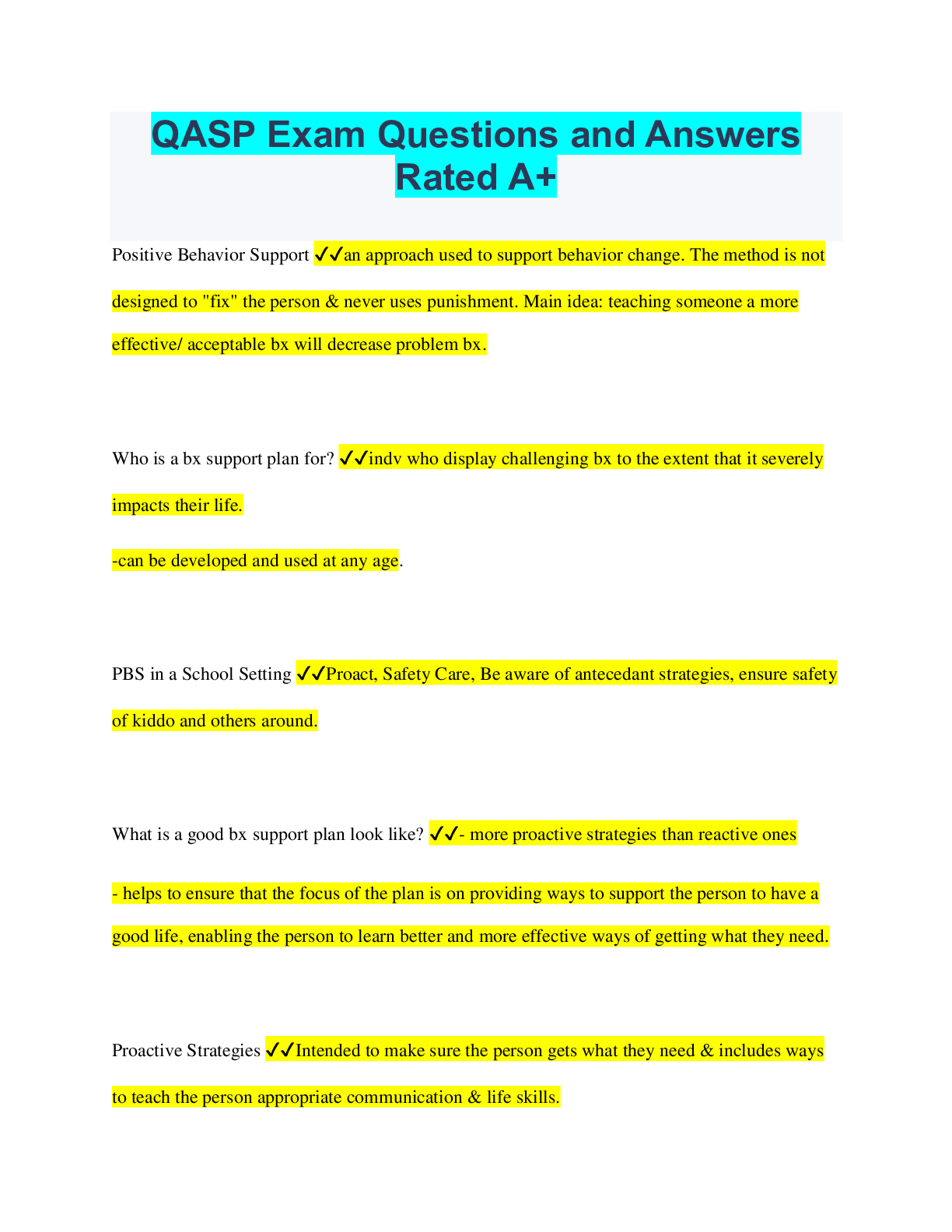
Positive Behavior Support ✔✔an approach used to support behavior change. The method is not
designed to "fix" the person & never uses punishment. Main idea: teaching someone a m
...
QASP Exam Questions and Answers
Rated A+
Positive Behavior Support ✔✔an approach used to support behavior change. The method is not
designed to "fix" the person & never uses punishment. Main idea: teaching someone a more
effective/ acceptable bx will decrease problem bx.
Who is a bx support plan for? ✔✔indv who display challenging bx to the extent that it severely
impacts their life.
-can be developed and used at any age.
PBS in a School Setting ✔✔Proact, Safety Care, Be aware of antecedant strategies, ensure safety
of kiddo and others around.
What is a good bx support plan look like? ✔✔- more proactive strategies than reactive ones
- helps to ensure that the focus of the plan is on providing ways to support the person to have a
good life, enabling the person to learn better and more effective ways of getting what they need.
Proactive Strategies ✔✔Intended to make sure the person gets what they need & includes ways
to teach the person appropriate communication & life skills.
Reactive Strategies ✔✔Designed to keep the person & those around them safe from harm. They
provide a way to react quickly when person is distressed & more likely to display challenging
behavior.
PBS & DRA ✔✔For new skills to be learned & used, they must be more effective than the old
skills.
Bx Support Plan ✔✔Document created to help understand & manage bx in children & adults w
learning disabilities & who display challenging bx. Provides step by step guide to make sure
carers know when to intervene & maximize quality of life.
Good Bx Support plans contain: ✔✔based on results of fx assessment, uses PBS approaches,
Contains a range of strategies that include ways to ensure the person has access to effective
reinforcers.
Functions of Behaviors & Alternatives ✔✔Sensory:teach them to ask for desired object/ activity,
use preferred sensory items to create new activities, have sensory time & structured activity so
stimming doesn't take over
Escape:Teach them to say yes/ no, ask for break/ all done, introduce them to a less preferred
activity gradually, change the way you ask them to do something
Attention: Teach them to tap/ vocalize sign for desired item; give frequent positive social attn
Tangibles:teach them to ask for object/ activity, Give what they asked for as soon as appropriate,
teach them to get something themselves, Make sure they are not left too long w/o food/drink/
something meaningful to do.
Green Amber Red Blue Proactive Strategies ✔✔Green: supporting person to stay calm
(environments, communication & body language, predictable routine.)
Amber: Responding to early warning signs (take away
[Show More]