Autism Core Knowledge (QABA ABAT
Exam Study Slides) (Part 1) Already
Passed
Autisitic Disorder ✔✔Children who were highly intelligent but displayed "a powerful desire for
aloneness" and "an obsessive insistence on pe
...
Autism Core Knowledge (QABA ABAT
Exam Study Slides) (Part 1) Already
Passed
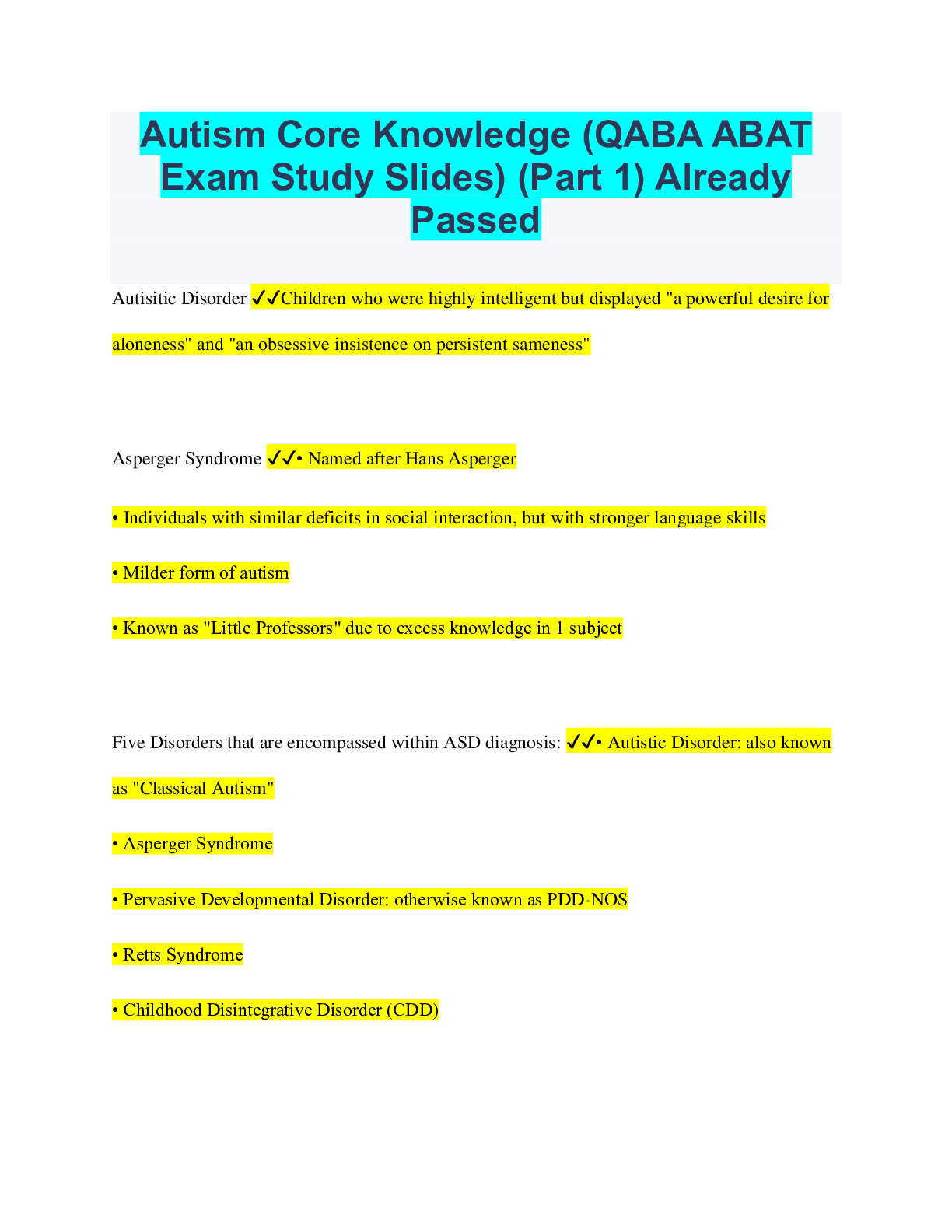
Autisitic Disorder ✔✔Children who were highly intelligent but displayed "a powerful desire for
aloneness" and "an obsessive insistence on persistent sameness"
Asperger Syndrome ✔✔• Named after Hans Asperger
• Individuals with similar deficits in social interaction, but with stronger language skills
• Milder form of autism
• Known as "Little Professors" due to excess knowledge in 1 subject
Five Disorders that are encompassed within ASD diagnosis: ✔✔• Autistic Disorder: also known
as "Classical Autism"
• Asperger Syndrome
• Pervasive Developmental Disorder: otherwise known as PDD-NOS
• Retts Syndrome
• Childhood Disintegrative Disorder (CDD)
T/F: There is NO single cause of ASD ✔✔True
Complex relationship between ____________ and ____________ factors. ✔✔Genetic
predisposition, environmental
Characterized by _____________ and ___________ patterns. ✔✔social communication deficits,
restricted and repetitive behavior
Two classifications of diagnostic criteria: ✔✔- International Classification of Disease, Tenth
Edition (ICD 10)
- Diagnostic and Statistical Manual of Mental Disorders, 5th edition (DSM- V)
What is the ASD: Triad of Primary Impairments? ✔✔1. Social & Emotional Interaction
2. Imagination & Flexibility of Thought
3. Social Communication & Language
Characteristics of Social & Emotional Interaction Impairments: ✔✔• Standing too close to
people
• Unaware of different ways of interacting with others
• Has desire to have friends and relationships but struggles to initiate and maintain these
Characteristics of Imagination & Flexibility of Thought Impairments: ✔✔• Does not understand
others points of view or feelings
• Takes everything literally
• Agitated by change in routine
Characteristics of Social Communication & Language Impairments: ✔✔• Asks repetitive
questions
• Cannot 'read between the lines' of what people mean
• Communicates for own needs, rather than for 'social' engagement
• Makes factual comments inappropriate to the context
•Center for Disease Control and Prevention (CDC) announces prevalence rates of autism;
updated every _______ years.
-2016: 1 in every _____ children
-2018: 1 in every _____ children
-2020: 1 in every _____ children
-Rate is higher in boys than girls (about _____ times more common in boys) ✔✔a) 2
b) 68
c) 59
d) 54
e) 4
Red Flags for Early Diagnosis of ASD: ✔✔• Not responding to their name by 12 months of age
• Not pointing at objects to show interest (e.g., pointing at an airplane flying over) by 14 months
• Not playing "pretend" games (e.g., pretending to "feed" a doll) by 18 months
• Avoiding eye contact and wanting to be alone
• Having trouble understanding other people's feelings or talking about their own feelings
• Having delayed speech and language skills
• Repeating words or phrases over and over (echolalia)
• Giving unrelated answers to questions
• Getting upset by minor changes
• Having obsessive interests
• Flapping their hands, rocking their body, or spinning in circles
• Having unusual reactions to the way things sound, smell, taste, look, or feel
What is a Developmental Evaluation? ✔✔An in-depth look at a child's development, by a trained
specialist, such as a developmental pediatrician, child psychologist, or pediatric neurologist.
- Consists of observation of the child, structured testing, and interview tools/questionnaires
- Uses the criteria in the DSM-V
- Results are either meets criteria for ASD or does not meet criteria.
Risk Factors of ASD: ✔✔• Genes can make it more likely a person will develop ASD
• Higher risk for those who have a sibling with ASD
• Having certain chromosomal or genetic conditions
• Certain medications (Valproic Acid and Thalidomide) taken during pregnancy
• Some evidence towards "critical period" (before, during and immediately after birth)
• Older parents (greater risk)
What is Pragmatic Language? ✔✔Appropriate social language skills, including verbal and nonverbal communication. Includes what we say, how we say it (volume, tone, intonation, etc.) and
when to say it.
What is Receptive Language? ✔✔Understanding what others say or what is read (e.g., following
instructions).
What is Expressive Language? ✔✔Using words/sentences to express oneself (communicate
wants, needs, ideas, etc.)
What is Sensory-motor? ✔✔The understanding that sensory stimulation/input and motor output
are directly tied to each other.
What are social skills? ✔✔Verbal and non-verbal communication skills we use to communicate
with others; Supports in development and maintenance of social relationships.
What is sterotypy? ✔✔Repetitive or restricted movements or sounds that serve no functional
purpose (automatically reinforced).
What is Joint Attention? ✔✔• Occurs when 2 people share interest in an object/activity
• When the child points to something, not because they want it, but to show it to someone for a
social purpose.
• The child can respond to someone initiating the joint attention, or the child can initiate it.
What is Hypo-sensitivity? ✔✔• Under reactivity to a sensory input
• Brain doesn't register incoming stimuli appropriately so the child is not as affected by the
stimuli.
What is Hyper-sensitivity? ✔✔• Over reactivity to sensory input
• Being overwhelmed by stimuli that most people would consider normal or common.
What is Serial Memory Processing? ✔✔- The act of attending to and processing one item at a
time
- Information is sequential or in stages
- Similar to DTT.
- Children with ASD learn better this way.
What is Parallel Memory Processing? ✔✔• The act of attending to and processing all items
simultaneously
• Knowing your color, motion, shape, and depth
• Similar to PRT
Medical Conditions associated with ASD: ✔✔• Learning disabilities
• Processing disorders:
-Auditory Processing Disorder (APD)
-Visual Processing Disorder (VPD)
-Sensory Processing Disorder (SPD)
• Gastrointestinal problems
• Feeding problems
• Disrupted/inconsistent sleep
• Epilepsy
• Anxiety
• Depression
• Obsessive compulsive disorder (OCD)
• Attention deficit hyperactivity disorder
Comorbid Diagnoses associated with Autism: ✔✔• Anxiety
• ADHD
• Bipolar disorder
• Clinical depression
• Down syndrome
• Fragile X syndrome
• Gastrointestinal symptoms
• Intellectual disability and developmental delays
• Motor difficulties
• Obsessive Compulsive Disorder (OCD)
• Seizures and epilepsy
• Tourette Syndrome
• Tuberous Sclerosis
Common Characteristics of Asperger Syndrome: ✔✔Generally considered to be on the "high
functioning" end of the spectrum. Affected children and adults have difficulty with social
interactions and exhibit a restricted range of interests and/or repetitive behaviors. Motor
development may be delayed, leading to clumsiness or uncoordinated motor movements.
Common Characteristics of High-functioning Autism: ✔✔It's often used to refer to people with
autism spectrum disorder who read, write, speak, and manage life skills without much assistance.
High-functioning autism is often used to refer to those on the milder end of the spectrum.
[Show More]