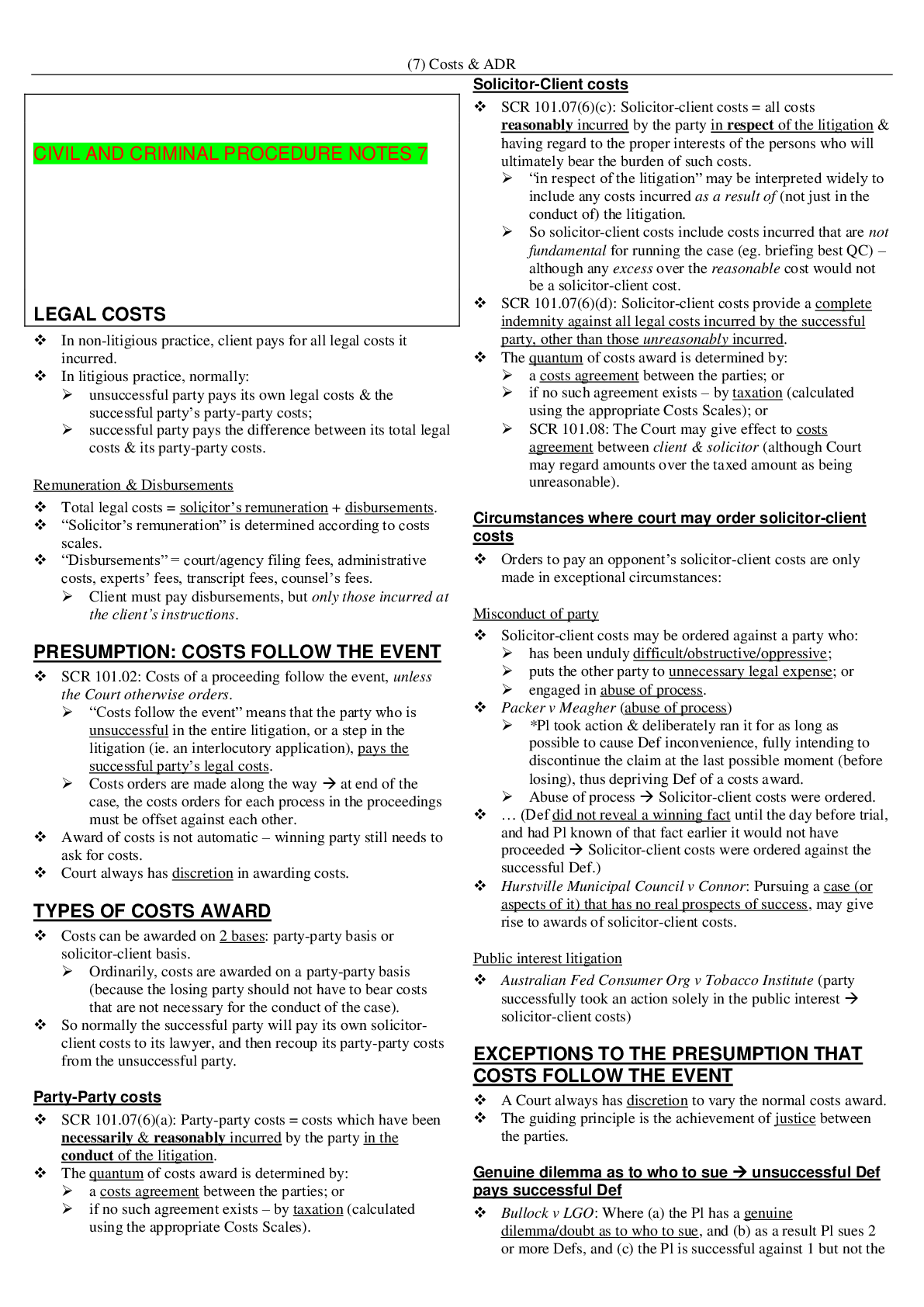
LEGAL COSTS
❖ In non-litigious practice, client pays for all legal costs it
incurred.
❖ In litigious practice, normally:
➢ unsuccessful party pays its own legal costs & the
successful party’s party-party costs;
➢ s
...
LEGAL COSTS
❖ In non-litigious practice, client pays for all legal costs it
incurred.
❖ In litigious practice, normally:
➢ unsuccessful party pays its own legal costs & the
successful party’s party-party costs;
➢ successful party pays the difference between its total legal
costs & its party-party costs.
Remuneration & Disbursements
❖ Total legal costs = solicitor’s remuneration + disbursements.
❖ “Solicitor’s remuneration” is determined according to costs
scales.
❖ “Disbursements” = court/agency filing fees, administrative
costs, experts’ fees, transcript fees, counsel’s fees.
➢ Client must pay disbursements, but only those incurred at
the client’s instructions.
PRESUMPTION: COSTS FOLLOW THE EVENT
❖ SCR 101.02: Costs of a proceeding follow the event, unless
the Court otherwise orders.
➢ “Costs follow the event” means that the party who is
unsuccessful in the entire litigation, or a step in the
litigation (ie. an interlocutory application), pays the
successful party’s legal costs.
➢ Costs orders are made along the way → at end of the
case, the costs orders for each process in the proceedings
must be offset against each other.
❖ Award of costs is not automatic – winning party still needs to
ask for costs.
❖ Court always has discretion in awarding costs.
TYPES OF COSTS AWARD
❖ Costs can be awarded on 2 bases: party-party basis or
solicitor-client basis.
➢ Ordinarily, costs are awarded on a party-party basis
(because the losing party should not have to bear costs
that are not necessary for the conduct of the case).
❖ So normally the successful party will pay its own solicitorclient costs to its lawyer, and then recoup its party-party costs
from the unsuccessful party.
Party-Party costs
❖ SCR 101.07(6)(a): Party-party costs = costs which have been
necessarily & reasonably incurred by the party in the
conduct of the litigation.
❖ The quantum of costs award is determined by:
➢ a costs agreement between the parties; or
➢ if no such agreement exists – by taxation (calculated
using the appropriate Costs Scales).
Solicitor-Client costs
❖ SCR 101.07(6)(c): Solicitor-client costs = all costs
reasonably incurred by the party in respect of the litigation &
having regard to the proper interests of the persons who will
ultimately bear the burden of such costs.
➢ “in respect of the litigation” may be interpreted widely to
include any costs incurred as a result of (not just in the
conduct of) the litigation.
➢ So solicitor-client costs include costs incurred that are not
fundamental for running the case (eg. briefing best QC) –
although any excess over the reasonable cost would not
be a solicitor-client cost.
❖ SCR 101.07(6)(d): Solicitor-client costs provide a complete
indemnity against all legal costs incurred by the successful
party, other than those unreasonably incurred.
❖ The quantum of costs award is determined by:
➢ a costs agreement between the parties; or
➢ if no such agreement exists – by taxation (calculated
using the appropriate Costs Scales); or
➢ SCR 101.08: The Court may give effect to costs
agreement between client & solicitor (although Court
may regard amounts over the taxed amount as being
unreasonable).
Circumstances where court may order solicitor-client
costs
❖ Orders to pay an opponent’s solicitor-client costs are only
made in exceptional circumstances:
Misconduct of party
❖ Solicitor-client costs may be ordered against a party who:
➢ has been unduly difficult/obstructive/oppressive;
➢ puts the other party to unnecessary legal expense; or
➢ engaged in abuse of process.
❖ Packer v Meagher (abuse of process)
➢ *Pl took action & deliberately ran it for as long as
possible to cause Def inconvenience, fully intending to
discontinue the claim at the last possible moment (before
losing), thus depriving Def of a costs award.
➢ Abuse of process → Solicitor-client costs were ordered.
❖ … (Def did not reveal a winning fact until the day before trial,
and had Pl known of that fact earlier it would not have
proceeded → Solicitor-client costs were ordered against the
successful Def.)
❖ Hurstville Municipal Council v Connor: Pursuing a case (or
aspects of it) that has no real prospects of success, may give
rise to awards of solicitor-client costs.
Public interest litigation
❖ Australian Fed Consumer Org v Tobacco Institute (party
successfully took an action solely in the public interest →
solicitor-client costs)
EXCEPTIONS TO THE PRESUMPTION THAT
COSTS FOLLOW THE EVENT
❖ A Court always has discretion to vary the normal costs award.
❖ The guiding principle is the achievement of justice between
the parties.
[Show More]