CEN Exam 1 Questions & Answers
Which dysrhythmia would be identified on an ECG/EKG six-second strip by a heart rate of 76
and a PR interval of 0.24?
a.sinus tachycardia
b.first-degree atrioventricular block
c.sinus
...
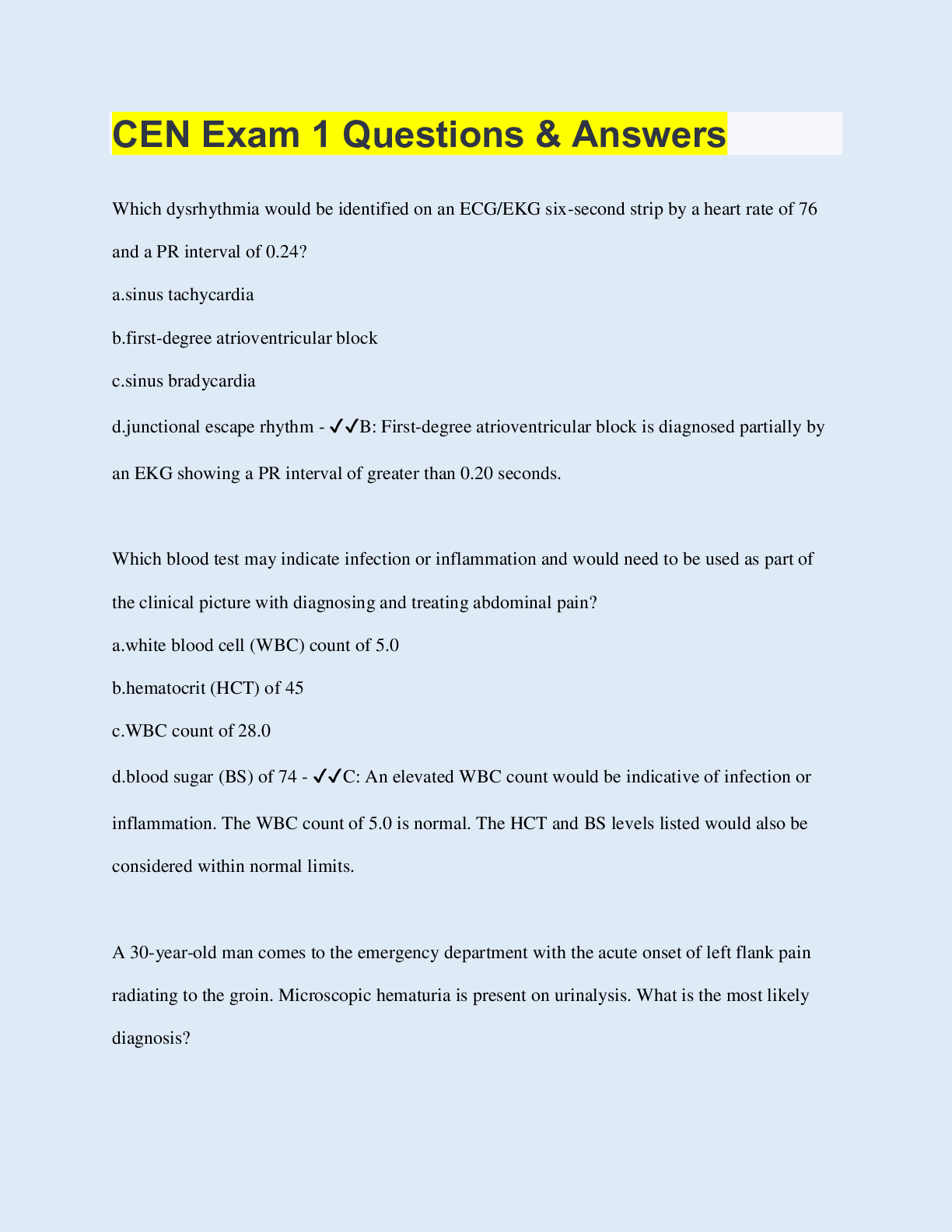
CEN Exam 1 Questions & Answers
Which dysrhythmia would be identified on an ECG/EKG six-second strip by a heart rate of 76
and a PR interval of 0.24?
a.sinus tachycardia
b.first-degree atrioventricular block
c.sinus bradycardia
d.junctional escape rhythm - ✔✔B: First-degree atrioventricular block is diagnosed partially by
an EKG showing a PR interval of greater than 0.20 seconds.
Which blood test may indicate infection or inflammation and would need to be used as part of
the clinical picture with diagnosing and treating abdominal pain?
a.white blood cell (WBC) count of 5.0
b.hematocrit (HCT) of 45
c.WBC count of 28.0
d.blood sugar (BS) of 74 - ✔✔C: An elevated WBC count would be indicative of infection or
inflammation. The WBC count of 5.0 is normal. The HCT and BS levels listed would also be
considered within normal limits.
A 30-year-old man comes to the emergency department with the acute onset of left flank pain
radiating to the groin. Microscopic hematuria is present on urinalysis. What is the most likely
diagnosis?
a.ureteral calcium oxalate calculus
b.ureteral cystine calculus
c.testicular torsion
d.cystitis - ✔✔A: Ureteral calculi are a quite common cause of acute emergency evaluation,
usually causing flank pain with radiation to the back and/or groin. About 75% of these are
calcium oxalate or phosphate; less common are struvite, uric acid, or cystine calculi. While KUB
or ultrasound may show the stone, helical CT is now the preferred diagnostic method. Additional
workup includes CBC, chemistry panel, urinalysis, and straining of urine to catch a passed stone
for chemical analysis. Nursing attention should be directed to intravenous hydration with input
and output recording and narcotic or narcotic plus NSAID (e.g., ketorolac) administration for
pain. Some patients may be discharged with analgesics and instructions for hydration and
calculus capture. Testicular torsion is most common in adolescents and usually presents with
testicular and groin pain with abdominal radiation; increasing pain by lifting the scrotum to the
level of the pubic symphysis causes exacerbation of the pain (Prehn sign). Cystitis may be
infectious or drug-induced, but cystitis usually causes dysuria and pyuria and shows positive
urine cultures.
Which of the following is NOT appropriate for screening for domestic violence by the
emergency department nurse?
a.asking if the person has been hit, kicked, or otherwise hurt by someone in the past year; if so,
by whom
b.asking, "Do you feel safe in your present relationship?"
c.avoid asking about intimate person violence if the patient is in the emergency department for a
medical ailment, not trauma
d.asking if there is a partner from a previous relationship that makes the individual feel unsafe -
✔✔C: Domestic violence, nearly always perpetrated against women, is a major problem
confronted by the emergency nurse. Screening for possible cases should include answers A, B
and D. Interestingly, victims of intimate partner violence often present with a medical ailment,
not trauma. These include back, abdominal, or pelvic pain, headaches, urinary infections,
sexually transmitted disease, or symptoms consistent with posttraumatic stress disorder (PTSD).
Sometimes evidence of old trauma such as healing fractures or cosmetically concealed bruises
may point toward the presence of domestic violence. Many victims will deny it but sometimes
compassionate questioning in a private setting will elicit a positive response. The nurse may then
offer advice, refer to a social agency or shelter, or ask for a consultation by the hospital social
worker.
A patient is intubated and on mechanical ventilation. The ventilator alarm rings and the airway
pressure is found to be elevated. Possible causes include the following EXCEPT:
a.endotracheal tube obstruction with sputum
b.pneumothorax
c.bronchospasm
d.cuff leak - ✔✔D: Mechanical ventilation requires diligent observation of the patient and
ventilator by the emergency nurse. Modern ventilators usually come with alarms that indicate
high or low airway pressure. High pressure may be caused by endotracheal tube obstruction with
sputum or kinks or inadvertent endobronchial disp
[Show More]