First Responder Exam Review
CPR consists of 4 main parts:
A=
B=
C=
D=
- ✔✔Airway
Breathing
Chest Compressions
Defibrillation
What is the compression? - ✔✔Pumps the blood in the heart to the rest of body
What c
...
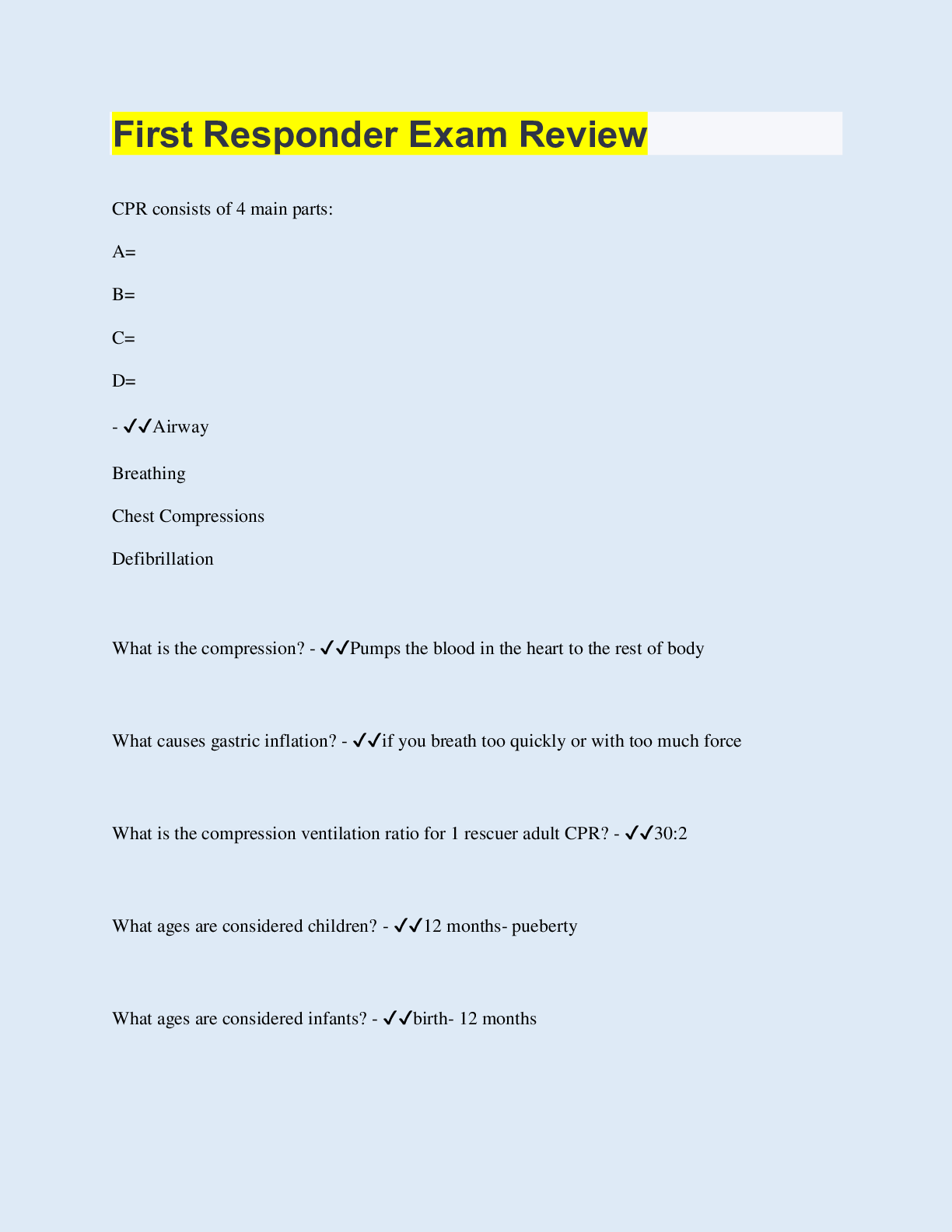
First Responder Exam Review
CPR consists of 4 main parts:
A=
B=
C=
D=
- ✔✔Airway
Breathing
Chest Compressions
Defibrillation
What is the compression? - ✔✔Pumps the blood in the heart to the rest of body
What causes gastric inflation? - ✔✔if you breath too quickly or with too much force
What is the compression ventilation ratio for 1 rescuer adult CPR? - ✔✔30:2
What ages are considered children? - ✔✔12 months- pueberty
What ages are considered infants? - ✔✔birth- 12 months
What ages are considered adults? - ✔✔pueberty and up
What is the compression-ventilation for 2 rescuer adult CPR? - ✔✔30:2
What is the compression-ventilation for 2 rescuer child CPR? - ✔✔15:2
The earlier the defibrillation occurs the ______ the survival rate - ✔✔higher
AED stands for___ - ✔✔Automated External Defibrillator
Use the _______ hands technique for infant 2 rescuers - ✔✔2-thumb- encircling
To relieve chocking in the infant give - ✔✔A combination of back slaps and chest thrusts
What should you do if a patient had agonal breaths - ✔✔Activate emergency response system,
check pulse, start CPR
Where should you assess a pulse in an adult? - ✔✔Carotid artery
Where should you assess a pulse in an infant - ✔✔Brachial Pulse
The chain of human resources and services linked together to provide continuous emergency
care from the prehospital scene, through transport, and arrival at the medical facility -
✔✔EMS(Emergency Medical Service System)
A member of the EMS System who provide pre-arrival instructions to callers, there by helping to
initiate life-saving care before EMS personnel arrive - ✔✔Emergency Medical Dispatcher
A physician who assumes the ultimate responsibility for medical oversight of the patient care
aspects of the EMS systems - ✔✔Medical Director
A specific set of steps developed by the EMS system's medical director - ✔✔Protocols
Specific instructions developed by the medical director, which authorize the Emergency Medical
Responder, EMT, or Paramedic to provide care for specific medical conditions or injuries -
✔✔standing orders
Standing orders and protocol developed by an EMS system that authorize rescuers to perform
particular skills in certain situations without actually speaking to the MD - ✔✔Off-line medical
direction
Orders to perform a skill or administer care from the on-duty physician, given to the rescuer in
person, by radio, or by phone - ✔✔On-line Medical Direction
To protect yourself from infectious diseases, typically you will need no more than _____ -
✔✔gloves
The prehospital assessment and basic care for the sick or injured patient - ✔✔Emergency care
Give several components of the EMS - ✔✔first reponders, paramedics, the dispature, police
man, fire man
The patient provides verbal permission to provide care - ✔✔Expressed consent
An unresponsive patient is assumed to want help - ✔✔Implied Consent
A failure to provide the expected standard of care - ✔✔Negligence
A series of laws designed to protect care providers who deliver care in good faith to the level of
there training and with out compensation - ✔✔Good Samaritan Law
Give the stages of grief and describe - ✔✔Denial- patient denys he is dying and puts off having
to deal with situation
Anger- angry about situation, vented on family members
Bargaining- patient believes bargaining will postpone the inevitable
Depression- patient becomes sad, depressed, and mourns things he has not done
Acceptance- works through all stages and finally is able to accept death
An emotionally draining, nerve raking time caused by an overload of work/drama - ✔✔stress
an emergency that involves more than one victim and over whelms the 1st responding units -
✔✔multiple-casualty
A method of infection control based on the presumption that all body fluids are infectious,
practice of using specific barriers to minimize contact with a patient's blood and body fluids -
✔✔BSI- Body Substances
Equipment such as eyewear, mask, gloves, gown, turnout gear, and helmet, which protect the
rescuers from infection and or from exposure to hazardous materials and the dangers of rescue
operations - ✔✔PPE- personal protective equipment
Give a blood-borne pathogen - ✔✔Hepatitis B, HIV
A lung infection that can be transmitted by airborne aerosplized droplets - ✔✔TB(Tuberculosis)
A disease that inflames and damages the liver, very infectious, life-long illness/ death -
✔✔Hepatitis
A situation or part of the situation that causes stress - ✔✔stressor
Common Causes of stress: - ✔✔Multi casualty incidents, death of coworker, child injury,
violence, abuse, neglect
An in-depth broad plan designed to help rescue personnel cope with the stress resulting from a
highly stressful incident - ✔✔Critical Incident Stress Management
The study of body structure - ✔✔Anatomy
The standard reference position for the body in the study of anatomy - ✔✔Anatomical Position
the patient is lying face up - ✔✔supine
The patient is lying face down - ✔✔Prone
the patient is lying on its side - ✔✔Lateral Recumbent
the front of the body - ✔✔Anterior
the back of the back of the body or body part - ✔✔Posterior
An imaginary vertical line used to divide the body into right and left - ✔✔Midline
Towards the midline of the body - ✔✔medial
To the side, away from the midline of the body - ✔✔lateral
towards the head - ✔✔Superior
away from the head - ✔✔Inferior
closer to the torso - ✔✔proximal
farther away from the torso - ✔✔distal
The muscular structure that divides the chest cavity from the abdominal cavity is the -
✔✔diaphragm
A body structure used to help find the position of the heart in the body for CPR is the -
✔✔Zyfoyd Process
The organ found in the pelvic cavity is the - ✔✔bladder, large intestine, reproductive organs
Responsible for the exchange of oxygen and carbon dioxide - ✔✔Respiratory System
carry well oxygenated blood and other nutrients to the body's calls, and assist with the removal
of wastes and carbon dioxide from the cells - ✔✔Circulatory System
Provides structure, support, and protection for the body and internal organs - ✔✔Muscular
System
Control movement, interprets sensations, regulate body activities and generate memory and
thought - ✔✔Nervous System
Digest and absorb food and remove certain waste - ✔✔Digestive System
Removes chemical waste from the blood and help balance water and salt levels in the blood -
✔✔Urinary System
Produces hormones needed for sexual reproduction - ✔✔Reproductive System
Protects the body from disease causing organisms with white blood cells, microorganismsattacking cells, anti producing cells and anti bodies - ✔✔Immune System
The proper use of the body to facilitate lifting and moving and to minimize injury - ✔✔Body
Mechanics
List the rules to follow in a lift - ✔✔Position your feet properly
Lift with your legs and avoid putting weight to either side
minimize twisting
keep weight as close to your body as possible
when going down stairs use a chair or commertial stair chair instead of wheeled stretcher
A patient move that is carried out quickly when the scene is hazardous care of the patient
requires immediate repositioning or you must reach another patient who needs life saving care -
✔✔Emergency Move
the preferred choice when the situation is not urgent the patient is stable and you have adequate
time and personnel for a move - ✔✔Non Emergency Move
The position in which a patient with no suspected spine injuries may be placed usually on the left
side - ✔✔Recovery Position
Also known as backboards used for patients who are found lying down or standing that have a
suspected spine injury - ✔✔Spine Board
Used to help immobilize and remove patients found in a seated position in a vehicle - ✔✔Vesttype extraction device
Typically used in more rural settings to move the patient from one level of the ground to another
or rough terrain - ✔✔basket stretcher
Normal Respiration of an adult - ✔✔12-20 breaths
Sample - ✔✔Signs and Symptoms
Allergies
Medications
pertinant past medical history
Last oral intake
Events leading to the illness or injusry
AVPU - ✔✔Alert
Verbel
Pain
Unresponsive
an abstructive indication of illness or injury that can be seem heard smelled of felt by another
person - ✔✔Sign
Is a subjective indication of illness or injury that cannot be observed by another person or felt
and reported by the patient - ✔✔Symptom
During which of the major part of the patient assessment is the patient assessed for life
threatening problems? - ✔✔Initial Assignment
What is blood pressure? - ✔✔One out of 5 signs referred to as vital signs. the measurement of
blood against the walls of your arteries
the heart's contractions faze the first beating or tapping sound heard - ✔✔systole
when the pressure in the arteries fall, the beating or tapping sound becomes dull or soft -
✔✔Diastole
What is the rule for estimating normal range of blood pressure? - ✔✔100+ their age
[Show More]