ECO 202 Exam One NVCC
The relationship between quantity supplied and price is ___ and the relationship between
quantity demanded and price is ___. - ✔✔direct, inverse
If average income increases, all else equal, then
...
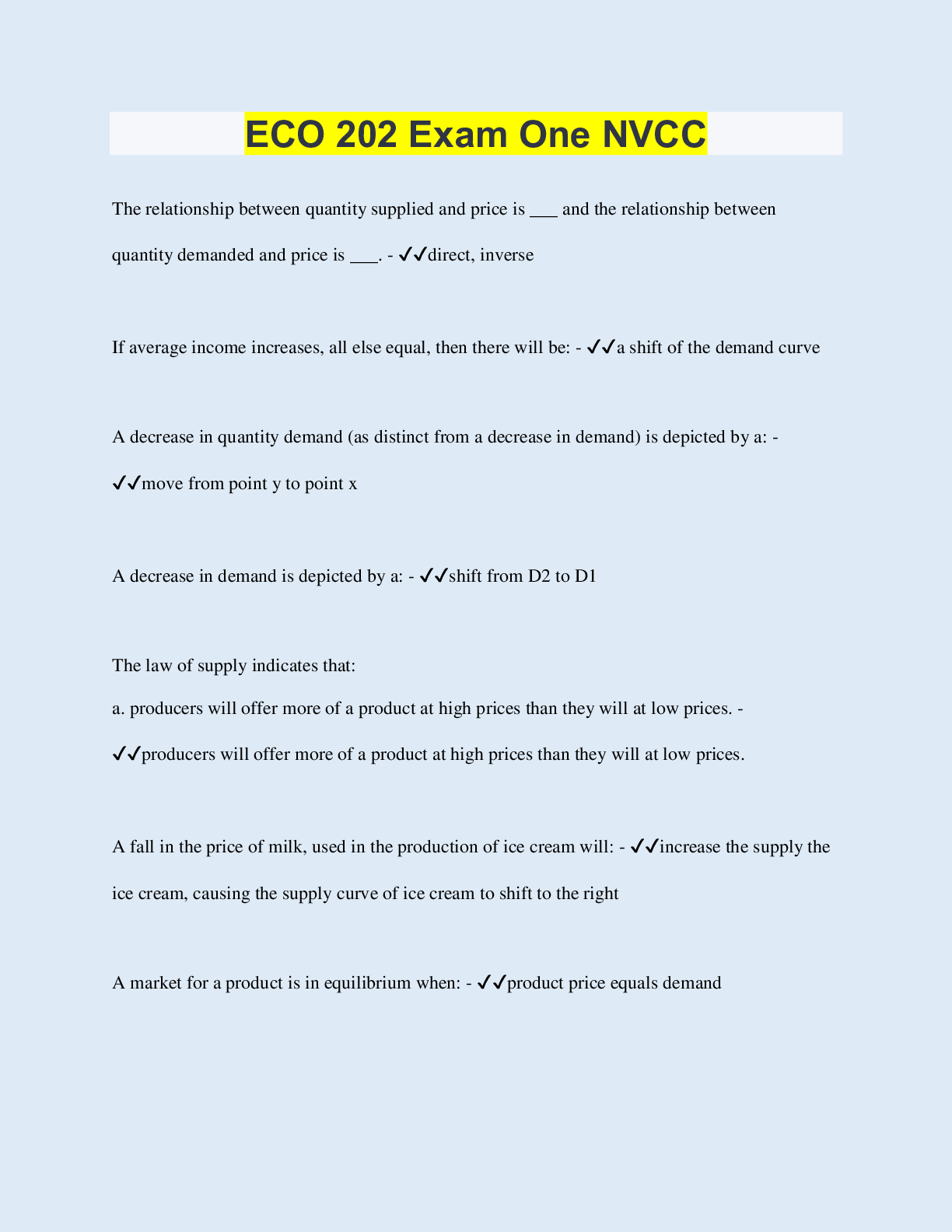
ECO 202 Exam One NVCC
The relationship between quantity supplied and price is ___ and the relationship between
quantity demanded and price is ___. - ✔✔direct, inverse
If average income increases, all else equal, then there will be: - ✔✔a shift of the demand curve
A decrease in quantity demand (as distinct from a decrease in demand) is depicted by a: -
✔✔move from point y to point x
A decrease in demand is depicted by a: - ✔✔shift from D2 to D1
The law of supply indicates that:
a. producers will offer more of a product at high prices than they will at low prices. -
✔✔producers will offer more of a product at high prices than they will at low prices.
A fall in the price of milk, used in the production of ice cream will: - ✔✔increase the supply the
ice cream, causing the supply curve of ice cream to shift to the right
A market for a product is in equilibrium when: - ✔✔product price equals demand
If the supply and demand curves for a product both decrease, then equilibrium: - ✔✔quantity
must decline, but equilibrium price may either rise, fall or remain unchanged
The price of elasticity of demand coefficient indicates: - ✔✔buyer responsiveness to price
change
The basic formula for the price elasticity of demand coefficient is ; - ✔✔percentage change in
quantity demanded/percentage change in price
The demand for a product is inelastic with respect to price if: - ✔✔consumers are largely
unresponsive to a per unit price change
The larger the coefficient of price elasticity of demand for a product, the: - ✔✔smaller the
resulting price change for an increase in supply
Utility refers to the: - ✔✔satisfaction that a consumer derives from a good or service
To maximize utility a consumer should allocate money income so that the: - ✔✔marginal utility
obtained from the last dollar spent on each product is the same.
Which of the following statements is correct? - ✔✔a product may yield utility, but not be
functionally useful.
Total utility may be determined by: - ✔✔summing the marginal utilities of each unit
Marginal Utility can be: - ✔✔positive, negative or zero
The law of diminishing marginal utility states that: - ✔✔beyond some additional units of a
product will yield less and less extra satisfaction to a consumer
Suppose the MUx/Px exceeds MUy/Py, to maximize utility the consumer who is spending all her
money income should buy: - ✔✔more of X and less of Y
If the price of X and Y are $2 and $4 per unit, respectively, and this consumer has $10 income to
spend, to maximize total utility this consumer should buy: - ✔✔1 units of X and 2 units of Y
To the economist total cost includes: - ✔✔explicit and implicit costs, including a normal profit
Which of the following definitions is correct?
accounting profit+economic profit=normal profit
economic profit-accounting profit= explicit costs
economic profit=accounting profit-implicit costs
economic profit-implicit costs=accounting profits - ✔✔economic profit=accounting profitimplicit costs
To economists the main difference between the short run and the long run is that: - ✔✔in the
long run all resources are variable, while in the short run at least one resource is fixed
Which of the following best expresses the law diminishing marginal returns? - ✔✔as successive
amounts of one resource (labor) are added to fixed amounts of other resources (property),
beyond some point the resulting extra output will decline
A fixed cost is - ✔✔associated with any productive resource whose price is fixed
Marginal cost is the - ✔✔change in total cost that results from producing one more unit of output
Which of the following is correct as it relates to cost curves?
1. average variable cost intersects marginal cost at the latter's minimum point
2. marginal cost intersects average total at the latter's minimum point
3. average fixed cost intersects marginal cost at the latter's minimum point.
4. marginal cost intersects average fixed cost at the latter's minimum point. - ✔✔marginal cost
intersects average total cost at the latter's minimum point
Which of the following is not a basic characteristic of pure competition?
1. considerable non-price competition
2. no barriers to the entry or exodus of firms
3. a standardized or homogeneous product
4. a large number of buyers and sellers - ✔✔considerable non price competition
The demand curve in a purely competitive industry is ___, while the demand curve to a single
firm in that industry is ___ - ✔✔downsloping, perfectly elastic
Which of the following is characteristic of a purely competitive seller's demand curve? -
✔✔price and marginal revenue are equal at all levels of output
In the short run a purely competitive firm that seeks to maximize profit will produce: - ✔✔where
total revenue exceeds total cost by the maximum amount
The MR-MC rule can be restated for a purely competitive seller as P=MC - ✔✔each additional
unit of output adds exactly its price to total revenue
In the short run a purely competitive firm will always make an economic profit if: - ✔✔P>ATC
Suppose you find that the price of your product is less than minimum AVC. You should: -
✔✔close down because, by producing your losses will exceed your total fixed costos
If a purely competitive firm shuts down in the short run: - ✔✔it will realize a loss equal to it's
total fixed cost
A purely competitive firm's short-run supply curve is: - ✔✔upsloping and equal to the portion of
the marginal cost curve that lies above the average variable cost curve
Which of the following conditions is true for a purely competitive firm in long run equilibrium?
a. P>MC=minimum ATC
b. P=MC=minimum ATC
c. P>MC>minimum ATC
d. P
[Show More]
Last updated: 7 months ago
Preview 1 out of 7 pages


.png)
.png)

.png)

.png)
.png)