OPOTA SPO'S Unit 1 Questions and
Answers 100% Pass
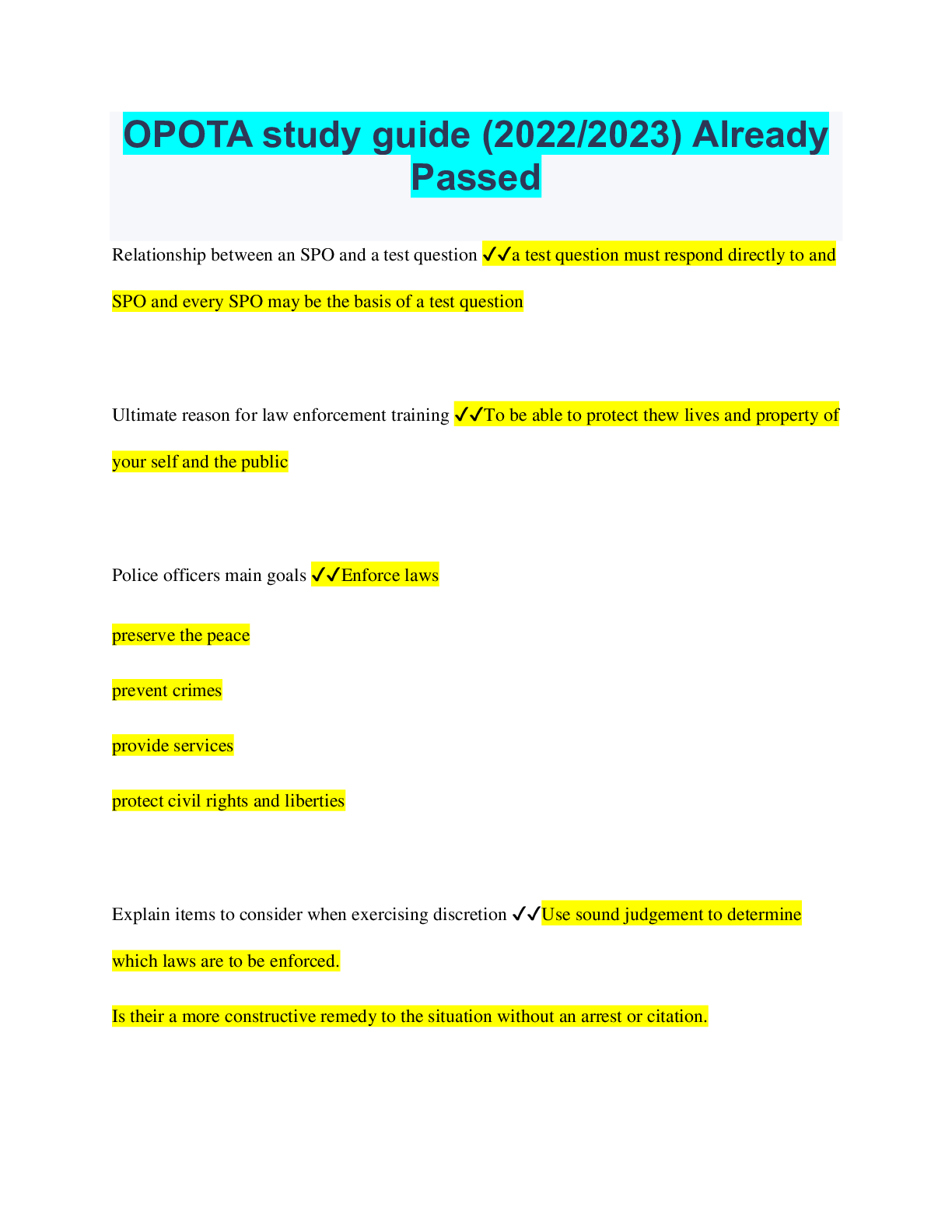
The relationship between an SPO and a test question is that ✔✔a test question must respond
directly to an spo and every spo may be the basis of a test question
The u
...
OPOTA SPO'S Unit 1 Questions and
Answers 100% Pass
The relationship between an SPO and a test question is that ✔✔a test question must respond
directly to an spo and every spo may be the basis of a test question
The ultimate reason for law enforcement training is ✔✔to be able to protect the life and property
of yourself and the public
A peace officers main goals are ✔✔Enforce Laws, Preserve the Peace, Prevent Crimes, Protect
Civil Rights and Liberties, Provide services
Considerations when exercising discretion ✔✔Use sound judgment to determine which laws are
to be formally enforced
Determine if there is a more constructive remedy to a situation without an arrest or citation
Factors necessary for the commission of a crime ✔✔Desire, Victim, Opportunity
Core Concepts of Community Policing ✔✔A Partnership between the police and the community,
Crime prevention, Organizational change of the agency, A problem-solving approach to the
police role that is proactive
Considerations for Off Duty Situations ✔✔Behavior, Situational Awareness, Be a good witness
if a situation arises when police intervention is necessary
The Purposes of The Bill of Rights ✔✔Protect an individual's freedoms, Prevent the government
from interfering in protected rights
The Major Concepts of the Criminal Justice System ✔✔Law Enforcement, Courts, Corrections
The Goals of Sentencing ✔✔Punish the offender and in many cases, rehabilitate the offender.
Protect Society. Restore the victim as much as possible.
The Purpose of any code of ethics or code of conduct ✔✔to identify expected behavior
Generally accepted ethical responsibilities of Peace Officers ✔✔External Influences on Behavior
( relationships with family/friends, local citizens, local media, dept. regulations)
Internal Influences on Behavior (officer's own more beliefs and values, anger, greed, lust)
Continuum of Compromise ✔✔Being exposed on a regular basis to "special authority" and at the
same time being exposed on a daily basis to that element of society that operates without values,
combines to severely challenge an officer's core values system
Acts of Omission ✔✔
Acts of Commission (administrative/criminal) ✔✔
Ethical Dilemmas ✔✔a situation in which the officer did not know what the right course of
action was, or the course of action the officer considered right was too difficult to do, or the
wrong course of action was tempting
Commons areas in which unethical acts occur ✔✔Corrupt Activity, Falsifying Reports, Sexual
Harassment and other sexual misconduct, Alcohol Usage, Drugs, Free Food and Gratuities
Decision Making Model ✔✔Step 1 Define the Problem
Step 2 Identify Alternative Solutions
Step 3 Evaluate the Identified Alternatives
Step 4 Make the Decision
Step 5 Implement the Decision
Step 6 Evaluate the Decision
PLUS filters ✔✔P= Policies (consistent with agency policies and procedures?)
L= Legal (is the action lawful?)
U= Universal (the universal principles and values of my agency?)
S= Self (does it align with my beliefs?)
Plus filters should be applied at the following Decision Making Model steps ✔✔Step 1 (define
the problem), Step 3 (evaluate alternative solutions), Step 6 (evaluate the decision)
Five Uses of Field notes ✔✔Preservation of Knowledge in written form
Foundation of the formal written report
Aids in further investigation
Evidence in court
Documentation of the officers efforts in the field
Seven types of information to be recorded in field notes ✔✔Complete info on victims, witnesses,
and suspects involved.
Date & time of offense or incident being reported.
Location of occurrence.
Type of place where offense or incident took place.
Details of offence or incident being reported.
Disposition of evidence, property, and subjects.
Corresponding report number.
Nine guidelines to be followed when taking field notes ✔✔Head notebook page with day and
time of shift.
Do not place information from one incident on the same page with information from another.
Write or print neatly so that you can read and understand your notes later.
Record all information in ink.
Let victims and witnesses talk through the event before you start recording notes.
Ask clarifying follow-up questions.
Be as complete as possible.
Consider the use of an electronic date device or template.
Do not record your personal information.
Six Essential questions answered in a report ✔✔Who, What, When, Where, Why, How
Four requirements of a Well-Written report ✔✔Complete, Factual, Accurate, Objective
[Show More]