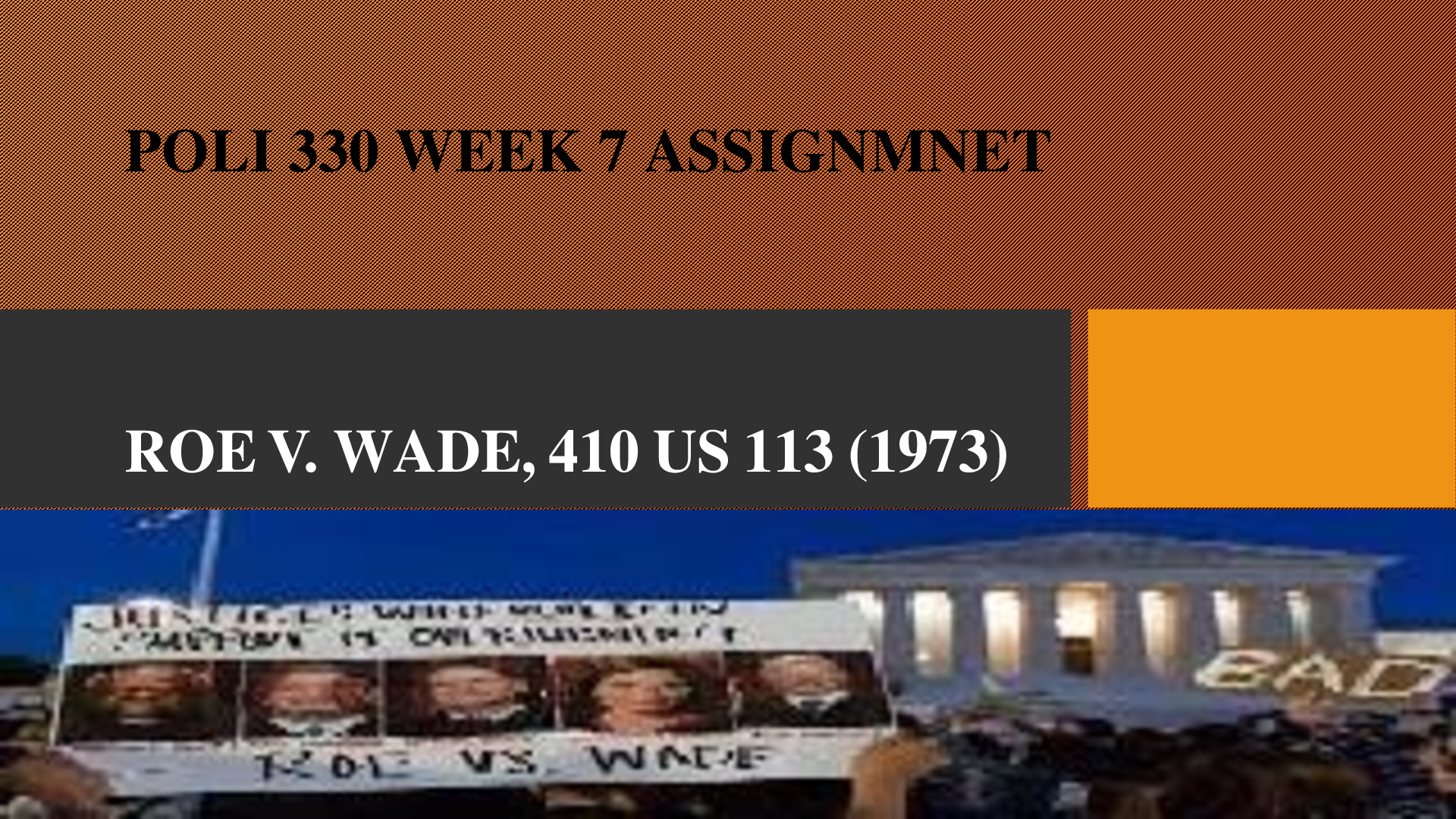
POLI 330N Week 7 Assignment: Part II: How the Courts Address or Respect Our Rights as Citizens – Presentation: Roe vs Wade
Document Content and Description Below
INTRODUCTION
❖ Roe v. Wade is one of the leading cases in American history that gave women the right to an abortion, with few exceptions. This case was a turning point in the reproduction right
...
s of women and has remained a hot-button matter within US politics ever since.
❖ The Supreme Court, in this case, established that the right to abortion was a fundamental right of a woman and protected under the right to privacy, as laid down by the Fourteenth Amendment.
❖ Even though the Court had recognized that abortion rights are women’s right to privacy, however, it is having been pointed out as integral to the ‘due process clause’ of the Fourteenth Amendment.
❖ It is not observed as an absolute right; it needs to be balanced with reasonable interest that every State lays down to regulate abortion.
INTRODUCTION CONTINUES….
❖ Jane Roe was a frictional name give to the plaintiff that sued the district antoney Henry Wade of Dallas county, Texas, where Roe resided.
❖ Jane Roe was a pregnant single woman who brought a class action challenged the constitutionality of the Texas criminal abortion laws, which proscribe procuring or attempting an abortion except on medical advice for the purpose of saving the mother's life
❖ In this case, the constitutional validity of Texas State Panel Codes Articles 1191 – 1194 (Texas Statute) was challenged for criminalizing abortion, except for when it was allowed by the medical practitioners for saving the mother’s life.
❖ Roe’s, the appellant, assertion that the Texas Statute was incantational and violative of her right to privacy, was upheld by the Court, thereby striking down the Statute, stating that the State compelling a woman to carry on with a pregnancy against her wish was an infringement of her fundamental right.
❖Jane Roe filed a lawsuit against the district attorney of Dallas Country Texas, Henry Wade.
❖She challenged a Texas law making abortion unlawful except by orders of a doctor to save the life of a woman.
❖Roe alleged that the laws of the state were unconstitutionally unclear and condensed her personal privacy right.
❖The Texas Statute provisioned criminalizing an attempt to receive abortion services except for when it was allowed by the medical practitioners for saving the mother’s life.
❖Roe, the appellant, brought a legal action against the Texas Statute by challenging its validity regarding its criminalizing provisions, jeopardizing her right to abortion.
❖Roe highlighted that the Statute was unconstitutional for infringing her right to privacy that a matter of abortion claims, as guaranteed under First, Fourth, Fifth, Ninth and Fourteenth Amendment.
❖ The District Court had held that childbirth is a woman’s right along with having the right to make a choice not to have it, as protected under Ninth and Fourteenth Amendment.
❖Even though it offered her a declaratory relief to the appellant, however it refused to grant an injunction, allowing the abortion.
❖This made the appellant appeal before the Supreme Court, which laid down the landmark judgement by striking down the Texas Statute.
❖ In 1960s, there wer a severe issue regarding abortion, marking it a public health crisis causing miscarriages and severe health problems among women.
❖ Griswold v. Connecticut 1965 and Eisenstadt v. Baird 1972 are the two controversial cases that led to Roe v Wade. In Griswold, criminalization of the use of birth controls by married couple as exercised in the State of Connecticut was struck down by the Supreme Court, while in Eisenstadt, the same matter was applied to single people.
❖ These two landmark cases had set a positive impact on Roe v Wade.
❖ Lord Ellenborough’s Act (1803) was adopted by Connecticut in 1821 and passed the initial law banning abortion after quickening.
❖ After 20 years, 8 states have such laws.
❖ Twenty states out of thirty-seven restricted abortion at the adoption of the 14th amendment.
❖ By the 1950s, nearly all states banned every abortion except when essential to save the life of the woman (Cohen et al., 2021).
Is abortion a woman’s fundamental right, recognized by the United State Constitution? (Paltrow, 2022).
❖ Is abortion a woman’s fundamental right, recognized by the U.S. Constitution?
❖ Women have the right to terminate their pregnancy under the Bill of Rights (Murray, M. (2020).
❖ Improper for a state to impose on women’s right to privacy in sexual, familial, and marital decisions.
❖ No case states that a fetus is a person.
❖ The fetus could not have any valid right to life.
❖ Wade arges that abortion is a crime because the state have the duty to safeguard parental life.
❖ Unborn fetus are people and have right to live.
❖ Protect the safety and health of citizens, including the unborn fetus (Craddock, 2017).
❖ The Texas law violated on rights to sexual, familial, and marital privacy guaranteed by the Bill of Rights.
❖ Supreme Court declared the right of women to an abortion protective within the privacy right by the fourteenth Amendment.
❖ The state can treat abortion just as a medical treatment.
❖ The interest of the state was observed as valid when it was safeguarding the mother’s health (Lazzarini, Z. 2022).
❖ Right to privacy includes the right to abortion; however, not marking it as an absolute right, thereby requiring the administration to exercise ‘due process clause’ considering the State’s interests as offered by the respective State laws
JUDGEMENT/ VERDICT
❖ The Supreme Court, in a 7-2 decision, held that the right to privacy includes the right to abortion, as women holds the right to decision whether to opt for childbirth, even though not marking it an unqualified right as it is to be observed by the ‘due process clause’.
❖ The Court investigated the history of abortion laws, pointing out some of the hazards of abortion, for which it has been criminalized so far.
❖ However, with the advancement of medical science and changing perspective of the world, broader point of view regarding abortion should be considered.
CONCURRING AND DISSENTING OPINIONS
❖ As per Justice Potter Stewart, the constitution makes no outlined regard the right to choose to have abortions without interference.
❖ Protection of liberty in Due Process Clause extends beyond simple process and safeguards various rights of fundamental (Lazzarini, Z. (2022).
❖ According to Chief Justice Warren Burger, it would be permissible to permit states to need two physicians to certify abortions prior it can be performed.
DISSENTING OPINIONS
❖ As per Justice William H. Rehnquist, the fourteenth Amendment did not intent for it to safeguard a privacy right of the people.
❖ However, it did not intend for it to safeguard the decision of women to have an abortion.
❖ Historical analysis of court was flawed in this case.
❖ It could be stated that Roe vs Wade has been an important judgement delivered by the Supreme Court that helped restoring women’s right to abortion in the form of protecting their right to privacy.
❖ It was certainly a wise step taken by the Court to look beyond the need to save a mother’s life in terms of allowing abortion; it could be a necessity when a teenage girl has conceived mistakenly or when a rape victim conceives.
❖ This case was the first to recognize that a woman must right to choose whether to become a mother. Legalised abortion in the United States.
❖ Except for the purpose of safeguarding the pregnant woman’s health.
❖ Help poor Texas women get a valid abortion
Gandhi, P., & Aranha, A. (2021). Understanding Roe v. Wade. Issue 3 Int'l JL Mgmt. & Human., 4, 4069. https://heinonline.org/HOL/LandingPage?handle=hein.journals/ijlmhs11&div=359&id=&page=
Lazzarini, Z. (2022). The End of Roe v. Wade—States’ Power over Health and Well-Being. New England Journal of Medicine, 387(5), 390-393. DOI: 10.1056/NEJMp2206055.
Murray, M. (2020). Race-ing Roe: Reproductive Justice, Racial Justice, and the Battle for Roe v. Wade. Harv. L. Rev., 134, 2025. https://heinonline.org/HOL/LandingPage?handle=hein.journals/hlr134&div=98&id=&page=
Paltrow, L. M. (2022). Roe v Wade and the new Jane Crow: Reproductive rights in the age of mass
incarceration. American Journal of Public Health, 112(9), 1313-1317. https://doi.org/10.2105/AJPH.2012.301104
[Show More]
Last updated: 2 years ago
Preview 1 out of 14 pages