SPēD SFPC: PHYSEC Questions and
Answers 100% Verified
Three different types of approved classified material storage areas. ✔✔1. GSA-approved storage
containers
2. Vaults (including modular vaults)
3. Open storage ar
...
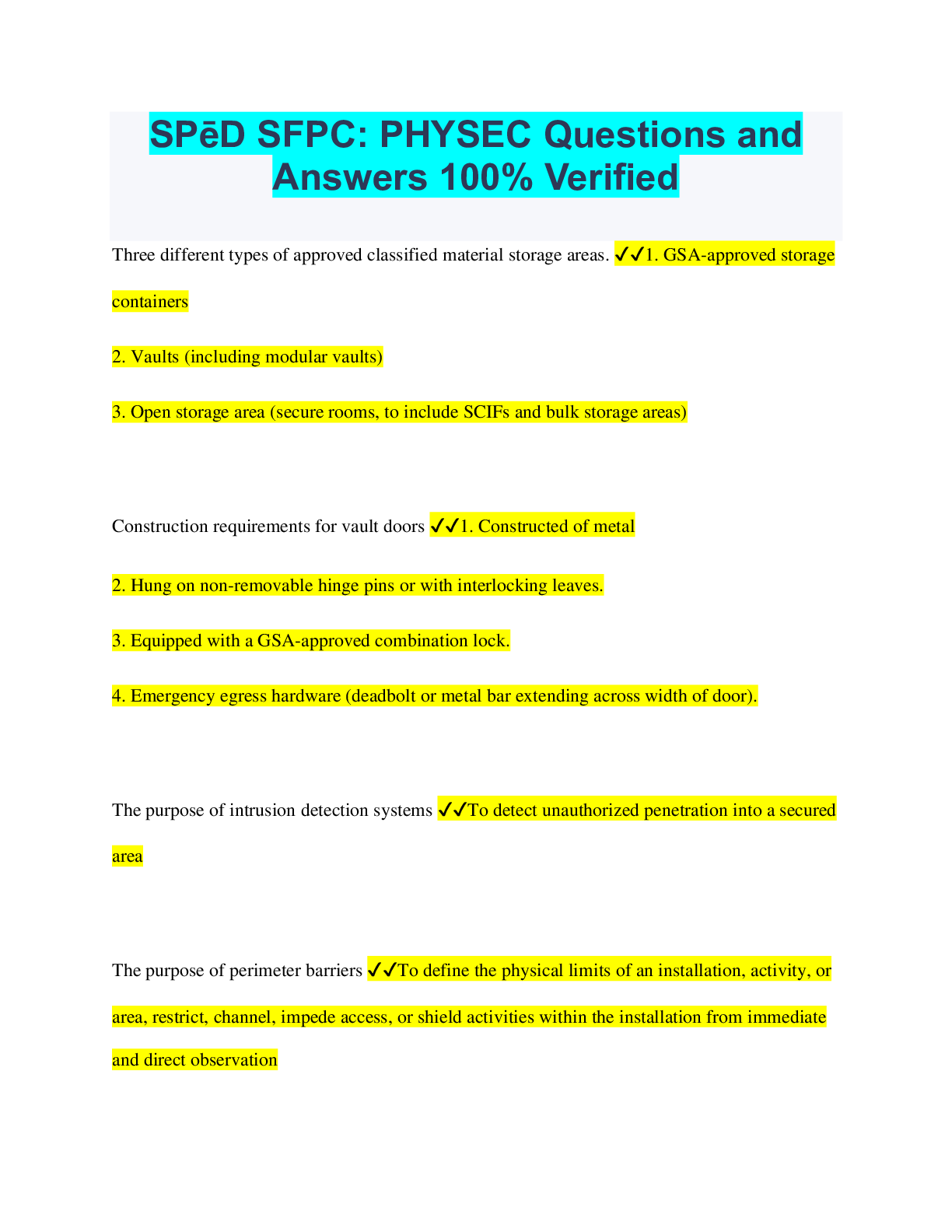
SPēD SFPC: PHYSEC Questions and
Answers 100% Verified
Three different types of approved classified material storage areas. ✔✔1. GSA-approved storage
containers
2. Vaults (including modular vaults)
3. Open storage area (secure rooms, to include SCIFs and bulk storage areas)
Construction requirements for vault doors ✔✔1. Constructed of metal
2. Hung on non-removable hinge pins or with interlocking leaves.
3. Equipped with a GSA-approved combination lock.
4. Emergency egress hardware (deadbolt or metal bar extending across width of door).
The purpose of intrusion detection systems ✔✔To detect unauthorized penetration into a secured
area
The purpose of perimeter barriers ✔✔To define the physical limits of an installation, activity, or
area, restrict, channel, impede access, or shield activities within the installation from immediate
and direct observation
The purpose of an Antiterrorism Program ✔✔Protect DoD personnel, their families,
installations, facilities, information, and other material resources from terrorist acts
Force Protection Condition levels ✔✔Normal, Alpha, Bravo, Charlie, Delta
The concept of security-in-depth ✔✔Layered and complementary security controls sufficient to
deter, detect, and document unauthorized entry and movement within an installation or facility.
Security Officer ✔✔This person is charged with management, implementation, and direction of
all physical security programs
Law Enforcement ✔✔Must be integrated into our intelligence gathering process so that they can
be part of coordinating emergency responses and criminal incidents on a Federal installation
Criticality ✔✔Determination based on an asset's importance to national security and effect of
loss
Area Security ✔✔Security is geared towards protecting an entire area of the installation or
facility
Threat ✔✔The intention and the capability of an adversary to undertake detrimental actions
Point Security ✔✔Security focused on the resource itself
Effective Protective Barriers ✔✔1. Steel barriers
2. Chain link fence
3. Barbed wire
Purpose of protective barriers ✔✔1. Establishing boundaries
2. Protecting the facility
3. Stopping observation
Controlling access ✔✔The establishment of a restricted area improves security by
______________ and providing additional layers of security.
True ✔✔True or False: Site lighting is used to enable guard force personnel to observe activities
inside or outside the installation
False ✔✔True or False: Standby lighting is used when regular lighting is not available
Two-way radio ✔✔Using these assists in security; however, there must always be back-up
communication systems in addition to these
Intrusion Detection Systems ✔✔This device sends a signal through wires when it has been
triggered
Closed Circuit Televisions (CCTV) ✔✔This system has a camera that captures a visual image,
converts the image to a video signal, and transmits the image to a remote location
Automated access control systems ✔✔This system allows one to be identified by their eye,
handprint, or fingerprint
Common Access Card (CAC) ✔✔This enables individuals to be able to authenticate themselves
on security websites and securely log into computer systems
Mechanical combination lock ✔✔Older style of lock; may be used for classified storage in
certain cases
Combination padlock ✔✔Lock that complies with UL Standard 768-Group 1
Electromechanical combination lock ✔✔Lock that complies with FF-L-2740 series lock
specification
Low security padlock ✔✔Lock that has limited resistance to forced entry
SCIF ✔✔A facility used by the intelligence community
GSA ✔✔The governing authority to approve security containers
Secure rooms ✔✔Areas designed and authorized for the open storage of classified information.
These facilities are usually build to commercial construction standards and do not afford the
extra security inherent with a vault.
Vaults ✔✔Constructed to meet strict forcible entry standards, including reinforced concrete on
all walls, ceiling, and floor, plus a hardened steel door
High terrorist threat level ✔✔The terrorist threat level indicating anti-U.S. terrorists are
operationally active and use large casualty-producing attacks as their preferred method of
operation. There is a substantial DoD presence, and the operating environment favors the
terrorist.
Low terrorist threat level ✔✔The terrorist threat level indicating no terrorist group is detected or
the terrorist group in non-threatening
Significant terrorist threat level ✔✔The terrorist threat level indicating anti-U.S. terrorists are
present and attack personnel as their preferred method of operation, or a group uses large
casualty-producing attacks as their preferred method but has limited operational activity. The
operating environment is neutral.
Moderate terrorist threat level ✔✔The terrorist threat level indicating terrorists are present but
there are no indications of anti-U.S. activity. The operating environment favors the host nation or
the U.S.
Physical security plan ✔✔At a minimum, these should include special and general guard orders,
access and material control, protective barrier lighting systems, locks, and Intrusion Detection
Systems (IDS)
Homeland Security Presidential Directive 12 (HSPD-12) ✔✔On August 27, 2004, President
Bush signed this directive; Policy for a Common Identification Standard for Federal Employees
and contractors. This requires government-wide development and implementation of a standard
for secure and reliable forms of identification for Federal employees and contractors.
DoD 5200.08-R ✔✔The DoD Physical Security Program regulation
DoD Instruction 5200.08, Security of DoD Installations and Resources and the DoD Physical
Security Review Board (PSRB) ✔✔This document authorizes commanders to issue regulations
for the protection or security of property and places under their command. This document also
establishes guidelines to build consistent minimum standards for protecting DoD installations
and resources.
[Show More]