Art terms-NES art test (2022/2023)
already passed
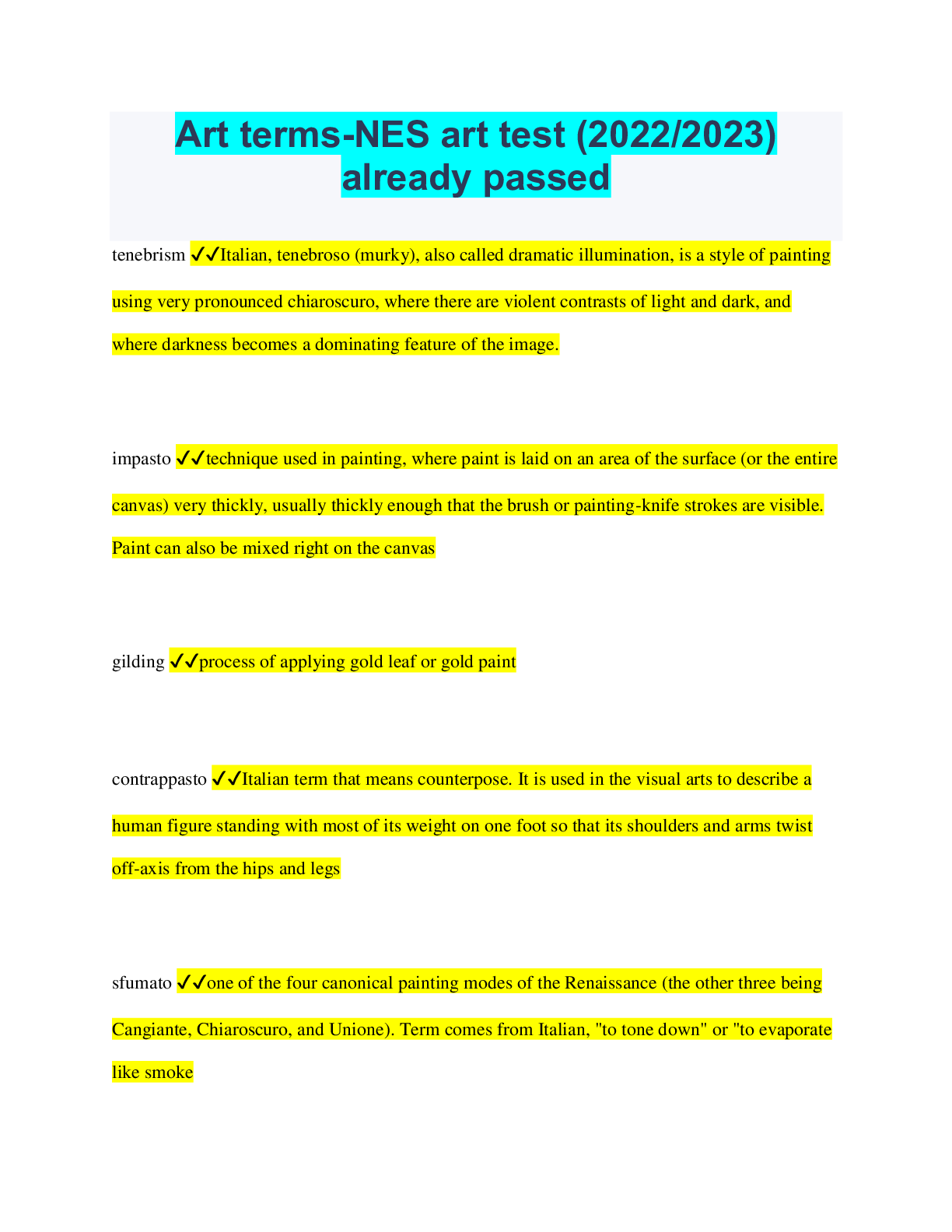
tenebrism ✔✔Italian, tenebroso (murky), also called dramatic illumination, is a style of painting
using very pronounced chiaroscuro, where there are violent contrasts
...
Art terms-NES art test (2022/2023)
already passed
tenebrism ✔✔Italian, tenebroso (murky), also called dramatic illumination, is a style of painting
using very pronounced chiaroscuro, where there are violent contrasts of light and dark, and
where darkness becomes a dominating feature of the image.
impasto ✔✔technique used in painting, where paint is laid on an area of the surface (or the entire
canvas) very thickly, usually thickly enough that the brush or painting-knife strokes are visible.
Paint can also be mixed right on the canvas
gilding ✔✔process of applying gold leaf or gold paint
contrappasto ✔✔Italian term that means counterpose. It is used in the visual arts to describe a
human figure standing with most of its weight on one foot so that its shoulders and arms twist
off-axis from the hips and legs
sfumato ✔✔one of the four canonical painting modes of the Renaissance (the other three being
Cangiante, Chiaroscuro, and Unione). Term comes from Italian, "to tone down" or "to evaporate
like smoke
Chiaroscuro ✔✔an effect of contrasted light and shadow created by light falling unevenly or
from a particular direction on something
Cangiante ✔✔one of the four canonical painting modes of the Renaissance (the other three being
Unione, Chiaroscuro, and Sfumato). The word itself derives from the Italian term ("to change")
Unione ✔✔characterized by its sfumato quality, while still maintaining vibrant color
Hudson River School ✔✔mid-19th century American art movement embodied by a group of
landscape painters whose aesthetic vision was influenced by romanticism. The paintings for
which the movement is named depict the Hudson River Valley and the surrounding area
raffia ✔✔material from an African palm tree with large leaves
Obverse; Reverse ✔✔the front side and back side of coin or medal
Rococo era painters ✔✔Watteau, Fragonard, Gainsborough
David Hockney ✔✔painted scenes of California life
Water ✔✔most common solvent in an art classroom
open composition ✔✔shapes appear to be running off sides of picture plane
Nandaemum ✔✔14th Century project that gave new Korean state an image of dignity and power
Fluxus ✔✔art movement of 60s and 70s characterized by art mixed with social and political
activism
Aegean ✔✔3000-1000BCE
Greek ✔✔1200BCE-0
Roman ✔✔0-500
Medieval ✔✔500-1500
Renaissance ✔✔1400-1600
Baroque ✔✔1600-1800
Neoclassical/Romantic ✔✔1750-1900
Modern ✔✔1850-
Laid Paper ✔✔suitable for sketching with pastel, charcoal and soft pencil, has a pattern of
parallel lines created by the wires of the mould in its production
Textured Pastel, Charcoal and Craft Papers ✔✔Textured paper is good for pastel and charcoal,
as well as expressive larger scale pencil sketching
Wove ✔✔made on a woven wire 'cloth' like a fine sieve, particularly well suited to ink drawing
and realist pencil drawing
Rough grained paper ✔✔bumpy surface, coarse surface makes it difficult to control tone, and
lends itself to simple, broad and expressive gestures in pastel, charcoal or soft pencil, a
traditional favorite of watercolorists, because the tiny pits allow paint to pool in a heavy wash,
while leaving dots of light with a dry brush, so the texture can be used to great effect
Medium paper ✔✔has a fine grain, which can look quite subtle when shading with a sharpened
pencil, or may be accentuated by shading with a blunt pencil or charcoalSmooth - Hot Press ✔✔very smooth, flat surface, allows you to draw very fine detail without
any bumps or texture showing up
Cold press ✔✔has texture, little bumps and grooves hold in the water and pigment, really sucks
up the water pretty quickly, a good choice when you want to convey texture in your subject
Armature ✔✔supports the wet clay, wet plaster or other soft and pliable mixed media materials
used by a sculptor to model or construct a sculpture
Artist's proof ✔✔One of the first proofs in a limited edition of original sculptures. Must bear the
artist's signature or mark, and, since the early 20th century, is usually numbered. On a sculpture
the appropriate mark is A/P.
Assembly ✔✔One of the 4 main methods a sculptor may use to achieve a desired overall form.
Basically constructing or adding existing shapes, objects or materials to one another in a method
other than welding to create a whole sculpture.
Bas relief ✔✔French for low relief. Basso-rilievo in Italian; figures project only slightly and no
part is entirely detached from the background (as in medals and coins, in which the chief effect is
produced by the play of light and shadow)
Base ✔✔Also called plinth, what the sculpture is attached, fixed or mounted on. A block (of any
shape or dimension and material placed between a sculpture and its pedestal).
Bronze ✔✔An alloy of copper and tin, sometimes containing small amounts of other elements in
varying proportions such as zinc and phosphorus. Harder and more durable than brass and used
extensively since antiquity for casting sculpture; alloys vary in colour from silvery hues to rich,
coppery red. In its molten form, it is poured into the main channel or sprue of an investment
casing surrounding a sculpture to produce the final cast piece of artwork.
Callipers ✔✔A device with two moveable jaws used by sculptors to take measurements in the
round while working. Also used when making copies of original work; come in different sizes;
originally only made of wood with brass fittings - but can now also be found in metal or plastic.
Caryatid ✔✔In architectural sculpture, the female figure that serves as a column supporting an
entablature. Usually a graceful figure dressed in long robes. From the Greek. Male counterparts
are Atlantes or Telamones.
Cast ✔✔1. To reproduce an object, such as piece of clay sculpture, by means of a mould (or
mold). Also an artist may choose to do this from life, real objects, or parts of a body or the entire
body. This is often referred to as moulage or life casting. 2. A copy produced by this means. The
original piece is usually of a less durable material
Clay ✔✔1. A native earth consisting mainly of decomposed feldspathic rock (feldspathic:
grouping of crystalline minerals that consist of aluminum silicates with either potassium, sodium,
calcium or barium) containing kaolin and other hydrous aluminous minerals. Becomes hard
when baked or fired. Used wet by the sculptor to build or model the form, often over an armature
of wood or metal: it is then called wet - as compared with what is often called modelling type 2.
Sold under various names such as Plasticine and Plastilina, originally made in Italy with tallow,
sulphur and high-quality clay. Also made less expensively with it, an inert filler and various
petroleum oils and greases heated and thoroughly mixed - can be variously coloured, i.e. made
with graphite oil it is blackish and yellow/green if made with normal car oil
Figurative ✔✔Of or portraying the (human or animal)
Haut relief ✔✔French for high or deep relief. Alto-rilievo in Italian; the figures project at least
half of their natural circumference from the background.
Installation ✔✔A mode of work in which art elements (sculptural or otherwise) are installed in a
location, either responding to the site itself (called site-specific) or not
Marble ✔✔In its entire form, one of the hardest stones to carve; in fact a hard type of limestone
(more or less crystallized by metamorphism), often with streaks. Takes a high polish if desired.
Also one of the most expensive stones and therefore prized. In its powdered form, can be used to
create bonded casts or "faux" as an alternative to plaster as a casting material. Resin can be
loaded with marble powder, as can a cement mix.
Metal ✔✔1. A chemical element that is more or less shiny, can be hammered, welded or
stretched, as iron, gold, aluminum, lead and magnesium. Distinguished from an alloy. In wire or
wire mesh form (of varying dimensions) can also be used to create sculpture. 2. Glass in its
molten state
Model - Modelling (UK) - Modeling (US) ✔✔process whereby a sculptor adds (bit by bit) wet
clay or other soft medium such as wet plaster or cement or other media to build up or construct
his or her original artwork - often using an armature. It is essentially an additive, not a
substractive process as contrasted with carving
Pedestal ✔✔1a. The support or foot of a late classic or neoclassic column. b. The base of an
upright structure. 2. Base, foundation or support for a sculpture.
Relief ✔✔any work that projects from the background; classified by degree of projection;
distinguished from sculpture in the round; may be carved from hard materials or modelled in wet
clay, softened wax, or plaster; often elements of architectural sculpture.
demi relief ✔✔half-relief or mezzo-relievo-relief in between bas relief and haut relief
crushed relief (relievo sticciato or schiacciato). ✔✔lowest degree of relief in which the
projection barely exceeds the thickness of a sheet of paper
hollow relief ✔✔relief in reverse; all the carving lies within a hollowed-out area below the
surface plane, and which, through an illusion of depth and roundness, looks like raised relief;
also called sunk or concave relief (cavo-relievo)
incised relief ✔✔(intaglio-rilievato) are the kind of carving done on gems by the Greeks and
Romans.
Sprue ✔✔In casting, the entrance hole and main channel in the wall of a mould through which
the liquid material (bronze or other metal) is poured; it is joined to the model by smaller channels
called gates. The waste material formed by the channel is also called by the same name and is cut
away after the investment material is removed, as the first step of cleaning up a cast metal
sculpture.
Steel ✔✔Medium used for sculpture, a commercial iron that contains carbon in any amount up to
1.7 percent as an essential alloying constituent, is malleable when under suitable conditions and
is distinghished from cast iron by its malleability and lower carbon content.
Stone ✔✔1. Cut rock, suitable for carving and building. One of the traditional materials of the
sculptor, it has been carved, drilled, and polished since prehistoric times. The most widely
available for sculpture are alabaster, granite, marble, sandstone and limestone. 2. In the
commercial world, any type except marble.
Terra Cotta ✔✔1. Literally "Cooked Earth". Italian for fired or baked clay. The end product of a
fired sculpture. 2. The term is often used for any clay suitable for shaping and firing, except for
the very fine porcelain clays
Welding ✔✔process of joining together two pieces of metal by fusion. Intense heat is applied by
an oxyacetylene torch in gas or oxacetylene torch; . It is done at much higher temperatures than
soldering and results in stronger, more durable joints. It is used in making direct metal sculpture
and comes under the general term of assembly - as opposed to carving and modelling
arc welding. ✔✔process of joining together two pieces of metal by fusion. Intense heat is applied
by electrical means
brazing ✔✔when, in welding, a filler rod is melted along the joint
fusion welding ✔✔The direct welding of two pieces by combining the molten edges
Rough Texture ✔✔Maximum contrast
Emotionally Active
Esthetically dynamic
Spatially in depth
Smooth Texture ✔✔Minimum contrast
Emotionally passive
Aesthetically decorative
Spatially static
Elements of Art ✔✔Line, color, shape, form, texture, value, space
Principles of Design ✔✔Balance, contrast, unity, variety, emphasis, harmony, repetition, rhythm,
pattern, movement
stippling ✔✔to paint, engrave, or draw by means of dots or small touches
foreshortening ✔✔method of rendering a specific object or figure in a picture in depth. The artist
records, in varying degrees, the distortion that is seen by the eye when an object or figure is
viewed at a distance or at an unusual angle
cross-hatching ✔✔to mark with two series of parallel lines that intersect, usually for shading, to
create depth
gesture drawing ✔✔work of art defined by rapid execution. Typical situations involve an artist
drawing a series of poses taken by a model in a short amount of time, often as little as 30
seconds, or as long as 2 minutes
contour drawing ✔✔the line which defines a form or edge - an outline; the place where most
beginners start, following the visible edges of a shape; describes the outermost edges of a form,
as well as dramatic changes of plane within the form
figure drawing ✔✔a drawing of the human form in any of its various shapes and postures using
any of the drawing media
cross-contour technique ✔✔the lines that reflect the movement of your eye in and around what
you see; describe form and volume. These lines can follow planes of form, moving around and
across objects as well as through them.
Think of a topographical map--the lines move across the terrain.
Scumbling / Glazing ✔✔a method of applying very thin layers to the painting. It is effective for
very smooth gradations, and also for adjusting dried layers. It can be used to great advantage to
manipulate the reflective or absorptive light qualities inherent in pigments; transparent painting
techniques
Open Canvas ✔✔starting with a transparent underpainting, and leaving areas of it uncovered
whatever other techniques are used. For example: as with the build-up/ tonal approach above; or
with wet-on-wet brushwork on top; or with scumbling and glazing layers on top. The important
thing: the underpainting itself is a dominant feature; also tends to utilize scumbling and glazing
as a primary application tool, rather than only as an adjustment tool.
Scumbling ✔✔scrubbing on a dryish layer of thick or stiff pigment; tends to stick to the top of
the canvas fibers (and the under-laying color shows through a bit;
has a very reflective effect, and is good for building form and depth by creating the illusion that
the surface is coming toward the viewer; areas are bright from a distance.
Too much of it: surface makes the painting appear flat; opaque; and oxidized.
You can do it any pigment, but the best ones for advancing the surface are the lighter, clay-like
pigments. The light clay-like pigments tend to be brittle and flakey
Glazing ✔✔adding a very transparent tinted wet medium layer; tends to settle in the crevices of
the canvas texture (the top can be wiped off to show the original color, but once it is down, the
texture will alter the color tone of the underlying hue); has a distancing effect, and is good for
building form and depth by creating the illusion that the surface is further away, or receding;
colors are saturated and jewel-like; appear dark from a distance. Too much can make the surface
look like it is under thick glass; or imagine stained glass pile up together; it will look muddy and
brown.
You can do it with any pigment. Some pigments will fade much more than others over time; and
how you layer scumbling and glazing affects the basic physical structure of the painting.
(improper application can result in cracking or flaking)
dark transparent pigments ✔✔sort of slimy or jelly-like and behave like wood stain; have
smaller, rounder molecules which penetrate surfaces more, and don't reflect as much light
bright reflective pigments ✔✔stiff and clay-like and behave more like chalk; have large rough
molecules with many reflective surfaces; layers high in these pigments should always be
alternated with layers of the opposite pigments to bind the dark layers securely together
Stand oil ✔✔kind of flexible binder which helps prevent cracking. Too much medium build-up
will become sticky and may sag over time. Because surface tension is pronounced in outer layers
of paint; medium should be lean in this binder in the bottom layers and richer in top layers. An
easy technique is to add a few drops of it to your medium with every new layer.
bracelet shading ✔✔shading around joints of rounded shapes, like tree limbs
graphite pencil-light grade ✔✔High Number ( highest 9) Letter H
graphite pencil-dark grade ✔✔High Number (9xx) Letter B
graphite pencil-medium grade ✔✔F and HB are right in middle of grades; from 9H being
lightest
2H lighter, H, F, HB, B, 2B darker all the way up to 9xxB
charcoal pencils ✔✔smears easily, use fixative as you go-grades same as graphite-F and HB are
right in middle of grades; from 9H being lightest
2H lighter, H, F, HB, B, 2B darker all the way up to 9xxB
conte crayons ✔✔frequently used on rough paper that holds pigment grains well. They can also
be used on prepared primed canvases for underdrawing for a painting. The sticks' square profile
make them more suitable for detailed hatched work; composed of compressed powdered graphite
or charcoal mixed with a wax or clay base, square in cross-section
Fixative (drawing) ✔✔a liquid usually sprayed over a finished piece of artwork to better
preserve it and prevent smudging
colored pencils ✔✔colored pigment in a wax base
bamboo brushes ✔✔used mainly for writing and detail work. The short handles allow for better
artist control, and the natural hair bristles are suitable for use with ink, washes and watercolors.
relief print ✔✔a process where protruding surface faces of the printing plate or block are inked;
recessed areas are ink free. Printing the image is therefore a relatively simple matter of inking the
face of the matrix and bringing it in firm contact with the paper
intaglio ✔✔the family of printing and printmaking techniques in which the image is incised into
a surface, and the incised line or sunken area holds the ink. It is the direct opposite of a relief
print
Encaustic ✔✔a wax based paint (composed of beeswax, resin and pigment), which is kept
molten on a heated palette. It is applied to an absorbent surface and then reheated in order to fuse
the paint
underpainting ✔✔an initial layer of paint applied to a ground, which serves as a base for
subsequent layers of paint
Sgraffito ✔✔a technique either of wall decor, produced by applying layers of plaster tinted in
contrasting colours to a moistened surface,
or in ceramics, by applying to an unfired ceramic body two successive layers of contrasting slip,
and then in either case scratching so as to produce an outline drawing
alla prima ✔✔(Italian, meaning at first attempt), is a painting technique, used mostly in oil
painting, in which layers of wet paint are applied to previous layers of wet paint
Varnish ✔✔a layer to protect your painting from pollution in the atmosphere and abrasion and
bring out the colors to the brilliance they had when you applied them
Aquatint ✔✔An etching technique that creates areas of tone through the use of powdered resin
that is sprinkled on the etching plate prior to being bitten by the etching acid. The result is a
finely textured tonal area whose darkness is determined by how long the plate is bitten by the
acid.
Chromolithograph ✔✔A color lithograph usually involving a large number of lithographic
stones to allow a complex color separation. The term is often used to describe late 19th century
color lithographs that emulate or reproduce paintings
Drypoint ✔✔Similar to etching, but the lines are simply scratched into the plate manually,
without the use of acid. The hallmark of a drypoint is a soft and often rather thick or bushy line
somewhat like that of an ink pen on moist paper.
Engraving ✔✔A form of intaglio printing in which lines are incised into a metal plate with a
carving tool called a burin. The characteristics of burin differ from that of etching in that ,
requiring considerable force, is done from the strength of the arm and eliminates the quavering
autographic qualities of etching, which is done more from the fingertips like fine drawing. The
hallmarks of are often elegantly swelling and tapering lines
Etching ✔✔A means of incising lines in a metal plate with acid for printing in the intaglio
technique. The plate is first covered with an acid resistant ground through which the artist
scratches a design with a stylus or needle, revealing the bare metal below. This plate is then
immersed in an acid bath that cuts the incised lines into the plate. These lines often betray the
subtle motions of the artist's fingertips
Lino Cut ✔✔A relief print carved into linoleum rather than wood.
Lithograph ✔✔A printing technique in which the image is drawn on a very flat slab of limestone
(or a specially treated metal plate). This stone is treated chemically so that ink, when rolled on to
the stone, adheres only where the drawing was done. This inked image can then be transferred to
a piece of paper with the help of a high pressure press
Metal Cut ✔✔A form of relief printing from an intaglio plate. In the 15th century, these often
employed drill holes that printed as white dots. Engraved lines will print white rather than black
in this type since the surface, rather than the marks in the plate, is inked
Mezzotint ✔✔An intaglio process invented around 1650 that allows the printing of rich tonal
areas of black and grey. The process begins by texturing a metal plate in such a way that it will
hold a great deal of ink and print a solid black field. This is done with a tool called a "rocker." A
rocker is essentially a large curved blade with very fine teeth along its edge. This blade is rocked
back and forth, putting courses of fine dots into the metal plate. After this has been done
repeatedly the plate will be covered with fine stipples that can hold ink. The next step is to scrape
away the stippled texture where lighter passages are needed. The more vigorously the plate is
scraped the less ink it will hold and the whiter it will print. Mezzotint differs conceptually from
other intaglio methods because the artist works from black to white rather than white to black.
For this reason, it lends itself to scenes with many dark passages
Monotype ✔✔A form of printmaking in which the artist draws or paints on some material, such
as glass, and then prints the image onto paper, usually with a press. The remaining pigment can
then be reworked, but the subsequent print will not be an exact version of the previous print.
They may be unique prints or variations on a theme
Proofs ✔✔Impressions of a print.
Relief print ✔✔Any print in which the image is printed from the raised portions of a carved,
etched, or cast block. A simple example would be a rubber stamp. The most common are
woodcuts. The term is used when it is not clear which kind of relief printing has been used
(photomechanical or hand carved, for example)
Screen Print ✔✔A form of stencil printing in which the stencil is adhered to a fine screen for
support. Ink can be squeegeed through the screen onto paper- can have a hard edged quality
caused by the crisp edges of the stencil. Also referred to as serigraphy.
serigraphy ✔✔screen printing/silkscreening
Silver print ✔✔A photographic print utilizing paper impregnated with silver nitrate (distinct
from a platinum print, for example)
Soft ground ✔✔An etching technique in which the plate is covered with malleable ground
through which a variety textures can be pressed, allowing them to be etched into the plate. For
example, a piece of paper laid on top of this kind of plate can be drawn upon with a pencil, and
the resulting etched image will resemble a pencil line drawn on paper.
Sulphur ground ✔✔A technique in which a caustic sulphur compound is painted directly on an
etching plate, or in which sulphur dust is otherwise applied to a plate. The resulting marks will
hold ink and can be printed like an etching. The technique typically creates blotchy expanses of
grey tones. This might be compared to printing rust marks on a steel or iron plate
Wood engraving ✔✔A relief print carved in the end grain of a block of wood whose thickness is
the same as the height as a piece of movable type ("type high"). This was traditionally a
commercial technique practiced by specialists and used in magazines and book illustrations
Woodcut ✔✔A relief print usually carved in the plank grain of a piece of wood. After the relief
image has been carved in the plank with knives or gouges it is inked with a dauber or roller. It
can then be printed by hand (in which case a sheet of paper is laid down on the inked plank and
rubbed from the back with a smooth surface such as the palm of the hand or a wooden spoon) or
with the help of a mechanical press.
Zincograph ✔✔A lithograph done on a zinc plate instead of on a stone. The term is also used to
designate a photo-etched relief print
Stencilling ✔✔produces an image or pattern by applying pigment to a surface over an
intermediate object with designed gaps in it which create the pattern or image by only allowing
the pigment to reach some parts of the surface.
Pulling prints ✔✔When you lift the sheet of paper from the print plate or block, revealing the
print you've created; process includes the inking of the plate or block, putting it through a press
(or burnishing on the back with a brayer or spoon), and then separating the sheet of paper from
the inked block to reveal the print
rasp ✔✔a tool used for shaping wood or other material. It consists of a point or the tip, then a
long steel bar or the belly, then the heel or bottom, then the tang. The tang is joined to a handle,
usually made of plastic or wood. The bar has sharp teeth. These generally cut more coarsely than
files.
gouge ✔✔a metal tool with a curved, sharp end that is used to cut and shape wood
earthworks ✔✔land art; an art movement in which landscape and the work of art are inextricably
linked. It is also an art form that is created in nature, using natural materials such as soil, rock
(bed rock, boulders, stones), organic media (logs, branches, leaves), and water with introduced
materials such as concrete, metal, asphalt, or mineral pigments. Sculptures are not placed in the
landscape, rather, the landscape is the means of their creation
Sandpaper grit ✔✔The higher the number, the coarser the grit
assemblage ✔✔a work of art made by grouping found or unrelated objects-Forms of modern
sculpture and painting utilizing readymades, found objects, and pasted fragments to form an
abstract composition. Louise Nevelson's boxlike enclosures, each with its own composition of
objects, illustrate the style in sculpture. Pablo Picasso developed the technique of cutting and
pasting natural or manufactured materials to a painted or unpainted surface.
dodging ✔✔decreases the exposure for areas of the print that the photographer wishes to be
lighter
aperture ✔✔The hole in a camera that lets light in-Basically, large (f/2.0, f/2.8 etc.) lets in more
light to the camera shutter for an exposure, while small (f/11, f/16, f/22 etc.) has a smaller
opening in the lens diaphragm to let in LESS light for a given exposure
shutter speed ✔✔Length of time of exposure to light. Slow, combined with panning the camera
can achieve a motion blur for moving objects. In photography, exposure time is the length of
time a camera's "doors" are open when taking a photograph. The amount of light that reaches the
film or image sensor is proportional to the exposure time
ISO ✔✔the level of sensitivity of your camera to available light. The lower the number, the less
sensitive it is to the light, while a higher number increases the sensitivity of your camera. The
component within your camera that can change sensitivity is called "image sensor" or simply
"sensor". It is the most important (and most expensive) part of a camera and it is responsible for
gathering light and transforming it into an image. With increased sensitivity, your camera sensor
can capture images in low-light environments without having to use a flash. But higher
sensitivity comes at an expense - it adds grain or "noise" to the pictures
burning ✔✔increases the exposure to areas of the print that should be darker
Polarizing Filter ✔✔Filters out glares, dramatically reducing reflections, enhancing colors and
increasing contrast. Can be used for any type of photography. These filters are typically circular,
allowing for easy control of the effect of polarization
infrared filters. ✔✔block infrared and pass visible light
bokeh filters ✔✔have a certain shape cut in the middle of the filter that makes highlights have
the same shape, etc
multivision filters ✔✔create multiple copies of a subject
Star filters ✔✔make bright objects look star-like;
color warming/cooler filter ✔✔Corrects colors, resulting in a change in camera white balance.
Some color filters can subtract colors, blocking one type of color and allowing other colors
through. These types of filters were popular for film. They are rarely used in digital photography,
since their effects can be easily applied in post-processing
softening/diffusion filters ✔✔create a "dreamy" look used for portraits
close-up filter ✔✔Also known as "diopter"; allows a lens to focus closer on subjects. These
filters are only used for macro photography
Reverse Graduated Neutral Density (GND) Filter ✔✔a specialized filter used by landscape
photographers when shooting against the sun while it is setting close to the horizon. While a
regular filter gradually transitions from dark to clear towards the center, this filter transitions
from dark to less dark from the center to the edge
Soft-Edge Graduated Neutral Density (GND) Filte ✔✔used in high contrast situations, but where
the horizon is not necessarily flat; allows for smoother transitions, making the use of a filter less
evident; also rectangular and are normally used with filter holders
Hard-Edge Graduated Neutral Density (GND) Filter ✔✔primarily used in high contrast
situations, where the sky is much brighter than the foreground and the horizon is flat. These
filters are always rectangular (giving the ability to move them in all directions) and are typically
used with filter holders-used in landscape photography
Neutral Density (ND) Filter ✔✔Reduces the amount of light entering the lens, thus decreasing
camera shutter speed. Useful for situations where motion blur needs to be created (rivers,
waterfalls, moving people) or large apertures must be used with flash to avoid overexposurelandscape and flash photography
UV/Clear/Haze Filter ✔✔Protects the front element of a lens from dust, dirt, moisture and
potential scratches. High quality filters can be permanently mounted on lenses with a minimum
impact on image quality
sharpening (photography) ✔✔makes your subjects POP; make edges appear more defined by
darkening the darker pixels and brightening the brighter pixels. This creates a crisp edge between
light and dark portions of the image, giving it more contrast
bokeh ✔✔blur or haze effect in photography
spotting ✔✔a type of retouching concerned with correcting minor flaws in the finished print with
specially made paints, dyes, pencils and pens
Kaolin Clays ✔✔Due to their mineral purity,these clays are used for porcelain. Although they do
have some range in color, they are all very light in color. While moist, they will be light grey and
will fire in the range between a very light grey or buff, to near-white and white; not nearly as
plastic as other clays and are difficult to work with. Pure types fire to maturity at about 3272°F
(1800°C). They are often mixed with other clays to both increase workability and lower the
firing temperature. Many porcelain bodies are a mixture of this and ball clays
Ball Clays ✔✔highly plastic and contain few mineral impurities. They fire to their mature
hardness at about 2336°F (1300°C). When moist they are dark grey and when fired they are
either light grey or light buff; do have a serious drawback- They cannot be used by themselves
due to their excessive shrinkage during drying and firing. They are extremely useful, however,
when added to other clays to increase workability and plasticity.
Stoneware clays ✔✔plastic and are often grey when moist. Their fired colors range through light
grey and buff, to medium grey and brown. Fired colors are greatly affected by the type of firing
Earthenware clays ✔✔some of the earliest clays used by potters, and it is the most common type
of clay found. These clays are highly plastic (easily worked) and can be sticky. Earthenware
clays contain iron and other mineral impurities which cause the clay to reach its optimum
hardness at between 1745°F and 2012°F (950°C and 1100°C).
Typical colors are red, orange, yellow, and light gray. Colors for fired include brown, red,
orange, buff, medium grey, and white. Fired colors are in large part determined by the content of
mineral impurities and the type of firing.
Raku ware ✔✔a type of Japanese Pottery that is traditionally used in the Japanese Tea
Ceremony, most often in the form of tea bowls.
batik ✔✔Indonesian- a technique of wax-resist dyeing applied to whole cloth, or cloth made
using this technique.
Shedding ✔✔where the ends are separated by raising or lowering heald frames (heddles) to form
a clear space where the pick can pass
Picking ✔✔where the weft or pick is propelled across the loom by hand, an air-jet, a rapier or a
shuttle.
Beating-up or battening ✔✔where the weft is pushed up against the fell of the cloth by the reed.
warp ✔✔the set of lengthwise yarns that are held in tension on a frame or loom. The yarn that is
inserted over-and-under the warp threads is called the weft, woof, or filler. Each individual warp
thread in a fabric is called a warp end or end-up & down/vertical
weft ✔✔the crosswise threads on a loom over and under which other threads (the warp) are
passed to make cloth. Across/horizontal
Wedging ✔✔A procedure for preparing clay or a clay body by hand: the lump of clay is
repeatedly thrown down on a work bench; between each operation the lump is turned and
sometimes cut through and rejoined in a different orientation. The object is to disperse the water
more uniformly, to remove lamination and to remove air
applique ✔✔a needlework technique in which patterns or representational scenes are created by
the attachment of smaller pieces of fabric to a larger piece of contrasting colour or texture
oxidation ✔✔Volatile portions of compounds and molecules break free and the free oxygen then
can attach to the remaining material.
In firing a pottery kiln, the materials will normally convert to their forms. For example, when
copper carbonate is fired, the carbon will detach and burn off. As soon as the copper-carbon
bond is broken, available oxygen will rush in and attach to the copper, forming copper oxide.
back stitch ✔✔outlines
Abstract Expressionism ✔✔American art movement of the 1940s that emphasized form and
color within a nonrepresentational framework.
Jackson Pollock ✔✔initiated the revolutionary technique of splattering the paint directly on
canvas to achieve the subconscious interpretation of the artist's inner vision of reality.
blanket stitch ✔✔loose buttonhole stitch-sewing on applique
Art Deco ✔✔Art Deco
A 1920s style characterized by setbacks, zigzag forms, and the use of chrome and plastic
ornamentation. New York's Chrysler Building is an architectural example of the style.
Art Nouveau ✔✔An 1890s style in architecture, graphic arts, and interior decoration
characterized by writhing forms, curving lines, and asymmetrical organization. Some critics
regard the style as the first stage of modern architecture.
Ashcan School ✔✔A group of New York realist artists at the beginning of the twentieth century
who rejected the formal subject matter of the academy and focused on gritty urban scenes and
ordinary, even ugly, aspects of life.
Barbizon School ✔✔(Landscape Painting) A group of 19th-century French painters who rejected
idealized landscape painting and sought a more informal, realistic portrayal of nature. They were
heavily influenced by 17th-century Dutch genre painting. Theodore Rousseau, one of the
principal figures of the group, was a proponent of outdoor painting, based on direct observation
of one's surroundings-REALISM
Baroque ✔✔European art and architecture of the 17th and 18th centuries. Giovanni Bernini, a
major exponent of the style, believed in the union of the arts of architecture, painting, and
sculpture to overwhelm the spectator with ornate and highly dramatized themes. Although the
style originated in Rome as the instrument of the Church, it spread throughout Europe in such
monumental creations as the Palace of Versailles
Black or African-American Art ✔✔The work of American artists of African descent produced in
various styles characterized by a mood of protest and a search for identity and historical roots.
Beaux Arts ✔✔Elaborate and formal architectural style characterized by symmetry and an
abundance of sculptured ornamentation. New York's old Custom House at Bowling Green is an
example of the style.
Constructivism ✔✔A form of sculpture using wood, metal, glass, and modern industrial
materials expressing the technological society. The mobiles of Alexander Calder are examples of
the movement.
Classicism ✔✔A form of art derived from the study of Greek and Roman styles characterized by
harmony, balance, and serenity.
Cubism ✔✔Early 20th-century French movement marked by a revolutionary departure from
representational art. Pablo Picasso and Georges Bracque penetrated the surface of objects,
stressing basic abstract geometric forms that presented the object from many angles
simultaneously.
Dada ✔✔A product of the turbulent and cynical post-World War I period, this anti-art movement
extolled the irrational, the absurd, the nihilistic, and the nonsensical. The reproduction of Mona
Lisa adorned with a mustache is a famous example. The movement is regarded as a precursor of
Surrealism. Some critics regard HAPPENINGS as a recent development of Dada. This
movement incorporates environment and spectators as active and important ingredients in the
production of random events.
Theodore Rousseau ✔✔one of the principal figures of the Barbizon School, was a proponent of
outdoor painting, based on direct observation of one's surroundings
running stitch ✔✔outlines
Giovanni Bernini ✔✔a major exponent of the Baroque style, believed in the union of the arts of
architecture, painting, and sculpture to overwhelm the spectator with ornate and highly
dramatized themes.
Romantic Movement ✔✔gave free rein to the artist's imagination and to the love of the exotic
HAPPENINGS ✔✔Some critics believe it is a recent development of Dada. This movement
incorporates environment and spectators as active and important ingredients in the production of
random events.
satin stitch ✔✔fill-in, like monograms
Expressionism ✔✔A 20th-century European art movement that stresses the expression of
emotion and the inner vision of the artist rather than the exact representation of nature. Distorted
lines and shapes and exaggerated colors are used for emotional impact. Vincent Van Gogh is
regarded as the precursor of this movement.
Futurism ✔✔This early 20th-century movement originating in Italy glorified the machine age
and attempted to represent machines and figures in motion. The aesthetics of Futurism affirmed
the beauty of technological society.
Fauvism ✔✔The name "wild beasts" was given to the group of early 20th-century French
painters because their work was characterized by distortion and violent colors. Henri Matisse and
Georges Rouault were leaders of this group.
Impressionism ✔✔Late 19th-century French school dedicated to defining transitory visual
impressions painted directly from nature, with light and color of primary importance. If the
atmosphere changed, a totally different picture would emerge. It was not the object or event that
counted but the visual impression as caught at a certain time of day under a certain light. Claude
Monet and Camille Pissarro were leaders of the movement.
Genre ✔✔This French word meaning "type" now refers to paintings that depict scenes of
everyday life without any attempt at idealization. These types of paintings can be found in all
ages, but the Dutch productions of peasant and tavern scenes are typical.
Mannerism ✔✔A mid-16th-century movement, Italian in origin, although El Greco was a major
practitioner of the style. The human figure, distorted and elongated, was the most frequent
subject.
Neoclassicism ✔✔An 18th-century reaction to the excesses of Baroque and Rococo, this
European art movement tried to recreate the art of Greece and Rome by imitating the ancient
classics both in style and subject matter
Neoimpressionism ✔✔A school of painting associated with George Seurat and his followers in
late 19th-century France that sought to make Impressionism more precise and formal. They
employed a technique of juxtaposing dots of primary colors to achieve brighter secondary colors,
with the mixture left to the eye to complete (pointillism).
Pop Art ✔✔In this return to representational art, the artist returns to the world of tangible objects
in a reaction against abstraction. Materials are drawn from the everyday world of popular
culture—comic strips, canned goods, and science fiction.
Op Art ✔✔The 1960s movement is characterized by geometrical forms that create an optical
illusion in which the eye is required to blend the colors at a certain distance.
Realism ✔✔A development in mid-19th-century France lead by Gustave Courbet. Its aim was to
depict the customs, ideas, and appearances of the time using scenes from everyday life.
Rococo ✔✔A French style of interior decoration developed during the reign of Louis XV
consisting mainly of asymmetrical arrangements of curves in paneling, porcelain, and gold and
silver objects. The characteristics of ornate curves, prettiness, and gaiety can also be found in the
painting and sculpture of the period.
Surrealism ✔✔A further development of Collage, Cubism, and Dada, this 20th-century
movement stresses the weird, the fantastic, and the dreamworld of the subconscious.
Symbolism ✔✔part of a general European movement in the latter part of the 19th century,
marked a turning away from painting by observation to transforming fact into a representation of
inner experience. Gauguin was an early practitioner.
Hagia Sophia ✔✔a former Greek Orthodox patriarchal basilica (church), later an imperial
mosque, and now a museum (Ayasofya Müzesi) in Istanbul, Turkey. From the date of its
construction in 537 until 1453, it served as an Eastern Orthodox cathedral and seat of the
Patriarchate of Constantinople, except between 1204 and 1261, when it was converted to a
Roman Catholic cathedral under the Latin Empire. The building was a mosque from 29 May
1453 until 1931. It was then secularized and opened as a museum on 1 February 1935
The Parthenon ✔✔a former temple on the Athenian Acropolis, Greece, dedicated to the goddess
Athena, whom the people of Athens considered their patron. Construction began in 447 BC when
the Athenian Empire was at the height of its power. It was completed in 438 BC although
decoration of the building continued until 432 BC. It is the most important surviving building of
Classical Greece, generally considered the zenith of the Doric order. Its decorative sculptures are
considered some of the high points of Greek art
The Pantheon ✔✔a building in Rome, Italy, commissioned by Marcus Agrippa during the reign
of Augustus (27 BC - 14 AD) and rebuilt by the emperor Hadrian about 126 AD.[2]
The building is circular with a portico of large granite Corinthian columns (eight in the first rank
and two groups of four behind) under a pediment. A rectangular vestibule links the porch to the
rotunda, which is under a coffered concrete dome, with a central opening (oculus) to the sky.
Almost two thousand years after it was built, its dome is still the world's largest unreinforced
concrete dome.[3] The height to the oculus and the diameter of the interior circle are the same,
43.3 metres (142 ft).[4]
Frank Lloyd Wright ✔✔an American architect, interior designer, writer, and educator, who
designed more than 1,000 structures, 532 of which were completed. Wright believed in designing
structures that were in harmony with humanity and its environment, a philosophy he called
organic architecture.
peristyle ✔✔colonade surrounding the cella and porches (Greek)
pediment ✔✔triangular region under temple roof
oculus ✔✔open hole at the top of a dome
basilica ✔✔civic hall, court of law in ancient Rome
lunette ✔✔semicircular boundary for painting
nave ✔✔large, central area in cathedral
clerestory ✔✔highest level of a cathedral with windows
apse ✔✔large niche facing the nave of a church
altar ✔✔structure on which offerings are made in worship, usu. on east side of a church
arcade ✔✔second level of a cathedral with open arches
pendentives ✔✔spherical triangles that form a circle to support a dome on a square base
flying buttress ✔✔arched bridge that reaches upward between the clerestory windows to support
outward thrusting of nave
groin vault ✔✔produced by the intersection at right angles of two barrel vaults
barrell vault ✔✔effectively a series of arches placed side by side, i.e., one after another; an
architectural element formed by the extrusion of a single curve (or pair of curves, in the case of a
pointed barrel vault) along a given distance
stele ✔✔a stone or wooden slab, generally taller than it is wide, erected as a monument, very
often for funerary or commemorative purposes
metope ✔✔rectangular architectural element that fills the space between two triglyphs in a Doric
frieze, which is a decorative band of alternating triglyphs and metopes above the architrave of a
building of the Doric order.
frieze ✔✔1. A plain or decorated horizontal part of an entablature between the architrave and
cornice.
2. A decorative horizontal band, as along the upper part of a wall in a room.
metamerism ✔✔when colors change in different light
pre-raphaelites ✔✔The nineteenth century encompassed a number of movements in art. The
group of artists of this period who had a mutual distaste for contemporary academic painting and
intended to reform art by rejecting this approach by returning to the abundant detail, intense
colors, and complex compositions of Quattrocento Italian and Flemish art
observation ✔✔The basis of Northern Renaissance art
stupa ✔✔a mound-like or hemispherical structure containing Buddhist relics, typically the ashes
of Buddhist monks, used by Buddhists as a place of meditation
fat over lean ✔✔a mound-like or hemispherical structure containing Buddhist relics, typically
the ashes of Buddhist monks, used by Buddhists as a place of meditation
gesso ✔✔a traditional mix of an animal glue binder (usually rabbit-skin glue), chalk, and white
pigment, used to coat rigid surfaces such as wooden painting panels as an absorbent primer coat
substrate for painting.
gouache ✔✔is a type of opaque watercolor paint in which the pigment is suspended in wate
[Show More]

.png)
.png)

 (1).png)
 6th Edition By Deanna D.png)