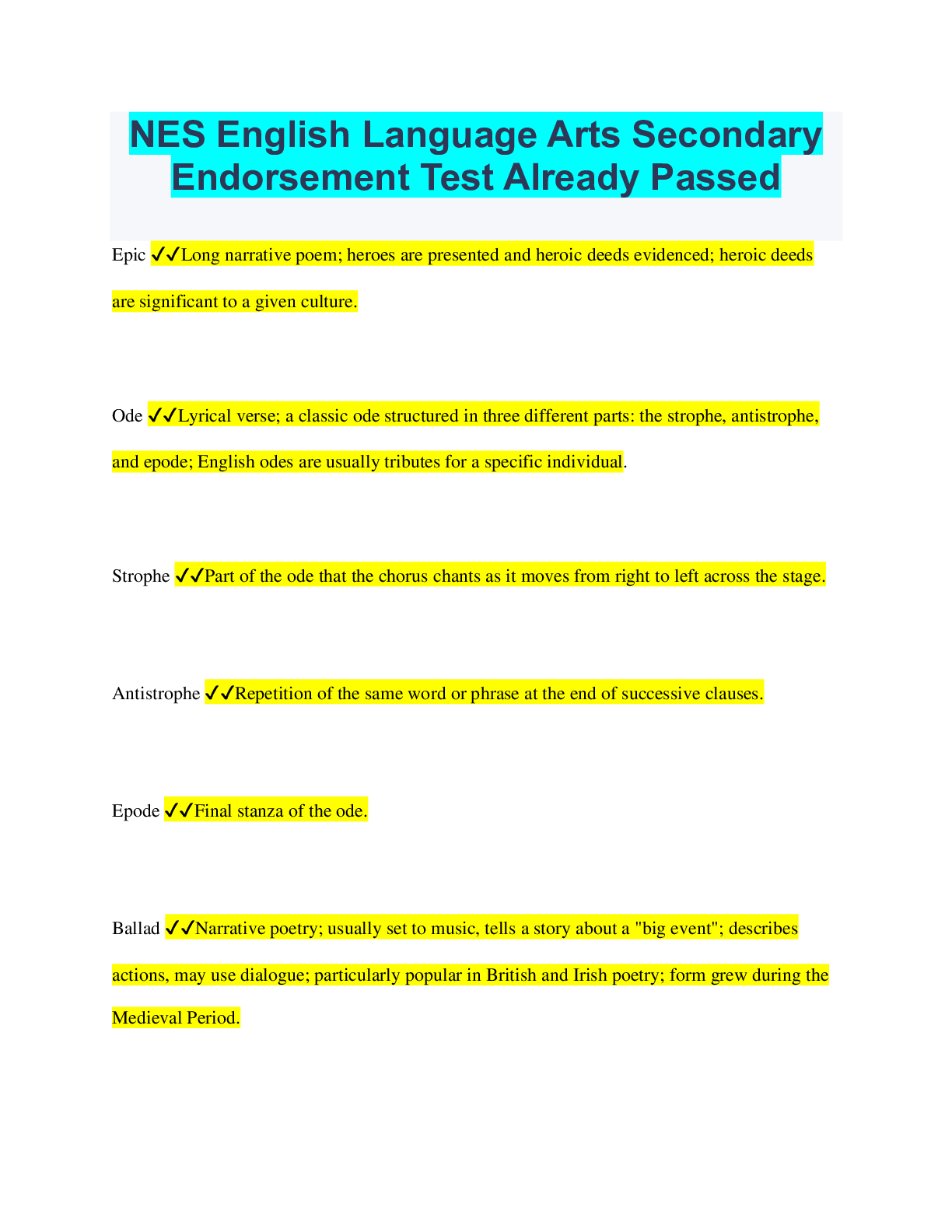
NES English Language Arts Secondary
Endorsement Test Already Passed
Epic ✔✔Long narrative poem; heroes are presented and heroic deeds evidenced; heroic deeds
are significant to a given culture.
Ode ✔✔Lyrical verse; a
...
NES English Language Arts Secondary
Endorsement Test Already Passed
Epic ✔✔Long narrative poem; heroes are presented and heroic deeds evidenced; heroic deeds
are significant to a given culture.
Ode ✔✔Lyrical verse; a classic ode structured in three different parts: the strophe, antistrophe,
and epode; English odes are usually tributes for a specific individual.
Strophe ✔✔Part of the ode that the chorus chants as it moves from right to left across the stage.
Antistrophe ✔✔Repetition of the same word or phrase at the end of successive clauses.
Epode ✔✔Final stanza of the ode.
Ballad ✔✔Narrative poetry; usually set to music, tells a story about a "big event"; describes
actions, may use dialogue; particularly popular in British and Irish poetry; form grew during the
Medieval Period.
Villanelle ✔✔French verse form; modeled after lyrical form used by medieval troubadours;
fixed form: 19 lines long consisting of 5 tercets and one concluding quatrain.
Tercet ✔✔3 line stanza.
Quatrain ✔✔4 line stanza.
Haiku ✔✔Japanese poetic form; consists of 3 unrhymed lines of 17 syllables in the following
pattern: 5, 7, 5.
Tanka ✔✔Japanese poetic form; consists of 5 unrhymed lines; the syllabic count for each line is:
5, 7, 5, 7, 7.
Petrarchan Sonnet ✔✔Also referred to as an Italian sonnet; first developed by Francesco
Petrarch; the 14 line poem is often dedicated to a lady or unrequited love; the poem is divided
into an octave and a sestet. The octave usually poses a question or problem and the sestet usually
provides a solution to the problem. The transition between the octave and sestet is called the
Volta or turn.
Octave ✔✔8 line stanza.
Sestet ✔✔6 line stanza.
Shakespearean Sonnet ✔✔English poetic form attributed to William Shakespeare; consists of
three 4 line stanzas (quatrains) and one concluding couplet; themes include love, time, beauty,
and morality; usually written in iambic pentameter.
Couplet ✔✔A pair of rhymed lines that may or may not constitute a separate stanza in a poem.
Iambic pentameter ✔✔a line of poetry that is ten syllables long and contains five metrical feet,
each foot consisting of one unstressed syllable followed by one stressed syllable.
Elegy ✔✔Sustained and formal poem setting forth the poets meditations upon death or another
solemn theme; often occasioned by the death of a particular person.
Imagery ✔✔Descriptive language that evokes a sensory experience. "She walks in Beauty like
the Night"
Symbolism ✔✔Use of a person, object, event, action, or image to represent an idea. (The Scarlet
A in Hawthorne's Scarlet Letter)
Allusion ✔✔A figure of speech that makes use of reference to a historical or literary figure,
event, or object.
Paradox ✔✔A statement, which while seemingly contradictory or absurd, may be well founded
or true.
Irony ✔✔A feeling, tone, mood, or attitude arising from an awareness that what is reality is
opposite from, and usually worse than, what it seems. Most common forms: Dramatic Irony,
Verbal Irony, and Situational Irony.
Apostrophe ✔✔A figure of speech in which a person is addressed as though present, or an
abstract quality or nonhuman entity is addressed.
Hyperbole ✔✔An extreme exaggeration.
Metaphor ✔✔A figure of speech in which two things, usually thought to be dissimilar, are
treated as if they were alike and have characteristics in common.
Metonymy ✔✔A figure of speech in which the name of one thing is substituted for that of
something closely associated with it.
Extended Metaphor ✔✔A comparison that is extended throughout the entire literary work.
Personification ✔✔Giving human qualities to a nonhuman entity
Simile ✔✔A comparison between two unlike things using like, as, or than.
Synecdoche ✔✔A special kind of metonymy in which a part of something is substituted for the
whole of which it is part, as in the commonly used phrase "lend me your ears".
Point of View ✔✔The perspective from which a poem is told.
Tone ✔✔The attitude towards the subject or audience.
Voice ✔✔The personality of the author, expressed through word choice, syntax, rhythm, and
other elements of style.
Mood ✔✔The overall emotional feeling or atmosphere of a poem experienced by the listener or
reader.
Foot ✔✔A group of syllables forming a metric unit.
Meter ✔✔The pattern of stressed and unstressed syllables in verse.
Free Verse ✔✔A form of poetry based on the irregular rhythmic cadence of the recurrence
phrases, images, and patterns. Rhyme may or may not be present but when it is, it is used with
great freedom.
Alliteration ✔✔Repetition of constant sounds, usually at the beginnings of words.
Onomatopoeia ✔✔A word that imitates a sound. (Boom, Whoosh)
Assonance ✔✔Repetition of similar vowel sounds in stressed syllable.
Consonance ✔✔Repetition of identical consonant sounds before and after different vowels.
Diction ✔✔Choice of words.
Stream of Consciousness ✔✔A style of writing in which the author tries to reproduce the
random flow of thoughts in the human mind.
Expository Writing ✔✔The kind of writing that explains a subject or provides information.
Cause and Effect ✔✔Explains why something happened. It also explores why certain conditions
exist or what may have resulted from an action or a condition. At the end of World War II, the
rise of Russia, or the Soviet Union, resulted in the Cold War. A cause-and-effect expository
writing would address the conditions created as a result of this historical event.
Functional/Technical Writing ✔✔Explains how something works, how it is defined, and how it
defines its component parts and usage. An example might be a discussion of a specific kind of
technology, its common usage, how and why it works, and how users can expect to benefit from
use.
Problem/Solution Writing ✔✔States a problem, examines the problem and presents a solution to
that problem. For example, naturalist Rachel Carson in her book, Silent Spring, documents the
devastating effects of DDT, a common pesticide used in the 50s. Carson's text launches public
concern for the environment and prompts legislation to ban the use of DDT.
Editorial ✔✔An article in a newspaper or magazine expressing the opinion of the editor or
publisher.
Audience ✔✔One's listener or readership; those to whom a speech or piece of writing is
addressed.
Affixes ✔✔morphemes (meaningful parts of words) that are attached to a root or base word. The
English language has two kinds of affixes: prefixes and suffixes.
Prefixes ✔✔a morpheme that precedes the root or base part of the word. Prefixes modify or
change the meaning of the root or base word. Pre, dis, etc.
Suffixes ✔✔alter the ends of words and fall in two categories; inflectional and derivational.
Noun ✔✔A person, place, thing, or idea
Verb ✔✔A word that expresses action, a state of being or feeling, or a relation between two
things.
Adverb ✔✔A word that describes a verb, an adjective, or another adverb.
Adjective ✔✔A word that describes a noun.
Idiom ✔✔A group of words established by usage as having a meaning not deducible from those
of the individual words.
Delimiter Comma ✔✔Used to set apart elements in a sentence.
Separator Comma ✔✔Used to separate three or more elements in a series.
Pronoun ✔✔A word that takes the place of a noun.
Subject Pronouns ✔✔I, you, he, she, me, it, we, they... is, are, was, were, am, will be...
Object Pronouns ✔✔me, you, him, her, it, us, them...
Present progressive tense ✔✔Present progressive tense describes an ongoing action that is
happening at the same time the statement is written. This tense is formed by using am/is/are with
the verb form ending in -ing.
Past progressive tense ✔✔Past progressive tense describes a past action which was happening
when another action occurred. This tense is formed by using was/were with the verb form ending
in -ing.
Future progressive tense ✔✔Future progressive tense describes an ongoing or continuous action
that will take place in the future. This tense is formed by using will be or shall be with the verb
form ending in -ing.
Present perfect tense ✔✔Present perfect tense describes an action that happened at an indefinite
time in the past or that began in the past and continues in the present. This tense is formed by
using has/have with the past participle of the verb. Most past participles end in -ed. Irregular
verbs have special past participles that must be memorized.
Past perfect tense ✔✔Past perfect tense describes an action that took place in the past before
another past action. This tense is formed by using had with the past participle of the verb.
Future perfect tense ✔✔Future perfect tense describes an action that will occur in the future
before some other action. This tense is formed by using will have with the past participle of the
verb.
Dangling Modifier ✔✔An introductory phrase that does not refer clearly or logically to a
subsequent modifier (usually the subject) in a sentence.
Misplaced Modifier ✔✔A modifier that is not placed near the word it modifies.
[Show More]


 (1).png)



.png)