ACLS Questions and Answers Rated A
Recommended time window after symptom onset for early fibrinolytic therapy or PCI with
STEMI ✔✔12 HOURS
Goal for PCI with symptomatic ischemia in STEMI ✔✔
When to administer first d
...
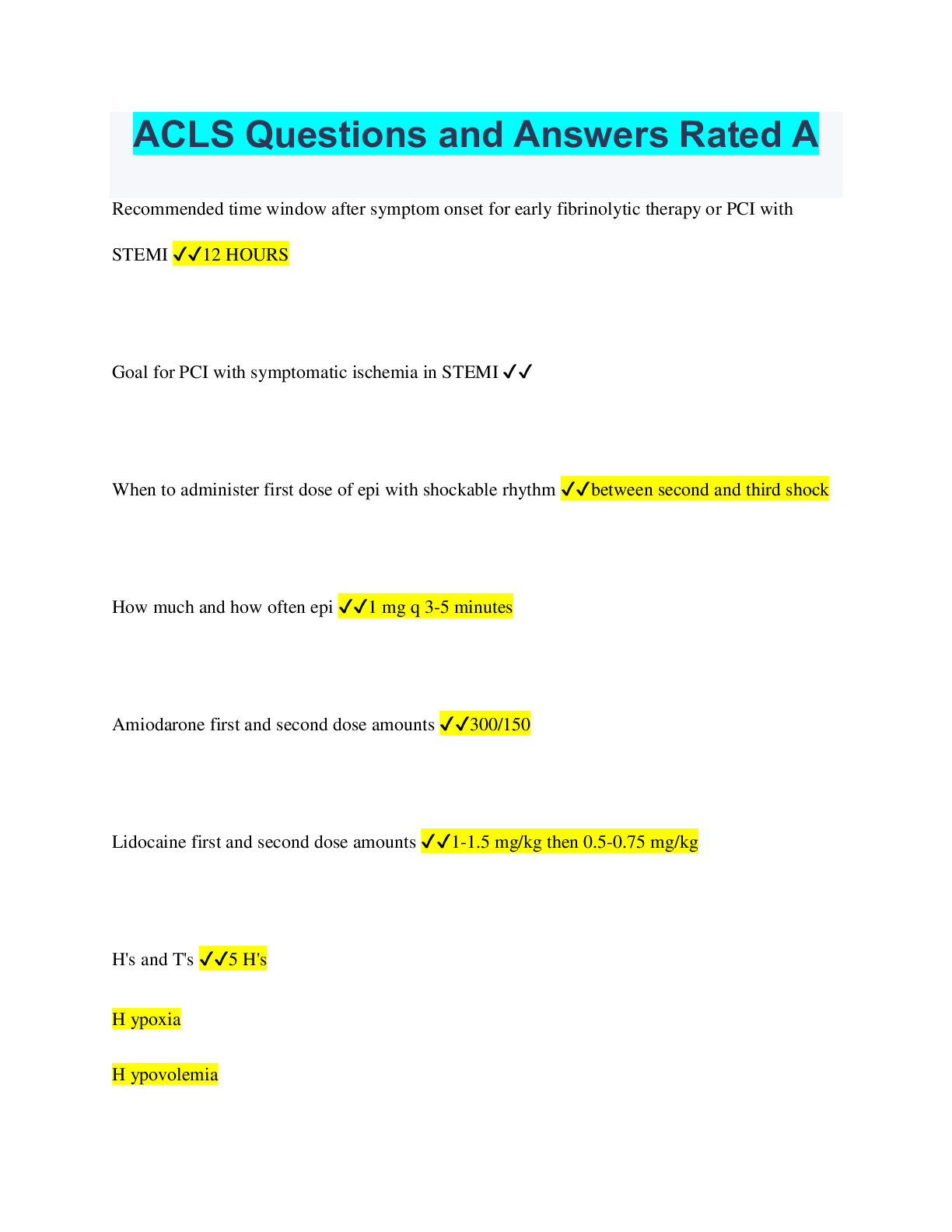
ACLS Questions and Answers Rated A
Recommended time window after symptom onset for early fibrinolytic therapy or PCI with
STEMI ✔✔12 HOURS
Goal for PCI with symptomatic ischemia in STEMI ✔✔
When to administer first dose of epi with shockable rhythm ✔✔between second and third shock
How much and how often epi ✔✔1 mg q 3-5 minutes
Amiodarone first and second dose amounts ✔✔300/150
Lidocaine first and second dose amounts ✔✔1-1.5 mg/kg then 0.5-0.75 mg/kg
H's and T's ✔✔5 H's
H ypoxia
H ypovolemia
H ydrogen ion (acidosis)
H ypo / H yper kalemia
H ypothermia
5 T's
T ension pneumothorax
T amponade
T oxins
T hrombosis (pulmonary)
T hrombosis (coronary)
Two most common underlying causes of PEA ✔✔hypovolemia and hypoxia
When is the recommended point to administer epinephrine to a pt with asystole? ✔✔As soon as
IV/IO access is available
Which alteration to standard ACLS algorithm is appropriate for patient's whose cardiac arrest is
secondary to hypothermia? ✔✔Spacing medications further apart
Which arrhythmia is caused by methadone and propoxyphene? ✔✔Torsades de Pontes
List all possible ways to administer Narcan ✔✔IV
IM
Nasal
Sub Q
Nebulize for inhalation
ET Tube
2 Most common causes of LVAD RVAD or BVAD devices ✔✔1. Disconnection of Power
2. Disconnection of Driveline
How will the current generation of continuous-flow VADs complicate BLS assessment ✔✔The
devices will not produce a pulse
What is the recommended position for a third trimester gravid pt? ✔✔Supine with left lateral
displacement
Whens should resuscitation team leaders activate the protocol for perimortem c section? ✔✔As
soon as cardiac arrest is detected in a gravid pt
ETCO2 ✔✔Concentration of CO2 in exhaled air at end of expiration
What is the recommended fluid bolus dose for patients who are hypotensive during the post
cardiac arrest phase ✔✔1-2L
Recommended dose of Norepi for hypotensive pts in post cardiac arrest phase? ✔✔0.1-0.5
mcg/kg/min
Recommended starting dose of IV drip epi for post cardiac arrest patients and need pressor
support? ✔✔2-10 mcg/min
MAP goals of pts where ROSC is achieved when administering epi ✔✔>65 mm Hg
What is the purpose of obtaining 12-lead EKG during post cardiac arrest phase? ✔✔To detect
ST elevation or LBBB
During post cardiac arrest phase the 12-lead EKG reveals a STEMI. Which step has the highest
priority? ✔✔Coronary angiography
Optimal duration of total temp mgt (TTM) to improve neuro recovery after cardiac arrest ✔✔24
hours
How to monitor core temp in TTM patients ✔✔1. Foley in non anuric patients
2. esophogeal thermometer
3. Pulm artery catheter if one is already in place for other indications
Temp range goal for TTM patients ✔✔32-36C
Which factor can confound neuroprognostication during the post-cardiac arrest phase?
✔✔Targeted temperature management
How long should you wait to determine the neurologic prognosis of a patient treated with TTM
after the pt returns to normothermia? ✔✔72 hours
Which EKG finding is indicative of high risk non st elev'n ACS? ✔✔Dynamic T wave inversion
STEMI is characterized by: ✔✔1. ST elevation in two or more contiguous leads
and
2. New LBBB
Oxygen should be delivered to a HF patient if O2 sats are __________ or below or unknown
✔✔90%
What invasive CPR measure reflects changes in CO due to chest compressions if O2
consumption, arterial O2 sats, and hgb remain constant? ✔✔Central Venous Oxygen Saturation
What is an example of knowledge sharing by a team leader? ✔✔Asking for suggestions about
interventions
Which is an example of summarizing and reeavluating? ✔✔Increasing monitoring if the patient's
situation deteriorates
What is an example of knowledge sharing by a team leader ✔✔Asking for suggestions about
interventions
What is the recommended depth of chest compressions? ✔✔at least 2 inches
What is an effect of excessive ventilation? ✔✔Decreased Cardiac Output
Five steps of Primary Assessment - ABCDE ✔✔A Airway
B Breathing
C Circulation
D Disability
E Exposure
AVPU - Part of "Disability" during primary assessment ✔✔Alert, Verbal, Pain, Unresponsive
Secondary Assessment - SAMPLE ✔✔- Signs and Symptoms (history of present issues);
- Allergies;
- Medications;
- Past Medical History, Pertinent Negatives;
- Last Oral Intake;
- Events (leading to present: trauma or medical)
Body temps that qualify as hypothermia ✔✔< 95 F or < 35 C
What is the first step in the systematic approach to patient assessment? ✔✔Initial Impressioon
Negative outcomes of excessive ventilation ✔✔1. Causes gastric insufflation
2. Increases intrathoracic pressure
3. Decreases venous return and Cardiac Output
4. Lowers Survival
Which airway adjunct for:
-unconscious
-no gag reflux ✔✔Oropharyngeal airway (OPA)
Which airway adjunct for:
-Conscious or semi-conscious or unconscious
-With or without gag reflex ✔✔Nasopharyngeal airway (NPA)
How to measure proper OPA size? ✔✔Opening at corner of mouth and end at angle of mandible
How to measure proper NPA size? ✔✔Opening at nostril and other end at ear lobe
How to monitor bag-mask ventilation and CPR quality/effectiveness ✔✔Waveform capnography
Hypo and Hyperventilation as measured by End Tital CO2 ✔✔Hypoventilation > 45 mm Hg
Hyperventilation < 35 mm Hg
angina that occurs at rest ✔✔unstable angina
Angina that occurs with exertion ✔✔stable angina
PCI within first ____ minutes of first medical contact
or fibrinolytics within ____ minutes of arrival to ED ✔✔90, 30
Immediate assessment by medical staff within first _____ minutes of arrival of ACS pt to ED
✔✔10
ED assessment checklist after arrival of Cardiac Alert patient ✔✔1. Check vital signs
2. Obtain medical hx
3. Review fibrinolytic checklist
4. Obtain blood studies
5. Obtain CXR
6. Draw a STEMI panel
8 D's of Stroke Care ✔✔1. Detection
2. Dispatch
3. Delivery
4. Door
5. Data
6. Decision
7. Drug
8. Disposition
[Show More]