CFA Level 1 Derivatives - R64 Exam 22 Questions with Answers
What is an interest rate swap? - CORRECT ANSWER exchange of one loan for another. notional amounts do not change hands at inception or at termination. on
...
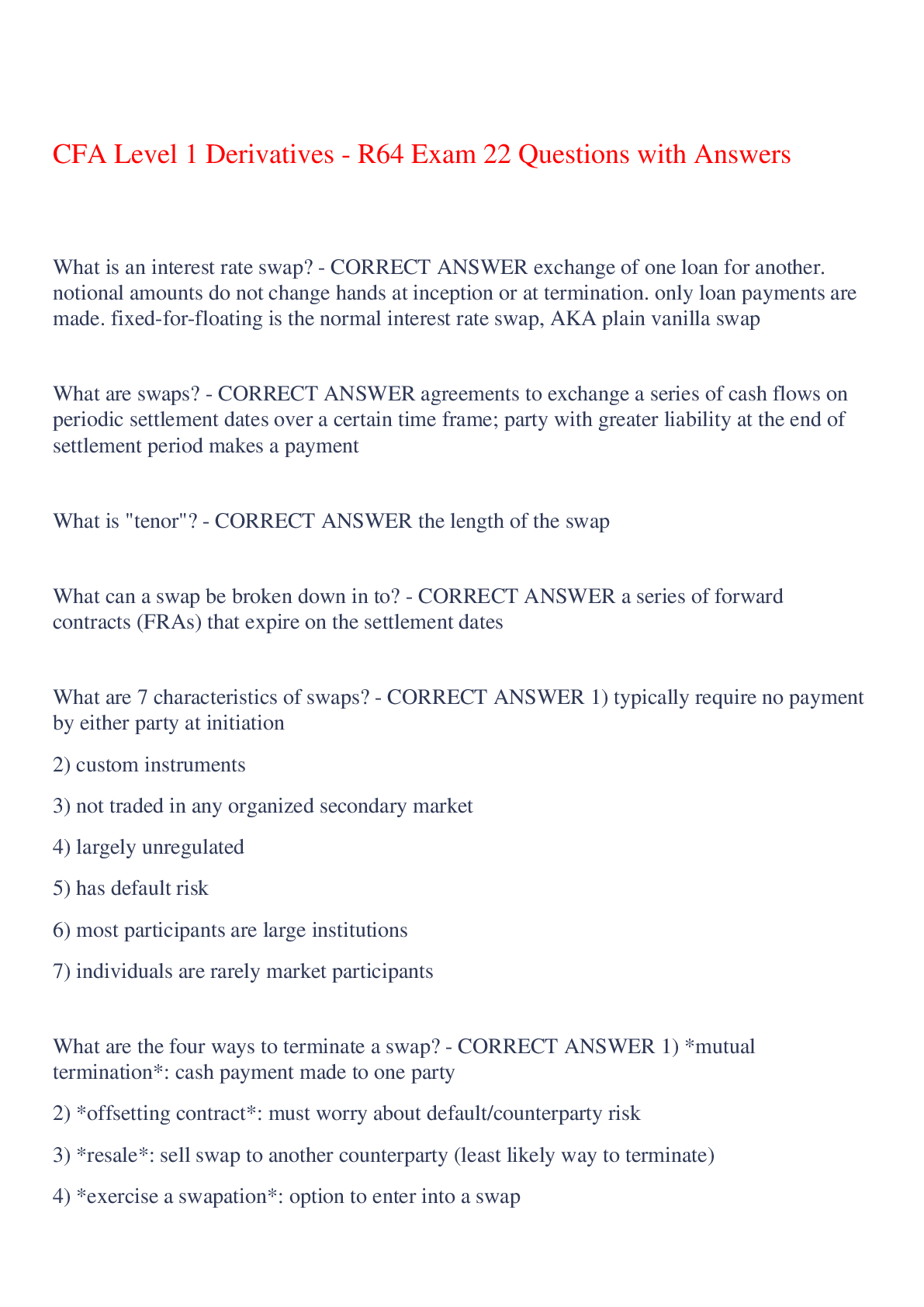
CFA Level 1 Derivatives - R64 Exam 22 Questions with Answers
What is an interest rate swap? - CORRECT ANSWER exchange of one loan for another. notional amounts do not change hands at inception or at termination. only loan payments are made. fixed-for-floating is the normal interest rate swap, AKA plain vanilla swap
What are swaps? - CORRECT ANSWER agreements to exchange a series of cash flows on periodic settlement dates over a certain time frame; party with greater liability at the end of settlement period makes a payment
What is "tenor"? - CORRECT ANSWER the length of the swap
What can a swap be broken down in to? - CORRECT ANSWER a series of forward contracts (FRAs) that expire on the settlement dates
What are 7 characteristics of swaps? - CORRECT ANSWER 1) typically require no payment by either party at initiation
2) custom instruments
3) not traded in any organized secondary market
4) largely unregulated
5) has default risk
6) most participants are large institutions
7) individuals are rarely market participants
What are the four ways to terminate a swap? - CORRECT ANSWER 1) *mutual termination*: cash payment made to one party
2) *offsetting contract*: must worry about default/counterparty risk
3) *resale*: sell swap to another counterparty (least likely way to terminate)
4) *exercise a swapation*: option to enter into a swap
What is a currency swap? - CORRECT ANSWER two parties swap loans in two different currencies; both currencies are exchanged at inception and swapped again at termination; *netting is not a typical practice*
What are the four types of currency swaps? - CORRECT ANSWER 1) party A pays fixed AUD, party B pays fixed USD
2) party A pays floating AUD, party B pays fixed USD
3) party A pays fixed AUD, party B pays floating USD
4) party A pays floating AUD, party B pays floating USD
When calculating fixed and floating payers in currency swaps, what do you need to be mindful of? - CORRECT ANSWER the receiver of a currency pays back the amounts (in arrears) *in the currency borrowed*
What are the motivations for entering into a currency swap? - CORRECT ANSWER 1) reducing transactions costs
2) maintaining privacy
3) avoiding regulation
Are interest rate swaps traded on exchanges? - CORRECT ANSWER no
What is a basis swap? - CORRECT ANSWER trading of one set of floating rates for another
What is the floating rate in an interest rate swap, usually based on? - CORRECT ANSWER LIBOR
What is the general formula for interest rate swaps? - CORRECT ANSWER (fixed rate - floating rate) x (days/360) x notional
If the net-fixed payment is positive ... - CORRECT ANSWER the fixed-rate payer owes/pays
If the net-fixed payment is negative ... - CORRECT ANSWER the fixed-rate payer receives
What is an equity swap? - CORRECT ANSWER a swap where a set of future cash flows are agreed to be exchanged between two counterparties at set date in the future. The two cash flows are usually referred to as "legs" of the swap; one of these "legs" is usually pegged to a floating rate such as LIBOR. The other leg of the swap is based on the performance of either a share of stock or a stock market index. Most equity swaps involve a floating leg vs. an equity leg, although some exist with two equity legs.
When are the payments known vis a vis equity swaps? - CORRECT ANSWER at the end of the period (quarter)
If index return is negative, who pays? - CORRECT ANSWER fixed-rate payer makes payment equal to the percentage decline in the index
If index return is positive, who pays? - CORRECT ANSWER fixed-rate payer receives payment equal to the percentage increase in the index
What are some reasons to enter into an equity swap? - CORRECT ANSWER 1) protect a large capital gain
2) avoid a sale for tax or control reasons
Currency swap markets consist of transactions in - CORRECT ANSWER both spot and forward contracts
[Show More]