LCDC – Assessment Questions and
Answers Already Passed
Assessment ✔✔An ongoing process through which the counselor collaborates with the client and
others to gather and interpret information necessary for planning tre
...
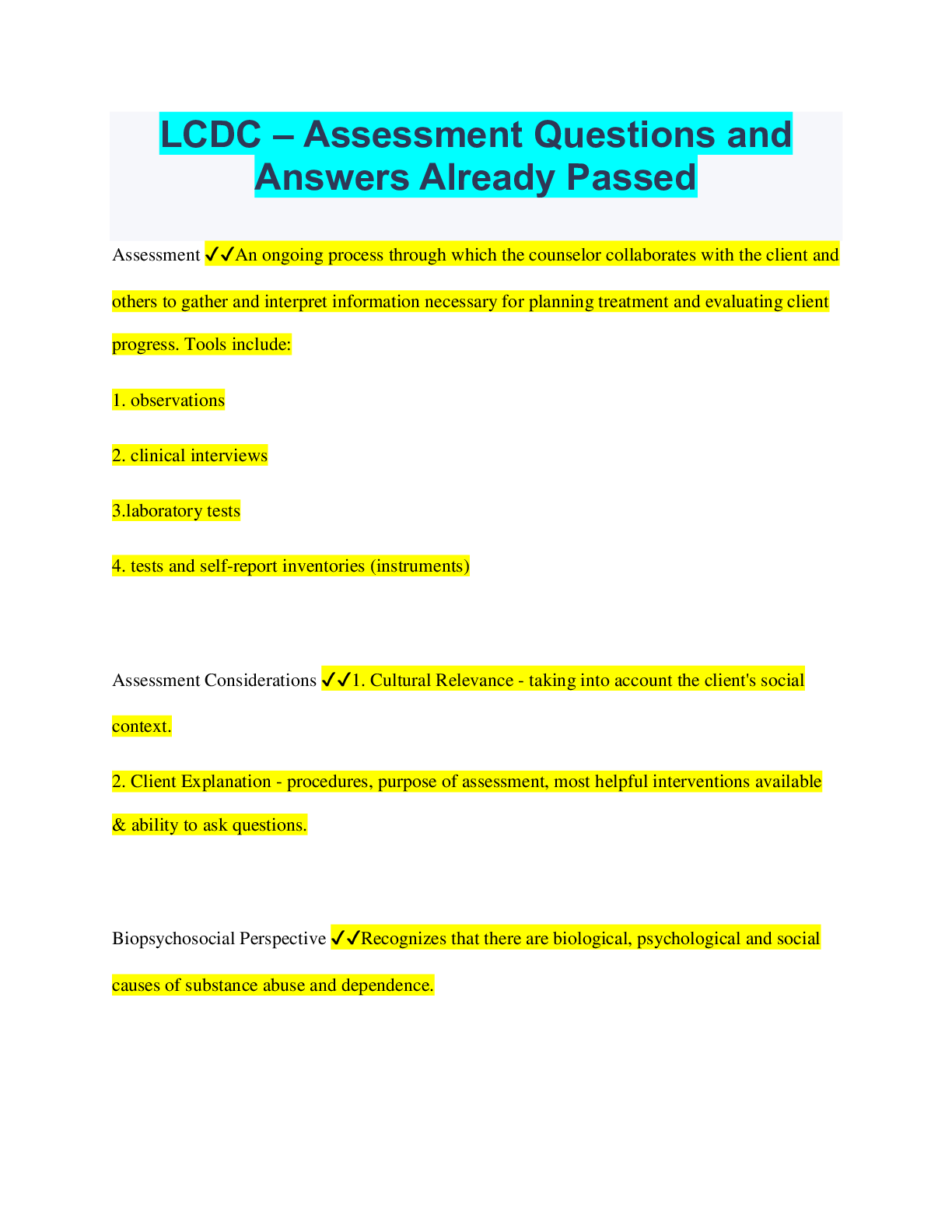
LCDC – Assessment Questions and
Answers Already Passed
Assessment ✔✔An ongoing process through which the counselor collaborates with the client and
others to gather and interpret information necessary for planning treatment and evaluating client
progress. Tools include:
1. observations
2. clinical interviews
3.laboratory tests
4. tests and self-report inventories (instruments)
Assessment Considerations ✔✔1. Cultural Relevance - taking into account the client's social
context.
2. Client Explanation - procedures, purpose of assessment, most helpful interventions available
& ability to ask questions.
Biopsychosocial Perspective ✔✔Recognizes that there are biological, psychological and social
causes of substance abuse and dependence.
Biological Factors ✔✔Brain chemistry problems, which may be genetic. Genetics influence
biochemistry, and biochemistry makes some people particularly vulnerable to addiction to
certain drugs one they try them.
Psychological Factors ✔✔Cognitive styles, personality traits, and early developmental
experiences.
Social Factors ✔✔Poverty, oppression, poorly developed social skills, and family dysfunction.
Assessment Information ✔✔1. Presenting problems
2. Alcohol and other drug use
3. Psychiatric and chemical dependency treatment
4. Medical history
5. Current health status
6. Family relationships
7. Social and leisure activities
8. Education and vocational training
9. Employment history
10. Legal problems
11. Mental/ emotional functioning
12. Strengths and weaknesses
Immediate Medical Evaluation Needed ✔✔Client's who present with:
1. Hallucinations
2. Severe tremors
3. Tachycardia
4. Confusion or delirium
5. Uncontrollable agitation
6. Ingested unknown substances or quantities of substances
Tremors ✔✔Involuntary fine movement of the body or limbs
Tachycardia ✔✔Abnormally rapid heartbeat (over 100 beats per minute)
Withdrawal Risk Factors ✔✔1. History of withdrawal
2. History of seizures
3. Dependence on multiple substances
Rapport ✔✔A comfortable working relationship, which helps assure the client's trust and
cooperation.
Person First Language ✔✔Placement of the noun (individual or person) before the descriptive
phrase (with
disabilities) to conceptualize the whole person with many abilities and disabilities rather than
emphasizing disabilities.
Motivational Interviewing ✔✔Used for ALL phases of treatment. A style of interacting with
clients that is helpful in reducing defensiveness and encouraging therapeutic collaboration
between counselor and client. Counselors use the interpersonal process to enhance client's
motivation to change. Motivational Interviewing respects the clients perception of the problem
and engages the client in a dialogue that promotes the client non-defensively reexamining the
situation and coming to determine that a problem exists.
Self Efficacy ✔✔Refers to one's belief about one's ability to perform behaviors that should lead
to expected outcomes. those with high levels for a particular task are more likely to succeed than
those with low levels
Stages of Change ✔✔1. Precontemplation—people do not think they have a problem and have
no intention of changing behavior
2. Contemplation—people know they have a problem and are intending to take action within 6
months
3. Preparation—people plan to take action within a month
4. Action—people outwardly modify their behavior and environment
5. Maintenance—successful behavior change for 6 months or longer
6. Termination—people are no longer tempted by the behavior which they have changed
Reliability ✔✔The extent to which a test yields consistent results.
Validity ✔✔The ability of a test to measure what it was designed to measure.
Screening Instrument ✔✔Distinguishes individuals who DO NOT have a disorder from those
who might have one.
Alcohol Use Disorders Identification Test (AUDIT)
Screening Instrument ✔✔10 item assessment. Developed by World Health Organization (WHO).
Asks about frequency of drinking, alcohol dependence, and problems caused by alcohol. Scores
range form 0 to 40, with a score of 8 or higher indicating the likelihood of harmful alcohol
consumption.
CAGE
Screening Instrument ✔✔Questions:
1. Have you ever felt you should CUT down on your drinking?
2. Have people ever ANNOYED you by criticizing your drinking?
3. Have you ever felt bad or GUILTY about your drinking?
4. Have you ever had a drink first thing in the morning? EYE OPENER
* One yes = possibility of alcohol dependence
Drug Abuse Screening Test (DAST)
Screening Instrument ✔✔Used to detect abuse of or dependence on drugs other than alcohol.
Provides a measure of lifetime problem severity.
Michigan Alcoholism Screening Test (MAST)
Screening Instrument ✔✔Requires yes/no answers to 25 questions.
Scores indicate:
Absence of alcohol dependence (0 to 3)
Possible substance dependence (4)
Likely alcohol dependence (5 or higher)
Also available:
Brief MAST (10 items)
Short MAST (13 items) SMAST
Geriatric MAST (MAST-G)
Rapid Alcohol Problems Screen (RAPS4)
Screening Instrument ✔✔An answer of yes to one or more questions = possibility of alcohol
dependence during the past year.
Questions have t do with remorse, amnesia, performance of life duties, and starting the day with
alcohol.
Substance Abuse Subtle Screening Inventory (SASSI)
Screening Instrument ✔✔Brief self-report designed to identify individuals with a high
probability of having a substance related disorder.
SASSI-A2 is for clients aged 12 to 18.
TWEAK
Screening Instrument ✔✔Five item instrument was designed to screen for harmful drinking in
pregnant women. Questions have to do with tolerance, worry of close friends and relatives, eye
openers, amnesia (black-outs), and felt need to cut down.
Time Line Follow Back (TLFB) Procedure
Comprehensive Measure ✔✔Makes connections between significant events in the clients life
and alcohol/drug use patterns and intensity for the past year. includes a calendar and a standard
drink conversion chart to aid memory. Useful with older adults.
Diagnostic Instruments ✔✔1. Alcohol Dependence Scale (ADS) - 25 items. provides
quantitative measure of severity of alcohol dependence.
2. Diagnostic Interview Schedule (DIS-IV) Alcohol Module. - 28 questions permit diagnosis of
alcohol abuse or dependence.
3. Impaired Control Scale (ICS). Paper and pencil self-administered instrument measures clients
attempts to control their drinking during the last 6 months and their perception of their ability to
control it now.
Treatment Planning ✔✔The process in which the counselor and the client identify and rank
issues requiring resolution, establish agreed upon immediate and long-term needs/goals, and
decide on the treatment methods and resources to be used.
Addiction Severity Index (ASI)
Instruments to Aid in TX Planning ✔✔Semi-structured inventory with 7 sub-scales addressing
problems in the areas of:
1. family/social status
2. medical status
3. employment and support
4. drug use
5. alcohol use
6. legal status
7. psychiatric status
Useful with adults
Alcohol Use Inventory (AUI)
Instruments to Aid in TX Planning ✔✔Self report inventory is multiple choice for ages 16 and
up. Based on multiple condition theory.
Multiple Condition Theory ✔✔Takes into account individuals different styles of drinking,
perceptions of alcohol's benefits and consequences, and how they want to deal with drinking
problems.
Coping Behaviors Inventory
Instruments to Aid in TX Planning ✔✔Measures factors that are related to relapse risk: positive
thinkig, negative thinking, avoidance/distraction, and seeking social supports.
Wechsler Adult Intelligence Scale (WAIS III)
Other Instruments ✔✔Intelligence test
Strong Interest Inventory
Other Instruments ✔✔The most widely used vocational interest test; based on answers of people
successful in certain fields.
Minnesota Multiphasic Personality Inventory (MMPI-2)
Other Instruments ✔✔A personality inventory that contains several clinical scales that detect
pathology. Contains the MacAndrew Alcoholism Scale, which indirectly screens for alcohol
problems by identifying attitudes that often accompany alcohol abuse and dependence.
Mental Status Exam
Other Instruments ✔✔A series of observations about a client's appearance, behavior, attention,
mood affect, perceptual and thought processes, judgment, and memory at a given point in time. It
includes observations of a client's orientation to time, place and person.
Meyers-Briggs Type Indicator (MBTI)
Other Instruments ✔✔A personality inventory that looks at clients preferred ways of being in the
world, and assigns them to 1 of 16 personality types. it does not detect pathology. Frequently use
din vocational and relationship counseling.
Beck Depression Inventory II
Other Instruments ✔✔13 and up. Individuals rate themselves on 21 groups of statements that tap
the affective, behavioral, cognitive, and physiological symptoms of depression for the 2 weeks
prior to testing. sensitive to changes over short periods of time, so it can be used repeatedly to
track changing levels of depression over the course of treatment.
Score interpretation:
minimal = 0 to 13
mild = 14 to 19
moderate = 20 to 28
severe = 29 to 63
Physiological Measures ✔✔Urine testing kits used for drug screening. based on enzyme
multiplied immunoassay test (EMIT)
Enzyme Multiplied Immunoassay Test (EMIT) ✔✔Uses antibodies that react to the presence of
a drug or its metabolites.
Can detect:
1. PCP
2. Heroin
3. Cocaine
4. Marijuana
Gas Chromatography/Mass Spectrometry ✔✔Isolates the drug from any mixing agents or other
substances; a small amount is injected into the gas chromatograph, and the sample is funneled
into a mass spectrometer, where an electron beam hits it and causes it to break apart; how it
breaks apart helps tell what type of substance it is.
Elevated Gamma-Glutamyltransferase (GGT) Levels ✔✔Indicates prolonged, rather than
episodic, heavy drinking.
Aspartate Aminotransferase (ASAT) ✔✔Screens for heavy drinking.
Alanine Aminotransferase (ALAT) ✔✔Screens for heavy drinking.
Carbohydrate Deficient Transferrin (CDT) ✔✔Sensitive enough to pick up moderate drinking
over a period of a few weeks.
Suicide Assessments ✔✔Suicide Assessment Checklist
Suicide Intent Scale
SAD PERSONS Scale
Suicide Risk Factors ✔✔1. Male
2. Being over 65
3. Having depression
4. Previous suicide attempts
5. Alcohol or drug abuse/dependence
6. Being psychotic
7. Having little social support
8. Having chronic illness
Readiness to Change Assessments ✔✔Stages of Change Readiness and Treatment Eagerness
Scale (SOCRATES)
The University of Rhode Island Change Assessment Scale (URICA)
Family Assessments ✔✔1. The Family Tree Questionnaire helps clients report information about
the incidence of alcohol problems in blood relatives. Clients assign relatives to categories such
as: never drank, social drinker, and definite problem drinker.
2. A Genogram is a pictorial representation of family structure. 3 generations. standard set of
symbols. Client and counselor construct together to aid in exploration of behaviors and issues.
[Show More]