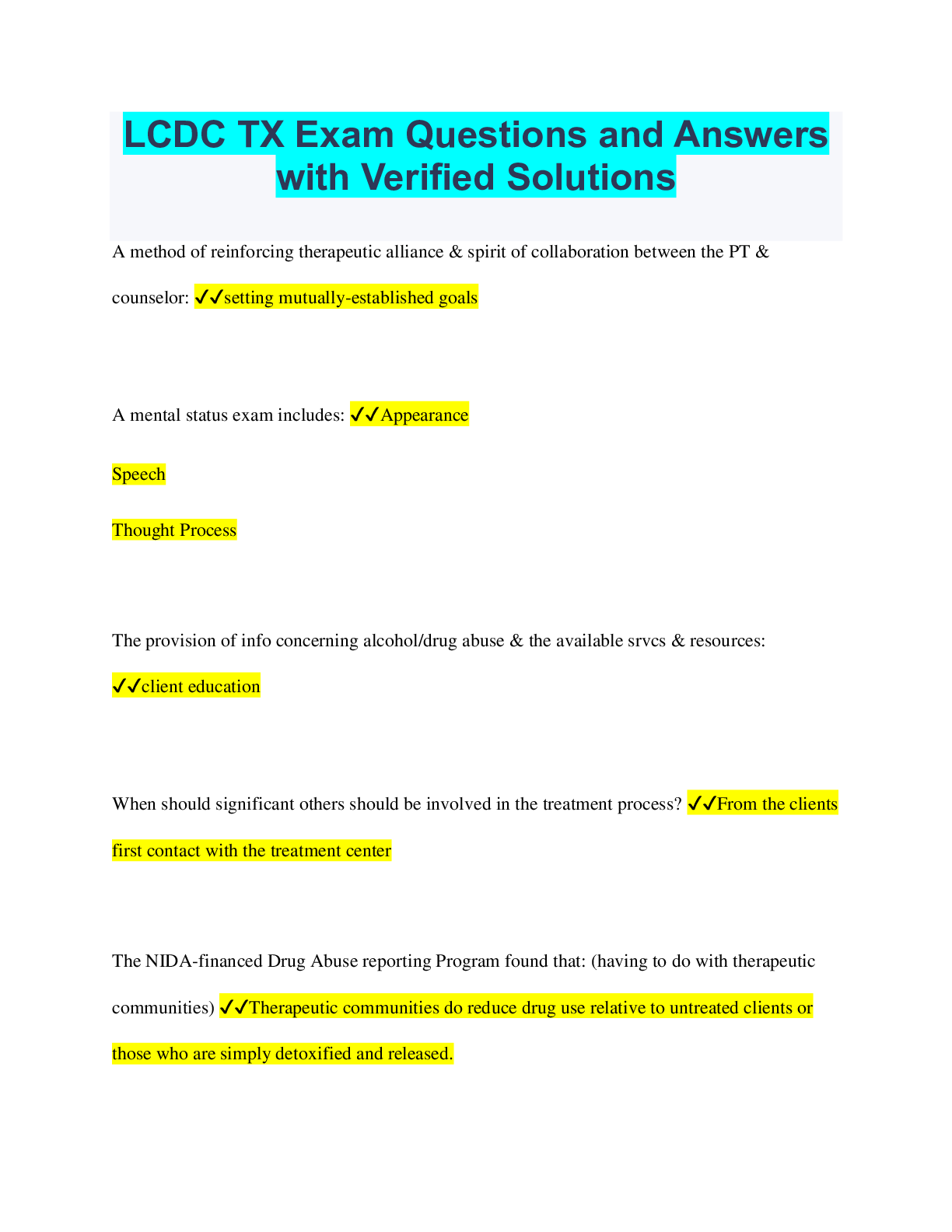
LCDC TX Exam Questions and Answers
with Verified Solutions
A method of reinforcing therapeutic alliance & spirit of collaboration between the PT &
counselor: ✔✔setting mutually-established goals
A mental status exam
...
LCDC TX Exam Questions and Answers
with Verified Solutions
A method of reinforcing therapeutic alliance & spirit of collaboration between the PT &
counselor: ✔✔setting mutually-established goals
A mental status exam includes: ✔✔Appearance
Speech
Thought Process
The provision of info concerning alcohol/drug abuse & the available srvcs & resources:
✔✔client education
When should significant others should be involved in the treatment process? ✔✔From the clients
first contact with the treatment center
The NIDA-financed Drug Abuse reporting Program found that: (having to do with therapeutic
communities) ✔✔Therapeutic communities do reduce drug use relative to untreated clients or
those who are simply detoxified and released.
A dually-diagnosed PT, stablized on meds for his psychatric D/O, wants to quit smoking. You
should: ✔✔Consult with his physician regarding nicotine/medication interaction.
A cognitive-based therapy, developed by Ellis, designed to confront a PT's irrational thinking
✔✔Rational-Emotive Therapy
A "release of information" must include: name, address, DOB & _____? ✔✔The purpose of the
release of information
When a client discloses suicidal thougths, the counselor's first step is to: ✔✔Assess the degree of
risk
When conducting an assessment what is the counselor's primary focus? ✔✔Identifying the
clients problems and needs, strengths and weaknessess.
The BEST indicator if an individual is physically dependent upon alcohol or another drug is:
✔✔The presence of withdrawal symptoms.
Guilt and ___ are painful emotions that are part of grieving. ✔✔Anger
Despite vast personality differences, virtually all substance abusers experience: ✔✔remorse,
self-hatred and shame
You are having difficultiy with a client early on in the case. The BEST thing for you to do is:
✔✔Seek out supervision with a colleage or supervisor
Self report screening instrument consists of 4 Y/N questions. Requires aprox 1 min to complete
✔✔CAGE questionnaire
Drug Offender Profile Evaluation/Refferal Strategies ✔✔D.O.P.E.R.S.
Michigan Alcoholism Screening Test ✔✔MAST
Self Administered Alcoholism Screening Test ✔✔SAAST
Short Michigan Alcoholism Screening Test ✔✔SMAST
Substance Abuse Subtle Screening Inventory - Adult or Adolescent Version ✔✔SASSI
Addiction Severity Index ✔✔ASI
Diagnostic and Statistical Manual of Mental Disorders ✔✔DSM
Adapted Short Michigan Alcoholism Screening Test for Fathers ✔✔F-SMAST
Global Appraisal of Individual Needs ✔✔GAIN
Minnesota Multiphasic Personality Inventory ✔✔MMPI
Minnosota Substance Abuse Problems Scale ✔✔MSAPS
Readiness To Change Questionnair ✔✔TRCQ
Substance Abuse Subtle Screening Invnetory for Adolescents ✔✔SASSI-A
Human Immunodeficiency Virus ✔✔HIV
The Stages of Change : ✔✔1) pre-contemplation
2) contemplation
3) preparation
4) action
5) maintenance
6) relapse
(SCM) Not yeat acknowledging that there is a problem behavoir that needs to be changed
✔✔Pre-Contemplation
(SCM) Acknowledging that there is a problem but not yet ready or sure of wanting to make a
change ✔✔Contemplation
(SCM) Getting ready to change ✔✔Preparation
(SCM) Changing behavior ✔✔Action
SCM) Maintaining the behavior change ✔✔Maintenance
(SCM) Returning to older behaviors and abandoning the new changes ✔✔relapse
The Stages of Change Model was originally developed in the late 1970's and early 1980's by...
✔✔James Prochaska, Carlo DiClemente
Bio-psychosocial perspective ✔✔This recognizes that there are biological, psychological and
social causes of substance abuse and dependence.
Biological factors ✔✔These include brain chemistry problems, which may be genetic, making
some people particularly vulnerable to addiction to certain drugs once they try them.
Psychological factors ✔✔These include cognitive styles, personality traits, and early
developmental experiences that may contribute to a client's causes of substance abuse and
dependence.
Social factors ✔✔These include poverty, oppression, poorly developed social skills, and family
dysfunction that may contribute to a client's causes of substance abuse and dependence.
Motivational interviewing ✔✔This is a style of interacting with clents, used not only for
assessment, but for all phases of treatment, that is particularly helpful for reducing defensiveness
and encouraging therapeutic collaboration between the counselor and client. Uses the
interpersonal process to enhance clients' motivation to change, and encourages clients to move
on to the next stage of readiness for change.
Assessment Instruments ✔✔These aid in the identification of, and treatment planning for
substance related disorders.
Reliability ✔✔This refers to the consistency with which an assessment instrument measures.
Validity ✔✔This refers to what an assessment instrument measures and how it is used.
Screening Instrument ✔✔This distinguishes individuals who do not have a disorder from those
who might have one.
` ✔✔`
CAGE ✔✔4 questions - Yes to 1 indicates possibility of alcohol dependence. Cut down?
Annoyed by criticism of drinking behavior? Guilty about drinking? Eye-opener?
DAST ✔✔Drug Abuse Screening Test (adapted from MAST) used to detect abuse or
dependence on drugs other than alcohol.
MAST ✔✔Michigan Alcoholism Screening Test - yes or no to 25 questions.
RAPS-4 (Rapid Alcohol Problems Screen) ✔✔An answer of yes to one or more questions
indcates the possibility of alcohol dependence during the past year. The questions have to do
with remorse, amnesia, performance of life duties, and starting the day with alcohol.
SASSI (Substance Abuse Subtle Screening Inventory) ✔✔This brief self-report is designed to
identify individuals with a high probability of having a substance related disorder.
SASSI-A2 ✔✔Substance Abuse Subtle Screening Inventory for Adolescents ages 12 to 18.
TLFB (Time Line Follow Back Procedure) ✔✔This is a Comprehensive Measure of Drinking
which makes connections between significant events in the client's life and alcohol/drug use
patterns and intensity, for the past year.
ADS (Alcohol Dependence Scale) ✔✔This diagnostic instrument is a 25-item instrument that
provides a quantitative measure of the severity of alcohol dependence.
DIS-IV (Diagnostic Interview Schedule - Alcohol Module) ✔✔This diagnostic instrument asks
28 questions that permit diagnosis of alcohol abuse or dependence.
ICS (Impaired Control Scale) ✔✔This diagnostic instrument is a pencil and paper selfadministered insturment that measures clients' attempts to control drinking during the last 6
months and their perception of their ability to control it now.
OCDS ✔✔Obsessive Compulsive Drinking Scale
SADD ✔✔Short Alcohol Dependence Data
SDSS ✔✔Substance Dependence Severity Scale
ASI (Addiction Severity Index) ✔✔This is a semi-structured interview with seven subscales
addressing problems in the areas of family/social status, medical status, employment and
support, drug use, alcohol use, legal status, and psychiatric status. It is useful for treatment
planning and outcome evaluation with adult clients.
AUI (Alcohol Use Inventory) ✔✔This self-report inventory is in multiple-choice format, for
ages 16 and up. It is based on the multiple condition theory, which takes into account individuals'
different styles of drinking, perceptions of alcohol's benefits and consequences, and how they
want to deal with drinking problems.
CBI (Coping Behaviors Index) ✔✔This instrument measures factors related to relapse risk:
positive thinking, negative thinking, avoidance/distraction, and seeking social supports.
WAIS-III (Wechsler Adult Intelligence Scale) ✔✔This is a popular intelligence test.
The Strong Interest Inventory ✔✔A vocational interest scale that compares clients' interests to
those of people who are happy in different occupations.
MMPI-2 ✔✔The Minnesorta Multiphasic Personality Inventory contaings several clinical scales
that detect pathology including the MacAndrew Alcoholism Scale.
The Mental Status Exam ✔✔A series of observations about a client's appearance, behavior,
attention, mood, affect, perceptual and thought processes, judgement, and memory at a given
point in time. Includes observations of a client's orientation to time, place and person.
MBTI (The Myers-Briggs Type Indicator) ✔✔This is a personality inventory that looks at
clients' preferred ways of being in the world and assigns them to 1 of 16 personality types.
Frequently used in vocational and relationship counseling.
The Beck Depression Inventory II ✔✔Used to track changing levels of depression over the
course of treatment for clients age 13 and over. Individuals rate themselves on 21 groups of
statements that tap the affective, behavioral, cognitive, and physiological symptoms of
depression for the 2 weeks prior to testing.
Biomarkers ✔✔Measuring these physiological markers at intervals throughout treatment may
provide early identification of relapse.
EMIT ✔✔Enzyme Multiplied Immunoassay Test - this urine testing kit uses antibodies that react
to the presence of a drug or its metabolites.
GGT ✔✔Gamma-glutamyltransferase - indicates prolonged, rather than episodic drinking.
ASAT ✔✔Aspartate aminotransferase - screens for heavy drinking.
ALAT ✔✔Alanine aminotransferase - screens for heavy drinking.
CDT ✔✔Carbohydrate Deficient Transferrin - sensitive enough to pick up moderate drinking
over a peoiod of a few weeks.
SOCRATES ✔✔A readiness-to-change scale that stands for Stages Of Change Readiness And
Treatment Eagerness Scale.
URICA ✔✔A readiness-to-change scale that stands for the University of Rhode Island Change
Assessment.
FTQ ✔✔Family Tree Questionnaire helps clients report information about the incidence of
alcohol problems in their blood relatives.
Genogram ✔✔A pictorial representation of family structure, using a least three generations and a
standard set of symbols.
DSM-IV-TR ✔✔Diagnostic and Statistical Manual of Mental Disorders, Fourth Edition, Text
Revision (APA, 2000).
Axis I ✔✔Contains 16 categories of clinical disorders, one of which is Substance Related
Disorders.
Substance Related Disorders ✔✔This category of clinical disorders in Axis I of the DSM IV-TR
includes both Substance Use Disorders and Substance Induced Disorders.
Substance Use Disorders ✔✔This sub-category of Substance Related Disorders includes both
Substance Abuse and Substance Dependence.
Substance Induced Disorders ✔✔These Axis I disorders are a sub-category of Substance Related
Disorders and can include Substance Intoxication and Substance Withdrawal, Substance induced
delirium, persisting dementia, persisting amnesic disorder, psychotic disorder, mood disorder,
anxiety disorder, sexual dysfunction disorder, and sleep disorder.
Axis II ✔✔This axis of the DSM IV- TR includes the personality disorders as well as mental
retardation.
Cluster A ✔✔Axis II disorders that feature odd, eccentric, isolative, or suspicious behavior.
They include Paranoid, Schizoid, and Schizotypal personality disorders.
Cluster B ✔✔Axis II disorders that often co-occur with substance abuse and dependence, and are
characterized by dramatic, emotional, erratic, or impulsive behavior, or a reduced capacity for
empathy. They include Antisocial Personality Disorder, BPD, Histrionic Personality Disorder
and Narcissistic Personality Disorder.
Antisocial Personality Disorder ✔✔This personality disorder features a pervasive pattern of
disregard for and violation of the rights of others.
Borderline Personality Disorder ✔✔This personality disorder features a pervasive pattern of
instability in interpersonal relationships, self-image, affect, and control over inpulses. Features
may include frantic attempts to avoid real or imagined abandonment, impulsivity in at least two
areas that are self-damaging, chronic feelings of emptiness.
Histrionic Personality Disorder ✔✔This personality disorder features a pervasive pattern of
excessive emotionality and attention seeking, often with provocative dress.
Narcissistic Personality Disorder ✔✔This personality disorder features a pervasive pattern of
grandiosity, need for admiration, and lack of empathy.
Cluster C ✔✔These Axis II personality disorders feature anxious, fearful, and perfectionistic
behavior. They are the Avoidant, Dependent, and Obsessive-Compulsive personality disorders.
` ✔✔`
Axis V ✔✔This axis of the DSM IV -TR is the Global Assessment of Functioning (GAF) scale,
which assigns a number from 1 to 100 to the counselor's judgement of the client's overall level of
psychological, social and occupational functioning.
Substance Abuse ✔✔A maladaptive pattern of substance use leading to clinically significant
impairment or distress, as manifested by at least one of the four following criteria occurring
within a 12- month period: recurrent substance use resulting in a failure to fulfill major
obligations at home, school or work, recurrent substance use in situations in which it is
physically hazardous, recurrent substance use legal problems, and continued substance use
despite having persistent or recurring problems caused or exacerbated by the effects of the
substance.
Substance Dependence ✔✔A maladaptive pattern of substance use, leading to clinically
significant impairment or distress, as manifested by 3 or more of the following 7 criteria:
tolerance, withdrawal, increased dose or dosing for longer periods of time, attempts to cut down
unsuccessfully, time spent obtaining, using, recovering from use, important social, occupational
and recreational activities given up or reduced because of use, physical or psychological
problems caused or exacerbated by continued use.
Physiological Dependence ✔✔Indicated by whether tolerance and withdrawal are present.
Withdrawal ✔✔Defined by either the characteristic withdrawal syndrome for the substance or
the same or a closely related substance being taken to relieve or avoid withdrawal symptoms.
Specifiers ✔✔Used for Substance Dependence Diagnosis, these 6 categories are: Early full
remission, early partial remission, sustained full remission, sustained partial remission, on
agonist therapy, in a controlled environment.
Polysubstance Dependence ✔✔The proper diagnosis for a client who has repeatedly taken at
least three groups of substances, and who meets creiteria for dependence for the substances as a
group, but not for the substances individually.
Dually-Diagnosed ✔✔This client has one or more other psychiatric disorders along with
substance abuse or substance dependence. Also known as co-occurring disorders. All disorders
should be treated concurrently and aggressively.
Affect ✔✔The external expression of an internal emotional state.
Mood ✔✔A sustained emotion. Changes less frequently than affect.
Delusions ✔✔False beliefs that are maintained despite proof against their truth.
Hallucinations ✔✔Perceiving something in the absence of a sensory input. May be auditory,
visual, olfactory, gustatory or tactile.
Illusions ✔✔Misperceptions of actual sensory input.
Problem Statement ✔✔Component of a MTP that should be stated in client's words whenever
possible. Answers the question, "Why are you here?" Include statement of problem and evidence
for it.
Goal Statement ✔✔Component of a MTP that should be acceptable to the client and answers the
question, "What is necessary to remedy the problem?" Should be stated positively - eg. "Client
will maintain abstinence," rather than, "Client will not drink."
Objectives ✔✔Component of a MTP that states specific things the client will do to meet the
goal. Stated in behavioral terms, and are observable, realistic, time specific, appropriate to the
level of treatment and measurable.
Strategies ✔✔Component of a MTP that states what the counselor will do to help meet the
client's objectives. Includes the theoretical model to be used, (eg. reality therapy) and the specific
techniques to be employed (eg. assertiveness training or refusal skills training). These are
sometimes also called "Interventions".
Axis I, IV and V ✔✔CASACs are responible for these three axes on the Written Assessment
Summary. Other axes can be written up as "deferred" or list symptoms eg. deferred, reports
frequent headaches.
AUDIT ✔✔world health organization, over 8 suggests harmful consumption, looks at frequency
` ✔✔`
DAST ✔✔drug dependence other than alc...lifetime severity
RAPS4 ✔✔Remorse, amnesia, personal respon, start day with drink...alc dependence
SASSI ✔✔allows diagnosis of cohabitating disorders...self report
TWEAK ✔✔use/abuse during pregnancy
CBI ✔✔coping behav inventory...relapse, social supports, attitude and avoidance
WAIS ✔✔Weschler...intelligence tet
MMPI ✔✔personality inventory...detects pathology
MMPI ✔✔MacAndrews alc scale
Myers Briggs ✔✔1-16 personality...no pathology
EMT ✔✔urine tests, tests metabolites/drugs, heroin, marij, pcp, cocaine
Beck depression ✔✔21 item...depression symptoms for 2 weeks...29-63 depression
CDT ✔✔blood biomarker...detects long term drinking
Induced disorder ✔✔brought on or worsened by substance
sub abuse disorder ✔✔substance abuse and dependence
Axis I ✔✔mood disorders
Axis II ✔✔personality disorder
Axis II Cluster A ✔✔odd...eccentric...suspicious
Axis II Cluster B ✔✔dramatic...emotional..impulsive...lack empathy
Axis III Cluster C ✔✔Fearful...anxious...perfectionist
Axis III ✔✔medical
Substance abuse ✔✔maladaptive patter of abuse...1 of 4 criteria..failure to meet life duties. cant
quit, legal problems, continues regardless of danger
Substance dependence ✔✔maladaptive pattern...3 of 7 criteria..cutting back, cont use despite
prob, tolerance, gives up activities
` ✔✔`
Mood ✔✔sustained emotion that colors the perception of the world
Dellusions ✔✔continued belief of something even when proof against it....false belief based on
faulty external reality
Hallucinations ✔✔sensory perception of reality occuring without external stimuli
Illusions ✔✔misperception about a real external stimuli...rustling leafs...
Assesment ✔✔gathering info about pt in order to make informed diagnostic impression
Empathy ✔✔ability to perceive pt emotions and see their world thru their eyes
concreteness ✔✔relates vague aspect to concrete terms...helps with coping skills
paraphrasing ✔✔picking out emotions and repeating them back with added clarity...builds trust
and reduces resistance
Reflection ✔✔restates content that produces emotions, counselor stays neutral
simplifying ✔✔reflection, removes confusion, avoids convoluted explanations so they can solve
problem in here and now
Probing ✔✔open ended questions help clarify and move to new understanding
Reframing ✔✔offers new perspective to situation
exploring alternatives ✔✔examine various options to pt
Person Centered Theory ✔✔Carl Rogers
Person Centered ✔✔Here and now...people are resourceful and capable of solving own problems
and are trustworthy
Person Centered ✔✔3 characteristics; unconditional positve regard, genuiness and accurate
empathy
Person Centered ✔✔in addictions counseling; builds rapport and T.R to help pt recover
Reality Therapy ✔✔William Glasser
Reality Therapy ✔✔Help pt in here and now...frustrated with psychoanalysis
Reality Therapy ✔✔humans have 2 basic needs; love and feel worthwhile
Reality Therapy ✔✔accepts no excuses..holds pt accountable..allows for natural
consequences...no enabling
Reality Therapy techniques ✔✔challenge inappropriate beh, focus on strengths, discourages
excses, help pt achieve goal, find constructive way to meet goals
Reality therapy ✔✔rejects medical mode, emphasis on responsibility, no transference and
encourages counselor to be himself
Rational Emotive ✔✔Albert Ellis
Rational Emotive ✔✔people born with both rational and irrational beliefs
Rational Emotive ✔✔learn irrational thoughts as a child that can lead to self destructive
behavior...disturbances come from faulty beliefs of everyone should love you
Rational Emotive ✔✔Help pt confront irrational beliefs through gathering evidence...pt becomes
aware of automatic thought process
Rational Emotive - irrational thoughts ✔✔lead to self criticism, isolation, self abuse, not striving
for potential and drug use
Rational Emotive ✔✔A-B-C; activating event, belief about, and consequences
Rational Emotive - techniques ✔✔detect irrational beliefs through words (ought, should, must
and always)...when is that not true...homework given
Cognitive behavior ✔✔Aaron Beck
Cognitive behavior ✔✔focus on here and now, pt with emotional probls have faulty thinking or
incorrect info
Cognitive behavior ✔✔cognitive distortions - over generalization, minimization, personalizing
events, polarized thinking
Cognitive behavior - Techniques ✔✔challenge faulty thoughts, ask where did evidence come
from, instill hope, Socratic
Brief Therapy ✔✔time limited, structured, directed at specific goal
Brief Therapy ✔✔uses motivation to change behavior, avoid getting ahead of pt, understands
stages to help clinican
Brief Therapy ✔✔reduces pt risk of harm from controlled substance use, specific goals for
consumption pattern, key is to extract single behavior change process
Brief Therapy ✔✔Five Stages
Brief Therapy - Precontemplation ✔✔user not considering change, or acknowledge problem
exists
Brief Therapy - contemplation ✔✔acknowledges problem, ambivalent about change
Brief Therapy - determination ✔✔begins once user decides to change - plan of action
Brief Therapy - action ✔✔putting plan into action, uses new behav, not yet stable
Brief Therapy - maintenance ✔✔establishes new behav on long term basis
Constructivism ✔✔George Kelly
Constructivism ✔✔people have system of constructs and symbols that reflect themselves in their
world. Problem is discrepancy between people capacity and current demands of environment.
Constructivism ✔✔focus current problem,then patterns...attention given to background and early
attachment
Constructivism ✔✔view people in positive optimistic terms, proactive, goal driven, operate
according to the knowledge they posses
Constructivism ✔✔clinican does not direct or pursuade, they use elaboration and metaphors to
advance the process, serve as co-investigators helping pt construct rewarding way of being and
coping.
Feminist therapy ✔✔Helen Deutsch and Karen Horney
Feminist therapy ✔✔Give women view of social position and sense of community with new
power, possibilities and overriding binding stigmas
Family Systems Theory ✔✔help addicts decrease anxiety by getting family members to focus on
their own recovery, Families are systems of interconnected ad interdependent individuals, a
system of interacting parts
Human Validation process ✔✔Virginia Satir - assisting individuals in transforming family rules
and messages (specifically abut individuation and communication) to be more acceptable and
flexible, allowing for change, enhance and validate self-esteem; family rules; sculpting;
nurturing triads; congruence & openness in communication; family mapping & chronologies
Therapist is the role model, facilitator, resource person and investigator
Structural famly therapy - present & past ✔✔Salvador Minuchin- modify the present, past
changed by interventions. Three subsystems of nuclear family - parent subsystem, sibling,
sibling/parent
Structural famly therapy - Clear boundaries ✔✔Clear but firm boundaries
Structural famly therapy - present & past ✔✔family supported but nurtured, balance between
autonomy and connectedness; freedom to indivuate
Structural famly therapy - Rigid boundaries ✔✔too much distance between family members,
children fight for boundaries, negotiate for themselves without parental protection
Structural famly therapy - diffuse boundaries ✔✔enmeshment, everyone in everyone elses
business, distinctions not present between subsystems
Intervention - organizer ✔✔witnessed the addiction firsthand and aware of consequences
Intervention - choose team ✔✔choose team gather data, make list of incidents, describe incident,
no anger or accusations
Intervention - rehearse ✔✔go over each item on list, determine order to read list, allows you to
find out team members individual emotions
Intervention - steps ✔✔determine steps that will be taken if person does not seek help
Intervention - treatment ✔✔find out about treatment, cost and info
Therapeutic community ✔✔believes substance abuse is whole person; self help proess of
incremental learning; changes in behavior, values and attitudes
Social learning model ✔✔therp communities based on social learning model, goal is to learn to
be different by participating in community that operates by different rules; commonly used for
judicial treatment
Components ✔✔members contribute, observe peers, model behavir, shared norms and values,
structure, and relationships
Case Mgt - Assessment ✔✔identify pt strength, weakness and needs
Case Mgt - Planning ✔✔negotiate what pt wants, develop plan for achieving it
Case Mgt - linking system ✔✔help pt obtain required services by referring to services for
formal/informal care
Case Mgt - advocacy ✔✔intercede on behalf of pt to obtain needed resources
Case Mgt - monitoring ✔✔evaluate progress continuously and take action if needed
Case Mgt - Brokerage- ✔✔id pt needs help access resources, no advocacy but when pt needs
access to resources
Case Mgt - Assertive community ✔✔frequent long term contact with pt in natural setting, focus
on practical problems of daily living
Case Mgt - strengths based ✔✔aggressive outreach, helps pt develop goal, advocates, and view
community as resources not a barrier, this is an alternative to disease concept
Level I Treatment ✔✔outpatient
Level 2 treatment ✔✔intensive outpatient/partical hospitalization
Level 3 ✔✔residential or inpatient
Level 4 ✔✔medically managed intensive inpatient
Aftercare ✔✔called continuing care, follows discharge, case mgr helps transition, and take
responsibility for their lives
Disengagement ✔✔takes place over time, discuss what has been learned in treatment
Community resources ✔✔coordination variety of resources, counselor should be familiar with
resources
Advocacy coordination in case mgt ✔✔involves coordinating with family, community agencies,
legal system and legislative bodies
Culturally sensitive case mgt ✔✔pt should be linked to services whose values are consistent with
their own
Case mgt with women ✔✔reluctant to seek treatment without encouragement, medical, mental
health and family counseling see more women
case mgt with adolescents ✔✔encouraging family involvement, provide support, track relapse
episodes, connect with school, work and community resources
Evaluate case mgt effectiveness ✔✔track through interviews, professionals, self report, arrests..
Sociocultural view of substance disorders ✔✔stressful socioeconomic conditions, cultural
differences in drinking patterns can enhane or reduce risk; social pressure, attitudes and cultural
norms all influence
behavioral view ✔✔influence both positive and negative reinforcement as casual factor for cont
drug use; positve reinforcement reinforces the cont use because of pleasure pathway,
reinforcement pleasure thru effects on GABA neurotransmitters
Negative reinforcement ✔✔provides escape from neg feelings, also called tension reduction, self
medication; avoiding unpleasant w/d symptoms
Biological view of addiction ✔✔biogenetic factors cause behavioral and psychological change;
internal, not environmental causes
Mesolimbic dopamine sys ✔✔A central group of structures is common to the actions of all drugs
/ pleasure pathway in the brain
Aldehyde dehydrogenase ✔✔an enzyme that is involved in metabolizing alcohol
Primary prevention ✔✔intended for young with no experience, promotes abstinence, develops
refusal skills, promote viable alternatives
Secondary prevention ✔✔seeks to stop experimental, incorporates intervention, education, skills
to avoid future use, instead of jail use treatment
Tertiary prevention ✔✔focus on stopping progressive damage of drug use, incorporates group
intervention to get people into treatment, residential ther communities, promotes healthire life
style
Treatment recovery continuum ✔✔nonuse, moderate and non problematic use, heavy and non
problematic use, heavey use with moderal life, heavy use with seirous life prob, depen/addiction
with life and health prob
Identification ✔✔can be self id, court order, probation
` ✔✔`
Stabilization ✔✔includes need for detox at a medical facility
Rehab/tx program ✔✔can range from providing duc, intensive outpatient, inpatient residential
prog
Relapse prevention ✔✔recovery and relapse are ongoing, not one event, should id individual
triggers and plan to confront as they occur, should be part of pt aftercare
AVE ✔✔abstinence violation effect - tendency for some to use substances problematically when
they believe abstinence is too difficult, happens when person attempts to abstain and then faces
conflict and guilt
Denial ✔✔early when occasional excessive drinking are explained as isolated event
Attempts to eliminate ✔✔users partner realizes usage not normal and pressures him to quit/cut
back
Disorganization/chaos ✔✔family operations have broken down, partner has to deal with critical
situations
Reorganization in spite of prob ✔✔partner takes charge redirecting main focus from user to
maintain life
Family reorganization ✔✔seperation occurs and family without user
Physical signs of alcohol dependence ✔✔weakened overall appearance, hyper pigmented,
jaundice skin, ataxia, unstady gate
Internal signs of alc ✔✔irritation causes inflammation, abdominal pain, bleeding esophagus and
stomach
Chronic use ✔✔acute pancreatitis, inflammation of panreas, blocking of duct causing digestive
juices to produce fat and then injury through attempts to digest
Moderate alc ✔✔decrease risk of gallstones, harms liver, acute fatty liver is fat deposits, build up
in liver cells, is reversable if stopped
Alcoholic hepatitis ✔✔heavy or extnded bout of alco, inflammation of liver, metablilism is
disrupted, jaundice, may be reversible with medical intervention
Cirrhosis ✔✔permanent, widespread destruction of liver cells, progress can slow with cessation
Anemia ✔✔insufficeient function of red blood cells, affects nutrient levels, buildup of toxins
reduces red blood cells production, those that are produced are defective and can cause bleeding
from ulcers
White blood cells ✔✔chronic alc use reduces white blood cells, negatively affects immune sys,
increases chances of infection
AHMD ✔✔alco heart muscle disease - serious condition where heart does not pump amt of
blood needed for demands of body
Seasonal alcohol arrhythmias ✔✔healy alcohol consumption assoc with holidays, subsides in
few days
ADH ✔✔antidireutic hormone - can inhibit production and output of ADH by pituitary region of
brain, causing kidneys to reasbsorb less water, and produce more urine
Respiratory sys decrease ✔✔increases respirations when low to moderate doses are used, larger
or toxic amts
Pulmonary defense ✔✔contrubtue to chronic obsturction in airflow, bronchospasm, affects
asthma lung cancer high long term drinkers, smokers and increases risk of TB
Endocrine system ✔✔affect pituitary gland, liver damage, production of, reception of and
metabolizing of hormones may be affected by alco
Skin ✔✔dilates vessels of skin, jaundice, itching, changes in hair distribution, skin infections
because liver dysfunciton
Substance abuse effects on musculoskeletal system ✔✔arthritis, gouty arthiritis
CNS ✔✔CNS - Body's coordinating center for mechanical and chemical actions, brain and
spinal cord
Black out ✔✔amnesia like state, appear to be functioning normally but have no memory of what
went on
Step 1 ✔✔admit powerlessness and lives unmanageble
Step 2 ✔✔a power greater than ourselves can restor sanity..indiv recognizes insanity of and
moves toward higher power
Step 3 ✔✔made decision to turn lives over to God, enables indiv to go to life preserver, begins
search for own direction
Step 4 ✔✔Made a searching and fearless moral inventory of self, provokes indiv to look closer
at basic errors in perceptin, begains teaching about responsibility
Step 5 ✔✔Admit to God, ourselves and others the nature of our wrongs, allows the release of
neg behav and wrong doings
Step 6 ✔✔we entirely ready to have God remove all defects of character, this step let go
Step 7 ✔✔Humbly ask him to remove short comings, admits to fear of repeated unhealthy behav
Step 8 ✔✔made list of person harmed and make amends
Step 9 ✔✔made direct aments, concerded effort to clean up situations and wrong doings
Step 10 ✔✔Cont to take personal inventory and when we were wrong promptly admit
it...promote support of sobriey and continue chane, helps recognize dont have to slip back into
old habits
Step 11 ✔✔sought through prayer and meditation to improve our conscious contact with God
Step 12 ✔✔having had spiritual awakening as result of steps, this step vital to maintain sobriety,
sharing steps with others
Rational recovery ✔✔self help based on RET, self reliance, non-spiritual, AVRT addictive coice
recognition technique
Moderate mgt ✔✔not intended for alcoholic, but prblem drinkers, abstinence is not primary
goals but guidelines and limits for moderate drinking, promotes early self recognition of risky
drinking behav
Secular org for sobriety SOS ✔✔promotes one day at a time toward sobriety, non religious,
sobriety being the priority in addict life
Drug ✔✔any substance, after enters body changes either the structure or function of body
Medicine ✔✔includes drugs used to prevent, treatment, diagnose illness/relieve pain
Misuse ✔✔unintentional or inappropriate use of drug for what other than intended
Abuse ✔✔intentional use of drug other than intended, to achiee altered state of consciousness,
leads to mental, phyusical, emotional or social impariment of using, family or society
Intoxication ✔✔temporary change caused by significant amt of drug affecting emotional,
cognitive or psychomotor functioning
Dependence ✔✔after using drugs, indiv finds difficult or impossible to control use, dependenc
or addiction usually involves tolerance or W/D
Physical dep ✔✔state of functional adaptation to drug in which presence of foreigh chemical
becomes normal and absence of drug would present abnormal state
Cross dependence ✔✔a person who is physically dep to one drug, lessens or prevents W/D
symptoms by using other drugs with similar classification
Tolerance ✔✔altered physiolocal state develops after repeated drug use and body becomes
accustomed and adapts to presence of drug, evidenced by drug having less of an effect in same
dose
Pharmacodynamic tolerance ✔✔nerve cells become less sensitive to effects of drug over time
Metabolic tolerance ✔✔liver adapts to presence of drug over time and produces mre enzyme to
break down drug
Behavioral tolerance ✔✔when, after peiro of time repeated drug use the user is able to modify
their behav in hopes that others wont notice intoxication
a form of diminishing effect that takes place because the user becomes accustomed to the effects
of a given drug and how to act under its influence
Cross tolerance ✔✔increased tolerance to effects of another drug in same class
Reverse tolerance ✔✔kindling efect - indiv can become more senstive to drugs rather than less
sensitive
Dose ✔✔amt of drug taken at any particular time
Half life ✔✔length of time drug remains in body and continues to affect user
Threshold dose ✔✔minimal dose - smallest amt of drug to produce detectable response
Max effect ✔✔greatest response from drug no matter the dose given or taken
Effective dose ✔✔amt of drug necessary to get desired effect in about 50% of those who use
Lethal dose ✔✔dose of drug results in death
Therapeutic index ✔✔dose determined to be safe for use and desired effect of drug, determined
by dividing the lethal dose by effective dose
Potency ✔✔amt of drug needed to produce desired effect
Additive Effect ✔✔when two or more drugs used same time result are equal to the sum of the
actions of the drugs used
Synergistic interactions ✔✔occur two or more drugs used same time, results are greater than the
sum of the actions of the drugs used
Antagonistic interactions ✔✔occur when two or more drugs used same time, results are less than
the sum of the acitons of the drug or they cancel the effects of each other
Oral ✔✔mouth or swallowed - 15 min
Injected ✔✔IV - few seconds to minutes
Inhalation ✔✔inhaled into lungs, immediately or few sec
Snorted ✔✔inhaled into nose absorbed through mucus membrances
Neurotransmitters ✔✔chemical messengers
Gaba ✔✔relates to inhibitory factors and slows communication
Norepinephrine ✔✔A neurotransmitter involved in arousal, as well as in learning and mood
regulation
Dopamine ✔✔neurotransmitter associated with movement, attention and learning and the brain's
pleasure and reward system.
Serotonin ✔✔anxiety, depression and aggressiveness
Affects mood, hunger, sleep, and arousal
Acetylcholine ✔✔arousal reactions or inhibitory factors
VTA ✔✔bentral tegmental area and nucleus accumbens of brain make up leasure center,
responsible for reward sys for all drugs
Abuse potential ✔✔speed of action and how long lasts/ and social factors
Schedule I ✔✔high level of abuse/dep, no accepted medical, heroin, lsd, marijuana
Schedule II ✔✔some medical use, restrictions of manufaucturing, prescriptions not refillable
Schedule III ✔✔moderate to low physical dep, high psychological dep, medical uses; steriords,
barbituates, ketamine
Schedule IV ✔✔low physical dep, moderate psychologcal dep, xanax, barbitatues, chloral
hydrate
Schedule V ✔✔low risk for either; medical mixture of opium or codeine
Depressants ✔✔slow CNS, decreases alertness and judgment, binds to GABA inhibitor receptors
Alcohol W/D ✔✔anxiety, hyper arousal, elevated vitals, sweating, shakes, altered perceptin,
visual/tactile hallucinations and illusions/swizures, possible death if combined with alco or
barbituate
Cocaine ✔✔snorting - 20 to 30 min, remains brain 2/3 days, affects dopamine, norepinephrine
and serotonin; blocks reuptake of dopamine increasing amt and prolonging the dopamine effect
Amphetamine ✔✔direct the release of dopamine and norepinephrine and blocks reuptake
creating euphoric effect
Meth ✔✔smoke, immediate intense rush lasts few min
Stimulants produce ✔✔alertness, well being, euphoria, increased engry,anxiety, medical prob,
cardiac, cns, respiratory and potential death
Stimulants ✔✔tolerance and dependence, snxiety, confusion, social w/d, weight loss, psychosis,
potential death, ireversable prob with CNS
Stimulant W/D ✔✔depression with suicidal thoughts, excessive need for sleep, fatigue,
increased appetite, drug craving, not life threathening but suicide potential high
Hallucinogens ✔✔change sensory perceptino and alter reality; hallicunations naturally occuring
and synthetically prepared drugs
LSD side effects ✔✔panic attacks, increased blood pressure, heart palpitations, tremors, nausea,
muscle weakness, increased temp,
LSD ✔✔structured like serotonin and binds to receptors
MDMA ✔✔nausea, clenching of jaw, blurred vision, painic attacks, confusion, depression,
paranoid psychosis, increased temp, cardiac arrest
PCP ✔✔psychotic reactions, bizarre behavior, ourbursts of hostility and violence, impending
death
Ketamine ✔✔can be snorted or injected, frightening experience of complete sensory detachment,
paranoia, boredom, explained near death experiences
Cannabinoids ✔✔mari, hashish, thc, well being, relaxed, euphoria, etachment, altered level of
consciuonsess, altered sense of time
Effects ✔✔slowed reaction time, altered perception, panic, anxiety, dizziness, increased
respiration, heart rate and body temp, red eyes, mild dilation of pupils, tremors, decreased
coordination, anxiety, probl with memory and possible hallucinations
Client files should be readily accessible to? ✔✔only those persons directly involved in providing
clinical services.
The first barbiturate produced in 1903 was called ✔✔barbital
Dr. Sigmund Frued unsuccessfully used cocaine to ✔✔reduce the severity of withdrawal
symptoms of morphine addicts.
Heroin, a chemically altered form of morphine, was originally introduced as ✔✔a cure for
morphine addiction.
THC can produce ✔✔hallucinations and analgesia
The "businessman's lunch" is a term used for ✔✔DMT
Regarding a "seropositive" result, the person has? ✔✔AIDS
The Interpersonal style in which a member of a minority group has pride in his/her racial
identity; it's history and cultural traditions and yet is comfortable in operating in the world is
known as: ✔✔The Bi-cltural Interpersonal Style
Prohibtion caused _________________to occur. ✔✔Decreased number of deaths associated
with alcoholism
Several experts believe that burn-out occurs in stages. The first stage is______________.
✔✔enthusiasm
Pattern of drinking accurately associated with the term "alcoholism" ✔✔Inability to control the
amount one drinks
Metalbolic process that changes alcohol to the compound acetaldehyde ✔✔detoxification
Frequent mistake that begining counselors make with clients ✔✔Failure to openly discuss each
others expectations
Metabolic process that leads to the formation of water and carbon dioxide by process of
chemically heating acetic acid ✔✔oxidation
Part of the brain that controls heart rate, hunger, body weight and arterial blood pressure
✔✔hypothalamus
Style of counseling in which a counselor is aware of his/her fears and dislikes for a minority
culture but hides those fears beneath the surface of counseling ✔✔Covert (Hidden) Prejudice
Neurotransmitter associated with arousal and mood ✔✔norepinephrine
Functional and structural unit of the nervous system ✔✔neuron
If an anti-ulcer medicine tends to increase blood alcohol levels and thus makes drinkers more
intoxicated, this type of drug interaction would be best described as _____________.
✔✔potentiating
Five Critical Components of Effective Treatment ✔✔Assessment, Patient-treatment matching,
Comprehensive services, Relapse prevention and Accountability of the treatment program
The medical view of addiction understands that addicted persons have a ________________.
✔✔treatable disease
Addiction is a __________ disorder that is prone to relapse, even after significant periods of
recovery. ✔✔chronic
Which two basic categories have treatment approaches evolved? ✔✔pharmacological and
behavioral modalities
Criminal view of addiction defines drug use as a ___________. ✔✔criminal behavior.
The nervous system is comprised of the specialized structures that control and coordinate all
body activities through the process of _______________ and ____________. ✔✔stimulus;
response
Three stages of the process of stimulus and response ✔✔sensory reception, interconnection and
motor response
Three major structures of the nervous system ✔✔Brain, spinal cord and peripheral nerves
Two major parts of the nervous system ✔✔Central and peripheral nervous systems
Two subdivisions of the peripheral nervous system ✔✔somatic and autonomic systems
Somatic system ✔✔Comprised of the cranial and spinal nerves which connect the CNS to the
skin and the skeletal muscles
Autonomic System ✔✔Nerves connect the CNS to the various body organs; including heart,
stomach, intestines and various glands
If one drug, such as a barbiturate tends to reduce the effectiveness of an oral contraceptive, the
drug interaction would be most accurately described as _________. ✔✔antagonistic
An irresistible impulse ✔✔compulsion
Barbiturates can be sub-classified into group by__________. ✔✔the speed of the onset and
duration of the effects
Heroin is an example of a ___________. ✔✔semi-synthetic narcotic
The ___________is the basic unit of the nervous system. ✔✔neuron
When an electrical impulse reaches the end of an axon; tiny saclike structures known as synaptic
knobs manufacture chemicals called ___________. ✔✔Neurotransmitter
Excitatory neurotransmitter released by axons ✔✔Acetylcholine
Neurotransmitter found in the brain associated with movement and pleasure ✔✔Dopamine
Neurotransmitter associated with regulation of sensory perception, sleep and body temp and its
alterations in functioning have been found to be related to mental illness and certain drug
hallucinations ✔✔serotonin
NIDA- financed drug abuse reporting program found ( having to do with therapeutic
communities) ✔✔therapeutic communities do reduce drug use relative to untreated clients or
those who are simply detoxified and released
when should significant others be involved in the treatment process ✔✔From first contact with
treatment center
Provision of information concerning alcohol and other drug abuse and the available services and
resources ✔✔Client Education
Mental status exam does not assess: a) education level b) appearance c)speech d) thought process
✔✔education level
Major method of reinforcing the therapeutic alliance and spirit of collaboration between the
client and the counselor ✔✔setting mutually-established goals
All of the following are benzodiazepines except: a)valium b)halcion c)trazodone d)xanax
✔✔trazodone
Tendency of the family to try and maintain balance ✔✔homeostasis
Primary purpose of professional standards of practice ✔✔Provide recognition of demonstrated
competency in addictions counseling
Primary purpose of a professional code of ethics ✔✔Serve as a guideline helping clients while
behaving in a fair way to colleagues
One of the best safeguards against differential power ✔✔Be alert to and understand the power
relationship
Common error counselors make when conducting an assessment? ✔✔Moving too quickly from
data collection to treatment planning
You are having difficulty with a client early in the case ✔✔Seek out supervision/consultation
CAGE questionaire ✔✔Self report screening instrument consisting of 4 yes or no questions.
Requires approx. 1 min to complete
Stages of Change ✔✔Pre-contemplation, Contemplation, Preparation, Action, Maintenance,
Relapse
Not yet acknowledging that there is a problem behavior that needs to be changed. ✔✔Precontemplation
Acknowledging that there is a problem but not yet ready or sure of wanting to make a change
✔✔Contemplation
Getting ready to change ✔✔Preparation
Changing behavior ✔✔Action
Stress inoculation ✔✔Focuses primarily on increasing coping skills
Special study of where and how drugs act in the human body ✔✔Pharmacodynamic
" primum non nocere" ✔✔Do no Harm
Potential pitfall for new counselors ✔✔Over-identification with clients
2nd or transition stage of group development involves ✔✔Control issues
After absorption and distribution of a drug, it is metabolized by the ___________. ✔✔liver
Positive reinforcement ✔✔Something specifically designed to increase the occurrence of a
particular behavior
What should occur after a PT is considered appropriate and eligible for treatment? ✔✔Counselor
should provide the PT with an overview describing the goals, objectives, rules and obligations of
the program
Personality Disorders ✔✔Maladaptive ways of perceiving, thinking and relating
While the overall national suicide rate has increased slightly but consistently in recent years,
disproportionate increase have occurred among ✔✔females and the young
Seconal taken with what drug will lead to a "potentiation"effect ✔✔Alcohol
To assist them in handling termination issues, effective counselors use appropriate levels
✔✔self- disclosure
T or F: Alcohol accounts for one half of the ten leading causes of death in the Native American
population ✔✔True
During a session you notice that the client is getting progressively more agitated. You suspect
potential violence unless something is done immediately. Best course of action: ✔✔Call for
assistance
After a counselor has made a summary statement, the most important thing the counselor should
do is ______________. ✔✔Remain quiet for a time to allow the client to consider the
summarized material
Bi-polar mood disorder is distinguished from major depression ✔✔By at least one episode of
mania
Must always be considered when consulting with out-of -agency professionals
✔✔Confidentiality
Process of termination should be discussed ✔✔At the onset of treatment
Chronis and relapsing nature ✔✔Disorder of addiction
The metabolic effects of alcohol and other drugs alter the individual's chemistry because
psychoactive drugs mimic, displace, block or deplete_________________. ✔✔specific chemical
messengers between nerve cells in the brain
Process of Addiction: Stage One ✔✔Experimental and Social Use of Drugs and Alcohol
Process of Addiction: Stage Two ✔✔Problem Use or Abuse
Process of Addiction: Stage Three ✔✔Dependency/Addiction
Frequent client reaction during the termination phase of counseling ✔✔Acting out behavior
Goal of an effective aftercare program ✔✔Support gains made in treatment
T or F: According to the American Society of Addiction Medicine(ASAM), detoxification
services are one of the five categories of primary treatment. ✔✔False
3 Stages of effective treatment ✔✔medical/physical interventions, psychosocial rehabilitation
and aftercare
Most important criteria for client inclusion in group counseling ✔✔Motivation
Tor F: Counselors should visit facilities to which they frequently make referrals. ✔✔True
Progress Notes ✔✔Must include interpretations of progress with reference to directly observed
behaviors
T or F: Hallucinogens are associated with physical withdrawal. ✔✔False
A counselor best communicates a non judgmental attitude by ______________ ✔✔non-verbal
behavior
Codiene, morphine and opium fall under what drug classification ✔✔narcotics
Drug misuse ✔✔Combining alcohol with other depressant drugs
PT discloses suicidal thoughts, counselor's first step? ✔✔Assess the degree of risk
" Release of Information" form must include client's name, address, date of birth and
________________. ✔✔purpose for release
Your dually-diagnosed client, stabilized on medication for his psychiatric disorder, decides he
wants to quit smoking. You should: ✔✔Consult with his physician regarding
nicotine/medication interaction
Trazadone is an ______________. ✔✔antidpressant
Valium, Halcion and Xanax are _________________. ✔✔bezodiazepines
In a crisis interview with a client, you are most concerned with ✔✔focusing questions about the
present situation and the clients means of coping with the stress.
While taking an alcohol drug history, a good clue to alcohol dependence is _________________.
✔✔increased tolerance and withdrawal symptoms when abstinence is attempted
You have assessed your client and determined that he is a problem drinker. He insists that the
reason he drinks is because of his wife's behavior. You intial objective is to help him? ✔✔take
responsibility for his behavior
The intake process involves________________. ✔✔screening
When alcohol and barbiturates are taken together, what pharmacological affect are they likely to
have? ✔✔synergistic
Despite Vast personality differences, virtually all substance abusers experience ✔✔remorse, selfhatred and shame
T or F: Guilt and anger are painful emotions that are part of grieving ✔✔True
The best indicator if an individual is physically dependent upon alcohol or another drug is
✔✔the presence of withdrawal symptoms
When conducting an assessment, what is the counselor's primary focus? ✔✔Identifying the
clients problems, needs, strengths and weaknesses
The primary purpose of the screening process is to ✔✔determine one's appropriateness and
eligibility for admission
During the screening process, a critical task that the counselor has to do is to ✔✔establish
rapport with the client.
Therapeutic communities differ from Synanon because ✔✔these communities try to return
clients to society.
What popular street drug that includes the main ingredient Cathonine? ✔✔KHAT
The following naturally occurring substance is not classified as a stimulant ✔✔Ergot
DOM, MDA and MDMA are ? ✔✔hallucinogen amphetamines
Double-Consciousness for a minority client means ✔✔"How I see myself" and " How I see
whites"
A relatively mild psychedelic substance which is chemically similar to LSD is ✔✔found in
morning glory seeds.
Amphetamines were first used clinically to treat? ✔✔narcolepsy
Pointing out parallels between a client's interpersonal relationships and client/counselor
interaction serves to focus awareness on ✔✔the "here and now".
Which cultural group has traditionally been the subject of a matriarchal family structure?
✔✔Blacks
The identification and ranking of problems needing resolution is ✔✔treatment planning.
According to the most recent National Survey on Drug Abuse and Health the specific drugs that
had the highest levels of past years dependence or abuse in 2009 were ✔✔marijuana, pain
relievers and cocaine
Benzodiazepines include the ability to_? ✔✔produce severe, even fatal, withdrawal.
T or F: Betel Nut has effects similar to that of cocaine. ✔✔False
Comprehensive client documentation ✔✔facilitates communication and enhances accountability
The goal of AL-ANON is ✔✔to provide a fellowship and support for individuals in relationships
with Alcoholics.
The focus of intervention in the criminal justice system is first to ✔✔protect the health, safety
and welfare of the public.
The description of the Clients Rights typically occurs during the ✔✔orientation.
Relapse prevention efforts are aimed at ✔✔identifying high risk situations and learning
alternative coping skills.
The initial stage of crisis intervention involves ✔✔determining the problem.
A counselor can avoid professional burnout by ✔✔attending to health through adequate sleep, an
exercise program and proper diet.
Maintenance ✔✔Maintaining the behavior change
Relapse ✔✔returning to older behaviors and abandoning the new changes
The Stages of Change Model was originally developed in the late 1970's and early 1980's by
________and __________ at the University of Rhode Island when they were studying how
smokers were able to give up their habits or addiction. ✔✔James Prochaska; Carlo DiClemente
6 Stages of Counseling ✔✔Evaluation, Feedback, Counseling, Agreement, Changing Behavior
and Termination
3 Stages of Drug/Alcohol Counseling ✔✔Medical, Psychosocial and Aftercare
Adolescent Drinking Index ✔✔24 item paper and pencil self report rating scale intended to
measure the severity of drinking. 5 min. completion time. Need 5th grade reading level.
Rational Recovery ✔✔Organization founded as an alternative to programs with spiritual
overtones, whose publications called" The Small Book".
PT is unhappy with the way treatment is progressing, counselor should __? ✔✔discuss these
concerns with the client and make necessary changes in treatment goals.
The essential first step in determining the possible causes of addiction for the person and the
most appropriate modality for his needs. ✔✔Assessment
Erickson's developmental theory- ____ should be accomplished in adulthood is ✔✔Intimacy vs.
Isolation
The following AIDS associated illness that may be less recognized in substance abusers is
✔✔Dementia
The intake process is usually an extension of the ✔✔screening.
Marijuana is a unique compound which contains over 200 chemicals, one particular chemical is
the main psychoactive chemical that makes marijuana "go". The name of the psychoactive
compound is ✔✔cannabinol
The primary factor in the development of young people's attitude toward drugs is ✔✔parental
role models
Destructive & rigid family rules which contribute to the low self-esteem of CoA's. -Claudia
Black ✔✔Don't Talk, Don't Trust, Don't Feel.
The following is the best indicator if an individual is physically dependent upon alcohol or
another drug. ✔✔Presence of withdrawal symptoms
Hallucinogens work on the brain by interfering with various neurotransmitters, causing an
overlap of the senses to occur. ✔✔synesthesia
A person wants to accept a party invitation because he is very social but is concerned because
there will be a lot of drinking and he is a member od AA. He is experiencing ✔✔approachavoidance conflict
The measurement of progress toward treatment goals id best assessed by ✔✔reviewing
documentation in progress notes.
Before therapy or counseling begins, clients may be given information about the treatment they
will receive, as will as possible risks involved. this process is called ✔✔obtaining informed
consent for treatment.
Effective communication occurs in group when ✔✔message senders use "I" messages.
One of the counselor's task is to guide the client in relating and communicating in specific terms,
rather than in general or abstract terms. This characteristic or ability is called ✔✔concreteness.
One of the earliest models for case management services in the criminal justice system was
created in 1972, when the White House launched a demonstration program known as
✔✔Treatment Alternatives to Street Crimes (TASC)
___ withdrawal - pupils dilated, gooseflesh, lacrimation, muscle jerks, flu syndrome, vomiting,
diarrhea, nervousness, yawning, severe anxiety ✔✔Opiod
Alcohol decreases resistance to HIV infection by ✔✔compromising T-cell functions
Effective case management for persons in need of multiple services requires ✔✔monitoring,
feedback and evaluation of services.
The method by which disulfiram (antibuse) act to deter the consumption of alcohol is ✔✔by
decreasing the body's ability to break down poisonous metabolites of alcohol.
potentiation ✔✔enhancement of one agent by another so that the combined effect is greater than
the sum of the effects of each one alone
12 Core Functions ✔✔1. Screening
2. Intake
3. Orientation
4. Assessment
5. Treatment Planning
6. Counseling
7. Case Management
8. Crisis Intervention
9. Client Education
10. Referral
11. Reports & Record Keeping
12. Consultation
Screening ✔✔The process by which a client is determined appropriate and eligible for admission
to a particular program.
Intake ✔✔Administrative and initial assessment procedures for admission to a program.
Orientation ✔✔Describing to the client the general nature and goals of the program; the rules
governing client conduct and infractions that can lead to disciplinary action or discharge from the
program, the hours during which services are available; the treatment costs that are to be borne
by the client, if any; and the client's rights.
Assessment ✔✔Ongoing process by which a counselor/program identifies and evaluates an
individual's strengths, weaknesses, problems and needs for the development of the treatment
plan.
Treatment Planning ✔✔The process in which the counselor and the client identify and rank
problems needing resolution, establish agreed upon immediate and long-term goals, and decide
on the treatment methods and resources to be used.
Counseling ✔✔The utilization of special skills to assist individuals, families, or groups in
achieving objectives through exploration of a problem and its ramifications; examination of
attitudes and feelings; consideration of alternative solutions; and decision making.
Case Management ✔✔Activities intended to bring services, agencies, resources, or people
together within a planned framework of action toward the achievement of established goals. It
may involve liaison activities and collateral contacts.
Crisis Intervention ✔✔Those services which respond to an alcohol and/or other drug abuser's
needs during acute emotional and/or physical distress.
Client Education ✔✔Provision of information to individuals and groups concerning alcohol and
other drug abuse and the available services and resources.
Referral ✔✔Identification of client's needs that cannot be met by the counselor or agency and
assisting the client to use the support systems and community resources available.
Reports and Record Keeping ✔✔Charting the results of the assessment and treatment plan;
writing reports, progress notes, discharge summaries, and other client-related data.
Consultation ✔✔Relating with counselors and other professionals in regard to client treatment
(services) to assure comprehensive quality care for the client.
Psychosocial Stage: Infancy (Birth to 18 months) ✔✔Trust vs Mistrust:
Psychosocial Stage: Early Childhood (2 to 3 years) ✔✔Autonomy vs Shame and Doubt
Psychosocial Stage: Preschool (3 to 5 years) ✔✔Initiative vs Guilt
Psychosocial Stage: School Age (6 to 11 years) ✔✔Industry vs Inferiority
Psychosocial Stage: Adolescence (12 to 18 years) ✔✔Indentity vs Role Confusion
Psychosocial Stage: Young Adulthood (19 to 40 years) ✔✔Intimacy vs Isolation
Psychosocial Stage: Middle Adulthood (40 to 65) ✔✔Generativity vs Stagnation
Psychosocial Stage: Maturity (65 to death) ✔✔Ego Integrity vs Despair
Assimilation ✔✔Adaptation to a new culture by taking on a new identity and abandoning the old
cultural identity.
Acculturation ✔✔Accommodation to rules & expectations of the majority culture without
entirely giving up cultural identity.
Bicultural/Multicultural ✔✔Individuals that are proud of their cultures and can function in,
fulfill their needs through, and be proud of the dominant culture. Their emotional, educational,
economic, and spiritual needs are usually fulfilled in a diverse, integrated living environment that
honors two (or more) cultures.
Culturally Immersed ✔✔Individuals have rejected mainstream culture, and their emotional and
spiritual needs are met exclusively in their ethnic community or in the gay community.
Traditional ✔✔Individuals are defined as carriers of the community ethos. They neither overtly
accept nor reject their ethnic identity. Traditional persons have most of their emotional, spiritual,
and, to some degree, educational needs met through their ethnic community and have limited
contact with the dominant culture or any outside communities.
Trust vs Mistrust ✔✔Children develop a sense of trust when caregivers provide reliability, care,
and affection. A lack of this will lead to mistrust.
Difference between, Autonomy vs Shame and Doubt ✔✔Success lead to feelings of autonomy,
failure results in feelings of shame and doubt.
Initiative vs Guilt ✔✔Children need to begin asserting control and power over the environment.
Success in this stage leads to a sense of purpose. Children who try to exert too much power
experience disapproval, resulting in a sense of guilt.
Industry vs Inferiority ✔✔Children need to cope with new social and academic demands.
Success leads to a sense of competence, while a failure results in feelings of inferiority.
Identity vs Role Confusion ✔✔Teens need to develop a sense of self and personal identity.
Success leads to an ability to stay true to yourself, while failure leads to role confusion and a
weak sense of self.
Intimacy vs Isolation ✔✔Young adults need to form intimate, loving relationships with other
people. Success leads to strong relationships, while failure results in loneliness and isolation.
Generativity vs Stagnation ✔✔Adults need to create or nurture things that will outlast them,
often by having children or creating a positive change that benefits other people. Success leads to
feelings of usefulness and accomplishment, while failure results in shallow involvement in the
world.
Ego Integrity vs Despair ✔✔Older adults need to look back on life and feel a sense of
fulfillment. Success at this stage leads to feelings of wisdom, while failure results in regret,
bitterness, and despair.
Maslows Hierarchy of Needs ✔✔Bottom to Top: Physiological (breathing, food, water, sex,
sleep, homeostasis, excretion) Safety (security of body, employment, resources, morality, the
family, health, property) Love/Belonging (Friendship, family, sexual intimacy) Esteem (self-
esteem, confidence, achievement, respect of others, respect by others) Self-Actualization
(morality, creativity, spontaneity, problem solving, lack of prejudice, acceptance of facts).
AUDIT ✔✔Alcohol Use Disorders Identification Test. The 10 items on this instrument
developed by the WHO ask about frequency of drinking, alcohol dependence, and problems
caused by alcohol. Scores range from 0 to 40 with a score of 8 or higher indicating the likelihood
of harmful alcohol consumption
CAGE ✔✔An answer of yes to one or more questions indicates the possibility of alcohol
dependence.
DAST ✔✔Drug Abuse Screening Test, adapted from the MAST, this self-report instrument is
used to detect abuse of or dependence on drugs other than alcohol. It provides a measure of
lifetime problem severity.
MAST ✔✔Michigan Alcoholism Screening Test. This instrument requires yes/no answers to 25
questions. Scores indicate the absence of alcohol dependence (0 to 3), possible substance
dependence (4), or likely alcohol dependence (5 or higher). A brief MAST (10 items) and a 13-
item Short MAST (SMAST) are available, as is a Geriatric MAST (MAST-G)
RAPS4 ✔✔Rapid Alcohol Problems Screen. An answer of yes to one or more questions
indicated the possibility of alcohol dependence during the past year. The questions have to do
with remorse, amnesia, performance of life duties, and starting the day with alcohol.
SASSI ✔✔Substance Abuse Subtle Screening Inventory. This brief self report is designed to
identify individuals with a high probability of having a substance related disorder. A version is
designed for adolescent, the SASSI-A2 is for clients 12 to 18.
TWEAK ✔✔This five-item instrument was designed to screen for harmful drinking in pregnant
women. The items have to do with tolerance, worry of close friends and relatives, using alcohol
as an eye opener, amnesia (blackouts), and felt need to cut down on drinking.
Tuckman's 5 Stages of Group Therapy ✔✔Forming, Storming, Norming, Performing,
Adjourning
Transtheoretical model of Change ✔✔Precontemplation (Not ready) , Contemplation (Getting
Ready), Preparation (Ready), Action, Maintenance
Active listening ✔✔Attending to verbal/nonverbal aspects of communication, counselor remains
neutral. Encourages trust and self-disclosure.
Restating ✔✔Paraphrasing what has said to clarify. Don't just repeat word for word what the
client is saying.
Clarifying ✔✔Grasps the message at both feeling and thinking levels; helping members sort out
conflicting and confused feelings and thoughts.
Summarizing ✔✔Tying together of the main points, themes, and issues presented by clients
during part or all of a session.
Empathy ✔✔The ability to perceive another person's experience and communicate that
perception back to the person.
Concreteness ✔✔Process by which the counselor relates the vague aspects of the client in direct
expression of feelings and experiences in specific concrete terms to assist the client to develop
more functional coping skills.
Paraphrasing ✔✔Includes therapeutic qualities of empathy and warmth. Paraphrasing refers to a
counselor's verbal response that rephrases the essence of the client's message. It allows the client
to hear what he or she has just said, either in parroted form or with added clarity. The interactive
process can increase trust and can reduce resistance.
Reflecting ✔✔Occurs when the counselor restates content that had generated emotion from the
client--it is a reflection of feeling. Reflection of feeling captures and expresses to the client the
core of what he or she is feeling. It allows the client to be aware of his or her own expressed
emotions and how the counselor understood his or her emotional message. The counselor should
be careful not to interpret the client's feelings. The counselor remains neutral and nonjudgmental
by not offering opinions, judgments, or advice.
Simplifying ✔✔Involves the reflection and restatement of what the client said. It removes
confusion, avoids intellectualizations, and convoluted explanations, and can help the client stay
focused on concerns, feelings, and problems in the here and now.
Attending ✔✔Refers to ways in which the clinician demonstrates that she/he is listening to the
client through the use of cues
Probing ✔✔Involves asking open-ended questions to clarify information and to help the client
toward a new understand.
Re-framing ✔✔Consists of offering a different perspective on a situation the client is facing.
Exploring Alternatives ✔✔Working with the client to examine various options
Self-disclosure ✔✔When the clinician shares something about him/herself for the benefit of the
client.
Confrontation ✔✔Involves the use of a statement or question to raise some discrepancy within
the client
Immediacy ✔✔Consists of dealing openly with issues that are present in the clinical relationship.
Name the Routes of Administration for Substances ✔✔Oral, Injection, Inhalation, Transdermal,
Buccal Administration (mucous membranes in the mouth), Rectum
The Controlled Substances Act created how many Schedules of drugs? ✔✔5 Schedules (I
through V)
Schedule I Drugs ✔✔Any drug included here has a high level of abuse/dependence. Also, there
is no accepted medical use. (Examples: Heroin, LSD and Marijuana)
Schedule II Drugs ✔✔These drugs are essentially similar to those in Schedule I. There is
evidence of the potential for abuse/dependence. The distinguishing feature in Schedule II is that
there is accepted medical use. There are restrictions on manufacture and distribution via
production quotas and import/export controls. Prescriptions are non-refillable. (Examples:
Methadone, Morphine, Methamphetamine, Ritalin, Adderall and Cocaine)
Schedule III Drugs ✔✔Drugs in this category are considered to be at moderate risk or low risk
for physical dependence but at high risk for psychological dependence. There are currently
reasons for medical use. (Examples: Anabolic steroids, most barbiturates, and ketamine)
Schedule IV Drugs ✔✔Drugs in this category are considered to be at low risk for physical
dependence but moderate risk for psychological dependence. There are currently accepted
indications for medical use. (Examples: Xanax, Ambien, Brabital, and Chloral hydrate)
Schedule V Drugs ✔✔Drugs in this category are considered to be at low risk for either physical
dependence or psychological dependence. Again, there are currently accepted indications for
medical use. (Examples: Medical mixtures using small amounts of opium or codeine)
Duty to Warn ✔✔If a client threatens to harm another person who is reasonably identifiable, the
counselor has a duty to warn the appropriate authorities of that threat. Texas counselors do not
have a duty to warn the intended victim, but the authorities.
Axis II of the DSM-IV-TR? ✔✔Contains personality disorders as well as mental retardation.
Axis III of the DSM-IV-TR? ✔✔Contains 16 general medical conditions that are potentially
relevant to the understanding or management of the client's diagnosed disorder.
Axis IV ✔✔Contains nine psychosocial and environmental problems that may affect the client's
diagnosis, treatment, and prognosis. (Examples: Homeless, Money problems, Access to
healthcare, Transportation)
substance abuse ✔✔A maladaptive pattern of substance use leading to clinically significant
impairment or distress, as manifested by at least one of the four following criteria occurring
within a 12 month period: There is recurrent substance use resulting in a failure to fulfill major
role obligations at work, school, or home; there is recurrent substance use in situations in which
it is physically hazardous; there are recurrent substance-related legal problems; and/or there is
continued substance use despite having persistent or recurrent social or interpersonal problems
caused or exacerbated by the effects of the substance. Additionally, if symptoms have ever met
the criteria for substance dependence, substance abuse cannot be diagnosed for that class or
substance.
What are the 4 main components to a treatment plan? ✔✔Problems, Goals, Objectives,
Strategies
Fundamental Ethical Principles ✔✔Autonomy: Respect the client's independence and selfdetermination.
Nonmaleficence: Do not harm the client
Beneficence: Provide benefit for the client
Justice: Be fair to the client
Fidelity: Be faithful to the client
Veracity: Be truthful with the client
What does SOAP mean in reference to note taking? ✔✔Subjective, Objective, Assessment, Plan
Agonist ✔✔Mimic the action of the endogenous (naturally occurring) neurotransmitters, same or
a stronger affinity than the neurotransmitter itself (Ex Methadone)
Antagonist ✔✔Blocks the receptor and prevents activation by neurotransmitters or other drugs
(Ex Naltrexone)
Antidipsotropic ✔✔Intended therapeutic effect is to reduce or prevent alcoholic drinking.
Psychotropic Medications ✔✔Psychiatric medications that treat mental disorders.
[Show More]



![Preview of Deviant Behavior, 12th Edition, By Alex Thio, Jim Taylor, Martin Schwartz [PDF] [eBook]](https://scholarfriends.com/storage/[PDF] [eBook] for Deviant Behavior, 12th Edition, By Alex Thio, Jim Taylor, Martin Schwartz.png)







![Preview of Introduction to Social Problems, 10th Edition, By Thomas J Sullivan, [PDF] [eBook]](https://scholarfriends.com/storage/[PDF] [eBook] for Introduction to Social Problems, 10th Edition, By Thomas J Sullivan,.png)


![Preview of Consumer behavior, 12th Edition, By Leon Schiffman, Joseph Wisenblit [PDF] [eBook]](https://scholarfriends.com/storage/[PDF] [eBook] for Consumer behavior, 12th Edition, By Leon Schiffman, Joseph Wisenblit.png)













