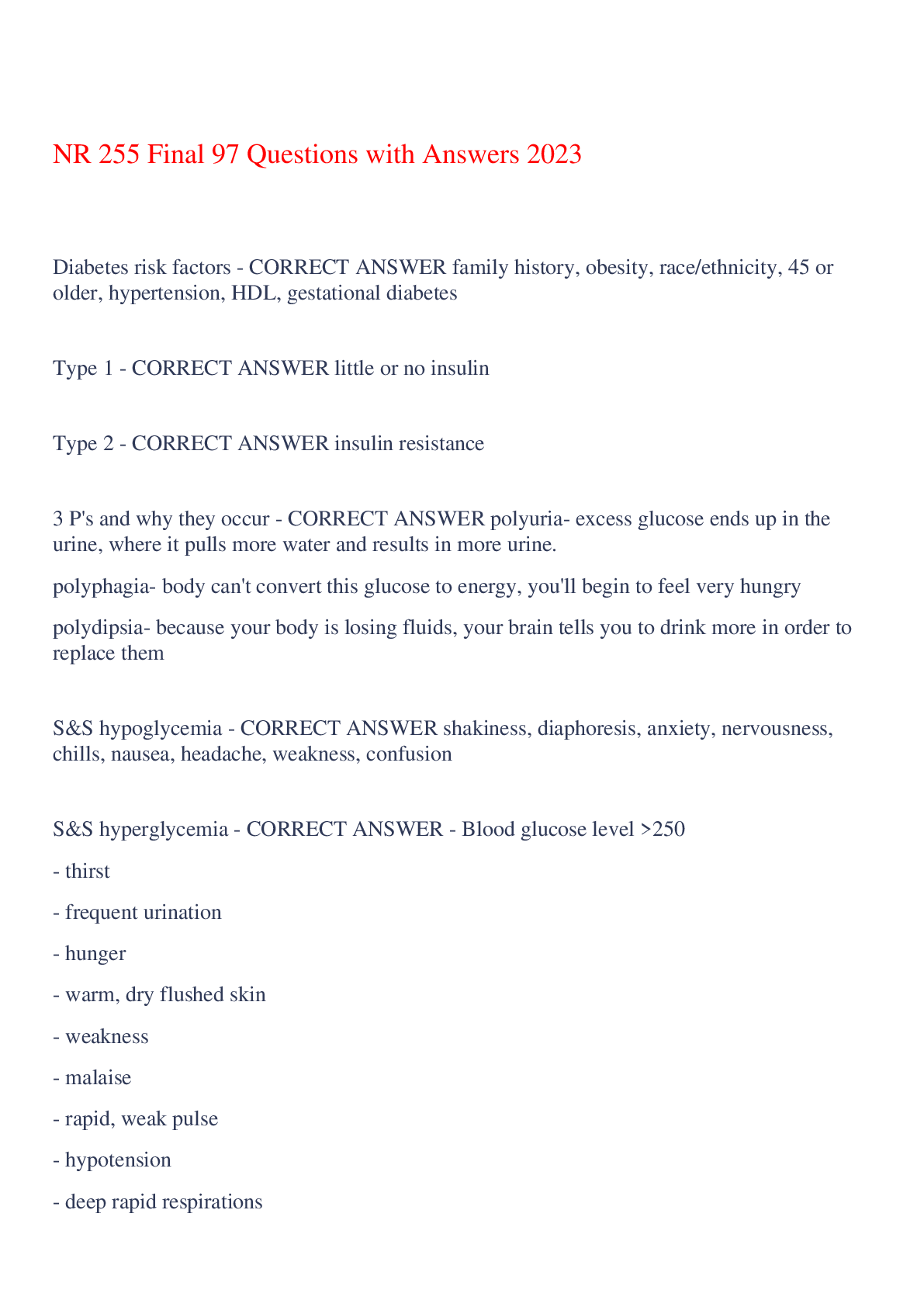
NR 255 Final 97 Questions with Answers 2023
Diabetes risk factors - CORRECT ANSWER family history, obesity, race/ethnicity, 45 or older, hypertension, HDL, gestational diabetes
Type 1 - CORRECT ANSWER little or n
...
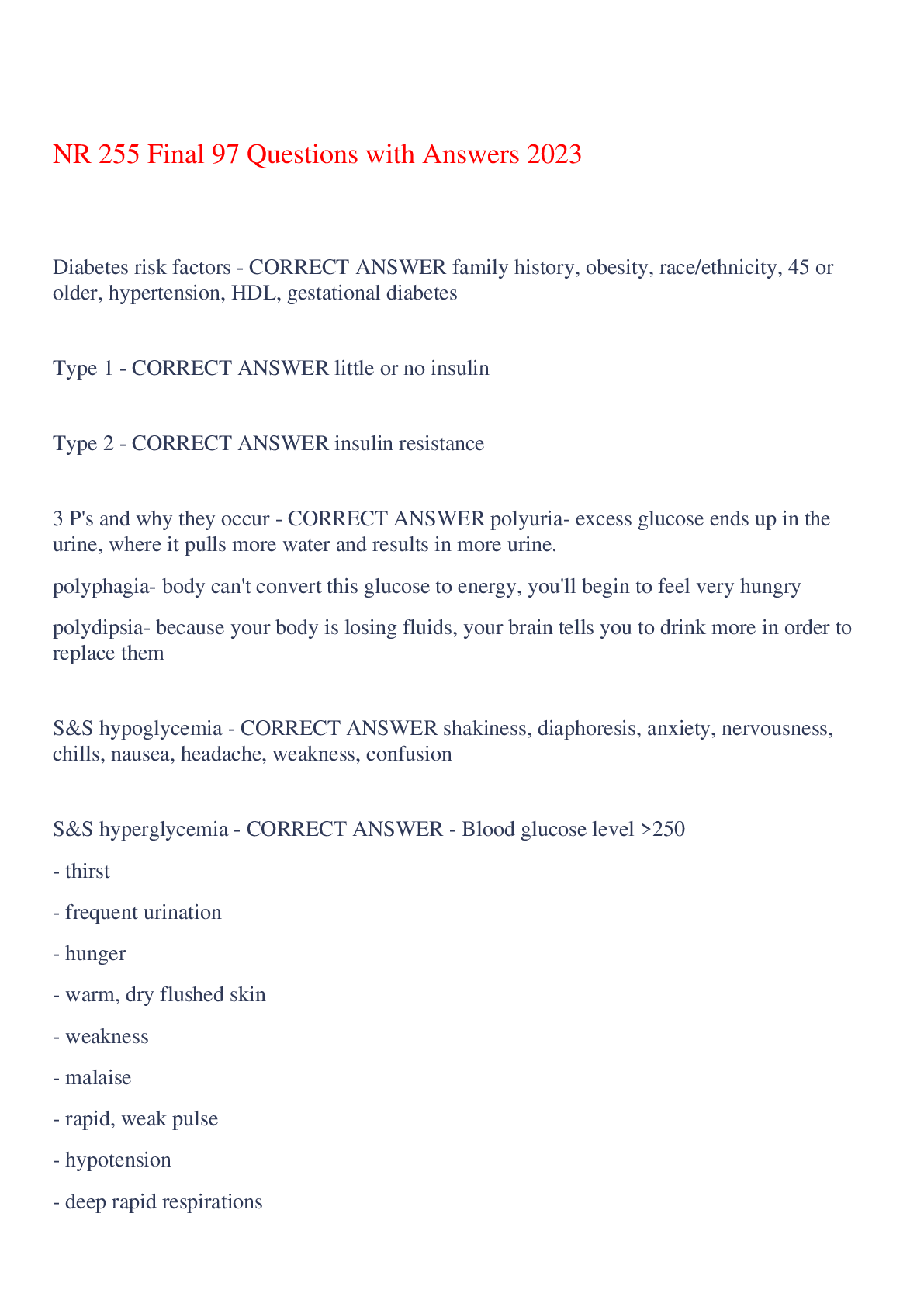
NR 255 Final 97 Questions with Answers 2023
Diabetes risk factors - CORRECT ANSWER family history, obesity, race/ethnicity, 45 or older, hypertension, HDL, gestational diabetes
Type 1 - CORRECT ANSWER little or no insulin
Type 2 - CORRECT ANSWER insulin resistance
3 P's and why they occur - CORRECT ANSWER polyuria- excess glucose ends up in the urine, where it pulls more water and results in more urine.
polyphagia- body can't convert this glucose to energy, you'll begin to feel very hungry
polydipsia- because your body is losing fluids, your brain tells you to drink more in order to replace them
S&S hypoglycemia - CORRECT ANSWER shakiness, diaphoresis, anxiety, nervousness, chills, nausea, headache, weakness, confusion
S&S hyperglycemia - CORRECT ANSWER - Blood glucose level >250
- thirst
- frequent urination
- hunger
- warm, dry flushed skin
- weakness
- malaise
- rapid, weak pulse
- hypotension
- deep rapid respirations
Criteria for diagnosing Diabetes - CORRECT ANSWER plasma glucose greater or equal to 200, FBS greater or equal to 126, A1C greater or equal to 6.5%
MNT - CORRECT ANSWER utrition-based treatment provided by a registered dietitian nutritionist
FBS - CORRECT ANSWER 80-100
HA1C - CORRECT ANSWER 3 month average of blood sugar
Glycemic Index - CORRECT ANSWER is a value assigned to foods based on how slowly or how quickly those foods cause increases in blood glucose level
Exercise precautions for diabetes - CORRECT ANSWER excercise 3 times a week, avoid extreme heat or cold, inspect feet after exercise, use proper footwear
Lispro (Humalog) - CORRECT ANSWER Peak: 1hr
Onset: 10-15min
rapid-acting
Aspart (Novalog) - CORRECT ANSWER peak: 45-50min
onset: 5-15min
rapid-acting
Glulisine (Apidra) - CORRECT ANSWER Peak: 30-60 min
Onset: 5-15min
rapid-acting
Humulin R, Novolin R, Ilentin 2 - CORRECT ANSWER Peak: 2-3 hours
Onset: 30-60 min
short-acting
NPH - CORRECT ANSWER Peak: 4-12 hours
Onset: 2-4 hours
intermidiate-acting
Glargine (Lantus) - CORRECT ANSWER Peak: continuous
Onset: 1 hour
Long-acting
Detemir (Levemir) - CORRECT ANSWER Peak: continuous
Onset: 6 hours
long-acting
Afrezza - CORRECT ANSWER Peak: 50 minutes
Onset: <15 min
inhaled insulin
Post-op shock - CORRECT ANSWER
Post-op teaching - CORRECT ANSWER
arterial insufficiency - CORRECT ANSWER
venous insufficiency - CORRECT ANSWER
Risk factors for PVD for patient education - CORRECT ANSWER
Intermittent claudication - CORRECT ANSWER
Stable angina - CORRECT ANSWER
Hypertension Classifications - CORRECT ANSWER
unstable angina - CORRECT ANSWER
Atherosclerosis - CORRECT ANSWER
Statin drug and side effect - CORRECT ANSWER
Nitro—self-administration guidelines - CORRECT ANSWER
heart failure staging - CORRECT ANSWER 1: no limitation to physical activity
2: slight limitation to physical activity
3:marked limitation of physical activity
4:unable to do physical activity
a: risk for developing
b: left ventricular dysfunction or structural heart disease
c: left ventricular dysfunction with symptoms
d:end-stage HF
BNP - CORRECT ANSWER less than 100 is normal, good indicator of CHF, edema, if elevated assess s/s of CHF
right sided heart failure - CORRECT ANSWER 1. Jungular Vein Distention
2. Ascending Dependent Edema
3. Weight Gain
4. Hepatomegaly (Liver Enlargement)
Lipid Panel levels - CORRECT ANSWER
Left sided heart failure - CORRECT ANSWER 1. Pnea, SOB
2. Crackles
3. Oliguria
4. Frothy Sputum
5. Displaced Apical Pulse (Hypertrophy)
COPD - CORRECT ANSWER
Emphesyma - CORRECT ANSWER
chronic bronchitis - CORRECT ANSWER
Asthma - CORRECT ANSWER
Pursed lip breathing - CORRECT ANSWER
Insentive Spirometry (IS) - CORRECT ANSWER
Pneumonia (whats the gold standard for testing) - CORRECT ANSWER
Osteoporosis - CORRECT ANSWER
pH - CORRECT ANSWER 7.35-7.45
below is:
above is:
CO2 - CORRECT ANSWER 35-45
HCO3- - CORRECT ANSWER 22-26
O2 - CORRECT ANSWER 80-100
Sodium levels S&S - CORRECT ANSWER 135-145
Potassium levels S&S - CORRECT ANSWER 3.5-5
FVE - CORRECT ANSWER
FVD - CORRECT ANSWER Dizziness (orthostatic/postural hypotension), Decreased urination (oliguria), Dry mouth, dry skin, Thirst and/or nausea, Weight loss (except in third spacing, where the fluid will still be in the body but inaccessible), Muscle weakness and lethargy.
Hyponatremia S/S - CORRECT ANSWER
Hypernatremia S/S - CORRECT ANSWER
Hypokalemia S/S - CORRECT ANSWER
Hyperkalemia S/S - CORRECT ANSWER
hemorrhagic stroke - CORRECT ANSWER
ischemic stroke - CORRECT ANSWER
Thrombolitic Ischemic Stroke - CORRECT ANSWER
Embolitic Ischemic Stroke - CORRECT ANSWER
tPA (tissue plasminogen activator) - CORRECT ANSWER
Stroke risk factors - CORRECT ANSWER
Stroke prevention - CORRECT ANSWER
Be FAST - CORRECT ANSWER Balance-
Eyes-
Face-
Arms-
Speech-
Time-
Preferred diagnostic test for suspected stroke - CORRECT ANSWER
GCS - CORRECT ANSWER
Nursing care for stroke - CORRECT ANSWER
Parkinson's Disease: - CORRECT ANSWER
constipation - CORRECT ANSWER
Diarrhea - CORRECT ANSWER
C difficle - CORRECT ANSWER
ulcerative colitis (UC) - CORRECT ANSWER
Chron's disease - CORRECT ANSWER
Gero consideration with diarrhea - CORRECT ANSWER
Diverticulitis - CORRECT ANSWER
Cholelithiasis - CORRECT ANSWER
Laparoscopic Cholecystectomy - CORRECT ANSWER
Glaucoma - CORRECT ANSWER
Cataracts - CORRECT ANSWER
AMD - CORRECT ANSWER
Types of Loss - CORRECT ANSWER
Kubler Ross stages - CORRECT ANSWER
Palliative care versus hospice - CORRECT ANSWER
Manifestations of approaching death - CORRECT ANSWER
Support for grieving family - CORRECT ANSWER
Post-Mortem Care - CORRECT ANSWER
ALZHEIMER'S DEMENTIA - CORRECT ANSWER
DELIRIUM - CORRECT ANSWER
RHEUMATOID ARTHRITIS - CORRECT ANSWER
A nurse is counseling an older adult client who describes having difficulty dealing whith several issues. Which of the following problems verbalized by the client should the nurse identify as priority?
a. "I spent my whole life dreaming about retirement, and now I wish I had my job back"
b. "It's been so stressful for me to have to depend on my child to help around the house"
c. "I just heard my friend Al died. Thats the third one in 3 months"
d. "I keep forgetting which medications I have taken during the day" - CORRECT ANSWER d. "I keep forgetting which medications I have taken during the day"
A nurse is providing teaching for an older adult client who has lost 4.5 kg (9.9lbs) since the last admission 6 months ago. Which of the following instructions should the nurse include in the teaching?
a. "eat 3 large meals a day"
b. "eat your meals in front of the television"
c. "eat foods that are easy to eat, such as finger foods"
d. "invite family members to eat meals with you"
e. "exercise everyday to increas appetite" - CORRECT ANSWER
A nurse is providing teaching for an older adult client who has lost 4.5 kg (9.9lbs) since the last admission 6 months ago. Which of the following instructions should the nurse include in the teaching?
a. "eat 3 large meals a day"
b. "eat your meals in front of the television"
c. "eat foods that are easy to eat, such as finger foods"
d. "invite family members to eat meals with you"
e. "exercise everyday to increas appetite" - CORRECT ANSWER c. "eat foods that are easy to eat, such as finger foods"
d. "invite family members to eat meals with you"
e. "exercise everyday to increas appetite"
A nurse is planning a presentation for a group of older adult clients about health promotion and disease prevention. Which of the following interventions should the nurse plan to recommend?
a. HPV immunization
b. Pneumococcal immunization
c. yearly eye examination
d. periodic mental health screening
e. annual fecal occult blood test - CORRECT ANSWER b. Pneumococcal immunization
c. yearly eye examination
d. periodic mental health screening
e. annual fecal occult blood test
A nurse is talking with an older adult client about improving nutritional status. which of the following interventions should the nurse recommend?
a. increase protein intake to increase muscle mass
b. decrease fluid intake to prevent urinary incontinence
c. increase calcium intake to prevent osteoporosis
d. limit sodium intake to prevent edema
e. increase fiber intake to prevent constipation - CORRECT ANSWER a. increase protein intake to increase muscle mass
c. increase calcium intake to prevent osteoporosis
d. limit sodium intake to prevent edema
e. increase fiber intake to prevent constipation
a nurse is collecting data from an older adult client as part of a comprehensive physical examination. which of the following findings should the nurse expect as associated with aging?
a. skin thickening
b. decreased height
c. increased saliva production
d. nail thickening
e. decreased bladder capacity - CORRECT ANSWER b. decreased height
d. nail thickening
e. decreased bladder capacity
A nurse is caring for a client who has terminal lung cancer. The nurse observes the client's family assisting with ADLs. which of the following rationales for self-care should the nurse communicate with the family
a. allowing the client to function independently will allow strengthen muscles and promote healing
b. the client needs privacy at times for self-reflecting and organizing life
c. the client's snese of loss can be lesseed through retaining control of some areas of life
d. performing ADLs is a requirement prior to discharge from an acute care facility - CORRECT ANSWER c. the client's snese of loss can be lesseed through retaining control of some areas of life
[Show More]








.png)