NR 255 Exam I|84 Questions with Answers 2023
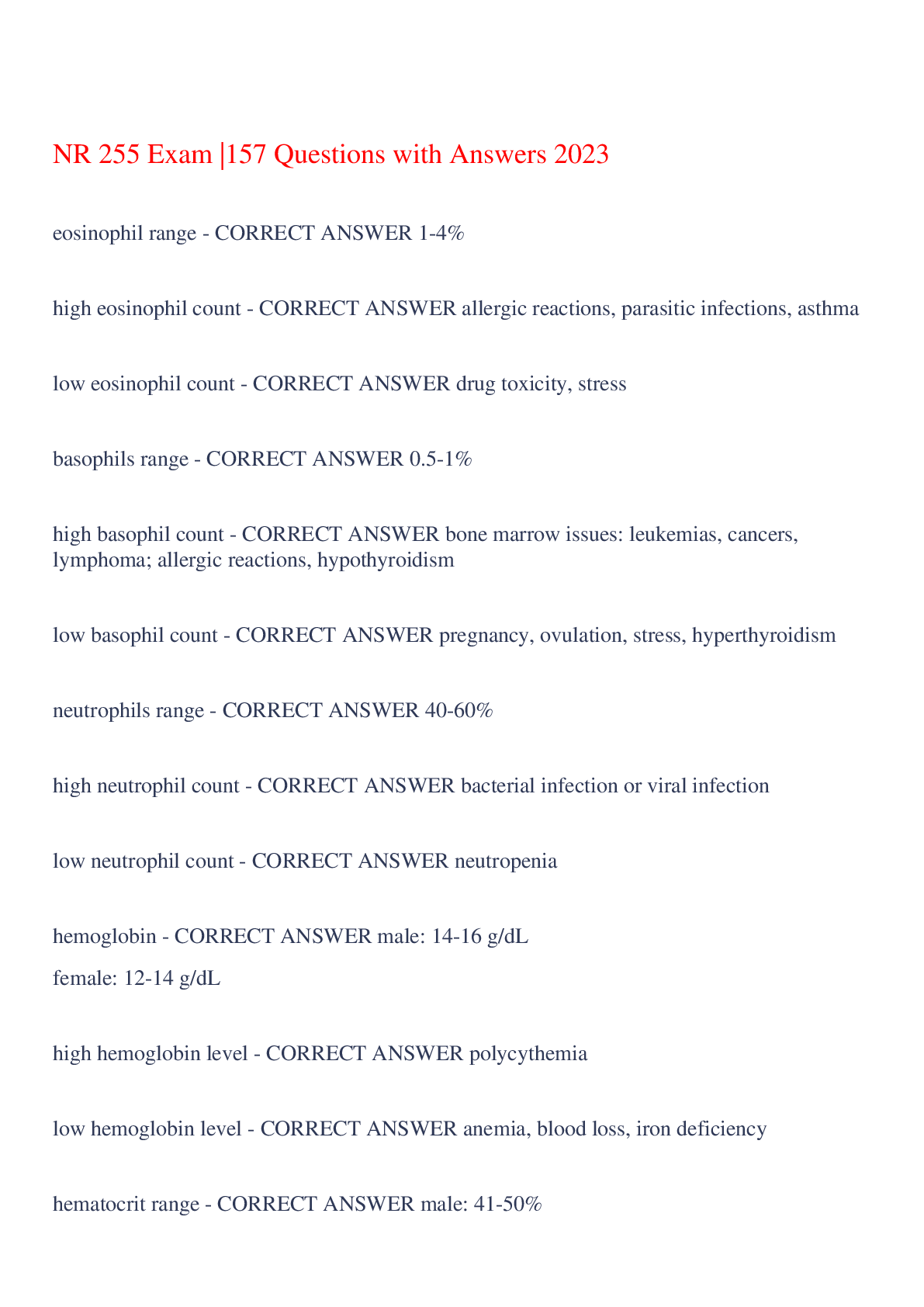
White Blood Cells (WBCs) - CORRECT ANSWER normal range- 5-10 cells/mcL
notes- very high=leukemia,
low= poor immunity
neutrophils (neutro) - CORRECT ANSWER normal
...
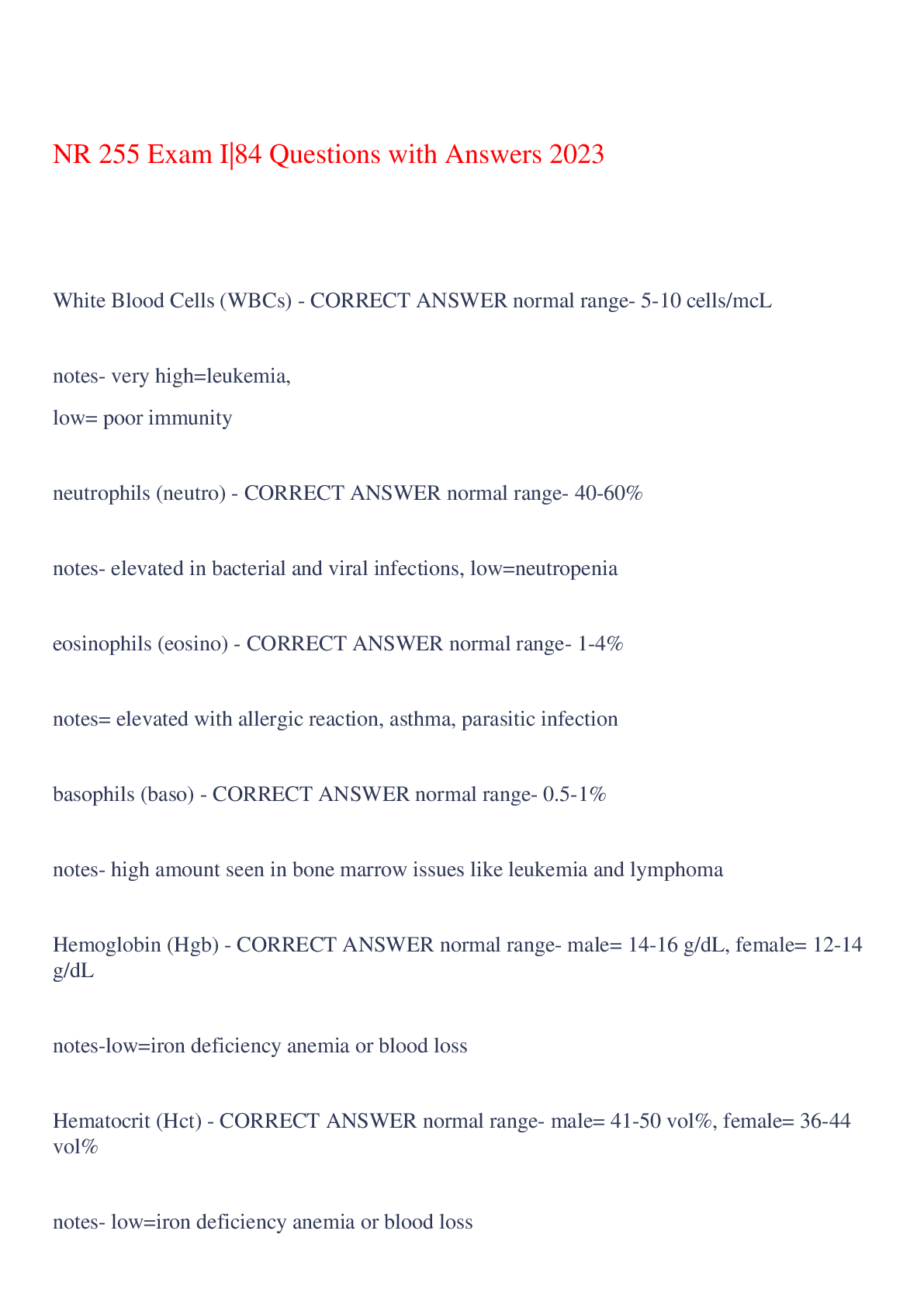
NR 255 Exam I|84 Questions with Answers 2023
White Blood Cells (WBCs) - CORRECT ANSWER normal range- 5-10 cells/mcL
notes- very high=leukemia,
low= poor immunity
neutrophils (neutro) - CORRECT ANSWER normal range- 40-60%
notes- elevated in bacterial and viral infections, low=neutropenia
eosinophils (eosino) - CORRECT ANSWER normal range- 1-4%
notes= elevated with allergic reaction, asthma, parasitic infection
basophils (baso) - CORRECT ANSWER normal range- 0.5-1%
notes- high amount seen in bone marrow issues like leukemia and lymphoma
Hemoglobin (Hgb) - CORRECT ANSWER normal range- male= 14-16 g/dL, female= 12-14 g/dL
notes-low=iron deficiency anemia or blood loss
Hematocrit (Hct) - CORRECT ANSWER normal range- male= 41-50 vol%, female= 36-44 vol%
notes- low=iron deficiency anemia or blood loss
BUN - CORRECT ANSWER normal range- 7-20 mg/dL
notes- high=impaired renal (kidney) function or dehydration, low= overhydration
Creatinine - CORRECT ANSWER normal range- 0.8-1.2 mg/dL
notes- high=impaired renal (kidney) function
Sodium - CORRECT ANSWER normal range- 135-145 mEq/L
notes- low=hyponatremia, high=hypernatremia, critical low < 120; critical high >160
Potassium - CORRECT ANSWER normal range- 3.5-5 mEq/L
notes- low= hypokalemia, high= hyperkalemia, critical low <2.6; critical high >6.1
Albumin - CORRECT ANSWER normal range- 4-6 g/dL
notes- helps determine liver or kidney disease, or if the body is not absorbing enough protein
Glucose - CORRECT ANSWER normal range- 70-110 mg/dL
notes- critical low < 40; critical high >450, normal fasting glucose 70-100
Perioperative phase - CORRECT ANSWER period of time from decision for surgery until patient is transferred into operating room pre-admission testing, admission to SC, In the holding area
Intraoperative phase - CORRECT ANSWER period of time from when patient is transferred into operating room to admission to post-anesthesia care unit (PACU)
• Maintenance of safety, physiologic monitoring, psychologic support
Postoperative phase - CORRECT ANSWER period of time from when patient is admitted to PACU to follow-up evaluation in clinical setting or at home
• Transfer of patient to PACU, post-op assessment, surgical unit, home or clinic
AORN - CORRECT ANSWER -Association of Peri-Operative Registered Nurses
-leader in advocating for excellence in peri-operative practice and healthcare
Ambulatory Surgery Centers (ASC) - CORRECT ANSWER - 23-hour surgeries or less take place at ASC
• Decreased length of surgery
• Decreased hospitalization
• Decreased associated costs
TJC (The Joint Commission)- NPSG (National Patient Safety Goals for the OR)-OR - CORRECT ANSWER 1. Identify patients correctly
2. Improve staff communication
3. Use medicines safely
4. Prevent infection
5. Identify patient safety risks
6. Prevent mistakes in surgery
scrub nurse - CORRECT ANSWER • Can be RN, LPN, surgical tech
• Keeping sterile field, doing counts, sending specimens
circulatory nurse - CORRECT ANSWER works alongside surgeons and other healthcare personnel in the operating room. They do not assist surgeons like scrub nurses, but instead record what happens during the procedure and make sure that the environment is clean and sterile
Special Considerations - CORRECT ANSWER - Patients who are obese
• Increased risk for infection, increased risk for pneumonia, increased risk for wound evisceration & dehiscence
- Patients with disabilities
• May require extra teaching
- Patients undergoing ambulatory surgery
• More vulnerable, very quick and requires fast teaching
- Patients undergoing emergency surgery
• More vulnerable, in a bad psychological state
Prophylactic infection control with antibiotics; know the timing - CORRECT ANSWER antibiotic prophylaxis is one of the most effective strategies for preventing SSIs especially if administered 1 hour before surgical incision
Medications That Can Affect Surgery or Anesthesia: Corticosteroids - CORRECT ANSWER • Thins skin
• Raises blood sugar levels
• Decreases immune system over time
Medications That Can Affect Surgery or Anesthesia: Diuretics - CORRECT ANSWER • Lose potassium
Informed Consent - CORRECT ANSWER -Should be in writing
-Should contain the following:
1. Explanation of procedure, risks
2. Description of benefits, alternatives
3. Offer to answer questions about procedure
4. Instructions that patient may withdraw
consent
5. Statement informing patient if protocol
differs from customary procedure
Patient Education in Preparation for OR - CORRECT ANSWER - Deep breathing, coughing, incentive spirometry
- Mobility, active body movement
- Pain management
- Cognitive coping strategies
- Instruction for patients undergoing ambulatory surgery
signs and symptoms of anaphylaxis - CORRECT ANSWER -Skin reactions, including hives and itching and flushed or pale skin
-Low blood pressure (hypotension)
-Constriction of your airways and a swollen tongue or throat, which can cause wheezing and trouble breathing
-A weak and rapid pulse
-Nausea, vomiting or diarrhea
-Dizziness or fainting
Types of Anesthesia - CORRECT ANSWER 1. General- done when patient is totally unconscious
2. Regional- sedated or given anesthesia in certain area
3. Local- given for stiches
4. Conscious Sedation- twilight (colonoscopy and EGD)
Penrose Drain - CORRECT ANSWER - Placed in the external aspect of the incision; drains directly on the dressing
Jackson-Pratt and Hemovac Drain - CORRECT ANSWER - Self-contained drainage systems that drain wounds directly through a tube via gravity and vacuum. They are sutured in place with suture that seals the area when the drain is removed. Nurses must use sterile technique to empty the reservoir and record the amount and color of drainage every shift or more, as ordered
how much drainage usually comes out in first 24 hrs - CORRECT ANSWER 200-800 mL
Post-Operative Complications - CORRECT ANSWER 1. Respiratory System
a. Atelectasis (complete respiratory failure)
b. Pneumonia
c. Hypoxemia
d. PE
2. Circulatory System
a. Hemorrhage
b. Hypovolemic shock
c. Thrombophlebitis
d. Thrombus
e. Embolism
3. GI
a. Paralytic ileus
b. Abdominal distension
c. N & V
4. Urinary System
a. Urinary retention
b. UTI
5. Integumentary System
a. Wound infection
b. Wound dehiscence
c. Wound evisceration
d. Skin breakdown
Surgical Environment - CORRECT ANSWER - Cool/basic design
- NPSG's
- Zones
- Required OR attire
Stages of Going Under General Anesthesia - CORRECT ANSWER 1. Stage 1: patient starts getting medication via IV; starts feeling dizzy
2. Stage 2: talk a lot, laugh a lot
3. Stage 3: patient is totally unconscious; intubated; patient has no response to pain
4. Stage 4 (NOT NORMAL): patient is too sedated; not coming out of anesthesia; vital signs are dropping
Additional risks for gero patients undergoing surgery - CORRECT ANSWER -Fear
-Complications/potential adverse effects/risks
-Gero Stats
-Biological Variations- Age-related changes
S/S of malignant hyperthermia - CORRECT ANSWER -Severe muscle rigidity or spasms
-Rapid, shallow breathing and problems with low oxygen and high carbon dioxide
-Rapid heart rate
-Abnormal heart rhythm
-Dangerously high body temperature
-Excessive sweating
-Patchy, irregular skin color (mottled skin)
S/S of hypothermia - CORRECT ANSWER -Shivering
-Exhaustion or feeling very tired
-Confusion
-Fumbling hands
-Memory loss
-Slurred speech
-Drowsiness
What is surgical asepsis? - CORRECT ANSWER the absence of all microorganisms within any type of invasive procedure. Sterile technique is a set of specific practices and procedures performed to make equipment and areas free from all microorganisms and to maintain that sterility
Anesthesia awareness - CORRECT ANSWER rare experience that occurs when surgical patients can recall their surroundings or an event - sometimes even pressure or pain -related to their surgery while they were under general anesthesia
Common medications used for N&V (nausea and vomiting - CORRECT ANSWER -odansetron
-metoclopramide
-promethazine
PACU nurse responsibilities - CORRECT ANSWER -view pertinent information, baseline assessment
upon admission to unit
-Assess airway, respirations, cardiovascular function,
surgical site, function of CNS, IVs, all tubes and
equipment
-Reassess VS, patient status every 15 minutes or more
frequently as needed
-Transfer report, to another unit or discharge patient to
home
aldrete scoring - CORRECT ANSWER -We use the Aldrete score to assess the anesthesia recovery phases
-examines the following five criteria: motor activity, respiration, blood pressure, consciousness, and color
Indicators of Hypovolemic Shock - CORRECT ANSWER - Pallor
- Cool, moist skin
- Rapid respirations
- Cyanosis
- Rapid, weak, thready pulse
- Decreasing pulse pressure
- Low blood pressure
- Concentrated urine
signs and symptoms of hemmorage - CORRECT ANSWER -A sudden severe headache
-Seizures with no previous history of seizures
-Weakness in an arm or leg
-Nausea or vomitin.
-Decreased alertness; lethargy
-Changes in vision
-Tingling or numbness
-Difficulty speaking or understanding speech
wound dehiscence - CORRECT ANSWER Dehiscence is a surgical complication where the edges of a wound no longer meet. 1 It is also known as "wound separation."
wound evisceration - CORRECT ANSWER abdominal organs then protrude or come out of the incision
DVT Prevention - CORRECT ANSWER -Anticoagulant. This is medicine that prevents blood clots.
-Compression stockings
-Exercises
-Ambulation (getting out of bed and walking)
-Sequential compression device (SCD) or intermittent pneumatic compression (IPC)
atelectasis - CORRECT ANSWER collapsed lung
-assess ABC's
-assess airway, respirations; patient at risk
for ineffective airway clearance every 15
minutes
Baby Boomers - CORRECT ANSWER - Turning 65 years of age beginning in 2010
- Most rapidly expanding population
- Disease presentations vary, most often complex and atypical
Differences in the presentation of disease in older adults - CORRECT ANSWER 1. UTI- confusion, incontinence, falls
2. Pneumonia- tachycardia, tachypnea, confusion, decreased appetite, decreased functioning
3. MI- sudden dyspnea, anxiety, confusion
Early Indicators of Acute Illness in Older Adults - CORRECT ANSWER 1. Mental status changes (often drug-related)
2. Falls (highly complex etiology)
3. Dehydration (reduced thirst response)
4. Decreased appetite
5. Loss of function
6. Dizziness
7. Incontinence (UTI)
Gerontology - CORRECT ANSWER study and care of adult age 65 and older
Changes in C-V System - CORRECT ANSWER - Leading cause of death
- Decrease in CO, decease in peripheral circulation
- Atypical symptoms such as fatigue, dizziness, fainting
- Orthostatic and post prandial hypotension
- Preventive measures include fall risk, keeping patient warm, monitoring vitals
Positive Orthostatic - CORRECT ANSWER blood pressure decreases, heart rate increases from the time they are supine to standing up
Post Prandial Hypotension - CORRECT ANSWER excessive decrease in blood pressure that occurs after a meal
Isolated Systolic Hypertension (ISH) - CORRECT ANSWER - Most common form of high blood pressure in people older than age 65
- Happens when your diastolic blood pressure is less than 80 mm Hg and your systolic blood pressure is 130 mm Hg or higher
- Cannot use antihypertensive because it will cause patient to "bottom-out"
Changes in Respiratory System - CORRECT ANSWER - Decreased aerobic capacity
- Decreased ciliary activity, decreased respiratory muscle strength
- Most older adults have smoked
- Preventive measures include deep breathing, incentive spirometry, hydration, coughing, etc.
Changes in Integumentary System - CORRECT ANSWER - Lose subcutaneous fat and connective tissue
- Skin less elastic, more dry and more fragile
- Lack of fever
- Reduced tolerance to temperature changes
- Xerosis (dry skin)
- Thinning and graying of hair
- Preventive measures include layer clothing, use sunscreen, etc.
Seborrheic Keratosis - CORRECT ANSWER • Benign
• Found on upper back and face
• Elevated, light brown, irregularly shaped
Cherry Angiomas - CORRECT ANSWER • Hyperproliferation of capillaries
• Most commonly occur in older adult
• Benign
• Can go away over time
Single Lentigo (Age Spots) - CORRECT ANSWER • In sun exposed areas
• Flat, occur on face, hands, forearms
• Benign
• Can be lasered off
Melanoma - CORRECT ANSWER • Most dangerous form of skin cancer
• Invades basement membrane and travels
o Asymmetry
o Boarder
o Color
o Diameter
o Evolution
Varicella Zoster- "Shingles" - CORRECT ANSWER - Viral infection that causes a painful rash
- Most often seen around your waist
- Caused by the same virus that causes chickenpox
Changes in Reproductive System - CORRECT ANSWER - Sexuality; libido unchanged; less intense response
Changes in Reproductive System FEMALE - CORRECT ANSWER • Supporting musculature of the reproductive organs weakens, increasing risk of uterine prolapse
• Breast tissue diminishes
Changes in Reproductive System MALE - CORRECT ANSWER • Prostate gland may enlarge
• Sperm count and viscosity of seminal fluid decrease
Changes in GI System - CORRECT ANSWER - Digestion declines
- Decreased sense of smell
- Decreased saliva (xerostomia)
- Decreased GI motility, increased risk of constipation
- Taste declines (dysgeusia)
- Dysphagia
- Tooth loss (edentulism)
Changes in the Endocrine System - CORRECT ANSWER - Less insulin secreted
- Decreased sensitivity to insulin
Nutrition - CORRECT ANSWER - Slower metabolic rate
- Less physically active
- Lack of vitamin D, Calcium and B12
Sleep - CORRECT ANSWER - Increased complaints
Obstructive Sleep Apnea (OSA) - CORRECT ANSWER - When the muscles of the oropharynx become relaxed and can block the trachea; patient stops breathing
Changes in the Musculoskeletal System - CORRECT ANSWER - ADL's and IADL's are altered
- Exercise
- DJD (O/A) after 70 years of age
Dorsal Kyphosis - CORRECT ANSWER - Curvature of the thoracic spine due to deterioration of the vertebrate
Changes in the Nervous System - CORRECT ANSWER - ANS is decreasing
Changes in GU System - CORRECT ANSWER - Male- benign prostatic hyperplasia (BPH)
- Female- more prone to incontinence
Changes in Vision - CORRECT ANSWER - Presbyopia- inability to see things in close range
- Sensitivity to glare
- Adjustment to changes in light
- Increase in eye diseases
- MD= primary cause of vision loss
- Visual aides
Changes in Hearing - CORRECT ANSWER - Presbycusis- inability to hear high-pitched tones
- Cerumen build-up
Mini-Mental State Exam (MMSE) - CORRECT ANSWER - Detects cognitive ability
Depression in older adult - CORRECT ANSWER - Most common mood disorder in older adult
- Suicide risk is greater in males
- Geriatric Depression Scale
- Treated by medications, biofeedback, etc.
Delirium in older adult - CORRECT ANSWER - Acute confusional state; reversible
- Always has an underlying cause
Dementia in older adult - CORRECT ANSWER - Describes a series of diseases made up of symptoms such as decreased memory and thinking skills; progressive and irreversible
- Most common type is AD
Alzheimer's Disease (AD) - CORRECT ANSWER - Disease of plaques and tangles
- Progressive, irreversible, degenerative
-First symptom of AD is memory loss
Vascular Dementia - CORRECT ANSWER - Second most common type of dementia
- Caused by blockage of carotids
Elder Abuse and Neglect - CORRECT ANSWER - Neglect= most common form of abuse
[Show More]