NR 255 Exam |157 Questions with Answers 2023
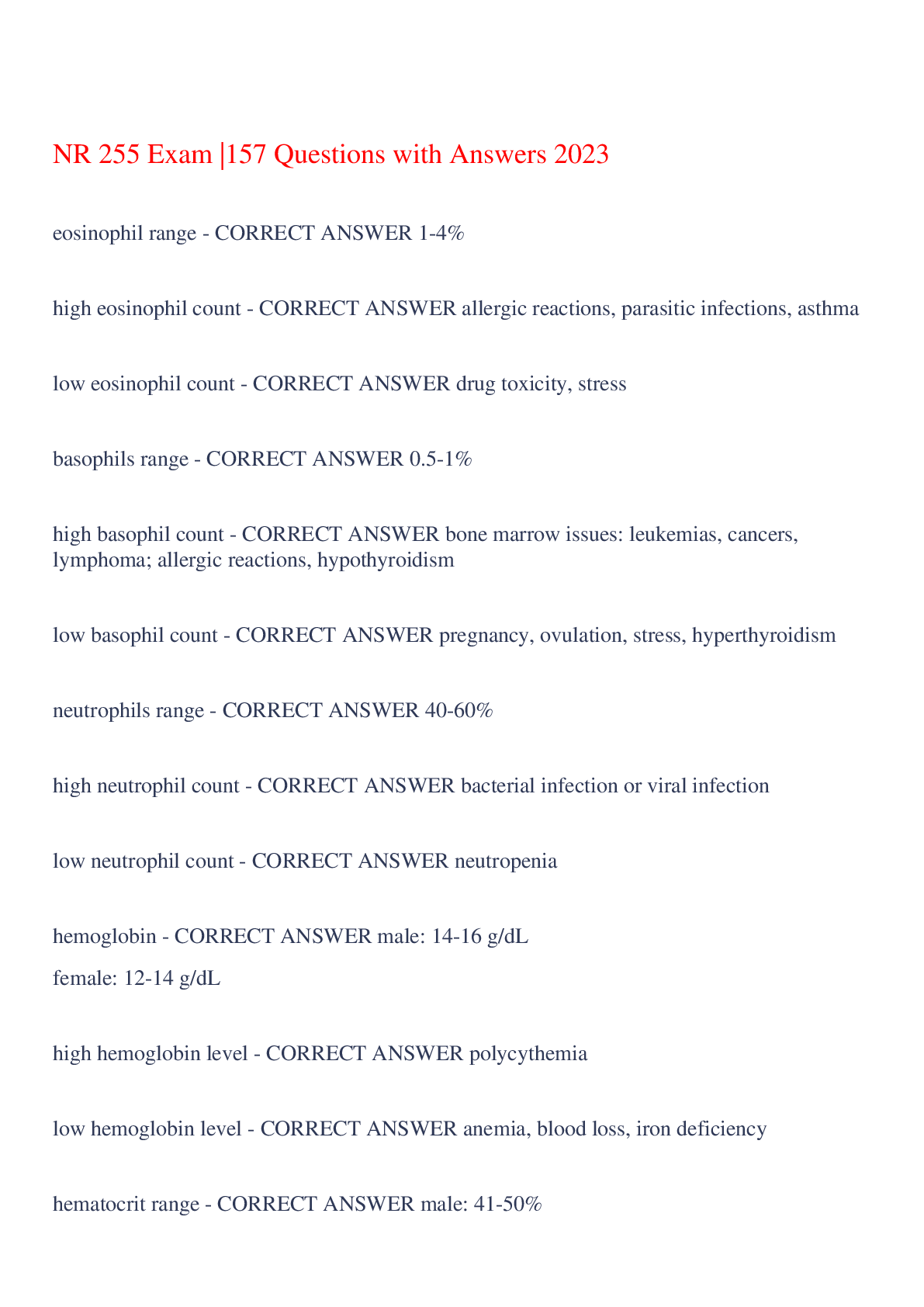
eosinophil range - CORRECT ANSWER 1-4%
high eosinophil count - CORRECT ANSWER allergic reactions, parasitic infections, asthma
low eosinophil count - CORRECT ANSWER
...
NR 255 Exam |157 Questions with Answers 2023
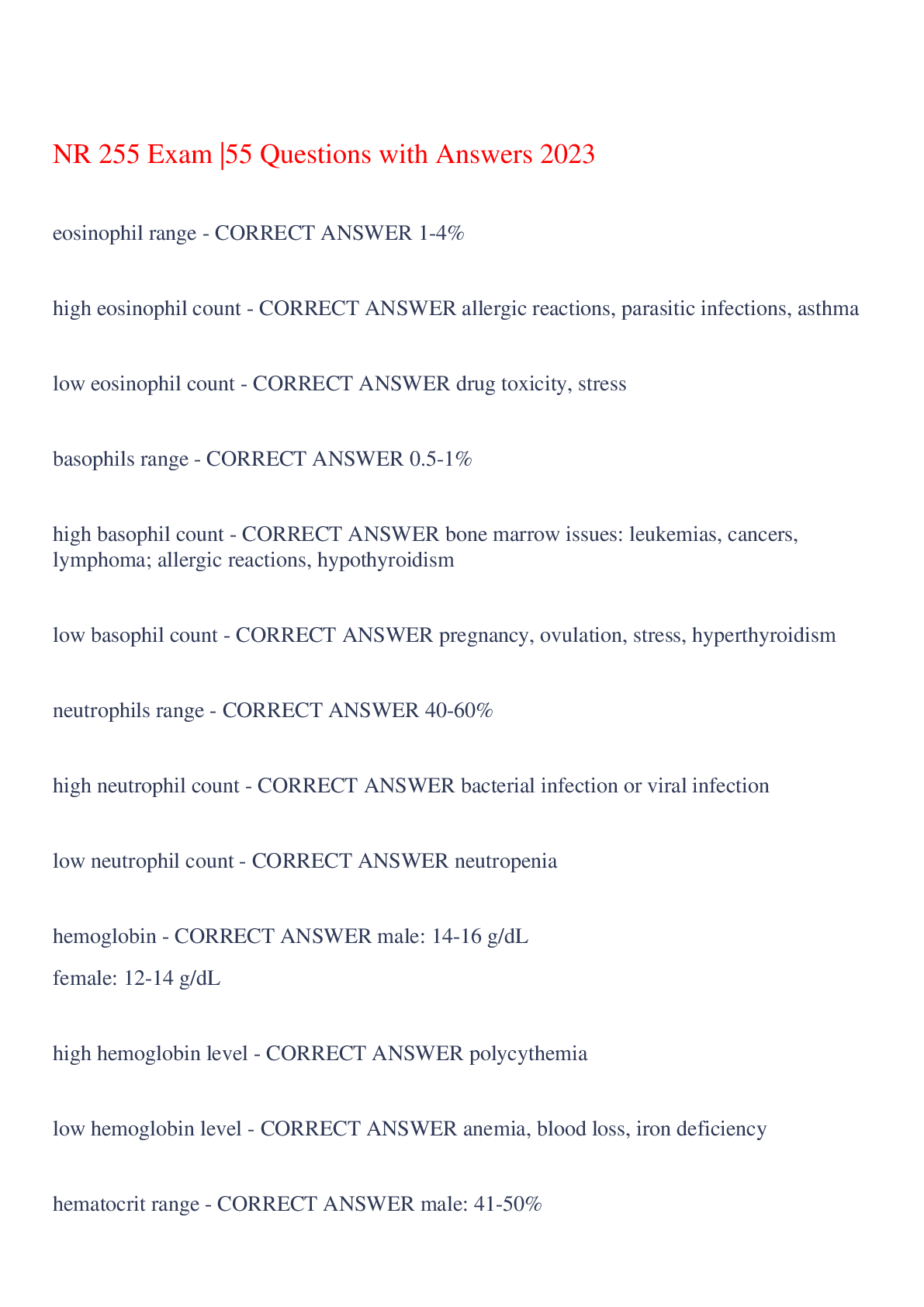
eosinophil range - CORRECT ANSWER 1-4%
high eosinophil count - CORRECT ANSWER allergic reactions, parasitic infections, asthma
low eosinophil count - CORRECT ANSWER drug toxicity, stress
basophils range - CORRECT ANSWER 0.5-1%
high basophil count - CORRECT ANSWER bone marrow issues: leukemias, cancers, lymphoma; allergic reactions, hypothyroidism
low basophil count - CORRECT ANSWER pregnancy, ovulation, stress, hyperthyroidism
neutrophils range - CORRECT ANSWER 40-60%
high neutrophil count - CORRECT ANSWER bacterial infection or viral infection
low neutrophil count - CORRECT ANSWER neutropenia
hemoglobin - CORRECT ANSWER male: 14-16 g/dL
female: 12-14 g/dL
high hemoglobin level - CORRECT ANSWER polycythemia
low hemoglobin level - CORRECT ANSWER anemia, blood loss, iron deficiency
hematocrit range - CORRECT ANSWER male: 41-50%
female: 36-44%
high hematocrit - CORRECT ANSWER dehydration, low availability of oxygen, genetic, erythrocytosis, COPD
low hematocrit - CORRECT ANSWER anemia, blood loss, iron deficiency
BUN range - CORRECT ANSWER 7-20
high BUN - CORRECT ANSWER impaired renal function, dehydration
low BUN - CORRECT ANSWER liver disease, liver failure, over hydrated
creatinine range - CORRECT ANSWER 0.8-1.2
high creatinine - CORRECT ANSWER renal failure
low creatinine - CORRECT ANSWER low muscle mass, advanced age, liver failure, malnutrition, malnutrition
sodium range - CORRECT ANSWER 135-145
high sodium - CORRECT ANSWER hypernatremia, dehydration, impaired thirst, confusion, lethargy, fatigue, exhaustion, seizures
low sodium - CORRECT ANSWER hyponatremia, fluid overload, nausea, headache, confusion, fatigue, lethargy, impaired excretion
potassium - CORRECT ANSWER 3.5-5.0
high potassium - CORRECT ANSWER hyperkalemia, chest pain, arrythmias, muscle weakness, nausea
low potassium - CORRECT ANSWER hypokalemia, weakness, cramps, palpitations, delirium
albumin range - CORRECT ANSWER 4-6 g/dL
high albumin - CORRECT ANSWER dehydration
low albumin - CORRECT ANSWER Malnutrition, Kidney disease, Liver disease, Uncontrolled Diabetes, Severe burns, SLE, RA, Heart Failure, Crohn, Celiac
glucose range - CORRECT ANSWER 70-110
high glucose - CORRECT ANSWER hyperglycemia, dry mouth, confusion, fruity-breath, abdominal pain N&V
low glucose - CORRECT ANSWER hypoglycemia, confusion, shakiness, anxiety, heart palpitations
a nurse is providing teaching to the partner of a client who has alzheimer's disease and has a new prescription for donepezil. which of the following statements by the partner indicates the teaching is effective - CORRECT ANSWER "this medication should help my husbands daily function"
a nurse is working in a long-term care facility is planning care for a client who has moderate alzheimer's (mild or moderate stage). which of the following interventions should be included in the plan of care - CORRECT ANSWER reorient the client to self and current events
a nurse is making a home visit to a client who has AD. the clients partner states that the client is often disoriented to time and place, is unsteady, and has a history of wandering. which of the following safety measures should the nurse review with the partner - CORRECT ANSWER remove floor rugs, provide increased lighting in stairwells, install handrails in the bathroom, place the mattress on the floor
a nurse is caring for a client who has AD and falls frequently. which of the following actions should the nurse take first to keep the client safe - CORRECT ANSWER place the client in a room close to the nurses station
a nurse is caring for a client who has alzheimer's disease. a family member of the client asks the nurse about risk factors for the disease. which of the following should be included in the nurses response - CORRECT ANSWER exposure to metal waste products, previous head injury, history of herpes infection
a nurse administered midazolam IV bolus to a client before a procedure. the client's blood pressure is 86/40 mmHg, and the heart rate is 134 /min. which of the following IV medications should the nurse administer - CORRECT ANSWER flumazenil
a nurse is assisting an anesthesiologist who is delivering nitrous oxide by face mask to a client during the induction of anesthesia. which of the following is the priority nursing action - CORRECT ANSWER assess oxygen saturation
a nurse is caring for a client who develops malignant hyperthermia. which of the following actions should the nurse take - CORRECT ANSWER infuse iced IV fluids, provide 100% oxygen, place a cooling blanket on the client, administer IV dantrolene
a nurse is caring for a client who develops a systemic toxic reaction following a regional block. which of the following actions should the nurse take - CORRECT ANSWER provide airway support
a nurse is caring for a client who reports a headache following an epidural regional nerve block. which of the following actions should the nurse take - CORRECT ANSWER place the head of the bed flat
a nurse is assessing a clients laboratory values before surgery. which of the following results should the nurse report to thee provider - CORRECT ANSWER creatinine 2.8 mg/dL, blood glucose 235 mg/dL, WBC 17,850/mm^3
a nurse is providing preoperative teaching to a client who is to have abdominal surgery. which of the following statements should the nurse make - CORRECT ANSWER "take your heart medication with a sip of water before surgery," "splint the abdominal incision with a pillow when coughing and deep breathing," "anti-embolism stockings are applied before surgery"
a nurse is verifying informed consent for a client who is having a paracentesis. which of the following actions should the nurse take - CORRECT ANSWER ensure the client understand information about the procedure, witness the client signing the informed consent, determine if the client is capable of understanding the reason for the procedure
a nurse is caring for a client who is scheduled for an exploratory laparotomy. the clients temperature is 39*C (102.2*F) orally. which of the following actions should the nurse take - CORRECT ANSWER inform the surgeon of the elevated temperature
a preoperative nurse is caring for client who is having a colon resection. which of the following actions should the nurse take - CORRECT ANSWER remove nail polish on fingers and toes
a nurse is reviewing the medical records fo several clients in the posts-anesthesia care unit (PACU) to identify risk factors that can lead to postoperative complications. which of the following clients are at risk for complications - CORRECT ANSWER a client who has a WBC of 22,500/uL, a client who uses an insulin pump, a client who takes warfarin daily, a client who has heart failure
a nurse is caring for a client who manifests indications of hypovolemia while in the PACU. which of the following findings requires action by the nurse - CORRECT ANSWER urine output less than 25 mL/hr, hematocrit 53%, BUN 24 mg/dL, tenting of skin over the sternum
a nurse is caring for a client who arrived in the PACU following a total hip arthroplasty. the client is not responding to verbal stimuli. which of the following actions should the nurse perform first - CORRECT ANSWER place the client in a lateral position
a nurse is planning care for a client to prevent postoperative atelectasis. which of the following interventions should the nurse include in the plan of care - CORRECT ANSWER encourage use of the incentive spirometer every 2 hours, instruct the client to splint the incision when coughing and deep breathing, reposition the client every 2 hours, assist with early ambulation
a nurse is caring for a client who reports nausea and vomiting 2 days postoperative following hysterectomy. which of the following actions should the nurse perform first - CORRECT ANSWER assess bowel sounds
a nurse is counseling an older adult who describes having difficulty dealing with several issues. which of the following problems verbalized by the client should the nurse identify as the priority - CORRECT ANSWER "i keep forgetting which medications i have taken during the day"
a nurse is providing teaching for an older adult client who has lost 4.5 kg (9.9 lbs) since the last admission 6 months ago. which of the following instructions should the nurse include in the teaching - CORRECT ANSWER "eat foods that are easy to eat, such as finger foods," "invite family member to eat meals with you," "exercise everyday to increase appetite"
a nurse is planning a presentation for a group of older adults about health promotion and disease prevention. which of the following interventions should the nurse plan to recommend - CORRECT ANSWER pneumococcal immunization, yearly eye examination, periodic mental health screening, annual fecal occult blood test
a nurse is talking with an older adult client about improving nutritional status. which of the following interventions should the nurse recommend - CORRECT ANSWER increase protein intake to increase muscle mass, increase calcium intake to prevent osteoporosis, limit sodium intake to prevent edema, increase fiber intake to prevent constipation
a nurse is collecting data from an older adult client as a part of a comprehensive physical examination. which of the following findings should the nurse expect as associated with aging - CORRECT ANSWER decreased height, nail thickening, decreased bladder capacity
registered nurse first assistant (RNFA) - CORRECT ANSWER RN with additional education and training in surgical technique. RNFA serves an assistant to the surgeon to perform the surgical procedure. can open, close and suture. like a PA
preoperative phase - CORRECT ANSWER period of time from decision for surgery until patient is transferred into operating room
intraoperative phase - CORRECT ANSWER period of time from when patient is transferred into operating room to admission to postanesthesia care unit (PACU)
postoperative phase - CORRECT ANSWER period of time from when patient is admitted to PACU to follow-up evaluation in clinical setting or at home
Association of Peri-Operative Registered Nurses (AORN) - CORRECT ANSWER governing body for OR nurses (and RNFA); domains of care for patients, guidelines and education, national patient safety
circulating nurse - CORRECT ANSWER provides needed materials during the procedure and handling surgical specimen. remains unsterile, documentation, helps position patient, adjusts lighting, grabs additional supplies, positions equipment
scrub nurse - CORRECT ANSWER a nurse who assists surgeons during surgery, wearing sterile attire and handling sterile equipment and supplies
ambulatory surgery center - CORRECT ANSWER same day surgery; decreased length of surgery, hospitalization, and costs
joint commission in the OR - CORRECT ANSWER identify patients correctly, improve staff communication, use medicines safely, prevent infection, identify patient safety risks and preventing mistakes in surgery; checklists
seriousness of surgical procedures - CORRECT ANSWER major vs. minor
urgency of surgical procedures - CORRECT ANSWER elective, urgent or emergency
purpose of surgical procedures - CORRECT ANSWER diagnostic, ablative, palliative, reconstructive/restorative, procurement/transplant, constructive, cosmetic
diagnostic surgery - CORRECT ANSWER exploratory; biopsy
ablative surgery - CORRECT ANSWER removal of diseased body part; amputation
palliative surgery - CORRECT ANSWER surgery that is performed to relieve pain or other symptoms but not to cure the cancer or prolong a patient's life; debridement
reconstructive/restorative surgery - CORRECT ANSWER restores function or appearance to traumatized or malfunctioning tissues; scar revision
procurement/transplant surgery - CORRECT ANSWER an organ or tissue is harvested from someone pronounced brain dead for transplantation into another person; kidney, heart, liver
constructive surgery - CORRECT ANSWER to restore function in congenital anomalies; cleft palate
cosmetic surgery - CORRECT ANSWER a medical operation to improve a person's appearance; breast augmentation, rhinoplasty
emergent surgery - CORRECT ANSWER right away
urgent surgery - CORRECT ANSWER within 24-30 hours
required surgery - CORRECT ANSWER within weeks or months
elective surgery - CORRECT ANSWER not needed, voluntary
optional surgery - CORRECT ANSWER not critical to survival or function, personal preference
pre admission testing - CORRECT ANSWER allergies/reactions, trouble with anesthesia, nutritional and fluid status, dentition, drug/alcohol use, medications, psychosocial factors, spiritual/cultural beliefs, each system assessment
pre op preparation - CORRECT ANSWER informed consent, teaching, fasting protocol (2 hours before elective, 8 hours before complex), reducing risks: fluid and electrolyte balance (125 ml/hr), surgical site infection (antibiotics 1 hour before, 1-2 days after), bowel and bladder measures; health promotion: hygiene, rest, and comfort
geriatric considerations with surgery - CORRECT ANSWER cardiac, circulatory, and respiratory compromise, renal function, confusion, fluid and electrolyte imbalances, skin, comorbities, altered sensory, mobility restrictions
special considerations for surgery - CORRECT ANSWER obese patients, disabled patients, ambulatory surgeries, emergency surgeries
evisceration - CORRECT ANSWER wound separation with protrusion of organs; cover with saline towel
medications that affect surgery/anesthesia - CORRECT ANSWER corticosteroids, diuretics, phenothiazines, insulin, antibiotics, anticoagulants, anti-seizure, thyroid hormone, opioids, OTC and herbals, illicit drugs
which medication classification must be assessed during the preoperative period because it can cause an electrolyte imbalance during surgery - CORRECT ANSWER diuretics (potassium)
informed consent - CORRECT ANSWER should be in writing; should include explanation and risks of the procedure, description of benefits and alternatives. offer to answer question, patient may withdraw consent up until sedation, statement informing patient if protocol differs from customary procedure
voluntary consent - CORRECT ANSWER freely given without coercion, at least 18 years old, obtained by physician, patients signature witnessed by staff
incompetent patient for consent - CORRECT ANSWER cannot give or withhold consent, must have POA
patient education with surgery - CORRECT ANSWER deep breathing, coughing, incentive spirometer, mobility, active body movement, pain management, cognitive coping strategies, hydration
steroids before surgery - CORRECT ANSWER increases risk of complications
diuretics before surgery - CORRECT ANSWER increases risk for dehydration
post op respiratory complications - CORRECT ANSWER atelectasis, pneumonia, hypoxia, pulmonary embolism
post op circulatory complications - CORRECT ANSWER hemorrhage, hypovolemic shock, thrombophlebitis, thrombus, embolism
post op GI complications - CORRECT ANSWER paralytic ileus, abdominal distention, N&V
post op urinary complications - CORRECT ANSWER urinary retention, UTI
post op integumentary complications - CORRECT ANSWER wound infection, wound dehiscence, wound evisceration, skin breakdown
S/S of anaphylaxis - CORRECT ANSWER -headache, dizziness paresthesia, feeling of impending doom
-pruritis, angioedema, erythema, urticaria, itching, burning
-hoarseness, coughing, sensation of narrowed airway, wheezing, stridor, dyspnea, tachypnea, respiratory arrest
-hypotension, dysthythmias, tachycardia, cardiac arrest
-cramping, abdominal pain, N&V, diarrhea
general anesthesia - CORRECT ANSWER the blockage of all body sensations, causing un-consciousness and loss of reflexes, intubation
regional anesthesia - CORRECT ANSWER temporary interruption of nerve conduction, is produced by injecting an anesthetic solution near the nerves to be blocked, epidural
local anesthesia - CORRECT ANSWER causes the loss of sensation in a limited area by injecting an anesthetic solution near that area
conscious sedation - CORRECT ANSWER condition in which internal sedative medications are used alone or in conjunction with local anesthetics and the client has a depressed level of consciousness but is still able to breathe and respond to verbal stimuli
preventing post op complications - CORRECT ANSWER diaphragmatic breathing, coughing, leg exercises, turning side to side, early ambulation, getting out of bed
JP drain - CORRECT ANSWER abbreviation for Jackson-Pratt drain; suction drain with tubing inside the body and a bulb reservoir which, when squeezed empty, applies suction and pulls fluid out of the body; used in thoracic or abdominal surgery
hemovac drain - CORRECT ANSWER closed wound drainage system connected to a suction often used for mastectomy and total knee/hip replacement
penrose drain - CORRECT ANSWER a flat, thin, rubber tube inserted into a wound to allow for fluid to flow from the wound; it has an open end that drains onto a dressing
drainage in first 24 hours post op - CORRECT ANSWER 200-800 mL
the nurse is preparing to administer a pre mediation which causes sedation. which of the following actions should the nurse take first - CORRECT ANSWER have the patient void
the primary goal in withholding food before surgery is to prevent aspiration - CORRECT ANSWER true
surgical environment - CORRECT ANSWER cool, basic design, 70-75*F, 50-60% humidity, zones, OR attire, staff: circulator, scrub tech, surgeon, PA, RNFA, CRNA/anesthesiologist
geriatric patients undergoing surgery - CORRECT ANSWER fear, complications, potential adverse effects, risks, statistics, age related changes
stage 1 of anesthesia - CORRECT ANSWER patient feels dizzy
stage 2 of anesthesia - CORRECT ANSWER giddy, laughing, excessive talking, "truth serum"
stage 3 of anesthesia - CORRECT ANSWER unconscious, intubation
stage 4 of anesthesia - CORRECT ANSWER over sedation, not waking up, overdose, reversible agent= narcan, decreased vitals
S/S of malignant hyperthermia - CORRECT ANSWER *allergy to anesthesia* fever, tachycardia, skin mottling, cyanosis, rise in end tidal carbon dioxide
S/S of hypothermia - CORRECT ANSWER shivering stops and muscular activity decreases/stiffness; no muscle coordination; lethargic; confused; sleepy; altered mental status; may try to remove clothing; decreased LOC; weak pulse and slow respirations; low BP or none; loss of sensation to touch; mood changes; impaired judgement ; warm blankets and warm IV fluids
surgical asepsis - CORRECT ANSWER sterile technique
how do nurses promote surgical asepsis - CORRECT ANSWER protocol, environment
anesthesia awareness - CORRECT ANSWER occurs when there is a paralysis effect but not a loss of consciousness, awake but paralyzed
antiemetics - CORRECT ANSWER control nausea and vomiting by blocking nerve impulses to the vomiting center of the brain; ativan, zofran
cold patient - CORRECT ANSWER increased cardiac workload
the primary nursing goal in the immediate postoperative period is maintenance of pulmonary function and prevention of a laryngospasm - CORRECT ANSWER false, anesthesia monitors this
primary objective of nurse in PACU - CORRECT ANSWER ABC's: airway, breathing, circulation
aldrete score - CORRECT ANSWER postanesthesia recovery score
S/S of shock - CORRECT ANSWER low BP, rapid & weak pulse, increased thirst, cold & clammy skin, restlessness
S/S of hemorrhage - CORRECT ANSWER Increase pulse rate, decrease in BP, excessive bright red bleeding, boggy uterus that does not respond to massage, unusual pelvic discomfort or back pain, cold, clammy skin
most common CNS complication with geriatric adults in surgery - CORRECT ANSWER postoperative delirium
cause of postoperative delirium - CORRECT ANSWER F&E imbalance, dehydration, hypoxia, infections, pain
treatment of postoperative delirium - CORRECT ANSWER antipsychotics
the most important nursing intervention when vomiting occurs postoperatively is to turn the patient's head to prevent aspiration of vomitus into the lungs - CORRECT ANSWER true
wound dehiscence - CORRECT ANSWER separation of the layers of a surgical wound; may be partial, or superficial only, or complete, with disruption of all layers
wound evisceration - CORRECT ANSWER protrusion of internal organs and tissues through incision
prevention of DVT - CORRECT ANSWER early ambulation, adequate hydration, scd's, anticoagulants
atelectasis prevention - CORRECT ANSWER increasing mobility, coughing, deep breathing, effective pain management, incisional splinting
Isolated systolic hypertension (ISH) - CORRECT ANSWER systolic is 140+ and diastolic is 90 or less--occurs mainly in older adults
early indicators of acute illness - CORRECT ANSWER mental status changes, falls, dehydration, decrease in appetite, loss of function, dizziness, incontinence
atypical presentation of illness in older adults - CORRECT ANSWER no s/s
benign skin conditions - CORRECT ANSWER age spots, skin tags, cherry angiomas, keratosis, warts, freckles
malignant skin conditions - CORRECT ANSWER skin cancer
physical changes with age - CORRECT ANSWER visual acuity, both sharpness and brightness
hearing, especially sensing higher pitch
reaction time and general motor abilities
neural processing speed, especially for complex and novel tasks
systemic changes with age - CORRECT ANSWER skin is thinner, cardiac output and BP lower, decreased lung capacity
sleep hygiene - CORRECT ANSWER practices that a patient associates with sleep, struggles with staying asleep, no deep sleep
obstructive sleep apnea (OSA) - CORRECT ANSWER repetitive pharyngeal collapse during sleep, which leads to absence of breathing; can produce daytime drowsiness and elevated blood pressure
ABCDEs of melanoma - CORRECT ANSWER asymmetry, border, color, diameter, evolution
shingles - CORRECT ANSWER viral disease that affects the peripheral nerves and causes blisters on the skin that follow the course of the affected nerves, herpes zoster
shingles treatment - CORRECT ANSWER antiviral and pain control
nutrition requirements for older adults - CORRECT ANSWER fewer calories, more nutrient rich food, barriers for getting food, calcium and B12 needs
dorsal kyphosis - CORRECT ANSWER curvature of the thoracic spine
Mini-Mental State Examination (MMSE) - CORRECT ANSWER A test that is used to measure cognitive ability, especially in late adulthood.
depression - CORRECT ANSWER A prolonged feeling of helplessness, hopelessness, and sadness
delirium - CORRECT ANSWER mental disorder marked by confusion; uncontrolled excitement; ADJ. delirious
dementia - CORRECT ANSWER An abnormal condition marked by multiple cognitive defects that include memory impairment.
elder abuse - CORRECT ANSWER the abuse or neglect of older family members
[Show More]