Nursing Jurisprudence Questions and
Answers 100% Verified
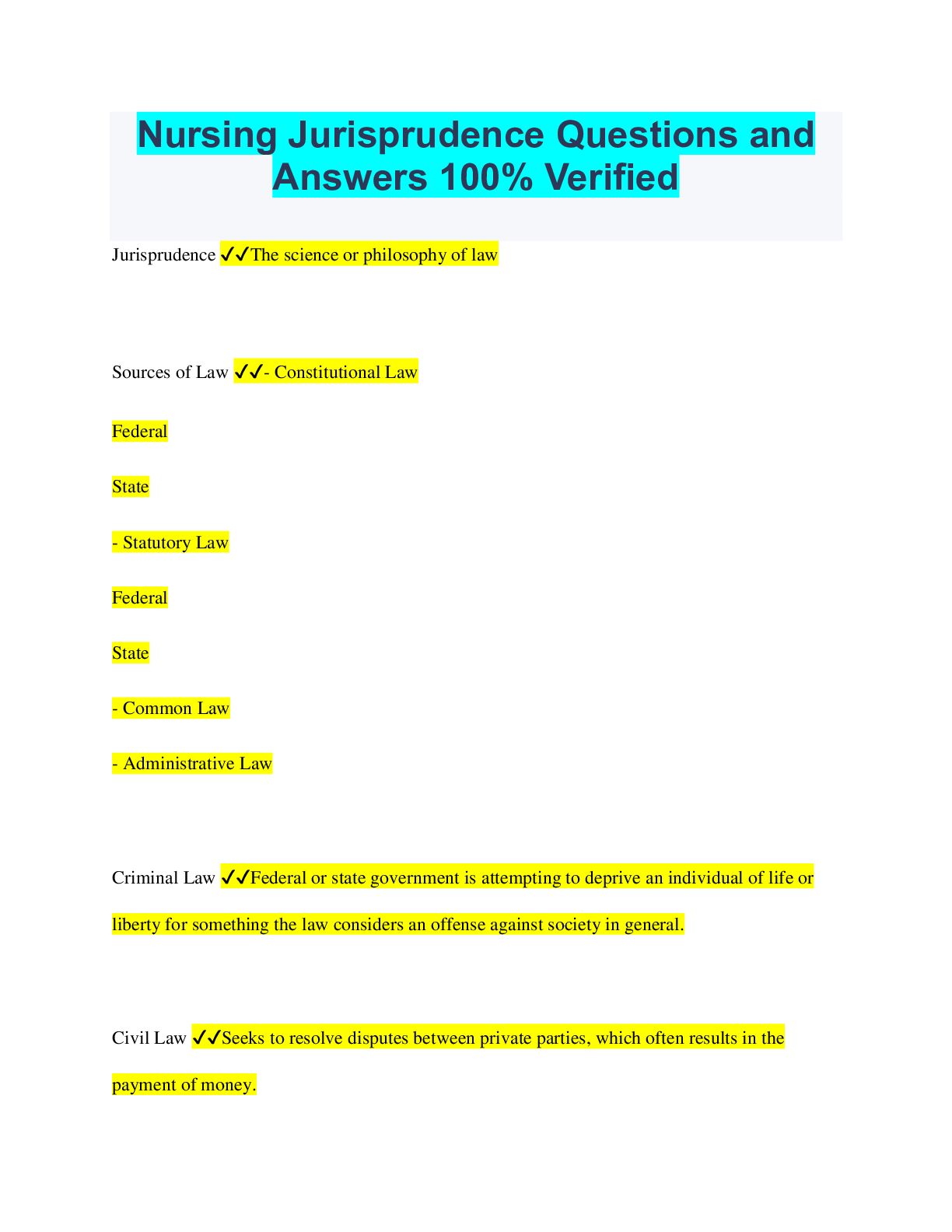
Jurisprudence ✔✔The science or philosophy of law
Sources of Law ✔✔- Constitutional Law
Federal
State
- Statutory Law
Federal
State
- Common Law
- Admini
...
Nursing Jurisprudence Questions and
Answers 100% Verified
Jurisprudence ✔✔The science or philosophy of law
Sources of Law ✔✔- Constitutional Law
Federal
State
- Statutory Law
Federal
State
- Common Law
- Administrative Law
Criminal Law ✔✔Federal or state government is attempting to deprive an individual of life or
liberty for something the law considers an offense against society in general.
Civil Law ✔✔Seeks to resolve disputes between private parties, which often results in the
payment of money.
Different Burden of Proof ✔✔Beyond a reasonable doubt
A preponderance of the evidence
Tort Law ✔✔A civil wrong that causes someone else to suffer loss or harm resulting in legal
liability for the person who commits the tortious act.
Types of Torts ✔✔- Negligence
- Intentional Torts
Assault
Battery
False Imprisonment
- Quasi-Intentional Torts
Defamaiton
Libel
Slander
Malpractice ✔✔Negligence committed by a person in his or her professional capacity is
malpractice. Also known as professional negligence.
Medical and nursing malpractice occur when a doctor or nurse fails to do that which a
reasonable, prudent doctor or nurse would do under the same or similar circumstances, or does
that which a reasonable or prudent doctor or nurse would not do under the same or similar
circumstances.
Elements of a Nursing Malpractice Lawsuit ✔✔Duty - the existence of a duty, owed by the nurse
to a patient, to conform to a recognized standard of care
Breach - a failure to conform to the required standard of care
Harm - an actual injury
Cause - there must be proof that the injury was caused by the nurse's act or omission
Intentional Tort: Assault ✔✔Intentionally placing another in apprehension or fear that they will
suffer harmful or offensive contact.
Intentional Tort: Battery ✔✔Intentional contact that is harmful or offensive, or creating the
apprehension that such contact is imminent.
Intentional Tort: False Imprisonment ✔✔Willful detention without consent and without authority
of law.
Quasi-Intentional Tort: Defamation ✔✔A communication that tends to hold the plaintiff up to
hatred, contempt or ridicule, or to cause him to be shunned or avoided.
Tarnishing the reputation of someone.
Quasi-Intentional Tort: Defamation Types ✔✔Types:
Libel - printed or broadcast
Slander - spoken
Nurse Practice Act ✔✔The practice of nursing is a right granted by a state to protect those who
need nursing care. The guidelines of the NPA and its rules provide safe parameters within which
to work, as well as protect patients from unprofessional and unsafe nursing practice. The act is a
dynamic document that evolves and is updated or amended as changes in scope of practice occur.
All states and territories have enacted a NPA
Generally, NPAs include:
Authority, power and composition of a board of nursing
Education program standards
Standards and scope of nursing practice
Types of titles and licenses
Requirements for licensure
Grounds for disciplinary action, other violations and possible remedies
Rules & Regulations ✔✔The NPA itself is insufficient to provide the necessary guidance for the
nursing profession, therefore, each NPA establishes a board of nursing (BON) that has the
authority to develop administrative rules or regulations to clarify or make the law more specific.
Rules and regulations must be consistent with the NPA and cannot go beyond it. These rules and
regulations undergo a process of public review before enactment. Once enacted, rules and
regulations have the full force and effect of law.
IT IS A NURSE'S RESPONSIBILITY TO KNOW NPA/RULES AND REGULATIONS ✔✔As
a nurse in Texas, you have a responsibility to know and follow the Nursing Practice Act and all
applicable BON Rules and Regulations relating to your nursing practice. All current BON Rules
and
Regulations and the Nursing Practice Act can be downloaded from the BON's web site at
www.bon.texas.gov
Standards of Nursing Practice ✔✔Standards Applicable to All Nurses. All vocational nurses,
registered nurses and registered nurses with advanced practice authorization shall:
(A) Know and conform to the Texas Nursing Practice Act and the board's rules and regulations
as well as all federal, state, or local laws, rules or regulations affecting the nurse's current area of
nursing practice.
The standards of practice establish a minimum acceptable level of nursing practice in any setting
for each level of nursing licensure or advanced practice authorization. Failure to meet these
standards may result in action against the
nurse's license even if no actual patient injury resulted.
Laws & Regulations Regarding Nursing ✔✔- Texas Nurse Practice Act (NPA)
- Texas Board of Nursing (BON) Rules & Regulations
- BON Position Statements
Don't have the force of law, but the Board strongly encourages nurses to choose those position
statements applicable to their practice setting and incorporate them into their daily practice to
assure patient safety
The Texas Board of Nursing (BON) ✔✔Established by passage of the NPA
BON empowered by NPA with the responsibility and legal authority for ensuring competent
practitioners of nursing.
Grants authority to the BON to make the rules and regulations to carry out the act.
The Board: ✔✔protects the public from unsafe nursing practice, provides approval for more than
200 nursing education programs, issues licenses to more than 27,000 nurses per year by
examination to new graduates and by endorsement to licensees from other states seeking a Texas
license, as well as providing nursing practice and education guidance to more than 350,000
currently licensed nurses practicing in the State of Texas.
BON Responsibilities & Services ✔✔Licensing qualified practitioners
Enforcement - investigating violations of the NPA and initiating appropriate legal action when
necessary
Establishing minimum standards for educational programs in nursing
BON Mission Statement ✔✔To protect and promote the welfare of the people of Texas by
ensuring that each person holding a license as a nurse in the State of Texas is competent to
practice safely.
BON Mission Fulfilled Through ✔✔The regulation of the practice of nursing, and
The approval of nursing education programs.
Licensure Required ✔✔A person may not practice or offer to practice professional nursing or
vocational nursing in this state unless the person is licensed [NPA § 301.251]
This section of the NPA establishes the NPA as a practice control act for RNs and LVNs
Use of Titles ✔✔Must hold a license to use the title:
Registered Nurse or RN
Professional Nurse
Licensed Vocational Nurse or LVN
Any designation that implies that the person is a licensed registered or vocational nurse
Clearly Legible Insignia ✔✔When interacting with the public in a nursing role, RNs and LVNs
must wear an insignia identifying them as RNs or LVNs [NPA § 301.351]
APRNs practicing in an advance practice role must identify themselves with their APRN title
BON Rule 217.10(b) requires the nurse's first or last name and licensure level
Although the board does not require the inclusion of any other designations, with the exception
of the
specific authorization of advanced practice nurses, the insignia may not contain information
other than: ✔✔(A) the registered nurse or licensed vocational nurse designation;
(B) the nurse's name, certifications, academic degrees, or practice position;
(C) the name of the employing facility or agency, or other employer; or
(D) a picture of the nurse.
No More Paper Licenses ✔✔The BON discontinued issuing wallet-sized paper licenses for
nurses renewing their licenses beginning September 1, 2008
Paper license certificates are issued for:
Graduate nurses who pass the NCLEX® exam and obtain their initial license in Texas;
Nurses who hold licenses in other states and are obtaining a Texas license for the first time; and
Nurses who receive full licensure as APRNs
Licensure Verification ✔✔Employers may verify the licensure status of all nurses seeking
employment online or by phone.
Renewal of Licensure ✔✔60 days prior to license expiration, the BON will mail a postcard
reminder to renew online.
This is one of the reasons it is important to keep your contact information up to date!
Continuing Competency (TAC Chapter 216) ✔✔Purpose: to ensure nurses stay abreast of
current industry practices, enhance their professional competence, learn about new technology
and treatment regimens, and update their clinical skills. [TAC § 216.2]
All nurses are required to demonstrate continuing competency for renewal of licensure.
Methods:
Complete 20 hours of continuing education, or
Attain, maintain, or renew an approved national nursing certification in the area of practice
Nursing Jurisprudence & Ethics - 2 hours [Rule 216.3 (g)]
Older Adult or Geriatric Care - 2 hours [Rule 216.3 (h)]
Nurse Licensure Compact ✔✔The Nurse Licensure Compact (NLC) allows RNs and LVNs to
have one multistate license, with the ability to practice in both their home state and other NLC
states.
The APRN Compact allows an advanced practice registered nurse to hold one multistate license
with a privilege to practice in other compact states.
Agreement among states to mutually recognize each others' licenses
Texas among first to adopt
Premise: current licensure requirements essentially the same from state to state
Does not interfere with each state defining scope of practice
Only defines requirements to hold license
Nurse Licensure Compact - Definitions ✔✔Party states - states who have adopted the compact
Home state license - where you permanently reside
Remote state - where you practice using multistate privilege (must be a party state)
Nurse Licensure Compact - Requirements ✔✔Maintain home state license
Adhere to state practice laws of state in which patient is located at the time care is provided
Use multistate privilege only in party states
Hold home state license in only one party state at a time.
Practice in a Non-Party State ✔✔To practice in a state that is not part of the Compact, the nurse
must obtain license from the non-party state
May concurrently hold a home state license and a license to practice in a non-party state
If you live in a non-party state, you must obtain a non-resident Texas license in order to practice
in Texas
Ethical Conduct ✔✔Year after year, Nursing is recognized as one of the most trusted
professions.
It is important to maintain that trust, so we can practice efficiently.
...what is good and bad and with moral duty and obligation...
Good Professional Character ✔✔Integrated pattern of personal, academic and occupational
behaviors which, in the judgment of the Board, indicates that an individual is able to consistently
conform his or her conduct to the requirements of the Nursing Practice Act, the Board's rules and
regulations, and generally accepted standards of nursing practice including, but not limited to,
behaviors indicating honesty, accountability, trustworthiness, reliability, and integrity [TAC §
213.27(a)].
Factors Indicating Good Professional Character ✔✔Distinguish right from wrong;
Think and act rationally;
Keep promises and honor obligations;
Accountable for own behavior;
Able to practice nursing in an autonomous role with patients/clients, their families, significant
others, and members of the public who are or who may become physically, emotionally, or
financially vulnerable;
Recognize and honor the interpersonal boundaries appropriate to any therapeutic relationship or
health care setting; and
Promptly and fully self-disclose facts, circumstances, events, errors, and omissions when such
disclosure could enhance the health status of patients/clients or the public or could protect
patients/clients or the public from unnecessary risk of harm [ Rule 213.27(b)(2)(A-G)].
Any conviction for a felony or for a misdemeanor involving moral turpitude or order of
probation with or without an adjudication of guilt for an offense that would be a felony or
misdemeanor involving moral turpitude if guilt were adjudicated [Rule 213.27 (b)(3)].
Any revocation, suspension, or denial of, or any other adverse action relating to, the person's
license or privilege to practice nursing in another jurisdiction [Rule 213.27 (b)(4)].
Criminal Behavior Disclosure ✔✔Requirement for criminal history for applicants for a license
[NPA § 301.2511].
Requirement for criminal history for renewal of license [NPA § 301.3011].
Disclose:
Convictions
Deferred adjudications
Probated sentences
Domestic offenses
Professional Boundaries ✔✔The appropriate limits which should be established by the nurse in
the nurse/client relationship due to the nurse's power and the patient's vulnerability. Refers to the
provision of nursing services within the limits of the nurse/client relationship which promote the
client's dignity, independence and best interests and refrain from inappropriate involvement in
the client's personal relationships and/or the obtainment of the nurse's personal gain at the client's
expense.
A zone of patient-centered care is in the center of the professional behavior continuum. This is
where the patient interactions should occur for effectiveness and patient safety. Overinvolvement with a patient is on the right side of the continuum; this includes boundary
crossings, boundary violations and professional sexual misconduct. Under-involvement lies on
the left side; this includes distancing, disinterest and neglect, and can be detrimental to the
patient and the nurse.
Rule 217.11. Standards of Nursing Practice ✔✔Know, recognize, and maintain professional
boundaries of the nurse-client relationship
Rule 217.12. Unprofessional Conduct ✔✔Misconduct — actions or conduct that include, but are
not limited to:
(D) Violating professional boundaries of the nurse/client relationship including but not limited
to physical, sexual, emotional or financial exploitation of the client or the client's significant
other(s)
Unprofessional Conduct ✔✔Using fraud or deceit in procuring a license
Improperly using a nursing license
Impersonating another person in examination
Aiding and abetting someone in unlawful practice
Failing to cooperate with a lawful investigation
Behaving in a threatening or violent manner in the workplace
Offering, giving, soliciting, or receiving or agreeing to receive, directly or indirectly, any fee or
other consideration to or from a third party for the referral of a client in connection with the
performance of professional services.
Rule 217.12. Standards of Nursing Practice ✔✔This rule covers standards of nursing practice
that apply to all nurses, including RNs, LVNs, and APRNs.
This is one rule to know well!
Standards of Nursing Practice (cont) ✔✔Know and conform to the Texas Nursing Practice Act
and the board's rules and regulations
Promote a safe environment for clients and others
Know the rationale for and the effects of medications and treatments and correctly administer
Accurately and completely report and document
Respect the client's right to privacy by protecting confidential information
Promote and participate in education and counseling
Notify the appropriate supervisor when leaving a nursing assignment
Know, recognize, and maintain professional boundaries of the nurse-client relationship
Role of LVN ✔✔Directed scope of practice that must be supervised
Educated to care for clients with stable and predictable conditions
Educated to do hands-on assessments using their senses
Role of RN ✔✔Works in both structured and unstructured healthcare environments
Responsible for well-being of all patients
Functions within the scope of the NPA and Board rules
Professional Nursing Only ✔✔Practice independently within NPA and board rules
Make nursing diagnosis
Develop a nursing care plan
Perform comprehensive assessment
Evaluate patient response to nursing care
Vocational Nursing ✔✔Practice in Planning of Nursing Care
Assisting in evaluating patient response to nursing care
Perform focused assessment
LVN Supervision ✔✔The practice of vocational nursing must be performed under the
supervision of a registered nurse, physician, physician assistant, podiatrist, or dentist.
Duty of a Nurse in any Practice Setting ✔✔Establishes, through the NPA and Board Rules, that a
nurse has a responsibility and duty to a client/patient to provide and coordinate the delivery of
safe, effective nursing care.
This duty supersedes any facility policy or physician order.
Duty to the patient
Lunsford v. Board of Nurse Examiners, 648 S.W. 2d 391 (Tex. App.--Austin, 1983)
The court in affirming the disciplinary action of the Board, held that a nurse has a duty to the
patient which cannot be superseded by hospital policy or physician's order.
This landmark case involved a gentleman who arrived to a rural hospital via private vehicle. The
gentleman was experiencing severe chest pain, nausea, and sweating—all hallmark symptoms of
myocardial infarction (heart attack). Nurse Lunsford was summoned to the ER waiting room by
this gentleman's friend. Upon seeing the acute distress the man was experiencing and hearing his
symptoms, she instructed his friend to drive the man to the nearest facility equipped to handle
heart attack victims. This facility was 24 miles away. The man succumbed to the heart attack 5
miles away from the small hospital.
When the Board sought to sanction the nurse's license, the nurse maintained that the ER
physician (who never saw the man) told her the man needed to be transported to the larger
facility. The facility policy was also to transfer patients experiencing heart attacks (via
ambulance) to the larger facility that was equipped to provide the broad range of therapies that
might be needed.
The court sided with the BON and agreed that the nurse had the knowledge, skills and abilities to
recognize the life-threatening nature of the man's symptoms. Because of this knowledge, the
court maintained that it was the nurse's duty to act in the best interest of the client by assessing
the man, taking measures to stabilize him and to prevent complications, and communicating his
condition to other staff (such as the MD) in order to enlist appropriate medical care
Graduate Nurse ✔✔Supervision for a period of six months, or lesser time, if agreed upon by the
newly licensed nurse and the supervising nurse
Competence to perform independently should be mutually determined by the new graduate and
the supervising nurse and demonstrated and supported by documentation
Nurses transitioning back to practice or to new primary practice area ✔✔Should not act as
charge nurse for at least six months, unless a lesser time period is agreed upon by the nurse and
his/her supervisor, based on the competency of the nurse
Six-Step Decision-Making Model ✔✔Tool developed by the BON to assist nurses in making
good professional judgments about the nursing tasks or procedures they choose to undertake.
Goal is making sure that he/she only accepts those assignments for which the nurse has the
education, training, and skill competency
1. Is the activity consistent with the Nursing Practice Act (NPA), Board Rules, and Board
Position Statements and or/Guideline? Yes: continue. No: stop.
2. Is the activity appropriately authorized by valid order/protocol and in accordance with
established policies and behaviors? Yes: continue. No: stop.
3. Is the act supported by either research reported in nursing and health-related literature or in
scope of practice statements by national nursing organizations? Yes: continue. No: stop.
4. Do you possess the required knowledge and have you demonstrated the competency required
to carry out this activity safely? ""
5. Would a reasonable and prudent nurse perform this activity in this setting?
6. Are you prepared to assume accountability for the provision of safe care and the outcome of
the care rendered?
Yes: Perform the activity. No: stop.
Delegation ✔✔Authorizing an unlicensed person to provide nursing services while retaining
accountability for how the unlicensed person performs the task. It does not include situations in
which an unlicensed person is directly assisting a RN by carrying out nursing tasks in the
presence of a RN [Rule 224.4 (3)].
RNs may delegate
LVNs may supervise
The RN is responsible for the evaluation of the delegated task to ensure it was completed and
completed correctly [Rule 224.3].
According to the BON website, many find delegation to be a perplexing concept with multiple
nuances.
The BON created the Delegation Resource Packet to afford RNs clearer direction for delegation
in a variety of settings thereby improving the delegation process
Criteria for Delegation ✔✔RNs may delegate
LVNs may supervise
The RN is responsible for the evaluation of the delegated task to ensure it was completed and
completed correctly [Rule 224.3].
Nursing Tasks Prohibited from Delegation ✔✔Formulation of the nursing care plan and
evaluation of the client's response to the care rendered.
Specific tasks involved in the implementation of the care plan which require professional nursing
judgment or intervention.
The responsibility and accountability for client health teaching and health counseling which
promotes client education and involves the client's significant others in accomplishing health
goals.
Administration of medications, including intravenous fluids, except by medication aides as
permitted under §224.9 of this title (relating to The Medication Aide Permit Holder).
Mandatory Reporting Requirement ✔✔A nurse shall report to the board if the nurse has
reasonable cause to suspect that:
1. Another nurse has engaged in conduct subject to reporting; or
2. the ability of a nursing student to perform the services of the nursing profession would be, or
would reasonably be expected to be, impaired by chemical dependency.
Alternative to Mandatory Reporting ✔✔Instead of reporting to the board under a nurse may
make a report to:
1. a nursing peer review committee under Chapter 303; or
2. to the nursing educational program in which the student is enrolled.
Employer Duty to Report ✔✔If an employer terminates a nurse (voluntarily or involuntarily),
suspends for seven (7) or more days, or takes other substantive disciplinary action against a nurse
or substantially equivalent action against an agency nurse for nursing practice errors/concerns,
the employer must report to the Board (BON) in writing [NPA § 301.405 (b)]
Minor Incidents ✔✔"conduct that does not indicate that the continuing practice of nursing by an
affected nurse poses a risk of harm to the client or other person."
Minor Incident Exclusions ✔✔Conduct that cannot be considered a minor incident:
1. Any error that contributed to a patient's death;
2. Criminal conduct defined in NPA § 301.4535; or
3. A serious violation of the board's Unprofessional Conduct Rule 217.12 involving intentional
or unethical conduct such as fraud, theft, patient abuse or patient exploitation.
TOC Chapter 303. Nursing Peer Review ✔✔Defined by NPA §303.001(5) as the evaluation of:
nursing services,
the qualifications of a nurse,
the quality of patient care rendered by a nurse,
the merits of a complaint concerning a nurse or nursing care, and
a determination or recommendation regarding a complaint.
Incident-Based Peer Review ✔✔Incident-Based, because it relates to an incident reported after
the fact, so it starts with an error or incident
Initiated by a nurse, facility, association, school, agency, or any other setting that utilizes the
services of nurses
Safe Harbor Peer Review ✔✔May be initiated by a LVN, RN or APRN prior to accepting an
assignment or engaging in requested conduct that the nurse believes would place patients at risk
of harm, thus potentially causing the nurse to violate his/her duty to the patient(s).
Invoking safe harbor in accordance with Rule 217.20 protects the nurse from licensure action by
the BON as well as from retaliatory action by the employer.
Employers of 10 or more licensed nurses must have a Peer Review Committee [TOC § 303.0015
(a) (1) and (2)].
The committee shall give the nurse being reviewed at least minimum due process [TOC §
303.002 (e)].
Due Process Rights ✔✔A facility conducting incident-based peer review shall:
Have written policies and procedures about peer review
Nurse must receive notice regarding the review, and have an opportunity to respond to the notice
Nurse may have an attorney, will get feedback after the decision, and have a chance to respond
to the decision
Minimum Due Process Rights Include ✔✔Notice must be provided in writing in person or by
certified mail
Notice must Include a description of the event(s) to be evaluated in sufficient detail to inform the
nurse of the incident, circumstances and conduct (error or omission)
The nurse must have the opportunity to:
(i) submit a written statement regarding the event under review;
(ii) call witnesses, question witnesses, and be present when testimony or evidence is being
presented
Employer Disciplinary Action ✔✔Employment and licensure issues are separate.
An employer may take disciplinary action before review by the peer review committee is
conducted, as peer review cannot determine issues related to employment.
The role of incident-based peer review is to determine if licensure violations have occurred and,
if so, if the violations require reporting to the board.
Safe Harbor Peer Review ✔✔Safe Harbor must be invoked prior to engaging in the conduct or
assignment for which peer review is requested, and may be invoked at any time during the work
period when the initial assignment changes.
Examples of Safe Harbor situations include clinical assignments related to staffing and/or acuity
of patients where the nurse believes patient harm may result [TAC § 217.11(1)(B) and (T)].
Safe Harbor allows nurses to accept assignments, and do the best patient care they are capable of,
without fear of licensure action by the Board if they accidentally commit an error.
It is important to remember; however, that NPA § 301.352 gives a nurse the right to refuse to
engage in conduct related to patient care if they believe the conduct would violate the NPA or
any BON rule
Activation of Safe Harbor Peer Review ✔✔Notify the supervisor making the assignment in
writing that the nurse is invoking Safe Harbor.
This must be done prior to engaging in the conduct or assignment for which safe harbor is
requested.
The "Comprehensive Request for Safe Harbor Nursing Peer Review" must be completed by the
end of the work period and before leaving the practice setting.
Please DO NOT mail or fax your request for Safe Harbor Nursing Peer Review to the Board of
Nursing.
The BON cannot conduct Peer Review - this must be done through the facility or agency where
the assignment was made to you.
Protections for the Nurse ✔✔A nurse who in good faith requests Safe Harbor peer review:
1. may not be disciplined or discriminated against for making the request;
2. may engage in the requested conduct pending the peer review; and
3. may not be disciplined by the board for engaging in that conduct while the peer review is
pending.
Withdrawal of Request for Safe Harbor ✔✔The nurse's request for Safe Harbor Peer Review
does not become invalid and the nurse does not have to withdraw his/her request for Safe Harbor
just because a supervisor is able to respond with adequate staff, equipment, or whatever else was
at issue with the original requested assignment.
It is the nurse's choice whether or not he/she wishes to still have a nursing peer review of the
situation.
Safe Harbor ✔✔Idea is that patients are better off with the nurse than without the nurse in the
vast majority of cases.
a nurse may engage in an assignment or requested conduct unless the requested assignment or
conduct is one that:
- constitutes a criminal act
-constitutes unprofessional conduct, or
-the nurse lacks the basic knowledge, skills, and abilities necessary to deliver nursing care that is
safe and that meets the minimum standards of care to such an extent that accepting the
assignment would expose one or more patients to an unjustifiable risk of harm
Standards of Nursing Practice ✔✔The standards of practice establish a minimum acceptable
level of nursing practice in any setting for each level of nursing licensure or advanced practice
authorization.
Failure to meet these standards may result in action against the nurse's license even if no actual
patient injury resulted.
Standards Applicable to All Nurses. All vocational nurses, registered nurses and registered
nurses with advanced practice authorization shall...
Standards Specific to Vocational Nurses...
Standards Specific to Registered Nurses...
Standards Specific to Registered Nurses with Advanced Practice Authorization...
Unprofessional Conduct ✔✔The unprofessional conduct rules are intended to protect clients and
the public from incompetent, unethical, or illegal conduct of licensees.
The purpose of these rules is to identify unprofessional or dishonorable behaviors of a nurse
which the board believes are likely to deceive, defraud, or injure clients or the public.
Actual injury to a client need not be established.
BON & Complaints ✔✔More than 16,000 complaints per year are typically received by the
BON.
Not all complaints result in an investigation or disciplinary action by the Board.
In all cases, the identity of the complainant is kept confidential.
Investigation of Complaints ✔✔The nurse is notified of the investigation and invited to respond.
The investigator gathers and reviews evidence, and then reviews the nurse's response.
Then, a decision is made by the Board.
Responsibilities During Investigation ✔✔Respond promptly to all requests for information by
the investigator assigned to your case.
Ask your investigator questions so you are certain you understand what is happening
Keep the investigator informed about how, when, and where you can be reached, and supply a
phone number
Respond promptly to the notice letter informing you of the allegations against you
The response should be concise, clearly written, and should address the facts as you know them
Disciplinary Action by the BON ✔✔Denial of an individual's application for a license, license
renewal, or temporary permit;
A written warning;
A public reprimand;
Restriction or limitation of the person's license (e.g., limiting one or more specified nursing
activities);
Suspension of the license;
Revocation of the license;
Assessment of a fine;
Submit to care, counseling or treatment designated by the Board;
Participate in a program of education or counseling, including remedial education;
Practice for a specified period of time under the direction of an RN or VN designated by the
Board;
Perform public service the Board considers appropriate;
Abstain from the consumption of alcohol or the use of drugs and submit to random periodic drug
screens;
Accept a voluntary surrender of a license;
Impose conditions for reinstatement of a license if the license has been revoked, suspended, or
voluntarily surrendered;
Place a probationary status on a license;
Order a licensee to pay a refund to a consumer;
Issue an emergency "cease and desist" order; and
Enjoin a violation of the Nursing Practice Act or Board rule
Cases that result in disciplinary action become public information
[Show More]