Texas nurse practice act and nurse
jurisprudence exam latest update with
verified solutions
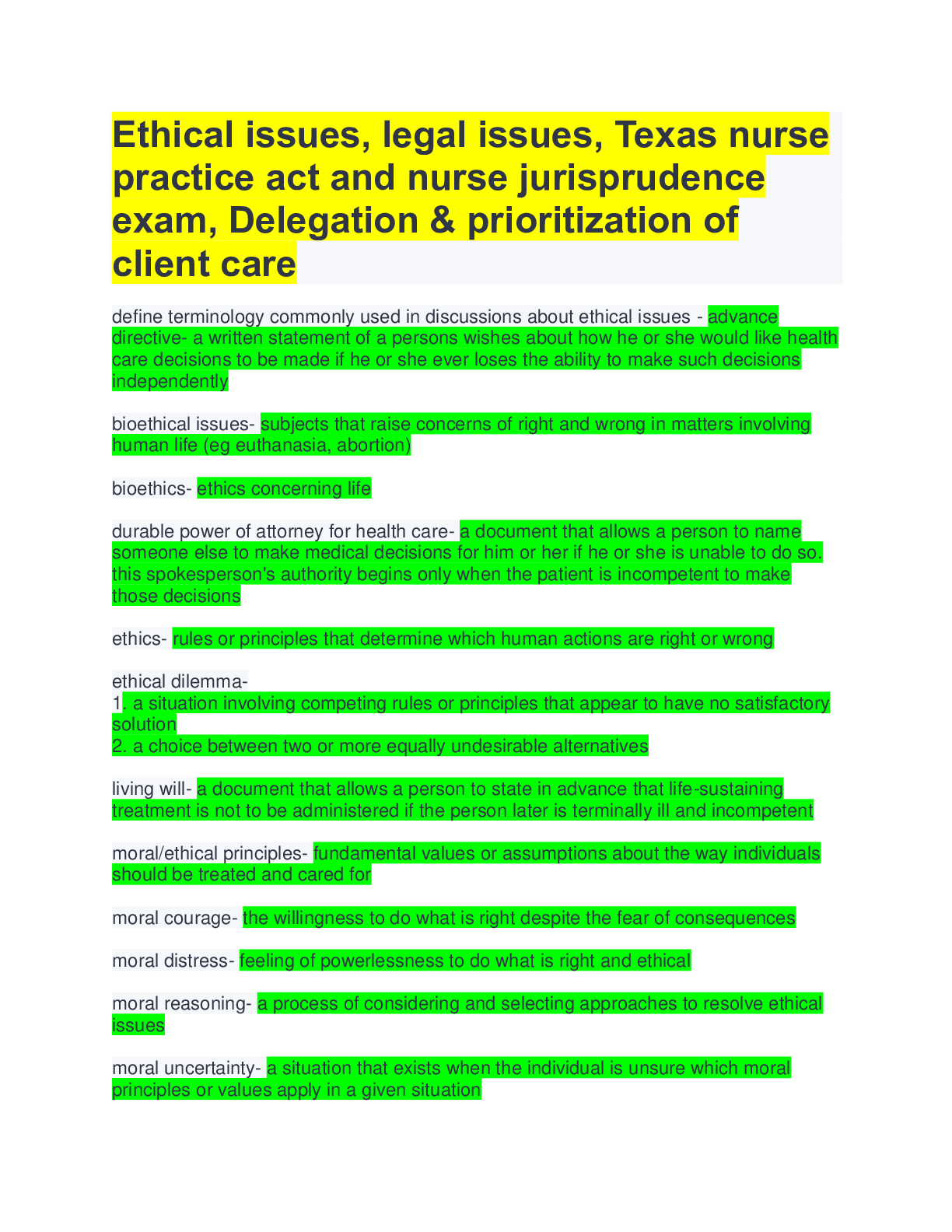
define nurse jurisprudence according to the texas BON ✔✔Jurisprudence is the science or
philosophy of law. The Texas Nurse P
...
Texas nurse practice act and nurse
jurisprudence exam latest update with
verified solutions
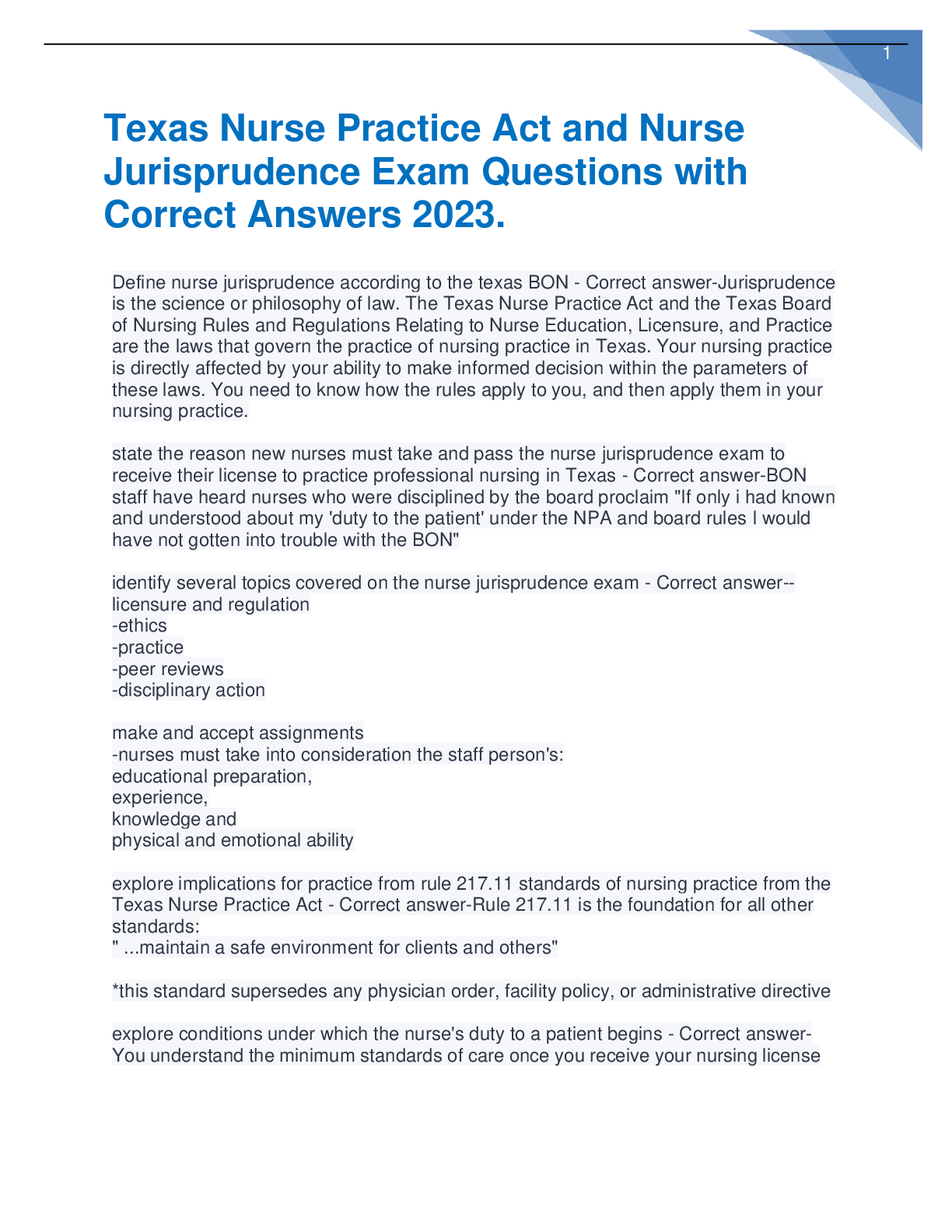
define nurse jurisprudence according to the texas BON ✔✔Jurisprudence is the science or
philosophy of law. The Texas Nurse Practice Act and the Texas Board of Nursing Rules and
Regulations Relating to Nurse Education, Licensure, and Practice are the laws that govern the
practice of nursing practice in Texas. Your nursing practice is directly affected by your ability to
make informed decision within the parameters of these laws. You need to know how the rules
apply to you, and then apply them in your nursing practice.
state the reason new nurses must take and pass the nurse jurisprudence exam to receive their
license to practice professional nursing in Texas ✔✔BON staff have heard nurses who were
disciplined by the board proclaim "If only i had known and understood about my 'duty to the
patient' under the NPA and board rules I would have not gotten into trouble with the BON"
identify several topics covered on the nurse jurisprudence exam ✔✔-licensure and regulation
-ethics
-practice
-peer reviews
-disciplinary action
make and accept assignments
-nurses must take into consideration the staff person's:
educational preparation,
experience,
knowledge and
physical and emotional ability
explore implications for practice from rule 217.11 standards of nursing practice from the Texas
Nurse Practice Act ✔✔Rule 217.11 is the foundation for all other standards:
" ...maintain a safe environment for clients and others"
*this standard supersedes any physician order, facility policy, or administrative directive
explore conditions under which the nurse's duty to a patient begins ✔✔You understand the
minimum standards of care once you receive your nursing license
-Nurses duty to a patient:
*begins when there is a relationship established between the nurse and the patient
*begins when the nurse has a responsibility for a patient
*doesn't begin with a single event (clocking in)
*when a nurse knows or should have known that a situation potentially
discuss the process of safe harbor ✔✔-Complete quick request first
-then before the shift ends complete the comprehensive one
mandatory overtime:
-a hospital is prohibited from scheduling mandatory overtime
-on call time cannot be used to produce mandatory overtime
-exceptions: disaster, state of emergency, unforeseen event, nurse is doing a procedure and
cannot leave(patient safety)
retaliation by the hospital is prohibited
the nurse should invoke safe harbor when asked to accept an assignment that is unsafe or outside
of her knowledge, skills, physical/emotional abilities
safe harbor applies to all nurses when the nurse believes an assignment may place patients at risk
of harm, thus violating the nurses' duty to a patient
identify situations when the Peer Review Committee might be activated ✔✔peer review
two types-
*safe harbor
*incident based
- eval of nursing care provided
- eval of nurses qualifications
- determination on the complaint about nursing
care
list specific acts identified as unprofessional conduct by the Nurse Practice Act ✔✔*unsafe
practice- delegating or assigning nursing functions when this could reasonably expect to result in
unsafe care
*unsafe practice- accepting those assignments that could result in unsafe care
*failing to supervise delegated task
*careless conduct that may endanger a client
*falsifying records
*violating professional boundaries
*drug diversion
*permitting client abuse/neglect
*sexual conduct with a client
discuss the nurse's role in reporting violations of the Nurse Practice Act ✔✔-First and foremost,
take steps to be sure that you or the patient involved are not in harm's way. ---
-Report the situation to a supervisor or the nurse's employer immediately.
-Then, contact your state BON (or state licensing authority) and file a complaint. If you are
unsure whether a nurse has done something that should be reported, contact the state BON for
assistance.
-A complaint can be filed at any time by anyone who feels that a nurse has provided
incompetent, negligent or unsafe care.
Examples of cases where a nurse should be reported immediately include:
-Appearance of being impaired by drugs or alcohol while working;
-Stealing from a patient or client, including medications;
-Providing treatment or care that should be provided only by a physician or advanced practice
nurse;
-Abusing a patient physically, emotionally, verbally
or sexually; or
-Involvement in criminal conduct.
Basically, you should report any nurse whose behavior is unsafe, incompetent, unethical,
affected by the use of alcohol, drugs or other chemicals, or affected by a physical
or mental condition.
Contact your BON with questions regarding confidentiality and how you, the complainant, may
be involved in the process.
consider professional boundaries and how to prevent one's own practice from crossing the
boundary ✔✔BOUNDARIES AND THE CONTINUUM OF
PROFESSIONAL NURSING BEHAVIOR
The nurse's responsibility is to delineate and
maintain boundaries.
The nurse should work within the therapeutic relationship.
The nurse should examine any boundary crossing,
be aware of its potential implications and avoid
repeated crossings.
Variables such as the care setting, community influences, patient needs and the nature of therapy
affect the delineation of boundaries.
Actions that overstep established boundaries to meet the needs of the nurse are boundary
violations.
The nurse should avoid situations where he or she has a personal, professional or business
relationship with the patient.
Post-termination relationships are complex because the patient may need additional services. It
may be difficult to determine when the nurse-patient relationship is completely terminated.
Be careful about personal relationships with patients who might continue to need nursing
services (such as those
with mental health issues or oncology patients).
RED FLAG BEHAVIORS
Some behavioral indicators can alert nurses to potential boundary issues for which there may be
reasonable explanations. However, nurses who display one or more of the following behaviors
should examine their patient relationships for possible boundary crossings or violations.
Signs of inappropriate behavior can be subtle at first, but early warning signs that should raise a
"red flag"
can include:
Discussing intimate or personal issues with a patient
Engaging in behaviors that could reasonably be interpreted as flirting
Keeping secrets with a patient or for a patient
Believing that you are the only one who truly understands or can help the patient
Spending more time than is necessary with a
particular patient
Speaking poorly about colleagues or your employment setting with the patient and/or family
Showing favoritism
Meeting a patient in settings besides those used to provide direct patient care or when you are not
at work
Patients can also demonstrate signs of over involvement by asking questions about a particular
nurse, or seeking personal information. If this occurs, the nurse should request assistance from a
trusted colleague or a supervisor.
THE NURSE'S CHALLENGE
Be aware.
Be cognizant of feelings and behavior.
Be observant of the behavior of other
professionals.
Always act in the best interest of the patient.
discuss the license renewal process for intial and subsequent periods ✔✔1st license good
between 6 months-29 months
renewal occurs in birth month and odd/even year to match birth year
*no CNE is required for the 1st license renewal
must have national certification or 20 CEUs per 2 year renewal thereafter
*CNE must be in the area of nurses practice or general topics
*CNE must be in the area of nurse's practice in general topics: ethics, nursing law,
documentation
new requirements April 2014
-2 contact hours in nursing jurisprudence and ethics every 6 years
-2 contact hours on older adult or geriatric care every 2 years
2 contact hours of forensic evidence training prior to performing (1 time)
identify the process of nurse licensure between compact states ✔✔allows a nurse licensed in one
"home" compact state to practice in a party contact state w/o seeking an additional nursing
license
becomes ENHANCED nurse licensure
can practice physically, electronically, and telephonically
Licensure and Privileges
A nurse licensed in a compact state must meet the licensure requirements in the primary state of
residence (home state). When practicing on a privilege in a remote state, the nurse is accountable
for complying with the Nurse Practice Act of that state.
Compact states may issue a multistate or a single state license. Employers should verify
licensure status online.
A nurse with an active multistate license has the privilege to practice in any of the remote states.
The NLC laws allow for the nurse to hold only one active license in his or her primary state of
residence. Employers should not require the nurse to apply for licensure in a remote state when
the nurse has lawfully declared a primary state of residence based on where he or she pays
federal income tax, votes and holds a drivers license.
A nurse who holds a license issued by a state that is not a member of the NLC has a single-state
license that is only valid
in that state.
While under some levels of disciplinary action, multistate privileges may be removed and the
nurse's practice may be
restricted to the home state.
[Show More]


.png)