ACCOUNTING 129A129a midterm 2 Chapter 6
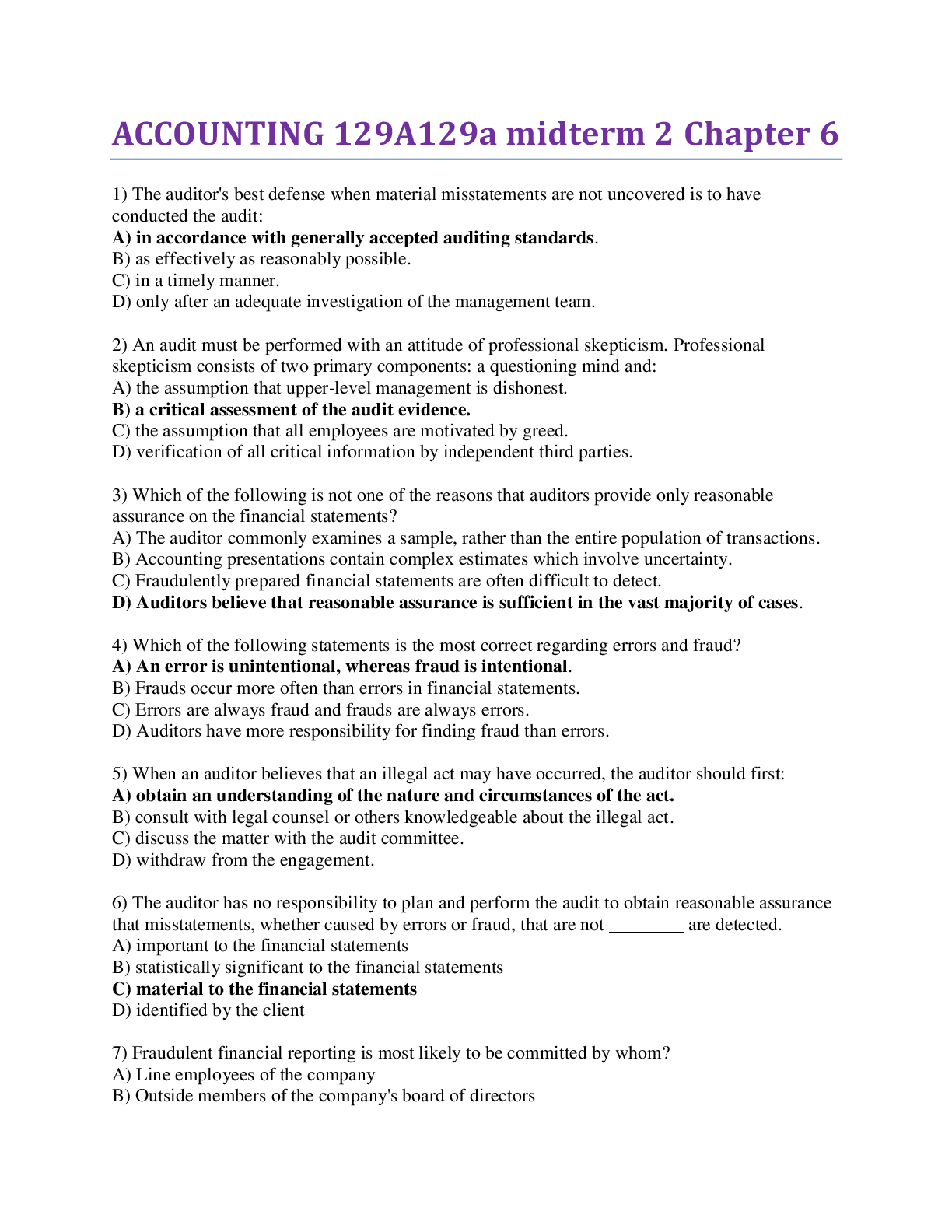
1) The auditor's best defense when material misstatements are not uncovered is to have conducted the audit:
A) in accordance with generally accepted auditing standards.
B) as
...
ACCOUNTING 129A129a midterm 2 Chapter 6
1) The auditor's best defense when material misstatements are not uncovered is to have conducted the audit:
A) in accordance with generally accepted auditing standards.
B) as effectively as reasonably possible.
C) in a timely manner.
D) only after an adequate investigation of the management team.
2) An audit must be performed with an attitude of professional skepticism. Professional skepticism consists of two primary components: a questioning mind and:
A) the assumption that upper-level management is dishonest.
B) a critical assessment of the audit evidence.
C) the assumption that all employees are motivated by greed.
D) verification of all critical information by independent third parties.
3) Which of the following is not one of the reasons that auditors provide only reasonable assurance on the financial statements?
A) The auditor commonly examines a sample, rather than the entire population of transactions. B) Accounting presentations contain complex estimates which involve uncertainty.
C) Fraudulently prepared financial statements are often difficult to detect.
D) Auditors believe that reasonable assurance is sufficient in the vast majority of cases.
4) Which of the following statements is the most correct regarding errors and fraud?
A) An error is unintentional, whereas fraud is intentional.
B) Frauds occur more often than errors in financial statements.
C) Errors are always fraud and frauds are always errors.
D) Auditors have more responsibility for finding fraud than errors.
5) When an auditor believes that an illegal act may have occurred, the auditor should first:
A) obtain an understanding of the nature and circumstances of the act.
B) consult with legal counsel or others knowledgeable about the illegal act.
C) discuss the matter with the audit committee.
D) withdraw from the engagement.
6) The auditor has no responsibility to plan and perform the audit to obtain reasonable assurance that misstatements, whether caused by errors or fraud, that are not ________ are detected.
A) important to the financial statements
B) statistically significant to the financial statements
C) material to the financial statements
D) identified by the client
7) Fraudulent financial reporting is most likely to be committed by whom?
A) Line employees of the company
B) Outside members of the company's board of directors
C) Company management
D) The company's auditors
8) Which of the following would most likely be deemed a direct-effect illegal act?
A) Violation of federal employment laws
B) Violation of federal environmental regulations
C) Violation of federal income tax laws
D) Violation of civil rights laws
9) The concept of reasonable assurance indicates that the auditor is:
A) not a guarantor of the correctness of the financial statements.
B) not responsible for the fairness of the financial statements.
C) responsible only for issuing an opinion on the financial statements.
D) responsible for finding all misstatements.
10) Which of the following is the auditor least likely to do when aware of an illegal act?
A) Discuss the matter with the client's legal counsel.
B) Obtain evidence about the potential effect of the illegal act on the financial statements.
C) Contact the local law enforcement officials regarding potential criminal wrongdoing.
D) Consider the impact of the illegal act on the relationship with the company's management.
11) An auditor discovers that the company's bookkeeper unintentionally made a mistake in calculating the amount of the quarterly sales. This is an example of:
A) employee fraud.
B) an error.
C) misappropriation of assets.
D) a defalcation.
12) The auditor has considerable responsibility for notifying users as to whether or not the statements are properly stated. This imposes upon the auditor a duty to:
A) provide reasonable assurance that material misstatements will be detected.
B) be a guarantor of the fairness in the statements.
C) be equally responsible with management for the preparation of the financial statements.
D) be an insurer of the fairness in the statements.
13) "The auditor should not assume that management is dishonest, but the possibility of dishonesty must be considered." This is an example of:
A) unprofessional behavior.
B) an attitude of professional skepticism.
C) due diligence.
D) a rule in the AICPA's Code of Professional Conduct.
14) If the auditor were responsible for making certain that all of management's assertions in the financial statements were absolutely correct:
A) bankruptcies could no longer occur.
B) bankruptcies would be reduced to a very small number.
C) audits would be much easier to complete.
D) audits would not be economically practical.
15) One of the characteristics of professional skepticism is ________, which is the conviction to decide for oneself, rather than accepting the claims of others.
A) interpersonal understanding
B) autonomy
C) suspension of judgment
D) self-esteem
16) When dealing with laws and regulations that do not have a direct effect on the financial statements, the auditor:
A) should inquire of management about whether the entity is in compliance with such laws and regulations.
B) has no responsibility to determine if any violations of these laws has occurred.
C) must report all violations, including inconsequential violations, to the audit committee.
D) should perform the same procedures as for violations having a direct effect on the financial statements.
17) Which of the following statements is usually true?
A) Materiality is easy to quantify.
B) Fraudulent financial statements are often easy for the auditor to detect, especially when there is collusion among management.
C) Reasonable assurance is a low level of assurance that the financial statements are free from material misstatement.
D) An item is considered material if it would likely have changed or influenced the decisions of a reasonable person using the statements.
18) Auditing standards make ________ distinction(s) between the auditor's responsibilities for searching for errors and fraud.
A) little
B) a significant
C) no
D) various
19) In comparing management fraud with employee fraud, the auditor's risk of failing to discover the fraud is:
A) greater for management fraud because managers are inherently more deceptive than employees.
B) greater for management fraud because of management's ability to override existing internal controls.
C) greater for employee fraud because of the higher crime rate among blue collar workers.
D) greater for employee fraud because of the larger number of employees in the organization.
20) Misappropriation of assets:
A) is generally committed by company management.
B) harms the users of the financial statements by providing them incorrect financial data for their decision making.
C) causes harm to stockholders because the assets are no longer available to their rightful owners.
D) causes the financial statements to be misstated since the misappropriation usually involves material amounts.
21) When comparing the auditor's responsibility for detecting employee fraud and for detecting errors, the profession has placed the responsibility:
A) more on discovering errors than employee fraud.
B) more on discovering employee fraud than errors.
C) equally on discovering errors and employee fraud.
D) on the senior auditor for detecting errors and on the manager for detecting employee fraud.
22) If several employees collude to falsify documents, the chance a normal audit would uncover such acts is:
A) very low.
B) very high.
C) zero.
D) none of the above.
23) When planning the audit, if the auditor has no reason to believe that illegal acts exist, the auditor should:
A) include audit procedures which have a strong probability of detecting illegal acts.
B) still include some audit procedures designed specifically to uncover illegalities.
C) ignore the issue.
D) make inquiries of management regarding their policies for detecting and preventing illegal acts and regarding their knowledge of violations, and then rely on normal audit procedures to detect errors, irregularities, and illegalities.
24) When the auditor identifies or suspects noncompliance with laws and regulations, the auditor:
A) should discuss the matter with those whom they believe committed the illegal act.
B) begin communication with the FASB in accordance with PCAOB regulations.
C) may disclaim an opinion on the basis of scope limitations if he is precluded by management from obtaining sufficient appropriate evidence.
D) should withdraw from the engagement.
25) When an auditor knows that an illegal act has occurred, she must:
A) report it to the proper governmental authorities.
B) consider the effects on the financial statements, including the adequacy of disclosure.
C) withdraw from the engagement.
D) issue an adverse opinion.
26) A questioning mindset:
A) means the auditor must prove every statement that management makes to them.
B) means the auditor should approach the audit with a "do not trust anyone" mental outlook.
C) assures that the auditor will only accept honest clients.
D) means the auditor should approach the audit with a "trust but verify" mental outlook.
27) Which of the following is an accurate statement concerning the auditor's responsibility to consider laws and regulations?
A) Auditors can follow an easy, step-by-step procedure to determine how laws and regulations impact the financial statements.
B) The auditor's responsibility will depend on whether the laws or regulations are expected to have a direct impact on the financial statements.
C) It is the responsibility of the auditor to determine if an act constitutes noncompliance.
D) The auditor must inform an outside party if management has knowingly not complied with a law or regulation.
28) Which of the following statements best describes the auditor's responsibility with respect to illegal acts that do not have a material effect on the client's financial statements?
A) Generally, the auditor is under no obligation to notify parties other than personnel within the client's organization.
B) Generally, the auditor is under an obligation to inform the PCAOB.
C) Generally, the auditor is obligated to disclose the relevant facts in the auditor's report.
D) Generally, the auditor is expected to compel the client to adhere to requirements of the Foreign Corrupt Practices Act.
29) Which of the following statements best describes the auditor's responsibility regarding the detection of fraud?
A) The auditor is responsible for the failure to detect fraud only when such failure clearly results from nonperformance of audit procedures specifically described in the engagement letter.
B) The auditor is required to provide reasonable assurance that the financial statements are free of both material errors and fraud.
C) The auditor is responsible for detecting material financial statement fraud, but not a material misappropriation of assets.
D) The auditor is responsible for the failure to detect fraud only when an unqualified opinion is issued.
30) The essence of the attest function is to:
A) assure the consistent application of correct accounting procedures.
B) determine whether the client's financial statements are fairly stated in accordance with an applicable financial reporting framework.
C) examine individual transactions so that the auditor may certify as to their validity.
D) detect collusion and fraud.
31) The auditor's evaluation of the likelihood of material employee fraud is normally done initially as a part of:
A) tests of controls.
B) tests of transactions.
C) understanding the entity's internal control.
D) the assessment of whether to accept the audit engagement.
32) One of the characteristics of professional skepticism is_______, which is a desire to investigate beyond the obvious.
A) self-esteem
B) an interpersonal understanding
C) a search for knowledge
D) a questioning mindset
33) Most illegal acts affect the financial statements:
A) directly.
B) only indirectly.
C) both directly and indirectly.
D) materially if direct; immaterially if indirect.
34) If a client has violated federal tax laws:
A) the auditor must notify the IRS.
B) and the amount is significant, the auditor should communicate with those charged with governance.
C) the noncompliance generally will not impact the financial statements.
D) the auditor does not need to evaluate the effects of the noncompliance on other aspects of the audit.
35) An auditor should recognize that the application of auditing procedures may produce evidence indicating the possibility of errors or fraud and therefore should:
A) plan and perform the engagement with an attitude of professional skepticism.
B) not rely on internal controls that are designed to prevent or detect errors or fraud.
C) design audit tests to detect unrecorded transactions.
D) extend the work to audit the majority of the recorded transactions and records of an entity.
1) Which of the following is not one of the three categories of assertions?
A) Assertions about classes of transactions and events for the period under audit
B) Assertions about financial statements and correspondence to GAAP
C) Assertions about account balances at period end
D) Assertions about presentation and disclosure
2) If a short-term note payable is included in the accounts payable balance on the financial statement, there is a violation of the:
A) completeness assertion.
B) existence assertion.
C) cutoff assertion.
D) classification assertion.
3) International auditing standards and U.S. GAAP classify assertions into three categories. Which of the following is not a category of assertions that management makes about the accounting information in financial statements?
A) Assertions about classes of transactions for the period under audit
B) Assertions about account balances at period end
C) Assertions about the quality of source documents used to prepare the financial statements
D) Assertions about presentation and disclosure
4) Management assertions are:
A) directly related to the financial reporting framework used by the company, usually U.S. GAAP or IFRS.
B) stated in the footnotes to the financial statements.
C) explicitly expressed representations about the financial statements.
D) provided to the auditor in the assertions letter, but are not disclosed on the financial statements.
5) Management makes the following assertions about account balances:
A) existence, completeness, classification and cutoff.
B) existence, accuracy, classification and rights and obligations.
C) existence, completeness, valuation and allocation, and rights and obligations.
D) existence, completeness, rights and obligations, and cutoff.
6) Which of the following statements is true about the completeness and occurrence assertions? A) Both assertions are relevant to classes of transactions and events and account balances.
B) If management asserts that recorded sales transactions represent exchanges of goods or services that actually took place, they are asserting to completeness.
C) Violations of the occurrence assertion relate to account overstatements.
D) The failure to record a sale that did occur is a violation of the occurrence assertion.
7) Which of the following assertions is described as "this assertion addresses whether all transactions that should be included in the financial statements are in fact included"?
A) Occurrence
B) Completeness
C) Rights and obligations
D) Existence
8) Which of the following management assertions is not associated with classes of transactions and events?
A) Occurrence
B) Classification
C) Accuracy
D) Rights and obligations
1) Which of the following statements is true regarding the distinction between general audit objectives and specific audit objectives for each class of transactions?
A) The specific audit objectives are applicable to every class of transactions.
B) The general audit objectives are applicable to every class of transactions.
C) Once the specific transaction-related audit objectives are established, they can be used to develop the general transaction-related objectives.
D) For any given class of transactions, usually only one audit objective must be met to conclude the transactions are properly recorded.
2) The auditor is determining that the correct selling price was used for billing and that the quantity of goods shipped was the same as the quantity billed. She is gathering evidence about which transaction related audit objective?
A) Existence
B) Completeness
C) Accuracy
D) Cut-off
3) The posting and summarization audit objective is the auditor's counterpart to management's assertion of:
A) occurrence.
B) completeness.
C) accuracy.
D) classification.
4) After the general transaction related-audit objectives are understood, specific transaction-related audit objectives for each material class of transactions can be developed. Which of the following statements is true?
A) There should be at least one specific objective for each relevant general objective.
B) There will be only one specific objective for each relevant general objective.
C) There will be many specific objectives developed for each relevant general objective.
D) There must be one specific objective for each general objective.
1) In testing for cutoff, the objective is to determine:
A) whether all of the current period's transactions are recorded.
B) whether transactions are recorded in the correct accounting period.
C) the proper cutoff between capitalizing and expensing expenditures.
D) the proper cutoff between disclosing items in footnotes or in account balances.
2) The detail tie-in objective is not concerned that the details in the account balance:
A) agree with related subsidiary ledger amounts.
B) are properly disclosed in accordance with GAAP.
C) foot to the total in the account balance.
D) agree with the total in the general ledger.
3) The detail tie-in is part of the ________ assertion for account balances.
A) classification
B) valuation and allocation
C) rights and obligations
D) completeness
4) The classification balance-related audit objective:
A) involves determining if items included on a client's listing are included in the correct general leger accounts.
B) is the counterpart to the management assertion of completeness.
C) involves determining if items included on a client's listing are disclosed properly in the financial statements.
D) involves tying in the account balances to the general ledger.
5) Which of the following best describes tests of details of balances?
A) Audit procedures designed to test for monetary misstatements in the accounts summarized in the financial statements
B) Audit procedures designed to test for the monetary amounts of transactions
C) Audit procedures designed to test for reasonableness of account balances
D) Audit procedures designed to test for effectiveness in recording accounting information
6) Which of the following statements is not true?
A) Balance-related audit objectives are applied to ending account balances.
B) Transaction-related audit objectives are applied to classes of transactions.
C) Balance-related audit objectives are applied to the ending balance in balance sheet accounts.
D) Balance-related audit objectives are applied to both beginning and ending balances in balance sheet accounts.
1)The responsibility for adopting sound accounting policies and maintaining adequate internal control rests with the:
A) board of directors.
B) company management.
C) financial statement auditor.
D) company's internal audit department
2) If management insists on financial statement disclosures that the auditor finds unacceptable, the auditor can withdraw from the engagement or:
A)
Issue an adverse audit report Issue a qualified audit report
Yes Yes
B)
Issue an adverse audit report Issue a qualified audit report
No No
C)
Issue an adverse audit report Issue a qualified audit report
Yes No
D)
Issue an adverse audit report Issue a qualified audit report
No Yes
5) The responsibility for the preparation of the financial statements and the accompanying footnotes belongs to:
A) the auditor.
B) management.
C) both management and the auditor equally.
D) management for the statements and the auditor for the notes.
Chapter 7
1) Auditors must make decisions regarding what evidence to gather and how much to accumulate. Which of the following is a decision that must be made by auditors related to evidence?
A)
Sample size Timing of audit procedures
Yes Yes
B)
Sample size Timing of audit procedures
No No
C)
Sample size Timing of audit procedures
Yes No
D)
Sample size Timing of audit procedures
No Yes
2) Audit procedures are concerned with the nature, extent, and timing in gathering audit evidence. Which, of the following, is true as to the timing of audit procedures?
A)
Prior to the fiscal year-end of the client Subsequent to the fiscal year-end of the client
Yes Yes
B)
Prior to the fiscal year-end of the client Subsequent to the fiscal year-end of the client
No No
C)
Prior to the fiscal year-end of the client Subsequent to the fiscal year-end of the client
Yes No
D)
Prior to the fiscal year-end of the client Subsequent to the fiscal year-end of the client
No Yes
3) A(n) ________ is the detailed instruction that explains the audit evidence to be obtained during the audit.
A) audit objectives
B) audit procedure
C) audit assertion
D) audit program
4) Which of the following is not one of the four decisions about what evidence to gather and how much of it to accumulate?
A) Which audit procedures to use
B) Which accounts must agree to the general ledger
C) When to perform the procedures
D) What sample size to select for a given procedure
1) Audit evidence has two primary qualities for the auditor; relevance and reliability. Given the choices below, which provides the auditor with the most reliable audit evidence?
A) General ledger account balances
B) Confirmation of accounts receivable balance received from a customer
C) Internal memo explaining the issuance of a credit memo
D) Copy of month-end adjusting entries
2) Which of the following is not a characteristic of the reliability of evidence?
A) Effectiveness of client internal controls
B) Education of auditor
C) Independence of information provider
D) Timeliness
3) The auditor must gather sufficient and appropriate evidence during the course of the audit. Sufficient evidence must:
A) be well documented and cross-referenced in the audit documents.
B) be based on sources that are external to company.
C) provide evidence that prove or disprove an audit objective/assertion.
D) be persuasive enough to enable the auditor to issue an audit report.
4) Audit evidence obtained directly by the auditor will not be reliable if:
A) the auditor lacks the competence to evaluate the evidence.
B) it is provided by the client's attorney.
C) the client denies its veracity.
D) it is impossible for the auditor to obtain additional corroboratory evidence.
5) Appropriateness of evidence is a measure of the:
A) quantity of evidence.
B) quality of evidence.
C) sufficiency of evidence.
D) meaning of evidence.
6) Which of the following statements regarding the relevance of evidence is correct?
A) To be relevant, evidence must pertain to the audit objective of the evidence.
B) To be relevant, evidence must be persuasive.
C) To be relevant, evidence must relate to multiple audit objectives.
D) To be relevant, evidence must be derived from a system including effective internal controls.
7) Two determinants of the persuasiveness of evidence are:
A) competence and sufficiency.
B) relevance and reliability.
C) appropriateness and sufficiency.
D) independence and effectiveness.
8) The two characteristics of the appropriateness of evidence are:
A) relevance and timeliness.
B) relevance and accuracy.
C) relevance and reliability.
D) reliability and accuracy.
9) Which of the following forms of evidence would be least persuasive in forming the auditor's opinion about marketable securities and other investments held by the company?
A) Responses to auditor's questions by the president and controller regarding the investments account
B) Correspondence with a stockbroker regarding the quantity of client's investments held in street name by the broker
C) Minutes of the board of directors authorizing the purchase of stock as an investment
D) The auditor's count of marketable securities
10) Which of the following statements is not correct?
A) It is possible to vary the sample size from one unit to 100% of the items in the population.
B) The decision of how many items to test should not be influenced by the increased costs of performing the additional tests.
C) The decision of how many items to test must be made by the auditor for each audit procedure. D) The sample size for any given procedure is likely to vary from audit to audit.
11) For audit evidence to be compelling to the auditor it must be sufficient and appropriate. Which statement below is not correct regarding the appropriateness of audit evidence?
A) The more effective the internal control system, the more assurance it provides the auditor about the reliability of financial reporting by the client.
B) An auditor's opinion, to be economically useful and profitable to the auditing firm needs to be formed within a reasonable time and based on evidence obtained that assures profits for the auditing firm.
C) Evidence obtained from independent sources outside the entity is generally more reliable than evidence secured solely within the entity.
D) The independent auditor's direct personal knowledge, obtained through inquiry, observation and inspection, is generally more persuasive than information obtained indirectly.
12) Which of the following is a correct statement regarding audit evidence?
A) A large sample of evidence provided by an independent party is always considered persuasive evidence.
B) A small sample of only one or two pieces of highly appropriate evidence is always considered persuasive evidence.
C) The auditor must obtain a sufficient amount of relevant and reliable evidence to form an opinion on the fairness of the financial statements.
D) Evidence is usually more reliable for balance sheet accounts when it is obtained within six months of the balance sheet date.
13) Which of the following is the most objective type of evidence?
A) A letter written by the client's attorney discussing the likely outcome of outstanding lawsuits B) The physical count of securities and cash
C) Inquiries of the credit manager about the collectability of noncurrent accounts receivable
D) Observation of cobwebs on some inventory bins
14) Which items affect the sufficiency of evidence when choosing a sample?
A)
Selecting items w/ a high likelihood of misstatement The randomness of the items selected
Yes Yes
B)
Selecting items w/ a high likelihood of misstatement The randomness of the items selected
No No
C)
Selecting items w/ a high likelihood of misstatement The randomness of the items selected
Yes No
D)
Selecting items w/ a high likelihood of misstatement The randomness of the items selected
No Yes
15) Determine which of the following is most correct regarding the reliability of audit evidence. A) Information that is indirectly obtained from external sources is the most reliable audit evidence.
B) Reliability of audit evidence is dependent upon the evidence being subjective.
C) Reliability of evidence refers to the amount of evidence obtained.
D) If internal controls are effective, evidence obtained is more reliable than when the controls are not effective.
16) Evidence is generally considered appropriate when:
A) it has been obtained by random selection.
B) there is enough of it to afford a reasonable basis for an opinion on financial statements.
C) it is relevant to the audit objective being tested.
D) it consists of written statements made by managers of the company under audit.
17) Given the economic and time constraints in which auditors can collect evidence about management assertions about the financial statements, the auditor normally gathers evidence that is:
A) irrefutable.
B) conclusive.
C) persuasive.
D) completely convincing.
18) Which of the following statements is not a correct statement regarding audit evidence?
A) Evidence obtained from an independent source outside the client organization is more reliable than that obtained from within.
B) Documentary evidence is more reliable when it is received by the auditor indirectly rather than directly.
C) Documents that originate outside the company are considered more reliable than those that originate within the client's organization.
D) External evidence, such as communications from banks, is generally regarded as more reliable than answers obtained from inquiries of the client.
19) Evidence is usually more persuasive for balance sheet accounts when it is obtained:
A) as close to the balance sheet date as possible.
B) only from transactions occurring on the balance sheet date.
C) from various times throughout the client's year.
D) from the time period when transactions in that account were most numerous during the fiscal period.
20) Which of the following statements is true?
A) Evidence must be relevant to all of the audit objectives.
B) If evidence is subjective, it cannot be reliable.
C) Evidence obtained directly by the auditor may not be reliable if the auditor lacks the qualifications to evaluate the evidence.
D) The persuasiveness of evidence can be evaluated after considering its sufficiency.
21) Which of the following statements relating to the competence of evidential matter is always true?
A) Evidence from outside an enterprise is always reliable.
B) Accounting data developed under satisfactory conditions of internal control is not reliable.
C) Oral representations made by management are not reliable evidence.
D) Evidence must be both reliable and relevant to be considered appropriate.
1) Calculating the gross margin for the current year under audit as a percent of sales and comparing it with previous years is what type of evidence?
A) Physical examination
B) Analytical procedures
C) Observation
D) Inquiry
2) When the auditor develops supporting evidence for amounts posted to account balances with documentary evidence, that process is called:
A) inquiry.
B) confirmation.
C) vouching.
D) physical examination.
3) An example of an external document that provides reliable information for the auditor is:
A) employees' time reports.
B) bank statements.
C) purchase order for company purchases.
D) carbon copies of checks.
4) An example of a document the auditor receives from the client, but which was prepared by someone outside the client's organization, is a:
A) confirmation.
B) sales invoice.
C) vendor invoice.
D) bank reconciliation.
5) The evaluations of financial information through analysis of plausible relationships among financial and nonfinancial data is the definition of:
A) analytical procedures.
B) tests of transactions.
C) tests of balances.
D) auditing.
6) Audit procedures can result in significant, unexpected differences. The auditor should investigate further if:
A)
Significant differences are not expected but do exist Significant differences are expected but do not exist
Yes Yes
B)
Significant differences are not expected but do exist Significant differences are expected but do not exist
No No
C)
Significant differences are not expected but do exist Significant differences are expected but do not exist
Yes No
D)
Significant differences are not expected but do exist Significant differences are expected but do not exist
No Yes
7) When the auditor uses tracing as an audit procedure for tests of transactions she is primarily concerned with which audit objective?
A) Occurrence
B) Completeness
C) Cutoff
D) Classification
8) When the auditor uses the audit procedure vouching she is primarily concerned with which of the following audit objectives when testing classes of transactions?
A) Occurrence
B) Completeness
C) Authorization
D) Classification
9) When auditors use documentation to support recorded transactions and amounts, the process is usually called:
A) tracing.
B) confirmations.
C) vouching.
D) reperformance.
10) Analytical procedures must be used during which phase(s) of the audit?
A)
Test of Controls Planning Completion
Yes Yes Yes
B)
Test of Controls Planning Completion
No Yes Yes
C)
Test of Controls Planning Completion
Yes No No
D)
Test of Controls Planning Completion
No No No
11) Auditors may decide to replace tests of details with analytical procedures when possible because the:
A) analytical procedures are more reliable.
B) analytical procedures are considerably less expensive.
C) analytical procedures are more persuasive.
D) tests of details are more difficult to interpret.
12) When making decisions about evidence for a given audit, the auditor's goal is to obtain a sufficient amount of timely, reliable evidence that is relevant to the information being verified. In addition, the goal of audit efficiency is to gather and evaluate the information:
A) no matter the cost involved in obtaining such evidence.
B) even if cost is irrelevant to the auditor, because they bill the client for costs incurred.
C) at the lowest possible total cost.
D) at the cost suggested in the engagement letter.
13) "Physical examination" is the inspection or count by the auditor of items such as:
A) cash, inventory, and payroll timecards.
B) cash, inventory, canceled checks, and sales documents.
C) cash, inventory, canceled checks, and tangible fixed assets.
D) cash, inventory, securities, notes receivable, and tangible fixed assets.
14) Which of the following statements is most correct regarding the primary purpose of audit procedures?
A) To detect all errors or fraudulent activities as well as illegal activities
B) To comply with auditing standards promulgated by the PCAOB for publicly held clients
C) To gather corroborative audit evidence about management's assertions regarding the client's financial statements
D) To determine the amount of errors in the balance sheet accounts in order to adjust the accounts to actual
15) Which of the following generally provides the most reliable evidence?
A) Confirmations
B) Recalculation
C) Reperformance
D) Observations
16) When practical and reasonable, U.S. auditing standards require the confirmation of:
A) individual transactions between organizations, such as sales transactions.
B) accounts receivable.
C) fixed asset additions.
D) payroll expenses.
17) To be considered reliable evidence, confirmations must be controlled by:
A) the client's employee responsible for accounts receivable.
B) the external auditor.
C) the client's internal audit department.
D) the client's controller or CFO.
18) Indicate whether confirmation of accounts receivable and accounts payable, provided they each are significant accounts, is required or optional:
A)
Accounts Receivable Accounts Payable
Required Required
B)
Accounts Receivable Accounts Payable
Required Optional
C)
Accounts Receivable Accounts Payable
Optional Required
D)
Accounts Receivable Accounts Payable
Optional Optional
19) The Auditing Standards Board has concluded that analytical procedures are so important that they are required during:
A) planning and test of control phases.
B) planning and completion phases.
C) test of control and completion phases.
D) planning, test of control, and completion phases.
20) A benefit obtained from using industry averages is that it provides a(n):
A) benchmark to compare the company's results.
B) indication where errors exist in the statements.
C) benchmark to be used in evaluating a client's budgets.
D) comparison of "what is" with "what should be."
21) Physical examination:
A) is a direct means of verifying that an asset really exists.
B) is sufficient evidence to verify that the existing assets are owned by the client.
C) can be used for both tangible assets and documents.
D) is not generally a reliable type of audit evidence.
22) Which of the following is not a correct combination of terms and related type of audit evidence?
A) Inquire — inquiries of client
B) Count — physical examination
C) Recompute — documentation
D) Read — documentation
23) Which of the following is a correct statement regarding confirmations?
A) Confirmations can be in oral or written form.
B) Electronic confirmations are not acceptable under generally accepted auditing standards.
C) Confirmations are generally used in the audit of fixed asset additions.
D) Auditors consider alternative evidence available when determining if confirmations should be used.
24) An important benefit of industry comparisons is as:
A) an aid to understanding the client's business.
B) an indicator of errors.
C) an indicator of fraud.
D) a least-cost indicator for audit procedures.
25) The auditor is concerned that a client is failing to bill customers for shipments. An audit procedure that would gather relevant evidence would be to:
A) select a sample of duplicate sales invoices and trace each to related shipping documents.
B) trace a sample of shipping documents to related duplicate sales invoices.
C) trace a sample of Sales Journal entries to the Accounts Receivable subsidiary ledger.
D) compare the total of the Schedule of Accounts Receivable with the balance of the Accounts Receivable account in the general ledger.
26) ________ is the auditor's examination of the client's documents and records to substantiate that the information is included in the financial statements.
A) Inspection
B) Recalculation
C) Observation
D) Verification
27) Which of the following statements regarding the appropriateness of evidence is correct?
A) The effectiveness of a client's internal control has no influence on the reliability of most types of evidence.
B) Analytical procedures will be reliable evidence even if the client's internal controls are weak.
C) One type of evidence is generally sufficient by itself to provide appropriate evidence.
D) The objectivity of evidence obtained through inspection is high.
28) You are auditing the company's purchasing process for goods and services. You are primarily concerned with the company not recording all purchase transactions. Which audit procedure below would be the most effective audit procedure in this case?
A) Vouching from the accounts payable account to the vendor invoices
B) Tracing vendor invoices to recorded amounts in the accounts payable account
C) Confirmation accounts payable recorded amounts
D) Reconciling the accounts payable subsidiary ledger to the accounts payable account
29) Which of the following discoveries through the use of analytical procedures would most likely indicate a relatively high risk of financial failure?
A) A decline in gross margin percentages
B) An increase in the balance in fixed assets
C) An increase in the ratio of allowance for uncollectible accounts to gross accounts receivable, while at the same time accounts receivable turnover also decreased
D) A higher than normal ratio of long-term debt to net worth as well as a lower than average ratio of profits to total assets
30) Which of the following statements is correct regarding the costs involved in obtaining evidence?
A)
Physical examination is usually the least expensive type of audit evidence Cost of obtaining evidence may be a factor in deciding whether to obtain that evidence
Yes Yes
B)
Physical examination is usually the least expensive type of audit evidence Cost of obtaining evidence may be a factor in deciding whether to obtain that evidence
No No
C)
Physical examination is usually the least expensive type of audit evidence Cost of obtaining evidence may be a factor in deciding whether to obtain that evidence
Yes No
D)
Physical examination is usually the least expensive type of audit evidence Cost of obtaining evidence may be a factor in deciding whether to obtain that evidence
No Yes
31) When using analytical procedures:
A) unusual fluctuations occur when significant unexpected differences between the current year's data and other data used in comparisons are found.
B) and no unusual fluctuations are noted, the possibility of material misstatement is increased.
C) "attention directing" indicates an area where fraud has occurred.
D) and no unusual fluctuations are noted, tests of details of balances can be eliminated,
Chapter 8
1) One of the purposes of an engagement letter is to avoid misunderstandings with the client. This is important for:
A)
Good client relations Facilitating high-quality work at a reasonable cost
Yes Yes
B)
Good client relations Facilitating high-quality work at a reasonable cost
No No
C)
Good client relations Facilitating high-quality work at a reasonable cost
Yes No
D)
Good client relations Facilitating high-quality work at a reasonable cost
No Yes
2) The auditor is likely to accumulate more evidence when the audit is for a company:
A)
Which has large amounts of debt Which is to be sold in the near future
Yes Yes
B)
Which has large amounts of debt Which is to be sold in the near future
No No
C)
Which has large amounts of debt Which is to be sold in the near future
Yes No
D)
Which has large amounts of debt Which is to be sold in the near future
No Yes
3) Initial audit planning involves four matters. Which of the following is not one of these?
A) Develop an overall audit strategy.
B) Request that bank balances be confirmed.
C) Schedule engagement staff and audit specialists.
D) Identify the client's reason for the audit.
4) Smith, CPA has requested permission to communicate with the predecessor auditor in order to review certain workpapers for high risk accounts for a new audit client. The new audit client's refusal to allow this communication to occur would impact Rodgers decision concerning:
A) the auditor's ability to design audit tests.
B) possible scope exception due to lack of access.
C) the desirability of accepting the prospective engagement.
D) violation of the GAAP rules concerning consistency and comparability of financial information.
5) A successor auditor may perform which of the following for a new audit client?
A)
Speak to local attorneys, banks and other businesses regarding the company's reputation Speak to the predecessor auditors about disagreements they had with management
Yes Yes
B)
Speak to local attorneys, banks and other businesses regarding the company's reputation Speak to the predecessor auditors about disagreements they had with management
No No
C)
Speak to local attorneys, banks and other businesses regarding the company's reputation Speak to the predecessor auditors about disagreements they had with management
Yes No
D)
Speak to local attorneys, banks and other businesses regarding the company's reputation Speak to the predecessor auditors about disagreements they had with management
No Yes
6) When dealing with audit risk:
A) audit risk should not be a factor when determining if a new client should be accepted.
B) audits with a low acceptable audit risk generally result in lower audit fees.
C) if management of a company has a reputation of integrity, but is also known to take aggressive financial risks, the auditor should not accept the company as a new client.
D) if the auditor concludes that acceptable audit risk is low, but the client is still acceptable, the auditor may still accept the engagement but increase the audit fee.
7) A written understanding detailing what the auditors will do in determining if the financial statements are fair representations of the company's financial statements and what the auditor expects from the client in performing an audit will normally be expressed in the:
A) management letter requested by the auditor.
B) engagement letter.
C) Audit Plan.
D) Audit Strategy for the client.
8) If an auditor is requested to perform nonaudit services for a public company audit client, who is responsible for agreeing to those services with the audit firm?
A) The client's management
B) The client's chief executive officer
C) The client's chief financial officer
D) The client's audit committee
9) Which of the following statements is true regarding communications between predecessor and successor auditors?
A) The burden of initiating the communication rests with the predecessor.
B) The predecessor's response can be limited to stating that no information will be provided.
C) The predecessor should communicate with the successor only if the client is public.
D) The predecessor auditor of a public company does not need permission from the client before communicating with the successor auditor.
10) The purpose of an engagement letter is to:
A) document the CPA firm's responsibility to external users of the audited financial statements. B) document the terms of the engagement.
C) notify the audit staff of an upcoming engagement so that personnel scheduling can be facilitated.
D) emphasize management's responsibility for approving the audit program.
11) Written communication that the auditor will provide reasonable assurance for the detection of fraud is found in:
A) engagement letter.
B) representation letter.
C) responsibility letter.
D) client letter.
12) Which of the following normally signs the engagement letter for an audit of a private company?
A) Management
B) Board of directors representative
C) Audit committee representative
D) Corporate treasurer
13) The two major factors affecting acceptable audit risk are:
A) inherent risk and the intended uses of the financial statements.
B) control risk and the intended uses of the financial statements.
C) the likely statement users and the intended uses of the statements.
D) the audit firm and the intended uses of the statements
14) An engagement letter sent to a publicly held audit client usually would not include a:
A) reference to the auditor's responsibility for the detection of errors or irregularities.
B) estimation of the time to be spent on the audit work by audit staff and management.
C) statement that management advisory services would be made available upon request.
D) reference to management's responsibility for the financial statements.
15) The preliminary audit strategy:
A) is set before the auditor understands the client's reasons for the audit.
B) guides the development of the audit plan.
C) is determined after the engagement staffing is set.
D) is the detailed steps to be followed for the substantive audit tests.
16) The purpose of the requirement in having communication between the predecessor and successor auditors is to:
A) allow the predecessor to disclose information which would otherwise be confidential.
B) help the successor auditor to evaluate whether to accept the engagement.
C) help the client by facilitating the change of auditors.
D) ensure the predecessor collects all unpaid fees prior to a change in auditor.
17) The predecessor auditor is required to respond to the request of the successor auditor for information, but the response can be limited to stating that no information will be provided when:
A) the predecessor auditor has poor relations with the successor auditor.
B) the client is dissatisfied with the predecessor's work.
C) there are actual or potential legal problems between the client and the predecessor.
D) the predecessor believes that the client lacks integrity.
18) Which of the following best expresses the understanding of the terms of the engagement that exist between the client and the CPA firm?
A) Management asserts there are no errors, material or immaterial, in the general ledger.
B) Auditors assert that the primary audit goal is audit efficiency.
C) Auditors assert that their primary responsibility is to plan and perform the audit in order to provide reasonable assurance as to the detection of material misstatement due to error or fraud.
D) Management asserts that they will provide the auditor with a risk assessment as to material misstatements due to errors or fraud in the company's financial statements.
19) When selecting staff for the audit engagement:
A) only staff members who are CPAs should be assigned to the audit.
B) only managers and above need to have appropriate competence and capabilities to perform the audit.
C) continuity of staff members from year to year should not be a factor.
D) staff assigned to the audit must be knowledgeable about the client's industry.
20) An auditor who accepts an audit engagement and does not possess the industry expertise of the business entity should:
A) engage financial experts familiar with the nature of the business entity.
B) obtain a knowledge of matters that relate to the nature of the entity's business.
C) refer a substantial portion of the audit to another CPA who will act as the principal auditor.
D) first inform management that an unqualified opinion cannot be issued.
21) Which is usually included in an engagement letter?
A)
Estimate of hours required to complete audit Dollar estimate of fees to be billed to the client
Yes Yes
B)
Estimate of hours required to complete audit Dollar estimate of fees to be billed to the client
No No
C)
Estimate of hours required to complete audit Dollar estimate of fees to be billed to the client
Yes No
D)
Estimate of hours required to complete audit Dollar estimate of fees to be billed to the client
No Yes
22) Which is usually included in an engagement letter?
A)
A reference to standards acceptable in the United States of America A reference to GAAS
Yes Yes
B)
A reference to standards acceptable in the United States of America A reference to GAAS
No No
C)
A reference to standards acceptable in the United States of America A reference to GAAS
Yes No
D)
A reference to standards acceptable in the United States of America A reference to GAAS
No Yes
23) Which is usually included in an engagement letter?
A)
The financial statements are the responsibility of the company's management Ratios to be used by the auditor in the planning phase
Yes Yes
B)
The financial statements are the responsibility of the company's management Ratios to be used by the auditor in the planning phase
No No
C)
The financial statements are the responsibility of the company's management Ratios to be used by the auditor in the planning phase
Yes No
D)
The financial statements are the responsibility of the company's management Ratios to be used by the auditor in the planning phase
No Yes
24) When may the auditor refer to a specialist in the audit report?
A)
Only if the specialist's report results in a modification of the audit opinion Only if the specialist assisted in the audit of an account material to the financial statements
Yes Yes
B)
Only if the specialist's report results in a modification of the audit opinion Only if the specialist assisted in the audit of an account material to the financial statements
No No
C)
Only if the specialist's report results in a modification of the audit opinion Only if the specialist assisted in the audit of an account material to the financial statements
Yes No
D)
Only if the specialist's report results in a modification of the audit opinion Only if the specialist assisted in the audit of an account material to the financial statements
No Yes
25) Which is usually included in the engagement letter?
A)
The projected type of opinion on the financials statement to be audited Name(s) of the client personnel responsible for supplying the auditor with information
Yes Yes
B)
The projected type of opinion on the financials statement to be audited Name(s) of the client personnel responsible for supplying the auditor with information
No No
C)
The projected type of opinion on the financials statement to be audited Name(s) of the client personnel responsible for supplying the auditor with information
Yes No
D)
The projected type of opinion on the financials statement to be audited Name(s) of the client personnel responsible for supplying the auditor with information
No Yes
26) Which is usually included in the engagement letter?
A)
List of audit procedures to be used in inventory observation The auditors' assessment of Audit Risk
Yes Yes
B)
List of audit procedures to be used in inventory observation The auditors' assessment of Audit Risk
No No
C)
List of audit procedures to be used in inventory observation The auditors' assessment of Audit Risk
Yes No
D)
List of audit procedures to be used in inventory observation The auditors' assessment of Audit Risk
No Yes
1) During audit planning, the auditor uses analytical procedures primarily to:
A) identify weaknesses in internal control.
B) determine if the company's financial statements appear reasonable and are free of material misstatement.
C) determine the correspondence of the company's financial statements to the valuation and accuracy audit objectives.
D) determine the nature, extent, and timing of audit procedures.
2) Which of the following is most correct with respect to the use of analytical procedures?
A) Analytical procedures may be used in evaluating balances in the testing phase as long as the auditor also uses them in assessing the going concern assumption.
B) Analytical procedures must be used throughout the audit.
C) Analytical procedures used in the testing phase of the audit are primarily used to direct an auditor's attention so that the auditor's understanding of the business is improved.
D) Analytical procedures are performed by studying plausible relationships between financial and nonfinancial data.
3) Analytical procedures:
A) are not a type of audit evidence.
B) are not required during the completion phase of the audit.
C) performed during the planning phase of the audit are used as a substantive test in support of account balances.
D) performed in the completion phase serve as a final review for material misstatements or financial problems.
1) Which of the following is a correct statement regarding analytical procedures?
A) A major strength in using industry ratios for auditing is the difference between the nature of the client's financial information and that of the firms making up the industry totals.
B) Common-size financial statements display all items as a percentage change from a base year. C) Auditors should investigate the most significant differences between budgeted and actual results.
D) In order to look for a misstatement in the allowance for bad debts, the auditor should divide gross sales by sales returns and allowances.
2) Which of the following would not be classified as an analytical procedure?
A) Benchmarking the company's profitability ratios against others in the industry
B) Variance analysis of actual versus budgeted amounts for production
C) Reperforming the client's depreciation expense using the client's accounting policies for capital expenditures made during the year
D) Reconciling fixed asset dispositions with the fixed asset ledger
3) Which of the following statements is not correct with respect to analytical procedures?
A) Auditing standards emphasize the need for auditors to develop and use expectations.
B) Analytical procedures must be performed throughout the audit.
C) Analytical procedures may be performed at any time during the audit.
D) Analytical procedures use comparisons and relationships to assess whether account balances appear reasonable.
4) When performing planning analytical procedures for a client the auditor detected that the gross profit percentage had declined by 50% from the previous year to the year currently under audit. The auditor should:
A) investigate the possibility the client may have made an error in their cost of goods sold computation.
B) assist management in developing greater cost efficiencies in their product line.
C) prepare a going concern opinion for the client.
D) advise the client to have extensive disclosure to alleviate investor concerns.
5) When are auditors likely to encounter judgment problems in the use of analytical procedures? A) Whenever the auditor places reliance on management's explanations for unusual fluctuations in account balances without first developing independent expectations
B) Whenever the auditor allows unaudited balances to unduly influence his/her expectations of current balances
C) Whenever the auditor fails to consider the pattern reflected by several unusual fluctuations when trying to explain what caused them
D) The auditor is likely to encounter judgment problems in each of the above instances.
6) The major concern when using nonfinancial data in analytical procedures is the:
A) accuracy of the nonfinancial data.
B) source of the nonfinancial data.
C) type of nonfinancial data.
D) presence of multiple sources of nonfinancial data.
7) Whenever an auditor compares client data to client-prepared budgets, there are two special concerns. Indicate if the two items below are concerns.
A)
Assessing whether the budgets were realistic plans Client data may have been altered to conform to the budget
A concern A concern
B)
Assessing whether the budgets were realistic plans Client data may have been altered to conform to the budget
Not a concern Not a concern
C)
Assessing whether the budgets were realistic plans Client data may have been altered to conform to the budget
A concern Not a concern
D)
Assessing whether the budgets were realistic plans Client data may have been altered to conform to the budget
Not a concern A concern
Chapter 9
1) If it is probable that the judgment of a reasonable person will be changed or influenced by the omission or misstatement of information, then that information is, by definition of FASB Statement No. 2:
A) material.
B) insignificant.
C) significant.
D) relevant.
2) The scope paragraph of the standard unqualified auditor's report states that "… the standards require that we plan and perform the audit to obtain ________ assurance about whether the financial statements are free of material misstatement." What type of assurance is given?
A) Immediate
B) Limited
C) Reasonable
D) Absolute
3) Auditors are responsible for determining whether financial statements are materially misstated, so upon discovering a material misstatement they must bring it to the attention of:
A) regulators.
B) the audit firm's managing partner.
C) the client shareholders.
D) the client.
1) Audit standards require the auditor to consider materiality early in the audit. Which statement(s) regarding preliminary materiality are true?
I. Preliminary materiality may change during the engagement.
II. Preliminary materiality is the maximum amount by which the auditor believes the financials could be misstated and still not affect the decisions of reasonable users.
A) I only
B) II only
C) both I and II
D) neither are true
2) Why do auditors establish a preliminary judgment about materiality?
A) To determine the appropriate level of staff to assign to the audit
B) So that the client can know what records to make available to the auditor
C) To help plan the appropriate evidence to accumulate
D) To finalize the control risk assessment
3) If an auditor establishes a relatively high level for materiality, then the auditor will:
A) accumulate more evidence than if a lower level had been set.
B) accumulate less evidence than if a lower level had been set.
C) accumulate approximately the same evidence as would be the case were materiality lower.
D) accumulate an undetermined amount of evidence.
4) The preliminary judgment about materiality and the amount of audit evidence accumulated are ________ related.
A) directly
B) indirectly
C) not
D) inversely
5) Which of the following is the primary basis used to decide materiality for a for-profit entity? A) Net sales
B) Net assets
C) Net income before tax
D) All of the above
6) Auditing standards ________ that the basis used to determine the preliminary judgment about materiality be documented in the audit files.
A) permit
B) do not allow
C) require
D) strongly encourage
7) Amounts involving fraud are usually considered ________ important than unintentional errors of equal dollar amounts.
A) less
B) no less
C) no more
D) more
8) Qualitative factors can affect an auditor's assessment of materiality. Which of the following statements is true?
I. Misstatements that are otherwise immaterial may be material if they affect earnings trends.
II. Misstatements that are otherwise minor may be material if there are possible consequences arising from contractual obligations.
A) I only
B) II only
C) I and II
D) neither I nor II
9) The five steps in applying materiality are listed below in random order.
1. Estimate the combined misstatement.
2. Estimate the total misstatement in the segment.
3. Set materiality for the financial statements as a whole.
4. Determine performance materiality.
5. Compare combined estimate with preliminary judgment about materiality.
The first three steps in correct sequence would be:
A) 1, 2, 5
B) 3, 4, 2
C) 2, 1, 5
D) 3, 2, 4
10) Which of the following statements is not correct?
A) Materiality is a relative rather than an absolute concept.
B) The most important base used as the criterion for deciding materiality is total assets.
C) Qualitative factors as well as quantitative factors affect materiality.
D) Given equal dollar amounts, frauds are usually considered more important than errors.
11) Certain types of misstatements are likely to be more important than other types to users, even if the dollar amounts are the same. Which of the following demonstrates this?
A)
Amounts involving frauds are considered more important than errors of equal amount Misstatements that are otherwise immaterial may be material if they affect a trend in earnings
Yes Yes
B)
Amounts involving frauds are considered more important than errors of equal amount Misstatements that are otherwise immaterial may be material if they affect a trend in earnings
No No
C)
Amounts involving frauds are considered more important than errors of equal amount Misstatements that are otherwise immaterial may be material if they affect a trend in earnings
Yes No
D)
Amounts involving frauds are considered more important than errors of equal amount Misstatements that are otherwise immaterial may be material if they affect a trend in earnings
No Yes
12) When setting a preliminary judgment about materiality:
A) more evidence is required for a low dollar amount than for a high dollar amount.
B) less evidence is required for a low dollar amount than for a high dollar amount.
C) the same amount of evidence is required for either low or high dollar amounts.
D) there is no relationship between it and the dollar amount of evidence needed.
13) Lewis Corporation has a few large accounts receivable that total one million dollars whereas Clark Corporation has many small accounts receivable that total one million dollars. Misstatement in any one account is more significant for Lewis corporation because of the concept of:
A) materiality.
B) audit risk.
C) reasonable assurance.
D) comparative analysis.
1) When auditors allocate the preliminary judgment about materiality to account balances, the materiality allocated to any given account balance is referred to as:
A) the materiality range.
B) the error range.
C) tolerable materiality.
D) performance materiality.
2) Auditors generally allocate the preliminary judgment about materiality to the:
A) balance sheet only.
B) income statement only.
C) income statement and balance sheet.
D) statement of cash flows.
3) Which of the following is an incorrect statement regarding the allocation of the preliminary judgment about materiality to balance sheet accounts?
A) Auditors expect certain accounts to have more misstatements than others.
B) The allocation has virtually no effect on audit costs because the auditor must collect sufficient appropriate audit evidence.
C) Auditors expect to identify overstatements as well as understatements in the accounts.
D) Relative audit costs affect the allocation.
4) Which of the following statements is true concerning the allocation of preliminary materiality?
A) It is necessary to allocate preliminary materiality to financial statements as a whole rather than by segments.
B) Preliminary materiality should be allocated to income statement accounts only.
C) Preliminary materiality is required by the SEC.
D) The PCAOB term used when preliminary materiality is allocated to segments is tolerable misstatement.
5) Which of the following statements is false?
A) Either an overstatement of an asset account or an understatement of a liability account would have the same effect on the income statement.
B) A misclassification in the balance sheet will have no effect on operating income.
C) Either an overstatement of an asset account or an overstatement of a liability account would have the same effect on the income statement.
D) Either an understatement of an asset account or an overstatement of a liability account would have the same effect on the income statement.
6) Which of the following are major difficulties auditors face when allocating materiality to balance sheet accounts?
A)
Certain accounts contain more misstatements than others Only overstatements need be considered Audit costs can affect allocation
Yes No Yes
B)
Certain accounts contain more misstatements than others Only overstatements need be considered Audit costs can affect allocation
Yes Yes No
C)
Certain accounts contain more misstatements than others Only overstatements need be considered Audit costs can affect allocation
Yes Yes Yes
D)
Certain accounts contain more misstatements than others Only overstatements need be considered Audit costs can affect allocation
No Yes No
7) When allocating performance materiality:
A) it is easy to predict in advance which accounts are mot likely to be misstated.
B) only overstatements need to be considered.
C) professional judgment is critical.
D) the sum of all the performance materiality levels cannot exceed the preliminary judgment about materiality.
8) When allocating materiality, most practitioners choose to allocate to:
A) the income statement accounts because they are more important.
B) the balance sheet accounts because most audits focus on the balance sheet.
C) both balance sheet and income statement accounts because there could be errors on either.
D) all of the financial statements because it is required by GAAS.
9) Which of the following is a correct statement regarding performance materiality?
A) Determining performance materiality is necessary because auditors accumulate evidence by segments.
B) The level of performance materiality does not affect the amount of evidence needed.
C) Performance materiality cannot vary for different classes of transactions.
D) Performance materiality is required for public companies, but not for private companies.
1) Auditors are ________ to document the known and likely misstatements in the financial statements under audit.
A) permitted
B) required
C) not allowed
D) strongly encouraged
2) ________ misstatements are those where the auditor can determine the amount of the misstatement in the account.
A) Potential
B) Likely
C) Known
D) Projected
3) Likely misstatements can result from:
A)
Computation of the sampling error for the cash account Differences between management's and an auditor's judgment about account balances Projections of misstatements based on an auditor's tests of a sample from a population
No Yes Yes
B)
Computation of the sampling error for the cash account Differences between management's and an auditor's judgment about account balances Projections of misstatements based on an auditor's tests of a sample from a population
Yes Yes No
C)
Computation of the sampling error for the cash account Differences between management's and an auditor's judgment about account balances Projections of misstatements based on an auditor's tests of a sample from a population
No No Yes
D)
Computation of the sampling error for the cash account Differences between management's and an auditor's judgment about account balances Projections of misstatements based on an auditor's tests of a sample from a population
Yes No No
4) When evaluating the audit findings, the auditor should be satisfied that the:
A) amount of known misstatement is documented in the management representation letter.
B) estimate of the total known and likely misstatements is less than a material amount.
C) estimate of the total likely misstatement includes sample error.
D) amount of known misstatement is acknowledged and recorded by the client.
1) Which of the following audit risk components may be assessed in non-quantitative terms?
A)
Control Risk Inherent Risk Detection Risk
Yes Yes Yes
B)
Control Risk Inherent Risk Detection Risk
Yes Yes No
C)
Control Risk Inherent Risk Detection Risk
No No Yes
D)
Control Risk Inherent Risk Detection Risk
No No No
2) Based on audit evidence gathered and evaluated, an auditor decides to increase the assessed level of control risk from that originally planned. To achieve an overall audit risk level that is substantially the same as the planned audit risk level, the auditor would:
A) increase materiality levels.
B) decrease detection risk.
C) decrease substantive testing.
D) increase inherent risk.
3) When dealing with audit risk:
A) auditors accept some level of risk in performing the audit function.
B) most risks that auditors encounter are relatively easy to measure.
C) the audit risk model is only used for classes of transactions.
D) most audit firms prefer to use a quantitative assessment for risk.
1) The measurement of the auditor's assessment of the likelihood that there are material misstatements due to error or fraud in a segment before considering the effectiveness of internal controls is defined as:
A) audit risk.
B) inherent risk.
C) sampling risk.
D) detection risk.
2) The risk that audit evidence for a segment will fail to detect misstatements exceeding performance materiality levels is:
A) audit risk.
B) control risk.
C) inherent risk.
D) planned detection risk.
3) As the risk of material misstatement increases, detection risk should:
A) medium increase.
B) decrease.
C) stay the same.
D) Is indeterminate.
4) Inherent risk is ________ related to detection risk and ________ related to the amount of audit evidence.
A) directly, inversely
B) directly, directly
C) inversely, inversely
D) inversely, directly
5) Auditors frequently refer to the terms audit assurance, overall assurance, and level of assurance to refer to ________.
A) detection risk
B) audit report risk
C) acceptable audit risk
D) inherent risk
6) If planned detection risk is reduced, the amount of evidence the auditor accumulates will:
A) increase.
B) decrease.
C) remain unchanged.
D) be indeterminate.
7) Planned detection risk
I. determines the amount of substantive evidence the auditor plans to accumulate.
II. is dependent on inherent risk and business risk.
A) I only
B) II only
C) I and II
D) None of the above
8) Inherent risk is often high for an account such as:
A) inventory.
B) land.
C) capital stock.
D) notes payable.
9) Inherent risk and control risk:
A) are inversely related to each other.
B) are inversely related to detection risk.
C) are directly related to detection risk.
D) are directly related to audit risk.
10) To what extent do auditors typically rely on internal controls of their public company
clients?
A) Extensively
B) Only very little
C) Infrequently
D) Never
11) Auditors typically rely on internal controls of their private company clients:
A) only as needed to complete the audit and satisfy Sarbanes-Oxley requirements.
B) only if the controls are determined to be effective.
C) only if the client asks an auditor to test controls.
D) only if the controls are sufficient to increase Control Risk to an acceptable level.
12) Which is a true statement about audit risk?
A) Audit risk measures the risk that a material misstatement could occur and not be detected by
internal control.
B) When auditors decide on a higher acceptable audit risk, they want to be more certain that the
financial statements are not materially misstated.
C) Audit assurance is the complement of acceptable audit risk.
D) There is an inverse relationship between acceptable audit risk and planned detection risk.
13) The risk of material misstatement refers to:
A) control risk and acceptable audit risk.
B) inherent risk.
C) the combination of inherent risk and control risk.
D) inherent risk and audit risk
14) When assessing risk, it is important to remember that:
A) for acceptable audit risk, the SEC decides the risk the CPA firm should take for public clients. B) inherent risk can be changed by the auditor.
C) detection risk can only be determined after audit risk, inherent risk, and control risk are determined.
D) control risk is determined by company management since they are responsible for internal control.
15) Auditors may assess inherent risk and control risk:
A)
Jointly to determine the risk of material misstatement Separately and combine their effects in the audit risk model
Yes Yes
B)
Jointly to determine the risk of material misstatement Separately and combine their effects in the audit risk model
No No
C)
Jointly to determine the risk of material misstatement Separately and combine their effects in the audit risk model
Yes No
D)
Jointly to determine the risk of material misstatement Separately and combine their effects in the audit risk model
No Yes
16) In a financial statement audit, inherent risk is evaluated to help an auditor assess which of the following?
A) The internal audit department's objectivity in reporting a material misstatement of a financial statement assertion it detects to the audit committee
B) The risk the internal control system will not detect a material misstatement of a financial statement assertion
C) The risk that the audit procedures implemented will not detect a material misstatement of a financial statement assertion
D) The susceptibility of a financial statement assertion to a material misstatement assuming there are no related controls
17) Which of the following statements is not true?
A) Inherent risk is inversely related to the amount of audit evidence whereas detection risk is directly related to the amount of audit evidence required.
B) Inherent risk is directly related to evidence whereas detection risk is inversely related to the amount of audit evidence required.
C) Inherent risk is the susceptibility of the financial statements to material error, assuming no internal controls.
D) Inherent risk and control risk are assessed by the auditor and function independently of the financial statement audit.
18) An auditor who audits a business cycle that has low inherent risk should:
A) increase the amount of audit evidence gathered.
B) assign more experienced staff to that area.
C) increase the performance materiality level for the area.
D) expand planning procedures.
1) If an auditor believes the chance of financial failure is high and there is a corresponding increase in business risk for the auditor, acceptable audit risk would likely:
A) be reduced.
B) be increased.
C) remain the same.
D) be calculated using a computerized statistical package.
2) When management has an adequate level of integrity for the auditor to accept the engagement but cannot be regarded as completely honest in all dealings, auditors normally:
A) reduce acceptable audit risk and increase inherent risk.
B) reduce inherent risk and control risk.
C) increase inherent risk and control risk.
D) increase acceptable audit risk and reduce inherent risk
3) When the auditor is attempting to determine the extent to which external users rely on a client's financial statements, they may consider several factors except for:
A) client size.
B) concentration of ownership.
C) nature and amounts of liabilities.
D) assessment of detection risk.
1) Which of the following statements regarding inherent risk is correct?
A) Inherent risk is unaffected by the auditor's experience with client's organization.
B) Most auditors set a low inherent risk in the first year of an audit and increase it if experience shows that it was incorrect.
C) Most auditors set a high inherent risk in the first year of an audit and reduce it in subsequent years as they gain more knowledge about the company.
D) Inherent risk is dependent upon the strengths in client's internal control system.
2) Auditors begin their assessments of inherent risk during audit planning. Which of the following would not help in assessing inherent risk during the planning phase?
A) Obtaining client's agreement on the engagement letter
B) Obtaining knowledge about the client's business and industry
C) Touring the client's plant and offices
D) Identifying related parties
3) Which of the following is not a primary consideration when assessing inherent risk?
A) Nature of client's business
B) Existence of related parties
C) Degree of separation of duties
D) Susceptibility to misappropriation of assets
Chapter 10
1) The person responsible for reconciling sales invoices to customer orders does not access to the company's master price list in order to correctly compute sales. This is an example of a(n):
A) operating deficiency.
B) design deficiency.
C) training deficiency.
D) management deficiency.
2) You are performing the audit of internal control for Clifton Company. Which of the following would represent a material weakness in internal control?
A) The company's audit committee has experienced unusual turnover of members.
B) The company's CFO was indicted for embezzling from the company.
C) Bank reconciliations are done monthly.
D) The CEO retired after twenty years of service to the company
3) The employee in charge of authorizing credit to the company's customers does not fully understand the concept of credit risk. This lack of knowledge would constitute:
A) a deficiency in operation of internal controls.
B) a deficiency in design of internal controls.
C) a deficiency of management.
D) not constitute a deficiency.
4) When assessing whether the financial statements are auditable, the auditor must consider:
A) that the integrity of management and the adequacy of accounting records are the two primary factors determining auditability.
B) that the integrity of management and the adequacy of risk management are the two primary factors determining auditability.
C) that if all of the transaction information is available only in electronic form without a visible audit trail, the company cannot be audited.
D) the control risk before determining if the entity is auditable.
5) Once auditors determine that entity level controls are designed and placed in the operation they:
A) make a preliminary assessment for each transaction-related audit objective for each major type of transaction.
B) make a preliminary assessment of control risk.
C) obtain an understanding of the design and implementation of internal control.
D) prepare audit documentation in order to opine on the company's internal control system.
6) Which of the following is the correct definition of "control deficiency"?
A) A control deficiency exists if the design or operation of controls does not permit company personnel to prevent or detect misstatements on a timely basis.
B) A control deficiency exists if one or more deficiencies exist that adversely affect a company's ability to prepare external financial statements reliably.
C) A control deficiency exists if the design or operation of controls results in a more than remote likelihood that controls will not prevent or detect misstatements.
D) A control deficiency exists if the design or operation of controls results in a more than probable likelihood that controls will prevent or detect misstatements.
7) Which of the following deficiency exists if a necessary control is missing or not properly formulated?
A) Control
B) Significant
C) Design
D) Operating
8) To determine if significant internal control deficiencies are material weaknesses, they must be evaluated on their:
A)
Likelihood Significance
Yes Yes
B)
Likelihood Significance
No No
C)
Likelihood Significance
Yes No
D)
Likelihood Significance
No Yes
9) The auditor must communicate:
A) only material weaknesses in internal control to those charged with governance.
B) both significant deficiencies and material weaknesses in internal control to those charged with governance.
C) any significant deficiencies in internal control to those charged with governance using a management letter.
D) issues regarding internal control to those charged with governance in writing within 90 days following the audit report release.
10) Before making the final assessment of internal control at the end of an integrated audit, the auditor must:
A)
Test controls Perform substantive tests of details
Yes Yes
B)
Test controls Perform substantive tests of details
No No
C)
Test controls Perform substantive tests of details
Yes No
D)
Test controls Perform substantive tests of details
No Yes
11) Significant deficiencies and material weaknesses in internal control of a public company must be reported in writing to which of the following?
A) Public Company Accounting Oversight Board
B) Members of management who are responsible for the related area of the company
C) Audit committee of the company's board of directors and to management
D) AICPA
12) Significant deficiencies are matters that come to an auditor's attention and should be communicated to an entity's audit committee because they represent:
A) material frauds perpetrated by high-level management.
B) internal control deficiencies that could adversely affect a company's ability to initiate, record, process, or report external financial statements reliably.
C) flagrant violations of the entity's documented conflict-of-interest policies.
D) intentional attempts by client personnel to limit the scope of the auditor's field work.
13) How must significant deficiencies and material weaknesses be communicated to those charged with governance?
A) Either oral or written communication is acceptable.
B) Oral communication is required.
C) Written communication is required.
D) Written communication is required for material weaknesses, but oral communication is allowed for significant deficiencies.
14) A five-step approach can be used to identify deficiencies, significant deficiencies, and material weaknesses. The first step in this approach is:
A) identify the absence of key controls.
B) consider the possibility of compensating controls.
C) determine potential misstatements that could result.
D) identify existing controls.
15) When assessing control risk:
A) many auditors use actuarial tables to assist in the control risk assessment process.
B) each control can be used to satisfy only one audit objective.
C) many auditors use a control risk matrix to assist in the control risk assessment process.
D) all controls, including key controls, should be considered.
16) When a compensating control exists, the absence of a key control:
A) is no longer a concern because there is no longer a significant deficiency or material weakness.
B) is still a major concern to the auditor.
C) could cause a material loss, so it must be tested using substantive procedures.
D) is magnified and must be removed from the sampling process and examined in its entirety
1) If the results of tests of controls support the design and operations of controls as expected, the auditor uses ________ control risk as the preliminary assessment.
A) a lower
B) the same
C) a higher
D) either a lower or higher
2) An auditor is likely to use four types of procedures to support the operating effectiveness of internal controls. Which of the following would generally not be used?
A) Make inquiries of appropriate client personnel
B) Examine documents, records, and reports
C) Reperform client procedures
D) Inspect design documents
3) Which of the following represents a correct statement regarding internal control testing?
A) When auditors plan to use evidence about the operating effectiveness of internal control contained in prior audits, auditing standards require tests of the controls' effectiveness at least every other year.
B) The greater the risk, the less audit evidence the auditor should obtain that controls are operating effectively.
C) The auditor uses control risk assessment and results of tests of controls to determine planned detection risk and the related substantive tests for the financial statement audit.
D) Testing of internal controls can only be performed by the auditor at the end of the fiscal year.
1) When determining what type of report to issue on internal control under Section 404:
A) an adverse opinion on internal control must be given if any weaknesses in a key internal control is discovered.
B) a scope limitation requires the auditor to disclaim an opinion on internal controls.
C) if the auditor gives a qualified opinion on the financial statements, they must give a qualified opinion on internal controls.
D) a scope limitation requires the auditor to express a qualified opinion or a disclaimer of opinion on internal controls.
1) A control available in a small company, which may be necessitated because of lack of competent personnel, is:
A) a wider segregation of duties.
B) a voucher system.
C) fewer transactions to process.
D) the owner-manager's direct involvement in the control process.
2) When auditing a private company, the auditor should obtain an understanding of internal control sufficient to:
A) provide reasonable protection against client fraud and defalcations by client employees.
B) assess control risk.
C) provide a basis for suggestions to the client for improving the accounting system.
D) provide a method for safeguarding assets, checking the accuracy and reliability of accounting data, promoting operational efficiency, and encouraging adherence to prescribed managerial policies.
3) In the audit of a private company, the auditor will test internal controls when control risk is initially assessed at:
A)
Low Moderate High
Yes No Yes
B)
Low Moderate High
No No Yes
C)
Low Moderate High
Yes Yes No
D)
Low Moderate High
No Yes No
4) The auditor's consideration of a private company's internal control is:
A) required by GAAP.
B) required by GAAS.
C) required by the IRS.
D) recommended by the SEC.
5) Which of the following may represent the biggest challenge smaller public companies face in implementing effective internal control?
A) A lack of expertise
B) Reduced importance
C) Limited resources
D) Limited available guidance
6) Which of the following is most correct for audits of non-public companies?
A) An audit of internal control is required.
B) An audit of internal control is not required.
C) An audit of the design of internal controls is required.
D) An audit of the operational effectiveness of internal controls is required.
Chapter 13
1)Shown below (1 through 5) are the five types of tests which auditors use to determine whether financial statements are fairly stated. Which three are substantive tests?
1. Risk assessment procedures
2. Tests of controls
3. Tests of transactions
4. Substantive analytical procedures
5. Tests of details of balances
A) 1, 2, and 3.
B) 3, 4, and 5.
C) 2, 3, and 5.
D) 2, 3, and 4.
2) Collectively, procedures performed to obtain an understanding of the entity and its environment, including internal controls, represent the auditor's:
A) audit strategy.
B) tests of controls.
C) risk assessment procedures.
D) tests of transactions.
3)Which of the following would not be considered further audit procedures?
A) Tests of controls
B) Analytical procedures
C) Tests of details of balances
D) Risk assessment procedures
4)Which of the following procedures would most likely be performed in response to the auditor's assessment of the risk of monetary misstatements in the financial statements?
A) Ratio analysis
B) Tests of controls
C) Tests of details of balances
D) Risk assessment procedures
5) Which of the following further audit procedures are used to determine whether all six transaction-related audit objectives have been achieved for each class of transactions?
A) Tests of controls
B) Risk assessment procedures
C) Substantive tests of transactions
D) Preliminary analytical procedures
6)You are auditing Rodgers and Company. After performing substantive analytical procedures you conclude that, for the accounts tested, the client's balance appears reasonable. This may indicate that:
A) details test of balances can be eliminated for those accounts.
B) certain tests of details of balances may be eliminated for those accounts.
C) control tests may be eliminated for those accounts.
D) control tests may be reduced for those accounts.
7)The purpose of tests of controls is to provide reasonable assurance that the:
A) accounting treatment of transactions and balances is valid and proper.
B) internal control procedures are functioning as intended.
C) entity has complied with GAAP disclosure requirements.
D) entity has complied with requirements of quality control.
8)In the context of an audit of financial statements, substantive tests are audit procedures that:
A) may be eliminated under certain conditions.
B) are designed to discover significant subsequent events.
C) are designed to test for dollar misstatements.
D) will increase proportionately with the auditor's reliance on internal control.
9)Which of the following is true?
A) Tests of details of balances focus on the ending general ledger balances for both balance sheet and income statement accounts.
B) Tests of details of balances focus on the transactions during the period for both balance sheet and income statement accounts.
C) Tests of details of balances focus on the auditor's understanding of internal controls.
D) Tests of details of balances focus on comparisons of recorded amounts to expectations developed by the auditor.
10)A system walkthrough is primarily used to help the auditor:
A) test the ending account balances.
B) test the details of transactions.
C) determine whether internal controls are in place.
D) determine whether the audit engagement should be accepted.
11)Risk assessment procedures are performed by auditors during an audit in order to:
A) determine the risk of material misstatement in the financial statements.
B) determine the amount of testing of internal control.
C) determine the extent of testing of details of balances.
D) determine the extent of testing of transactions.
12)Tests of controls are directed toward the control's:
A) efficiency.
B) effectiveness.
C) cost and effectiveness.
D) cost benefit ratio.
13)A procedure designed to test for monetary misstatements directly affecting the correctness of financial statement balances is a:
A) test of controls.
B) substantive test.
C) test of attributes.
D) monetary-unit sampling test.
14)Analytical procedures:
A) involve comparisons of recorded amounts to expectations developed by management.
B) are only performed during the planning stage of the audit.
C) are required to be performed when auditing an account balance.
D) provide substantive evidence.
15)The primary emphasis in most tests of details of balances is on the:
A) balance sheet accounts.
B) revenue accounts.
C) cash flow statement accounts.
D) expense accounts.
16)Which of the following statements is NOT true?
A) Analytical procedures emphasize the overall reasonableness of transactions and balances.
B) Tests of controls are concerned with evaluating whether controls are sufficiently effective to justify reducing control risk and thereby reducing analytical review procedures.
C) Substantive tests of transactions emphasize the verification of transactions recorded in the journals and then posted in the general ledger.
D) Tests of details of balances emphasize the ending balances in the general ledger.
17)Many auditors perform extensive analytical procedures on audits because:
A) they are required by GAAS.
B) they pinpoint errors in accounts.
C) they indicate areas of potential risk and misstatement.
D) they are required for tests of controls.
18)When controls are deemed ineffective and assessed control risk is at the maximum for a private company, which of the following would normally be true?
A) No emphasis is placed on the controls.
B) Relatively little emphasis is placed on the controls.
C) Moderate emphasis is placed on the controls.
D) Heavy emphasis is placed on the controls.
19)Which of the following is ordinarily designed to detect material dollar errors on the financial statements?
A) Tests of controls
B) Analytical review procedures
C) Computer controls
D) Tests of details of balances
28)In order to promote audit efficiency the auditor considers cost in selecting audit tests to perform. Which of the following audit tests would be the most costly?
A) Analytical procedures
B) Risk assessment procedures
C) Tests of controls
D) Tests of details of balances
29)An exception or deficiency found in a test of controls:
A) indicates a financial statement misstatement.
B) indicates the likelihood of a misstatement.
C) indicates that the financial statements are fairly stated.
D) indicates that an adverse opinion is warranted on the audit of internal control
30)If no material differences are found using analytical procedures and the auditor concludes that misstatements are not likely to have occurred:
A) other substantive tests may be reduced.
B) it will be necessary to increase the tests of balances.
C) it will not be necessary to perform tests of balances.
D) it will be necessary to increase the tests of transactions.
31)Which of the following audit tests is usually the least costly to perform?
A) Analytical procedures
B) Tests of controls
C) Tests of balances
D) Substantive tests of transactions
32)An increased extent of tests of controls is most likely to occur when:
A) it is a first-year audit.
B) the auditor is doing a "fraud audit."
C) controls are effective and the preliminary control risk assessment is low.
D) controls are ineffective and the preliminary control risk assessment is high.
33)When an auditor believes that analytical procedures indicate a reasonable possibility of misstatement, the auditor usually would:
A)
Perform additional tests of controls Decide to modify tests of details of balances
Yes Yes
B)
Perform additional tests of controls Decide to modify tests of details of balances
No No
C)
Perform additional tests of controls Decide to modify tests of details of balances
Yes No
D)
Perform additional tests of controls Decide to modify tests of details of balances
No Yes
34)If tests of controls support the control risk assessment, then ________ in the audit risk model is increased.
A) planned detection risk.
B) planned inherent risk.
C) planned fraud risk.
D) planned assurance risk.
35)The auditor would design which of the following audit tests to detect possible monetary errors in the financial statements?
A) Control tests
B) Analytical procedures
C) Risk assessment procedures
D) Tests of operating effectiveness of controls over revenue and cash
36)The reliance the auditor places on substantive tests in relation to the reliance placed on internal control varies in a relationship that is ordinarily:
A) parallel.
B) inverse.
C) direct.
D) equal.
37)A deficiency uncovered in the audit of internal control is explained by which of the following in relation to a financial statement misstatement?
A) The amount of the misstatement
B) The likelihood of the misstatement
C) The amount, likelihood, and classification of the misstatement
D) The amount and the classification of the misstatement
38)Which of the following is not a valid basis for omitting an audit test in forming an opinion on the clients financial statements?
A) The difficulty and expense involved in testing a particular item
B) The relative risk involved
C) The degree of reliance on the relevant internal controls
D) The relationship between the cost of obtaining evidence and its usefulness
51)The document that details the specific audit procedures for each type of test is the:
A) audit strategy.
B) audit program.
C) audit procedure.
D) audit risk model.
52)Auditors follow a four step approach to reduce assessed control risk. Which of the following is not one of the four?
A) Apply transaction related audit objectives to a class of transactions.
B) Identify accounts that have high inherent risk.
C) Identify key controls that reduce control risk.
D) For potential misstatements, design appropriate substantive tests of transactions.
53)When designing the audit program and the particular audit tests, the auditor should keep in mind that:
A) the audit program is broken down into two parts-the risk assessment procedures and the tests of details of balances.
B) the tests of controls will not vary depending on assessed control risk.
C) analytical procedures performed during substantive testing are generally more focused and more extensive than those done as part of planning.
D) auditing standards require that the tests contained in the audit program must be approved by the PCAOB.
[Show More]