Fisdap Airway Questions and Answers
Already Graded A
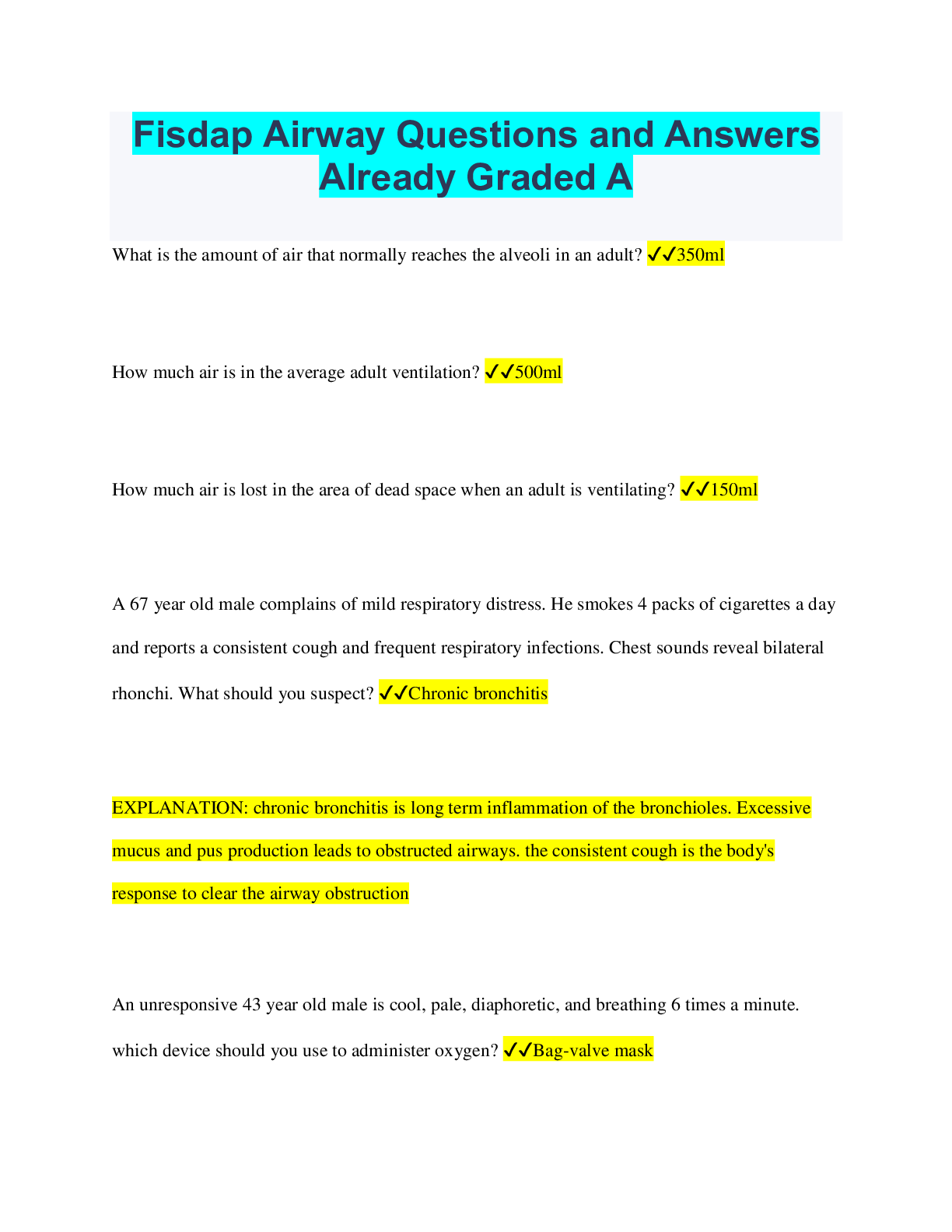
What is the amount of air that normally reaches the alveoli in an adult? ✔✔350ml
How much air is in the average adult ventilation? ✔✔500ml
How much air is lost in
...
Fisdap Airway Questions and Answers
Already Graded A
What is the amount of air that normally reaches the alveoli in an adult? ✔✔350ml
How much air is in the average adult ventilation? ✔✔500ml
How much air is lost in the area of dead space when an adult is ventilating? ✔✔150ml
A 67 year old male complains of mild respiratory distress. He smokes 4 packs of cigarettes a day
and reports a consistent cough and frequent respiratory infections. Chest sounds reveal bilateral
rhonchi. What should you suspect? ✔✔Chronic bronchitis
EXPLANATION: chronic bronchitis is long term inflammation of the bronchioles. Excessive
mucus and pus production leads to obstructed airways. the consistent cough is the body's
response to clear the airway obstruction
An unresponsive 43 year old male is cool, pale, diaphoretic, and breathing 6 times a minute.
which device should you use to administer oxygen? ✔✔Bag-valve mask
EXPLANATION: He is unresponsive and breathing too slow. This is a "sick" patient and
assisting his ventilation should be the first intervention. You can increase his respiratory rate
with a bag-valve mask.
diaphoretic ✔✔Characterized by profuse sweating.
Nasal cannula delivers about what percentage of oxygen ✔✔20-44%
What are the structures that branch off of the trachea into the lower airway? ✔✔Bronchi
EXPLANATION: the trachea splits at the carina into the left and right bronchus. The bronchi get
smaller and smaller until it reaches the terminal bronchioles where the alveoli are located.
What is the normal range of breaths per minute for an adult ✔✔12-20
A febrile 44 year old male complains of shortness of breath and has dull chest pain. he has been
coughing up "rusty" sputum for the last 3 days. what is the most likely cause? ✔✔Pneumonia
EXPLANATION: Pneumonia is an infection of the lung tissue and the "rusty" sputum (spit) is a
sign of a lower airway infection. He is febrile (has a fever) from an immune response to the
infection, and the "dull" chest pain is a common symptom at the location of the infection.
A 42 year old male complains of shortness of breath after being sprayed with super-heated
steam. He has burns to his face, neck and upper chest. Vitals signs are BP 112/66, P 124, R 26
shallow and labored. What should you do? ✔✔Assists his ventilations
EXPLANATION: He is in respiratory failure. His breathing is ineffective because his
respirations are fast and shallow. Shallow respirations do not allow for adequate oxygen
exchange because the air is not drawn down far enough into the lungs. Assisting his breathing
with positive pressure ventilations will help reduce any developing pulmonary edema from the
lower airway burns.
What is the term for abnormal breath sounds that result from an obstructed upper airway?
✔✔Stridor
How should you insert a nasopharyngeal airway? ✔✔Face the bevel toward the septum
Also know to only use water-soluble lubricants when inserting a NPA, no oil-based lubricants
The use of accessory muscles and nasal flaring are signs of what type of breathing? ✔✔Labored
breathing
Expect to initially see an increases respiratory rate ad heart rate with labored breathing. As the
patient begins to tire, the respiratory rate and the quality will begin to decrease, which worsens
the problem.
What are the small air sacs at the end of the airway that are responsible for gas exchange?
✔✔Alveoli
A 53 year old male is sleepy, diaphoretic, difficult to arouse and breathing 8 times a minute.
What do you suspect? ✔✔Respiratory failure
What is directly posterior to the nose? ✔✔Nasopharynx
The nasopharynx connects the opening of the nostrils to the soft palate, which is located at the
back of the mouth. This passage is designed to warm up inhaled air and filters out fine particulate
matter
What is the name of the muscular structure the divides the chest cavity from the abdominal
cavity? ✔✔Diaphragm
What is the most common location for an airway obstruction? ✔✔Pharynx
This passageway is shared by air and food, so it is a common site for a partial of complete
obstruction, which could be food or a flaccid tongue.
What part of the respiratory system contains the vocal cords? ✔✔Larynx
This structure is directly above the trachea.
What is the normal respiratory rate for an adult? ✔✔12-20
What is the name of the cartilaginous ridge in the trachea at which the right and left lungs split?
✔✔Carina
How many lobes are in the lungs? ✔✔5
3 lobes on the right and 2 lobes on the left
What is the name of the passageway shared by the digestive system and the respiratory system
for air and food? ✔✔Pharynx
The nasal cavity and mouth share this passageway. Air travels down the larynx and food travels
into the esophagus
What ring-shaped structure forms the lower portion of the larynx? ✔✔Cricoid cartilage
This is located directly inferior of the thyroid cartilage
What structure is at the terminal portion of the respiratory tree? ✔✔Alveloi
An inadequate amount of oxygen being delivered to the cells is called: ✔✔Hypoxia
What is the name of the only complete cartilaginous ring of the trachea? ✔✔Cricoid Cartilage
The two main branches of the trachea form the: ✔✔Bronchi
You are managing a patient with damage to the brainstem due to a stroke. How can this have a
detrimental effect on the patient's breathing status? ✔✔There can be a change in both the
breathing rate and regularity
Of the following influences on breathing, which one has the MOST significant impact on the
moment-to-moment regulation of breathing? ✔✔Carbon dioxide levels
External respiration is best described as the: ✔✔Exchange of gases between the alveoli and the
surrounding capillary bed
During cellular respiration and metabolism, there is constant production of acidic waste products
such as hydrogen. How does the body initially manage this acid? ✔✔Hydrogen is converted into
carbonic acid and later into CO2 and H2O
While you are transporting a young teenager with a cold and cough, he asks you what his
respiratory system does. How would you respond? ✔✔It takes oxygen from the air and supplies
it to the blood
Which muscle of the body is the primary one that allows normal inhalation to occur?
✔✔Diaphragm
When your patient inhales, the diaphragm and what other muscle group contracts in order for air
to flow into the lungs? ✔✔External intercostal muscles
You are caring for a patient with respiratory distress. The patient is found in a tripod position
with nasal flaring, the pulse oximetry is 94 percent, and you note absent alveolar breath sounds
and cyanosis around the mouth and nail beds. Given these findings, which is MOST suggestive
of actual breathing inadequacy? ✔✔Absent alveolar breath sounds
Following the assessment of a patient who was found in a tripod position, you have concluded
that the patient is unable to adequately deliver oxygenated blood to the peripheral tissues despite
high-flow oxygen via NRB. This is known as: ✔✔Hypoxia
As brain cells start to become initially hypoxic, what is a common CNS response?
✔✔Restlessness and agitation
Which of the following patients, in the absence of disease or injury, will use oxygen at the
highest rate, and thus, must always be adequately oxygenated and ventilated? ✔✔A patient who
is 3 years old
Which patient population is most likely to become hypoxic from poor oxygen reserves during
periods of hypoventilation or apnea? ✔✔Infants
You are caring for a two-week-old who reportedly is having trouble breathing. Which of the
below findings BEST supports the suspicion the patient is truly hypoxic? ✔✔The heart rate is 60
per minute
As compared to infants, what response do adults typically display as they initially start to
become hypoxic? ✔✔The heart rate increases
An infant who is conscious with a pulse has an obstructed airway, the EMT should: ✔✔Alternate
back blows and chest thrusts
How does the mental status of a patient change in light of an airway occlusion from a foreign
body trapped in the trachea? ✔✔The patient can rapidly become unresponsive
The most common cause of airway obstruction in the patient who is found supine and
unresponsive is: ✔✔The tongue
Which of the following anatomical differences between the pediatric and adult airway renders
the pediatric patient more susceptible to airway occlusion when becoming obtunded?
✔✔Proportionally larger tongue
Your unit is on the scene of a call for a 19-year-old female who is having an asthma attack. Her
pulse ox is in the mid-90s, and you hear bilateral wheezing with auscultation. What is your initial
concern for this conscious patient with respiratory distress? ✔✔Diminishing pulmonary function
until respiratory failure occurs
Which of the following would have the least contributory effect on reducing tidal volume in a
patient? ✔✔Diabetes or high blood pressure
You are managing a patient who is suffering from a right ventricular infarction. If the patient is
also complaining of mild dyspnea, how could the MI contribute to the perception of dyspnea?
✔✔Decreased perfusion to the lungs
If a patient has suffered a heart attack and the left ventricle can no longer pump blood
effectively, how can this cause respiratory compromise in the patient? ✔✔Increased amount of
fluid filling the alveoli
Blood, vomitus, or other substances that occlude the nasopharynx may drain and lead to:
✔✔Airway occlusion
Just because a patient is attempting to breathe against a partially occluded airway, if they do
NOT move enough air to reach the alveoli, what secondary complication might they experience?
✔✔Hypoxia or Hypercapnia
Which of the following is the MOST important airway concern for any patient who displays an
altered mental status? ✔✔The tongue will relax into the back of the throat and cause a partial or
complete airway obstruction
Which of the following statements is MOST correct about the relationship between the airway
status and the level of hypoxia that may be present in a patient who is awake and talking to you?
✔✔The airway is intact and the risk of hypoxia is low
Which of the following differences between the airways in the adult and pediatric is correct?
✔✔Pediatrics have a proportionally larger tongue
The narrowest part(s) of an infant's upper airway is (are) the: ✔✔Cricoid cartilage
Which of the following vital sign changes is consistent with pediatric hypoxia that may
necessitate airway and/or ventilatory assistance? ✔✔Bradycardia
Compared to the adult patient, an infant's ventilation rate is: ✔✔Faster and with a lower tidal
volume
A child's metabolic rate and limited oxygen reserves will cause what detrimental effect to occur
more quickly in a child patient than in an adult patient during periods of hypoventilation?
✔✔Hypoxia
A harsh, high-pitched sound heard during inspiration, characteristic of an upper airway
obstruction due to swelling, is called: ✔✔The patient's skin is pale and clammy
You respond to the scene of a witnessed opiate overdose. On your arrival, the patient is
unconscious and supine with labored, sonorous respirations and cyanotic lips. What would be the
cause of the sonorous airway sounds? ✔✔Airway occlusion from the tongue
You respond to the scene of an industrial accident. As you approach the unconscious middleaged male patient, bystanders tell you that he was struck in the face by a large metal beam being
transported by a crane. He is unconscious and cyanotic with gurgling respirations. Your FIRST
action would be to: ✔✔Clear the oropharynx
Steps in performing a head-tilt, chin-lift maneuver for opening the airway of a non-trauma
patient include: ✔✔Tilting the head backward with one hand
You are caring for an adult who was seen by a family member to become unconscious on the
couch, and then slid to the carpeted floor. He appears to have taken an overdose of a medication.
What is the proper technique used to open his airway? ✔✔Head-tilt, chin-lift maneuver
If a gurgling sound is heard during the provision of artificial ventilation with a bag valve mask
(BVM), the EMT should: ✔✔Immediately apply suction to remove the liquid from the airway
Why would an EMT select a nasopharyngeal airway (NPA) instead of an OPA? ✔✔The patient
still has a gag reflex
f a patient has a medical problem that caused him to pass out and strike his head, the EMT
should open the airway using the: ✔✔Jaw-thrust maneuver
When an infant is unconscious in his bed, the EMT should use what procedure to open the
airway. ✔✔head-tilt, chin-lift maneuver
[Show More]