Module 6 TESOL/TEFL Questions and
Answers Rated A+
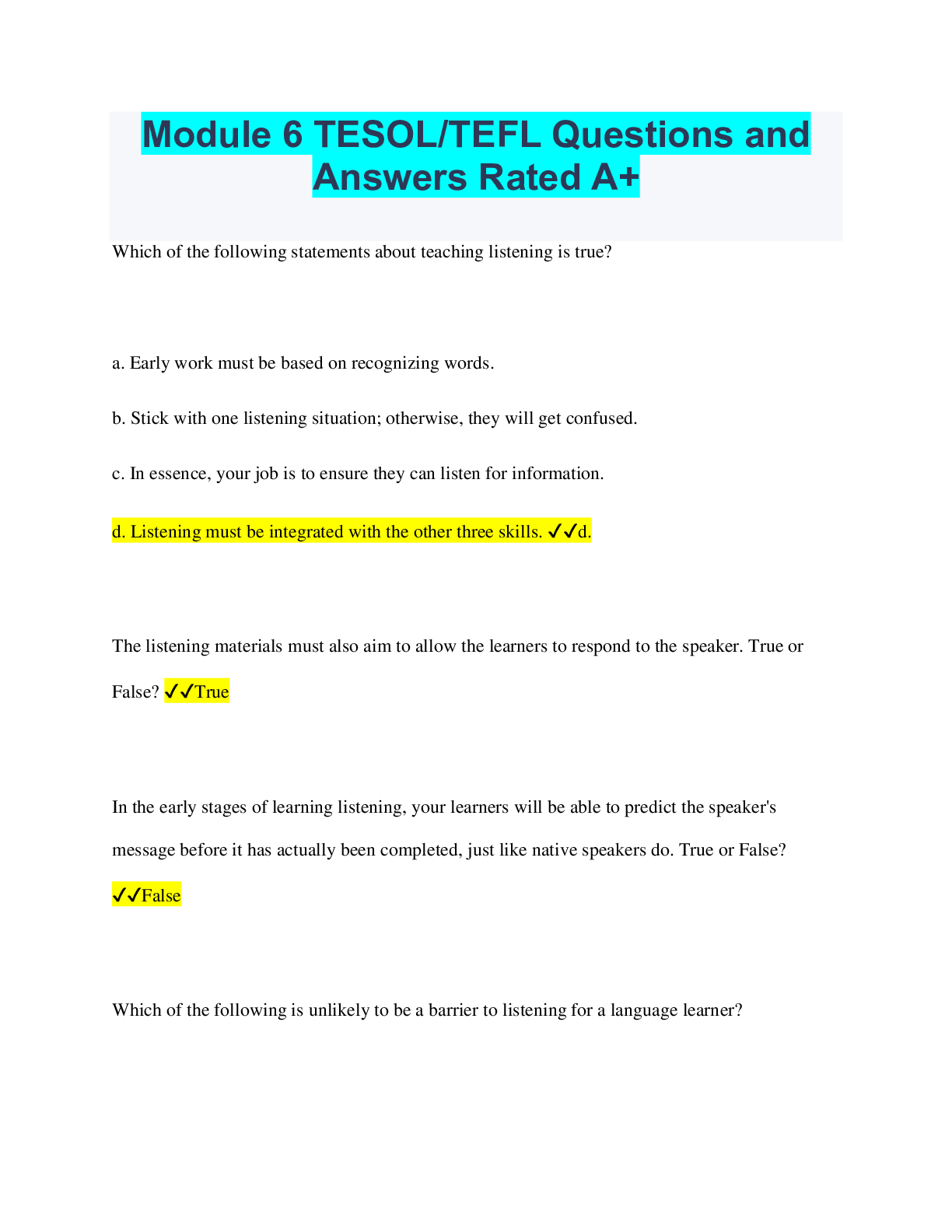
Which of the following statements about teaching listening is true?
a. Early work must be based on recognizing words.
b. Stick with one listening situation; otherwis
...
Module 6 TESOL/TEFL Questions and
Answers Rated A+
Which of the following statements about teaching listening is true?
a. Early work must be based on recognizing words.
b. Stick with one listening situation; otherwise, they will get confused.
c. In essence, your job is to ensure they can listen for information.
d. Listening must be integrated with the other three skills. ✔✔d.
The listening materials must also aim to allow the learners to respond to the speaker. True or
False? ✔✔True
In the early stages of learning listening, your learners will be able to predict the speaker's
message before it has actually been completed, just like native speakers do. True or False?
✔✔False
Which of the following is unlikely to be a barrier to listening for a language learner?
a. Inability to adequately distinguish particular sounds
b. Lack of familiarity with commonly-used vocabulary
c. Speaker speaks too slowly
d. Inability to distinguish the key elements from the unimportant parts of the message ✔✔c.
When listeners listen to a text and try to formulate the main idea(s) of the text, which sub-skill
are they developing?
a. Discerning attitude
b. Listening for the gist
c. Predicting
d. Listening for specific information ✔✔b.
Which one of the following pairs is deemed to be productive skills?
a. Speaking and writing
b. Listening and reading
c. Listening and speaking
d. Writing and reading ✔✔a.
Which of the following statements about speaking is true?
a. It is a dissociated (non-interactive) process.
b. Its form and meaning are dependent on the context in which it occurs.
c. It is seldom spontaneous, open-ended, and evolving.
d. It does not require that learners know how to produce specific points of language such as
grammar. ✔✔b.
Which of the following statements about speaking is correct?
a. Outside the classroom, speaking is used twice as much as listening.
b. You will be guiding your students to attain fluency more than accuracy.
c. Accuracy is speaking at a normal speed without hesitation, repetition or self-correction, and
with cohesion and coherence.
d. Fluency is speaking, utilizing correct forms of grammar, vocabulary, and pronunciation. ✔✔b.
Effective speaking requires sociolinguistic competence. True or False? ✔✔True
Which of the following types of writing is generally least important for students who are learning
a second language?
a. Imitative writing
b. Creative writing
c. Self-writing
d. Display writing ✔✔b.
Writing micro skills focus on accuracy. True or False? ✔✔True
In relation to learning writing, which of the following is a macro skill?
a. Spelling and punctuating correctly
b. Choosing appropriate vocabulary
c. Ordering sentences or paragraphs coherently
d. Employing the correct grammar and structure ✔✔c.
Which of the following is unlikely to be the focus of reading in an EFL/ESOL classroom?
a. Language acquisition
b. Creative ideas and interpretation of creative ideas
c. Understanding of the language
d. Language manipulation. ✔✔b.
When learners search through a text looking for specific information, this is called:
a. skimming
b. scanning
c. intensive reading
d. cohesion ✔✔b.
Extensive reading is used to describe activities that involve the students in analyzing the text in
detail. True or False? ✔✔False
[Show More]