Nutrition, Cedarville, Exam 1 Quiz Reviews
Anaerobic glycolysis results in the formation of which products? - ✔✔Lactic acid and ATP
If carbohydrate intake is adequate to meet energy demands and carbohydrate stores are
...
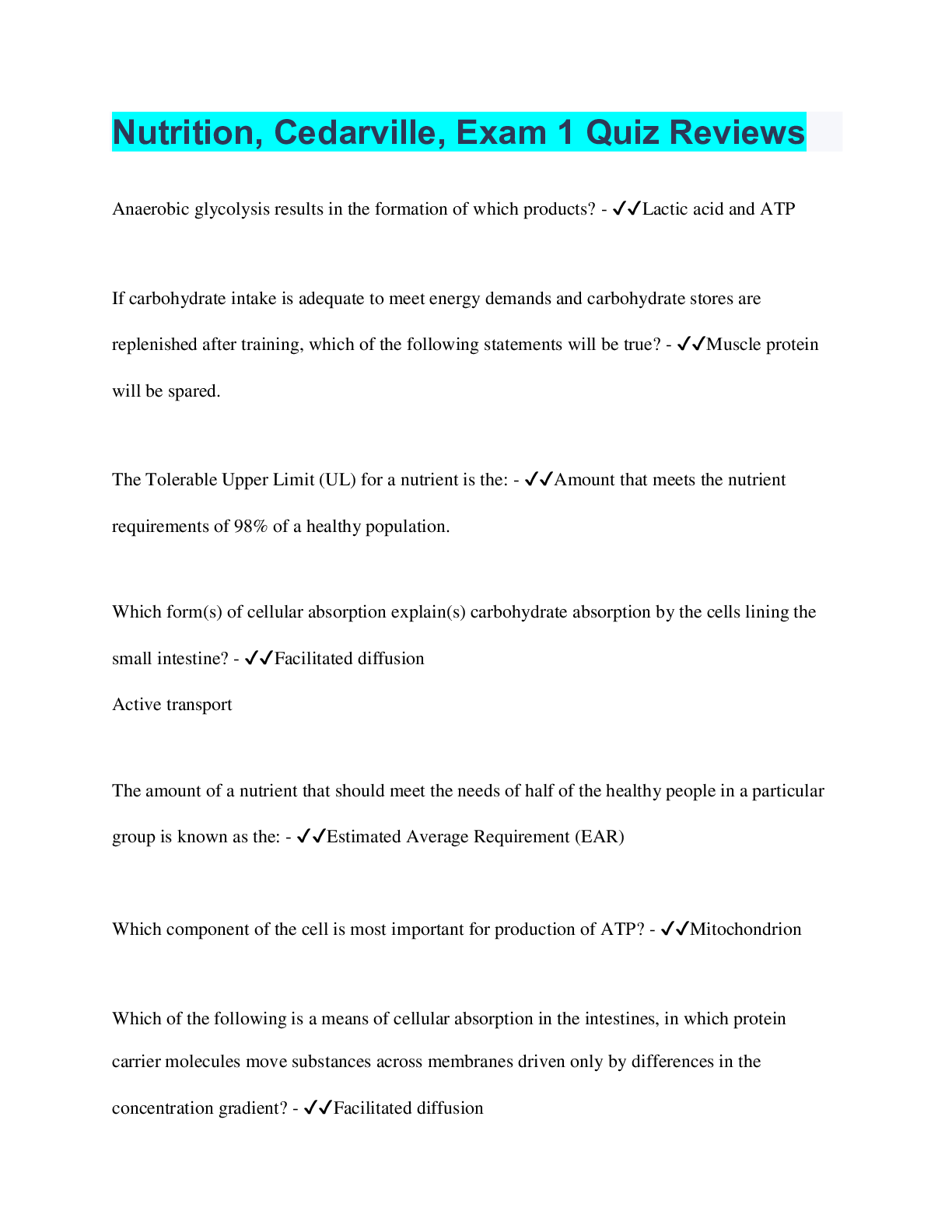
Nutrition, Cedarville, Exam 1 Quiz Reviews
Anaerobic glycolysis results in the formation of which products? - ✔✔Lactic acid and ATP
If carbohydrate intake is adequate to meet energy demands and carbohydrate stores are
replenished after training, which of the following statements will be true? - ✔✔Muscle protein
will be spared.
The Tolerable Upper Limit (UL) for a nutrient is the: - ✔✔Amount that meets the nutrient
requirements of 98% of a healthy population.
Which form(s) of cellular absorption explain(s) carbohydrate absorption by the cells lining the
small intestine? - ✔✔Facilitated diffusion
Active transport
The amount of a nutrient that should meet the needs of half of the healthy people in a particular
group is known as the: - ✔✔Estimated Average Requirement (EAR)
Which component of the cell is most important for production of ATP? - ✔✔Mitochondrion
Which of the following is a means of cellular absorption in the intestines, in which protein
carrier molecules move substances across membranes driven only by differences in the
concentration gradient? - ✔✔Facilitated diffusion
To prevent fatigue and maintain ATP levels above the threshold for fatigue, muscle cells rely
predominantly on which of the following? - ✔✔The aerobic energy system
Which of the following macronutrients can be catabolized for energy in the absence of oxygen? -
✔✔Carbohydrates
Which of the following energy systems is the primary contributor to intense activities or
maximal efforts that last from 1 to 3 minutes? - ✔✔Anaerobic system
Glycogen is: - ✔✔A polysaccharide that is found in plant cells
Some functions of carbohydrates in the body: - ✔✔A. They provide energy to muscles during
exercise.
B. They must be present to metabolize fats.
C. They are the primary energy source for the nervous system.
To help accelerate recovery, what amount of carbohydrate intake is recommended for the 6 hours
immediately after exercise? - ✔✔Approximately 1.0 to 1.5 grams per kilogram of body weight
every 2 hours
Why is dietary fiber an important part of a healthy diet? - ✔✔It decreases blood cholesterol
levels, thus reducing the risk of cardiovascular disease.
Functions of triglycerides - ✔✔They provide 9 calories per gram, helping athletes meet their
daily energy needs.
They provide protection to vital organs and thermal insulation for the body.
They aid in the absorption of fat-soluble vitamins and phytochemicals.
Jason is a cross-country athlete who is currently training six days per week, 1-3 hours per day.
He weighs 62 kg. Based on his body weight, what should his carbohydrate intake be? -
✔✔Approximately 620 grams per day
Solid fats generally have a high proportion of what type of fatty acids? - ✔✔Saturated
Name 3 monosaccharide? - ✔✔Glucose
Fructose
Galactose
Which of the following is true of the glycemic index? - ✔✔Consumption of moderate to high
glycemic index foods is recommended during exercise.
During competition lasting longer than 90 minutes, which of the following would be an
appropriate recommendation for carbohydrate intake? - ✔✔Consume carbohydrates at a rate of
about 30 to 60 grams per hour.
Jack is a high school shot putter with a body mass of 100 kg. He reports that he is consuming
350 grams of protein per day. Which of the following statements is true? - ✔✔Jack is consuming
more than the recommended protein for strength/power athletes.
Which of the following statements is true regarding fat intake and exercise performance? - ✔✔A
long-term pattern of high-fat intake can decrease the glycogen stores in the body.
Which of the following best describes "complementing proteins"? - ✔✔Protein sources that,
when combined, supply all of the essential amino acids
After reading about fats in your course textbook, you determine that you should consume more
sources of unsaturated fats than saturated fats in your diet. Which of the following fats supplies
more unsaturated fat than saturated fat?
A. Olive oil
B. Butter
C. Whole milk
D. Hard cheese - ✔✔A. Olive oil
Which of the following food sources provides the greatest amount of dietary protein?
A. Skim milk
B. Whole wheat bread
C. Broccoli
D. Chicken
E. Bananas - ✔✔D. Chicken
Which of the following is not a function of proteins in the body?
A. They play an important role in immune functioning.
B. They are used by the body to produce enzymes.
C. They help to maintain the body's fluid balance.
D. They are a major source of energy during exercise.
E. They provide structure to muscles and other tissues. - ✔✔D. They are a major source of
energy during exercise.
Which of the following statements is true regarding protein supplements?
A. The cost of protein supplements is often cheaper than the cost of high protein foods.
B. Protein supplementation produces greater muscle mass gains than dietary protein.
C. Most athletes do not consume adequate protein; thus, supplements are recommended.
D. Protein supplementation should not be recommended to athletes of any age group.
E. Protein supplements may be helpful when athletes travel or lack easy access to food. - ✔✔E.
Protein supplements may be helpful when athletes travel or lack easy access to food.
Which of the following statements is true regarding protein intake and exercise performance?
A. Combining carbohydrates and proteins after exercise is not currently recommended.
B. Consumption of essential amino acids after exercise can increase protein synthesis.
C. Ingestion of amino acids during exercise is recommended for rapid energy supply.
D. Protein-rich foods should be the predominant form of dietary intake prior to exercise. - ✔✔B.
Consumption of essential amino acids after exercise can increase protein synthesis.
Which of the following statements is true regarding fat utilization during exercise?
Select one:
A. The supply of energy from fats diminishes quickly during endurance exercise.
B. Fat utilization for energy is greatest during high intensity exercise activities.
C. Long-term endurance training decreases working muscles' capacity for fat oxidation.
D. Delivery of fats to working muscles for energy is slower than that of carbohydrates. - ✔✔D.
Delivery of fats to working muscles for energy is slower than that of carbohydrates.
Which of the following statements is true regarding cholesterol?
A. There is increasing evidence that lipoprotein (a) is protective against heart disease.
B. High levels of HDL cholesterol are associated with increased risk of heart disease.
C. Release of LDL cholesterol in arterial walls may eventually lead to atherosclerosis.
D. A diet high in saturated fats can help in reducing high levels of LDL in the blood. - ✔✔C.
Release of LDL cholesterol in arterial walls may eventually lead to atherosclerosis.
Which of the following would be an excellent source of Vitamin B6?
A. All bran cereal
B. Green tea
C. Low fat milk
D. Strawberries - ✔✔A. All bran cereal
Some fat-soluble vitamins: - ✔✔Vitamin D
Vitamin A
Vitamin K
Some things true of minerals? - ✔✔Minerals are needed in small amounts by the body.
Major and trace minerals contain no calories.
Their structure remains unaltered after ingestion.
Major and trace minerals are organic or inorganic molecules? - ✔✔Inoganic
Primary function of Vitamin K with respect to blood health? - ✔✔Clotting of blood
Why is magnesium important for energy production? - ✔✔It improves the effectiveness of
enzymes needed for energy release.
Which of the following foods would be the richest sources of calcium?
A. Low-fat milk and yogurt
B. Fruits and vegetables
C. Butter and margarine
D. Bran cereal and breads - ✔✔A. Low-fat milk and yogurt
Good sources of non-heme iron are: - ✔✔whole grains, legumes, and vegetables.
How are water-soluable vitamins transported? - ✔✔Easily through the blood
3 Antioxidant - ✔✔Vitamin A (carotenoids)
Vitamin C
Vitamin E
Some vitamins and minerals vital for bone health? - ✔✔Phosphorus
Vitamin K
Vitamin D
Calcium
[Show More]


.png)