BLS for Healthcare Providers Exam
How would you know that a rescue breath for a victim of any age is effective? - ✔✔You should
see their chest rise.
A child has a heart rate greater than 60 per minute and a pulse, but
...
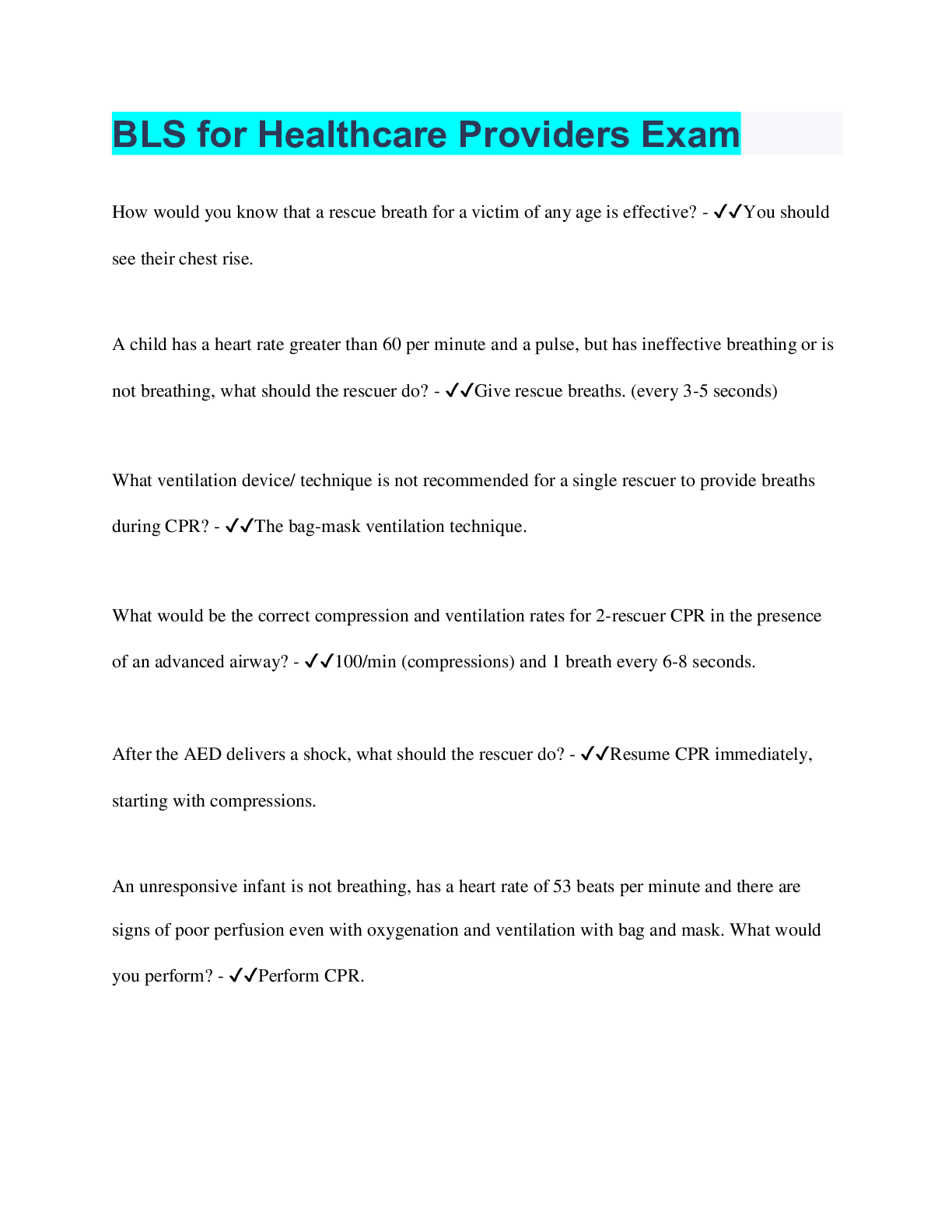
BLS for Healthcare Providers Exam
How would you know that a rescue breath for a victim of any age is effective? - ✔✔You should
see their chest rise.
A child has a heart rate greater than 60 per minute and a pulse, but has ineffective breathing or is
not breathing, what should the rescuer do? - ✔✔Give rescue breaths. (every 3-5 seconds)
What ventilation device/ technique is not recommended for a single rescuer to provide breaths
during CPR? - ✔✔The bag-mask ventilation technique.
What would be the correct compression and ventilation rates for 2-rescuer CPR in the presence
of an advanced airway? - ✔✔100/min (compressions) and 1 breath every 6-8 seconds.
After the AED delivers a shock, what should the rescuer do? - ✔✔Resume CPR immediately,
starting with compressions.
An unresponsive infant is not breathing, has a heart rate of 53 beats per minute and there are
signs of poor perfusion even with oxygenation and ventilation with bag and mask. What would
you perform? - ✔✔Perform CPR.
Where do you place your hands to perform chest compressions on an adult? - ✔✔On the
breastbone, center of chest, between the nipples/sternum.
What is the preferred chest compression technique for an infant for 2-rescuer CPR? - ✔✔The
two thumb-encircling hands technique.
What is the rate for performing chest compressions for a victim all ages? - ✔✔100 per minute.
What is the depth of compressions for an adult? - ✔✔2 inches.
What is the ratio for 2-rescuer child CPR? - ✔✔15/2
What is the ratio for 1-rescuer adult CPR? - ✔✔30/2 (5 cycles)
What is the ratio for 2-rescuer infant CPR? - ✔✔15/2 (10 cycles)
What is the depth of compressions for an infant? - ✔✔1/3 to the 1/2 the diameter of the chest.
(1.5 inches)
When would you start CPR for any victim? - ✔✔When there's no breathing, pulse, or
consciousness.
Why is the correct depth of compressions important during CPR? - ✔✔Because it maximizes the
refilling of the heart with blood.
What is the first step in operating an AED? - ✔✔Turning it ON.
When a choking victim becomes unresponsive, what should you do after you have someone
activate the emergency response system? - ✔✔Lower victim to the ground and begin CPR.
When should the rescuer begin to check for scene safety? - ✔✔Before performing any other
CPR procedures, when you arrive.
According to new guidelines when a victim is unresponsive and not breathing, it is
recommended that a healthcare provider check a pulse for no more than how many seconds? -
✔✔10 seconds.
How do you minimize the risk of gastric inflation during bag-mask ventilation? - ✔✔By making
sure the chest rises adequately.
A victim is unresponsive, not breathing, and has no pulse, you should begin chest compressions
within how many seconds? - ✔✔10 seconds.
During a 2-rescuer CPR, what does the second rescuer do while the first rescuer gives chest
compressions? - ✔✔Give rescue breaths, maintain open airway.
After the airway is opened, what technique would you use to ensure proper mouth-to-mouth
ventilation? - ✔✔Head-tilt-chin-lift.
What is the rate of rescue breaths for a child that has a pulse but not breathing when using a bagmask device? - ✔✔1 every 3-5 seconds.
[Show More]