Red Cross CPR/AED/ First Aid
Certification Test
What are the good samaritan laws? - ✔✔protect the responder from financial liability, developed
to encourage people to help others in an emergency situation.
What is co
...
Red Cross CPR/AED/ First Aid
Certification Test
What are the good samaritan laws? - ✔✔protect the responder from financial liability, developed
to encourage people to help others in an emergency situation.
What is consent, and how do you get it? - ✔✔permission from the injured or ill person or their
parent or guardian if the person is a minor. To obtain; start with your name, state type and level
of training you have, explain what you think is wrong, explain what you plan to do, ask if you
may help.
What are the emergency action steps? - ✔✔Check, Call, Care
When is it time to call 911? - ✔✔when the situation has become one of the emergency situations
or you recognize emergency conditions in play
What are the clues that an emergency has happened? - ✔✔unusual sounds, sights, odors, and
behaviors.
What are PPE's? - ✔✔Personal Protective Equipment, such as gloves, breathing barriers, hand
washing, etc.
If a victim is responsive what 2 skills do you do? - ✔✔Interview the person and do a head to toe
check. Roll the person into the recovery position.
How long and how do you check for breathing? - ✔✔No more than 5-10 seconds. Head tilt chin
lift, ear to mouth look towards sternum.
How do you give rescue breaths? - ✔✔Head tilt chin left, breath in until you see chest plate rise.
In intervals of 2.
What leads to cardiac issues in infants & children? - ✔✔
What is cycle for CPR and how long do you do it? - ✔✔2 rescue breaths for every 30 Chest
compressions. Continue until exhaustion, more trained professional takes over, scene becomes
unsafe, or person shows obvious signs of life.
What if a responsive, child, infant, or adult is choking? - ✔✔5 abdominal thrusts and 5 back
blows for adults and children. For an infant, put the infant in a secure position alternating
between legs to rest the infant on and do 5 chest thrusts and 5 back blows
How do we know somebody is having a breathing emergency? - ✔✔Panicked, surprised, or
confused facial expression, holding throat with both hands, trying to forcibly cough, initially
flushed skin but turning pale rapidly.
Where do you place hands during CPR for an adult, a child, and an infant? - ✔✔Child and adult:
two hands interlocked w/ one on top of the other in the center of the chest, infant: two fingers on
center of chest just below the nipple line.
What are effective compressions? - ✔✔Forcible compressions of at least 2 inches for an adult,
about 2 inches for a child and about 1 1/2 inches for an infant.
What do we do if air does not go in an unresponsive adult, child, or infant? - ✔✔Give CPR with
one modification: after each set of compressions and before giving rescue breaths, open the
mouth, look for an object in the person's mouth, and if you see it, remove it.
What are the signs and symptoms of a heart attack for a male, and for a female? - ✔✔Men
usually experience the more "classic" signs and symptoms such as: chest pain, pressure,
squeezing, tightness, aching or heaviness that lasts longer than 3-5 minutes or goes away and
comes back. Relating pain to arms, neck or shoulder. Secondary signs for men may include
dizziness, loss of consciousness, sweating, nausea, or unusual shortness of breath. Women may
experience the "classic" signs but often milder and may be accompanied by more general signs
and symptoms such as: shortness of breath, nausea or diarrhea, fatigue, dizziness, sweating, and
back or jaw pain.
What are the 2 types of cardiac chain of survival? - ✔✔Adult and Pediatric.
For an adult the chain is as follows: Recognize and call 911, Early CPR, Early Defibrillation,
Early advanced life support, and Integrated Post-cardiac arrest care.
For pediatric: Injury prevention and safety, Early CPR, Early emergency care, Pediatric
advanced life support, and Integrated Post-Cardiac arrest care.
What is an AED? - ✔✔Automated External Defibrillator
When is an AED used? - ✔✔Whenever it is available and as soon as possible when it is
available.
What is the purpose of and AED? - ✔✔Can correct the underlying problem for some people who
go into sudden cardiac arrest. Two abnormal heart rhythms in particular, ventricular fibrillation
(V-fib) and
ventricular tachycardia (V-tach).
When the AED prompts analyzing, what should you do? - ✔✔Stand clear and deliver a shock
What is the first thing you do with and AED? - ✔✔Turn it on
Where do the pads go on the victim? - ✔✔Upper ride side of the chest and lower left side of the
chest near the armpit of the victim
Why do you say "stand clear"? - ✔✔So that the AED can get an accurate reading, and you may
get shocked.
What are overall signs for sudden illness? - ✔✔Trouble breathing, chest or abdominal pain,
headache, light-headed or dizzy, nausea, vomiting, diarrhea, stomach cramps, fever, pale or
flushed skin, problems with senses, numbness, weakness, paralysis, seizures.
What are care steps for shock? - ✔✔Have person lie flat on their back, control any external
bleeding, cover the person to prevent loss of body heat, DO NOT give the person anything to eat
or drink, provide reassurance, continuously monitor.
Care steps for muscle, bone, and joint injuries - ✔✔Rest, Immobilize, Cold, Elevate (RICE)
Care steps for bleeding wounds - ✔✔For a minor bleeding wounds, use gauze pads and a wrap to
apply pressure and stop up the bleeding until you can get help. Major bleeding wounds require
immediate medical attention, so do your best to slow down bleeding until help arrives.
Care steps for use of a tourniquet - ✔✔A device placed around an arm or leg to constrict blood
vessels and stop blood flow to a wound. In some life-threatening circumstances, you may need to
use a tourniquet to control bleeding as the first step instead of maintaining direct pressure over
several minutes.
Care steps for seizure - ✔✔Call for help if it... lasts more than 5 minutes, the person was injured,
person is gasping or unresponsive and not breathing after, person is pregnant or has diabetes,
young child or infant and cause was a high fever, elderly, cause is unknown or its persons first
one ever, took place in the water.
Care steps for stroke - ✔✔Call 911, try and note or figure out the last time the person was well
because some EMS medications are only effective in a certain time frame, stay with person and
reassure them of safety until help arrives, put into recovery position if possible. Facial drooping,
Arm weakness, Speech difficulties and Time to call emergency services.(FAST)
Care steps for diabetic emergency - ✔✔Call 911 if person is unresponsive, interview bystanders
and do head to toe check, check the airway, if person has a history use a suitable form of sugar
such as fruit juice, glucose tablets, fruit strips, chewable candies, regular soda, milk, a spoonful
of sugar in a glass of water.
Care steps for burn - ✔✔Stop the source of the burn, cool the burn and relieve pain using clean,
cool or cold water for at least 10 minutes. Use water that you could drink. Never use ice or ice
water to cool a burn because doing so can cause more damage to the skin. If clean cool or cold
water is not available, you can apply a cool or cold (but not freezing) compress instead. Cover
with a lovely sterile dressing.
Care steps for severe life threatening bleeding - ✔✔Do best to slow down bleeding and call 911
Care steps for head, neck, and back injury - ✔✔Always assume that an injury involving the
head, neck or spine is serious and provide care accordingly. If you suspect a head, neck or spinal
injury, call 9-1-1 or the designated emergency number. As long as the person is breathing
normally, have him or her remain in the position in which he or she was found. If the person is
wearing a helmet, do not remove it unless you are specifically trained to do so and removing the
helmet is necessary to give CPR. Similarly, if a child is strapped into a car seat, do not remove
him or her from it unless you need to give the child CPR.
Care steps for concussions - ✔✔Advise the person to stop the activity he or she was engaged in
when the incident occurred. The person should follow up with a healthcare provider for a full
evaluation. A healthcare provider is best able to evaluate the severity of the injury and make
recommendations about when the person can return to normal activities. And, while rare,
permanent brain injury and death are potential consequences of failing to identify and respond to
a concussion in a timely manner.
Care Steps for anaphylaxis - ✔✔If you know that the person has had a severe
allergic reaction before, and the person is having trouble breathing or is showing signs and
symptoms
of anaphylaxis, have someone call 9-1-1 or the designated emergency number immediately. If
the person carries medication (e.g., epinephrine) used for the emergency treatment of
anaphylaxis, offer to help the person use the medication. If you are alone, help the person
administer the medication and then call 9-1-1 or the designated emergency number. While you
wait for help to arrive, make sure the person is sitting in a comfortable position, or have the
person lie down if he or she is showing signs of shock.
What is implied consent? - ✔✔somebody who is unresponsive, confused, or mentally impaired,
also applies to a minor in a medical emergency situation when a parent or guardian is not around.
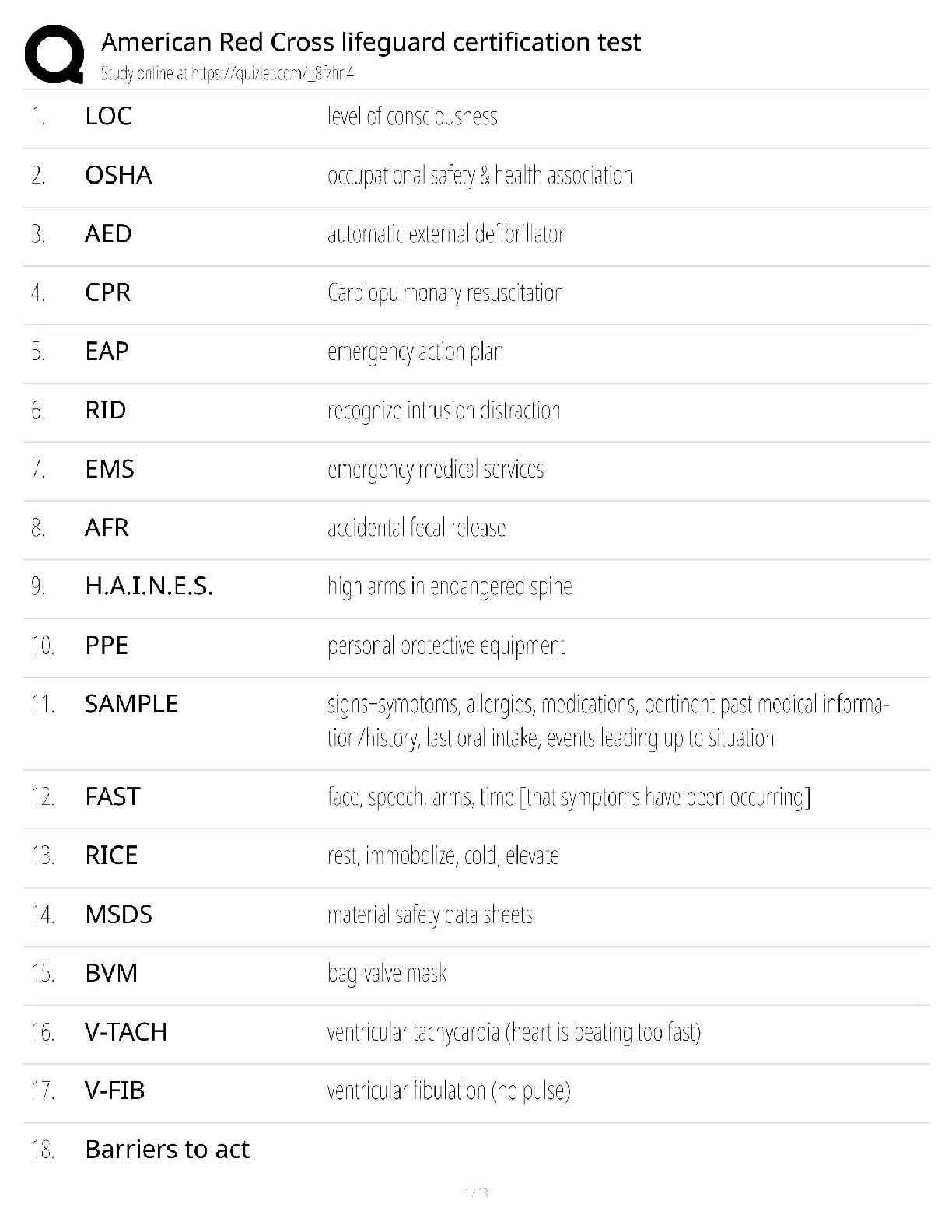
S.A.M.P.L.E. - ✔✔Signs and symptoms, Allergies, Medications, Pertinent medical history, Last
food or drink, Events leading up to the incident.
[Show More]






.png)