Introductory Chemistry Version II by David W. Ball - Complete, Elaborated and Latest(Solution Manual)COMPLETE
Elaborated Solution Manual
for
Introductory Chemistry Version II
by
David W. Ball
2022
Prof.Exams
Intr
...
Introductory Chemistry Version II by David W. Ball - Complete, Elaborated and Latest(Solution Manual)COMPLETE
Elaborated Solution Manual
for
Introductory Chemistry Version II
by
David W. Ball
2022
Prof.Exams
Introductory Chemistry Version II by David W. Ball
ISBN-10 1260247848
ISBN-13 978-1260247848
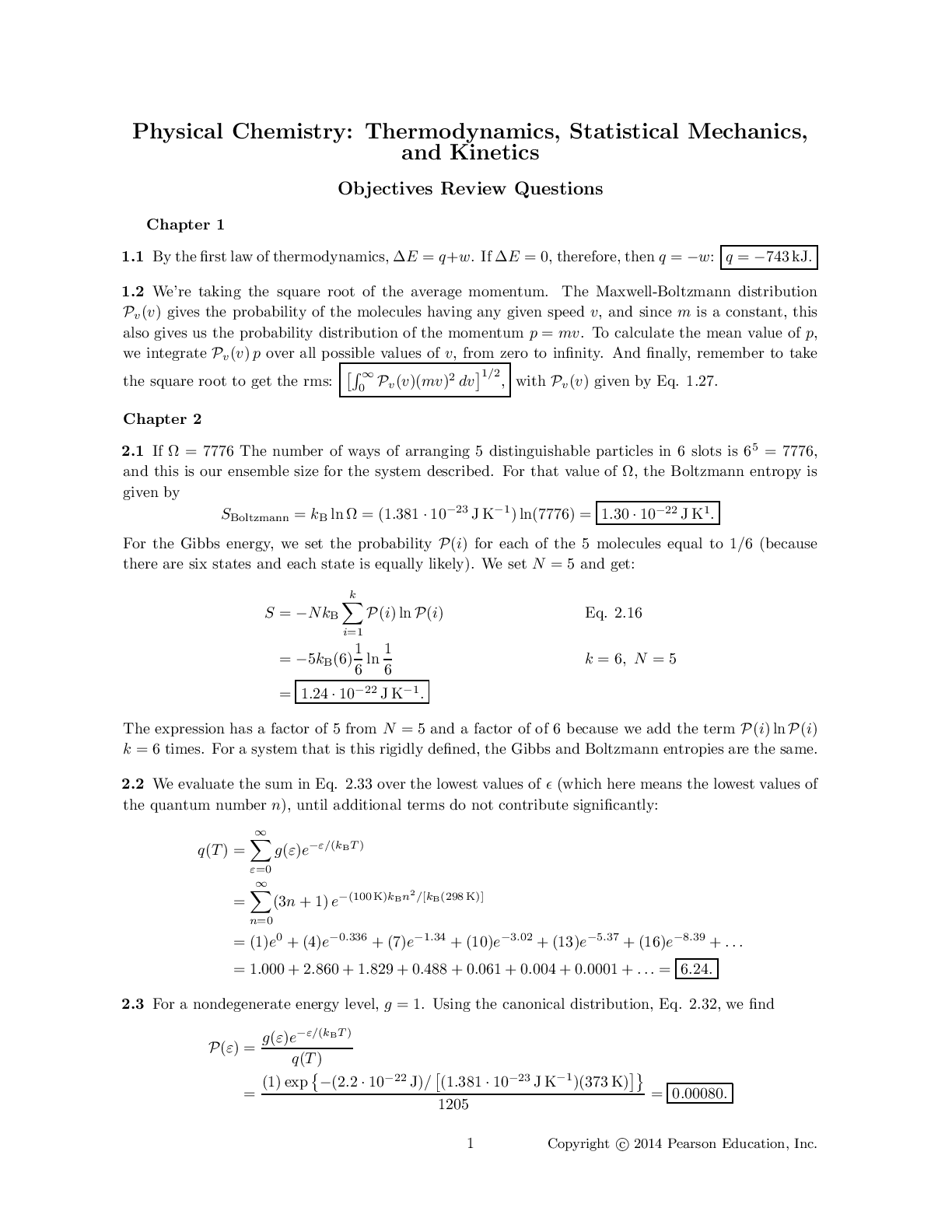
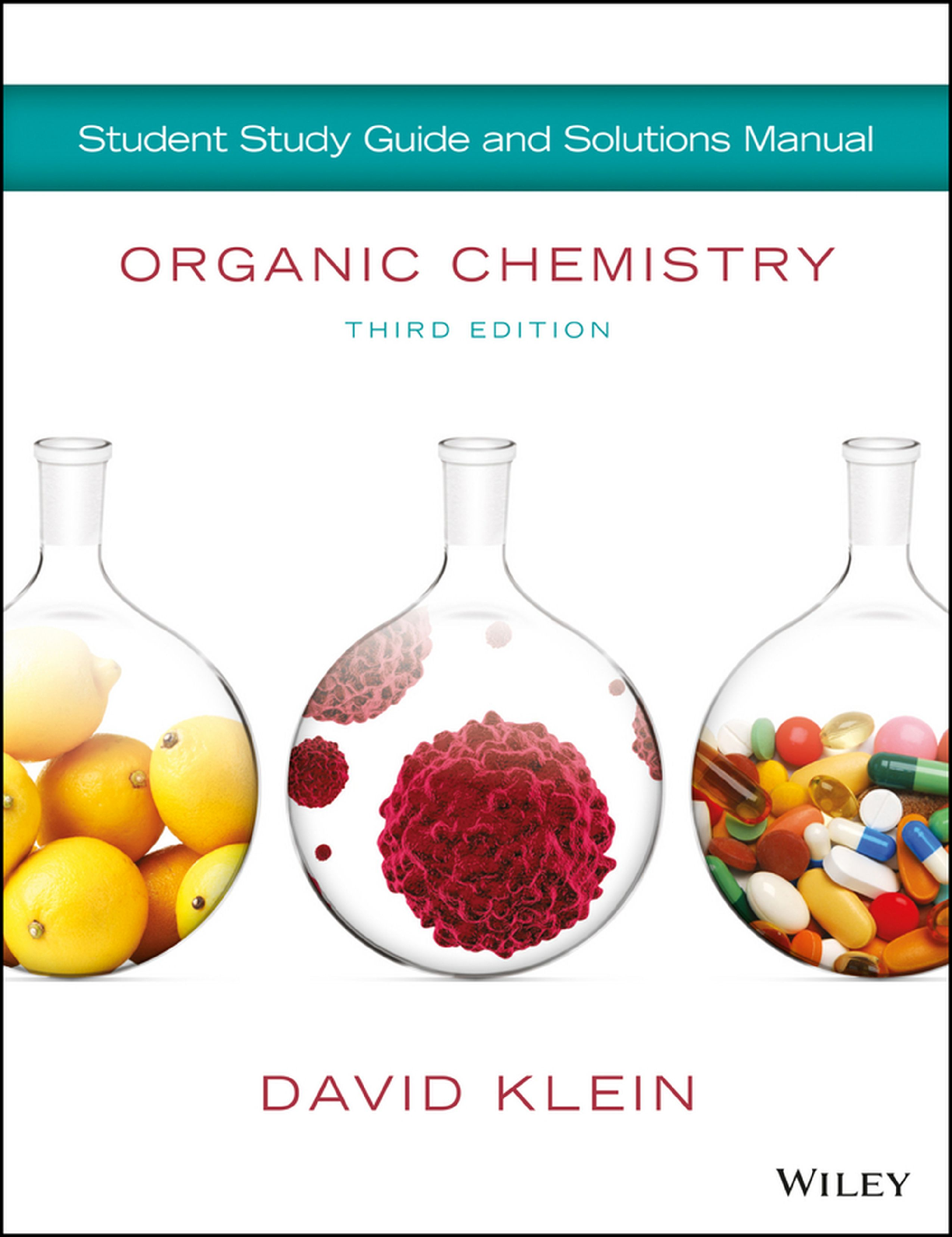
Solution Manual for Introductory Chemistry Version II by David W. Ball
ISBN-10 1260247848
ISBN-13 978-1260247848
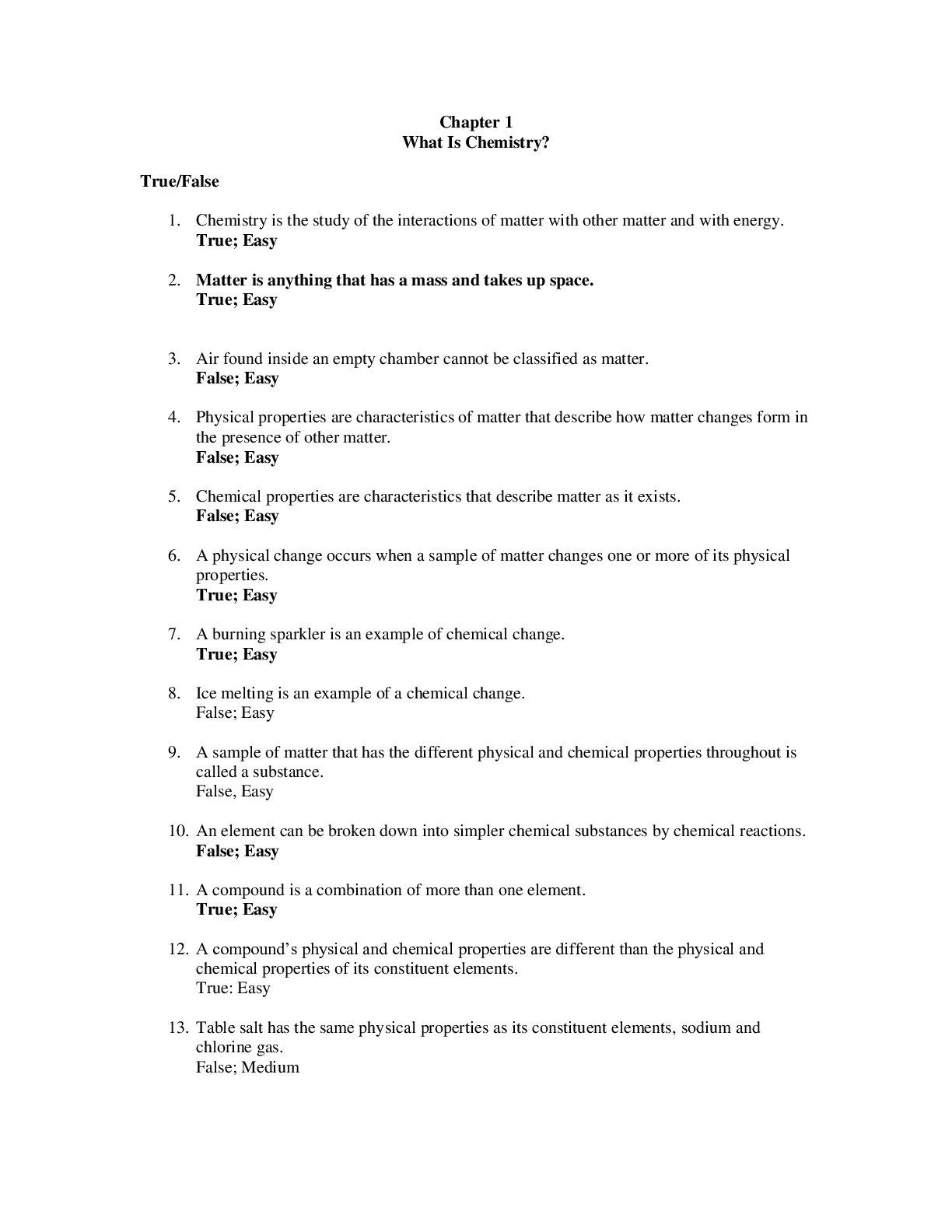
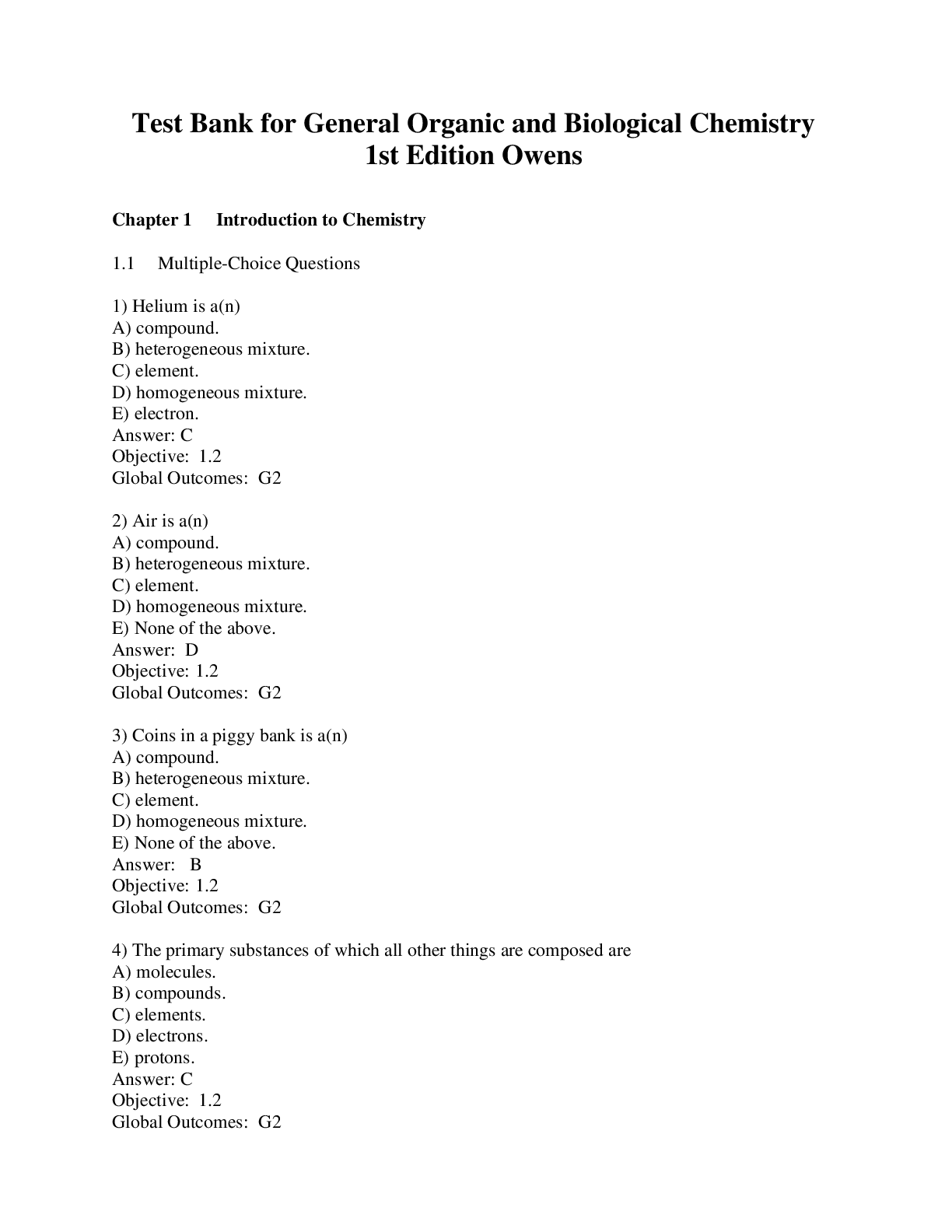
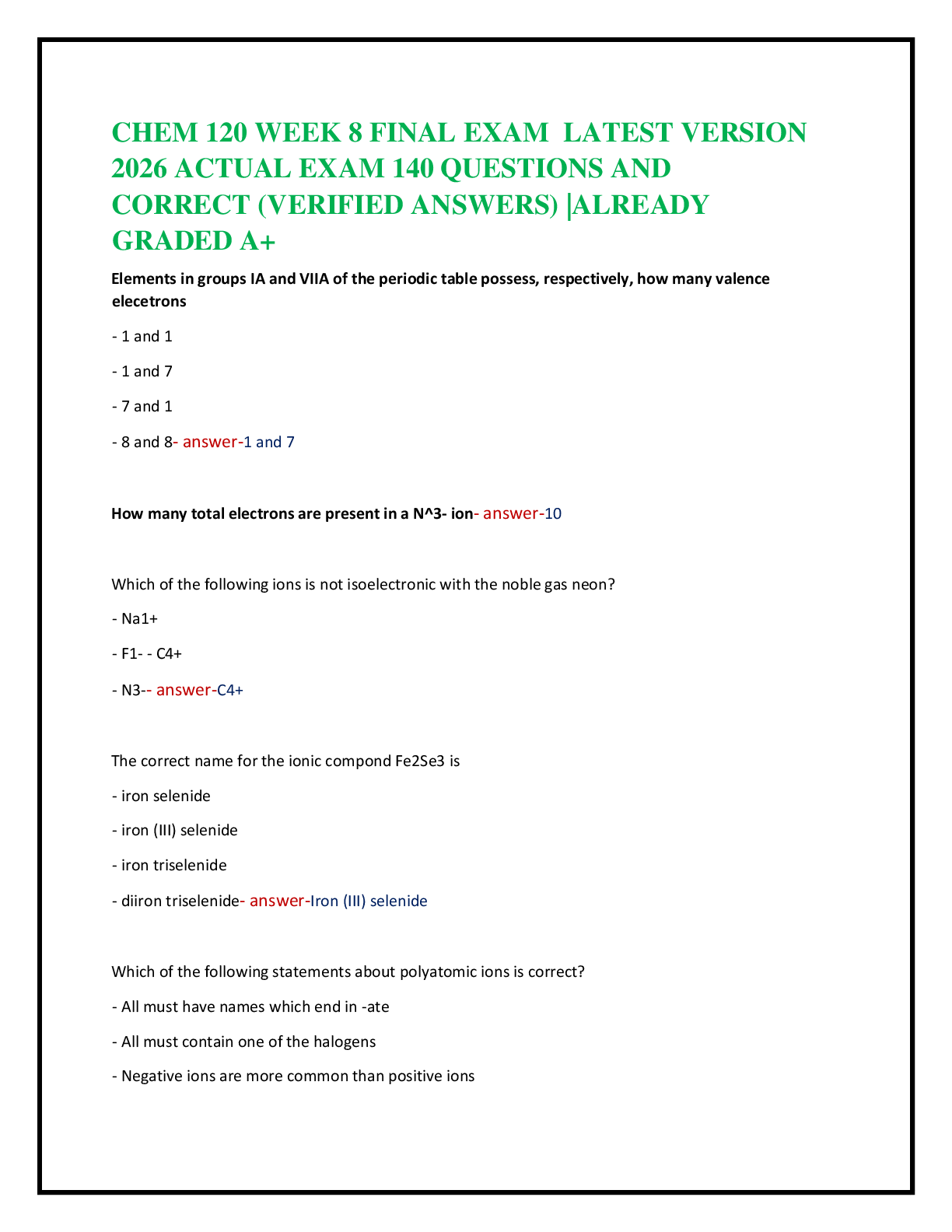
THIS IS NOT THE ACTUAL BOOK. YOU ARE BUYING it is the Official Test Bank in e-version INSTANT DOWNLOAD
>The test bank is what most professors use as a template when making exams for their students, which means
there’s a very high chance that you will see the exact questions in the tests!
>The file is either in.pdf, excel, or zipped in the package and can easily be read on PCs and Macs.
>Delivery is INSTANT. You can download the files IMMEDIATELY once payment is done.
If you have any questions, please feel free to contact us. Our response is the fastest. All questions will always be answered in 6 hours, most of the time within 30mins.
We also faced similar difficulties when we were students, and we understand how you feel. But now, with the Official Test Bank, you will be able to
* Anticipate the type of the questions that will appear in your exam.
* Know the correct answers to those questions.
* Reduce the hassle and stress of your student life.
* Improve your studying and get a better grade!
* Get prepared for examination questions.
* Save you time and help you understand the material.
Prof.Exams
TABLE OF CONTENTS
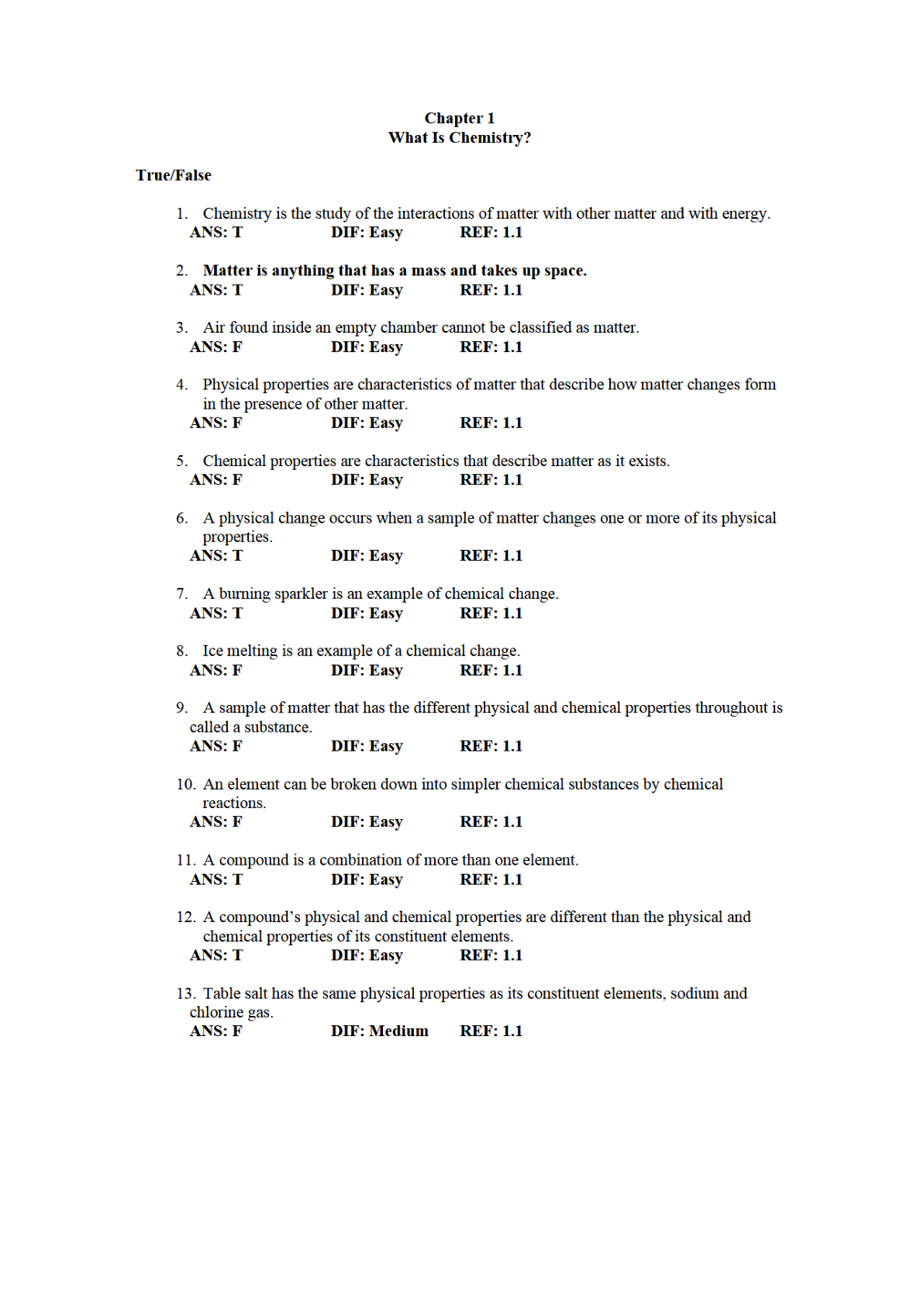
Chapter 1: What Is Chemistry?
1.1 Some Basic Definitions
1.2 Chemistry as a Science
Chapter 2: Measurements
2.1 Expressing Numbers
2.2 Expressing Units
2.3 Significant Figures
2.4 Converting Units
2.5 Other Units: Temperature and Density
2.6 End-of-Chapter Material
Chapter 3: Atoms, Molecules, and Ions
3.1 Atomic Theory
3.2 Molecules and Chemical Nomenclature
3.3 Masses of Atoms and Molecules
3.4 Ions and Ionic Compounds
3.5 Acids
3.6 End-of-Chapter Material
Chapter 4: Chemical Reactions and Equations
Prof.Exams
4.1 The Chemical Equation
4.2 Types of Chemical Reactions: Single- and Double-Displacement Reactions
4.3 Ionic Equations: A Closer Look
4.4 Composition, Decomposition, and Combustion Reactions
4.5 Neutralization Reactions
4.6 Oxidation-Reduction Reactions
4.7 End-of-Chapter Material
Chapter 5: Stoichiometry and the Mole
5.1 Stoichiometry
5.2 The Mole
5.3 The Mole in Chemical Reactions
5.4 Mole-Mass and Mass-Mass Calculations
5.5 Yields
5.6 Limiting Reagents
5.7 End-of-Chapter Material
Chapter 6: Gases
6.1 Kinetic Theory of Gases
6.2 Pressure
6.3 Gas Laws
Prof.Exams
6.4 Other Gas Laws
6.5 The Ideal Gas Law and Some Applications
6.6 Gas Mixtures
6.7 End-of-Chapter Material
Chapter 7: Energy and Chemistry
7.1 Energy
7.2 Work and Heat
7.3 Enthalpy and Chemical Reactions
7.4 Stoichiometry Calculations Using Enthalpy
7.5 Hess’s Law
7.6 Formation Reactions
7.7 End-of-Chapter Material
Chapter 8: Electronic Structure
8.1 Light
8.2 Quantum Numbers for Electrons
8.3 Organization of Electrons in Atoms
8.4 Electronic Structure and the Periodic Table
8.5 Periodic Trends
8.6 End-of-Chapter Material
Prof.Exams
Chapter 9: Chemical Bonds
9.1 Lewis Electron Dot Diagrams
9.2 Electron Transfer: Ionic Bonds
9.3 Covalent Bonds
9.4 Other Aspects of Covalent Bonds
9.5 Violations of the Octet Rule
9.6 Molecular Shapes
9.7 End-of-Chapter Material
Chapter 10: Solids and Liquids
10.1 Intermolecular Forces
10.2 Phase Transitions: Melting, Boiling, and Subliming
10.3 Properties of Liquids
10.4 Solids
10.5 End-of-Chapter Material
Chapter 11: Solutions
11.1 Some Definitions
11.2 Quantitative Units of Concentration
11.3 Dilutions and Concentrations
Prof.Exams
11.4 Concentrations as Conversion Factors
11.5 Colligative Properties of Solutions
11.6 Colligative Properties of Ionic Solutes
11.7 End-of-Chapter Material
Chapter 12: Acids and Bases
12.1 Arrhenius Acids and Bases
12.2 Brønsted-Lowry Acids and Bases
12.3 Acid-Base Titrations
12.4 Strong vs. Weak Acids and Bases and Their Salts
12.5 Autoionization of Water
12.6 The pH Scale
12.7 Buffers
12.8 End-of-Chapter Material
Chapter 13: Chemical Equilibrium
13.1 Chemical Equilibrium
13.2 The Equilibrium Constant
13.3 Shifting Equilibria: Le Chatelier’s Principle
13.4 Calculating Equilibrium Constant Values
13.5 Some Special Types of Equilibria
Prof.Exams
13.6 End-of-Chapter Material
Chapter 14: Oxidation and Reduction
14.1 Oxidation-Reduction Reactions
14.2 Balancing Redox Reactions
14.3 Applications of Redox Reactions: Voltaic Cells
14.4 Electrolysis
14.5 End-of-Chapter Material
Chapter 15: Nuclear Chemistry
15.1 Radioactivity
15.2 Half-Life
15.3 Units of Radioactivity
15.4 Uses of Radioactive Isotopes
15.5 Nuclear Energy
15.6 End-of-Chapter Material
Chapter 16: Organic Chemistry
16.1 Hydrocarbons
16.2 Branched Hydrocarbons
16.3 Alkyl Halides and Alcohols
Prof.Exams
16.4 Other Oxygen-Containing Functional Groups
16.5 Other Functional Groups
16.6 Polymers
16.7 End-of-Chapter Material.
[Show More]