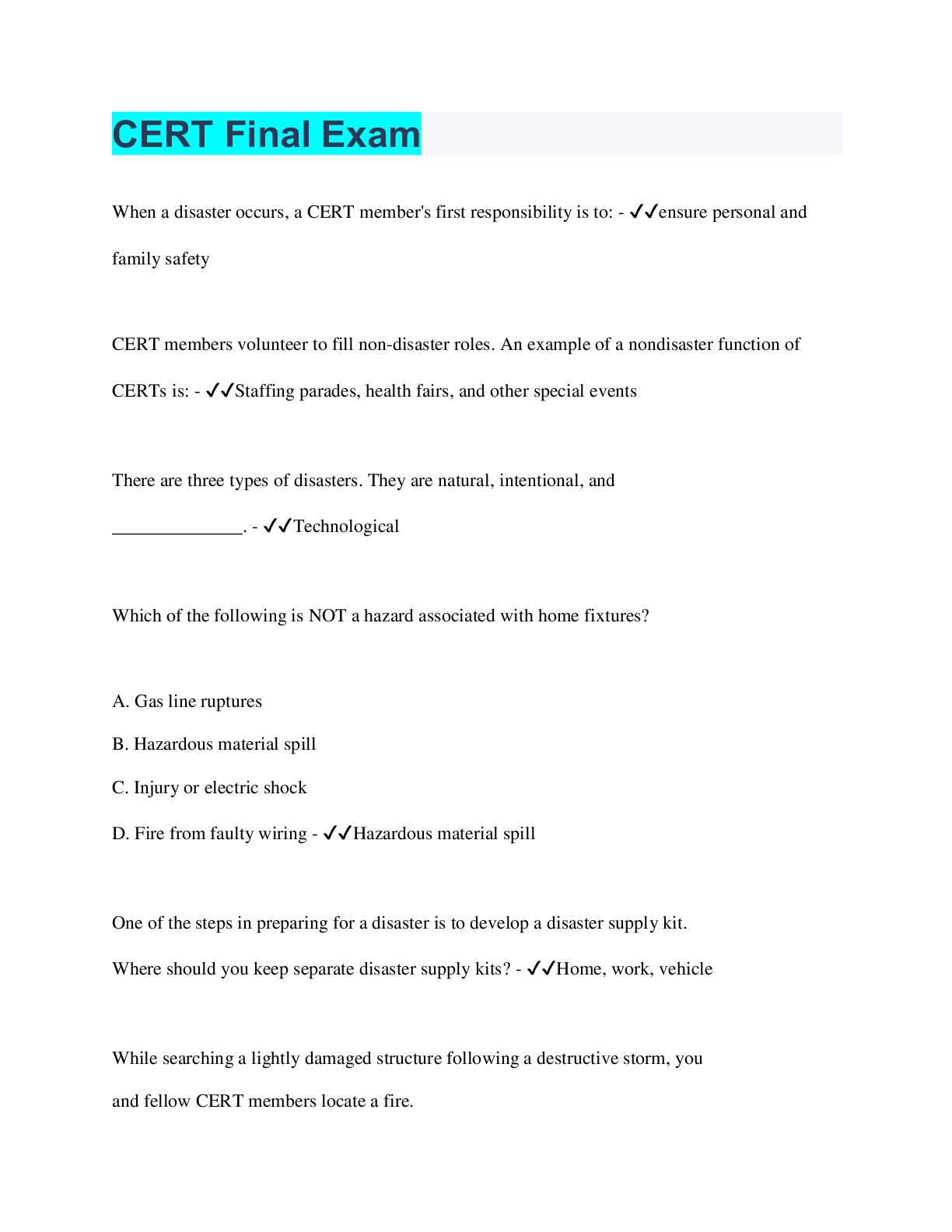
CERT Final Exam
When a disaster occurs, a CERT member's first responsibility is to: - ✔✔ensure personal and
family safety
CERT members volunteer to fill non-disaster roles. An example of a nondisaster function of
...
CERT Final Exam
When a disaster occurs, a CERT member's first responsibility is to: - ✔✔ensure personal and
family safety
CERT members volunteer to fill non-disaster roles. An example of a nondisaster function of
CERTs is: - ✔✔Staffing parades, health fairs, and other special events
There are three types of disasters. They are natural, intentional, and
______________. - ✔✔Technological
Which of the following is NOT a hazard associated with home fixtures?
A. Gas line ruptures
B. Hazardous material spill
C. Injury or electric shock
D. Fire from faulty wiring - ✔✔Hazardous material spill
One of the steps in preparing for a disaster is to develop a disaster supply kit.
Where should you keep separate disaster supply kits? - ✔✔Home, work, vehicle
While searching a lightly damaged structure following a destructive storm, you
and fellow CERT members locate a fire.
As you conduct your fire sizeup, which of the following is the least important
question to consider:
A. Can my buddy and I fight the fire safely?
B. Do my buddy and I have the right equipment?
C. How many people are in the building?
D. Can my buddy and I escape? - ✔✔How many people are in the building?
From your sizeup, you determine that the fire can be put out with a portable fire
extinguisher. You and your buddy quickly retrieve a portable fire extinguisher,
which you have determined is the right type of extinguisher to fight this fire.
What should you do before approaching the fire?
A. Test the extinguisher after pulling the pin
B. Wait for the fire department to arrive
C. Tell your buddy to wait at the door for you
D. Make sure the house's water supply is shut off - ✔✔Test the extinguisher after pulling the pin
Following the correct CERT procedure (P.A.S.S.), you discharge the
extinguisher.
What should you do if the fire continues to burn 5 seconds after you start to
extinguish it? - ✔✔Leave immediatley
The fire has spread to other areas by the time the fire department arrives.
What's your next course of action? - ✔✔Communicate what you know to one of the firefighters
If the chief officer asks you and your fellow CERT members to remain outside
at a safe distance, how should you respond? - ✔✔Continue to conduct a sizeup from a safe
distance outside of the
building
While the fire department manages to suppress most of the fire inside the
building, a small fire has started to spread through the yard. You notice a nearby
shed is posted with an NFPA 704 Diamond featuring the numbers 1, 1, and 2.
What should you do?
A. Suppress and overhaul the fire because the numbers in the Diamond are
small and indicate that little risk is present
B. Leave the area and communicate the information to one of the
professional firefighters on the scene if they are accessible
C. Suppress and overhaul the fire only if the number in the blue quadrant is
less than 2
D. Make sure you are using the correct type of fire extinguisher - ✔✔Leave the area and
communicate the information to one of the
professional firefighters on the scene if they are accessible
In the aftermath of a magnitude 7.7 earthquake, you have ensured your safety
and your family's safety and you grab your CERT kit and PPE. As you are
making your way to your CERT's established meeting point, you come across a
woman lying by the side of the road. You call out your name and affiliation and
ask, "Are you okay?" There is no response.
Based on what you know thus far, how should you proceed?
A. Assume the woman is dead and continue to the CERT meeting point
B. Call 9-1-1 on your cell phone immediately
C. Assess for airway, bleeding, and signs of shock
D. Make a note of the woman's location and go for help - ✔✔Assess the airway, bleeding, and
signs of shock
You move closer to the survivor. Once again, you ask, "Can you hear me? Are
you okay?" As you approach, you hear a very faint "help me," and now that you
are closer, you notice that that the survivor is bleeding heavily from a laceration
on her thigh. You immediately attempt to call 9-1-1 on you cell phone but the
system is down.
2. You know this woman is seriously injured. How would you help her?
A. Assess for the "three killers" systematically, starting with the airway
B. Focus immediately on the most critical threat, the heavy bleeding
C. Get blankets from your supply kit because this woman is clearly in shock
D. Keep the woman company until more help arrives - ✔✔Focus immediately on the most
critical threat, the heavy bleeding
You notice that the blood is spurting from the laceration on the survivor's inner
thigh. What type of bleeding is this? - ✔✔Arterial
What will you do to stop the bleeding? - ✔✔Using the sterile dressings in your supply kit, apply
pressure directly
to the wound
After a few moments, the bleeding slows considerably. You ask the woman, "Are
you okay? Squeeze my hand if you can hear me." She is only able to groan
unintelligibly in response. You notice that her fingers are cold — despite soaring
temperatures — when she tries to squeeze your hand.
5. The signs and symptoms that you witness tell you that this woman is suffering
from what?
A. Low blood sugar
B. Shock due to inadequate blood flow
C. Malnourishment
D. Shock due to the extreme stress of the situation - ✔✔Shock due to inadequate blood flow
How would you treat the woman based on your findings? - ✔✔Wrap her arm in something warm
If asked to triage the woman, how would you tag her? - ✔✔With a tag signifying "Immediate"
Arriving at the treatment area,
you notice sections marked "I," "D," and "M" where survivors are already being
placed for treatment.
What do the section markers indicate? - ✔✔Immediate, Delayed, Minor
What should you do to sterilize the water for medical use? - ✔✔Mix 1 part bleach and 10 parts
water
How and where will you set up the morgue? - ✔✔Away from all three treatment areas
you notice swelling and deformity in the survivor's upper left arm. After you have
finished your head-to-toe assessment, you try to feel for signs of a fracture, but
the survivor cries out in pain before you get too far.
[Show More]