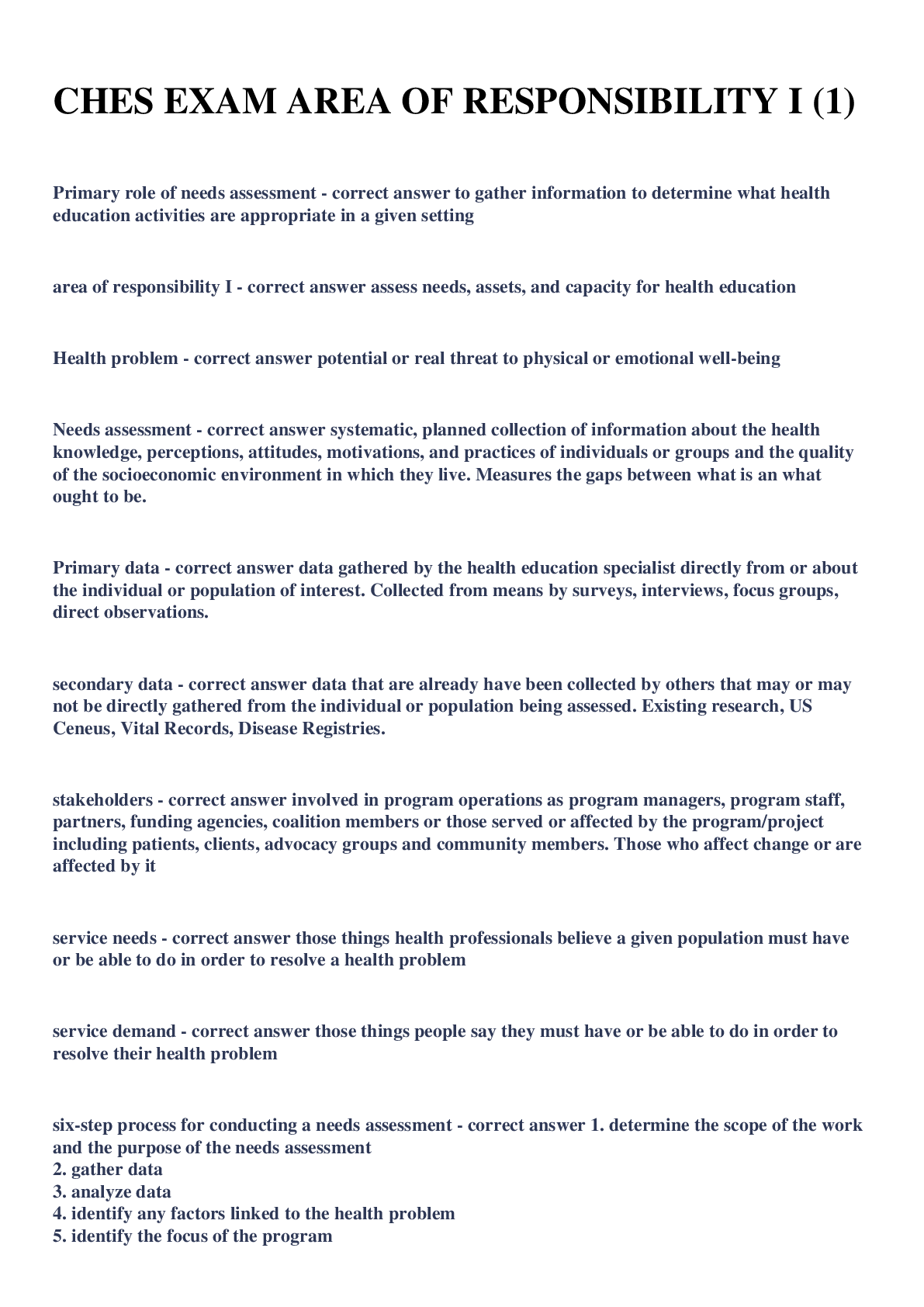
Primary role of needs assessment
to gather information to determine what health education activities are appropriate in a given setting
area of responsibility I
assess needs, assets, and capacity for health educ
...
Primary role of needs assessment
to gather information to determine what health education activities are appropriate in a given setting
area of responsibility I
assess needs, assets, and capacity for health education
Health problem
potential or real threat to physical or emotional well-being
Needs assessment
systematic, planned collection of information about the health knowledge, perceptions, attitudes, motivations, and practices of individuals or groups and the quality of the socioeconomic environment in which they live. Measures the gaps between what is an what ought to be.
Primary data
data gathered by the health education specialist directly from or about the individual or population of interest. Collected from means by surveys, interviews, focus groups, direct observations.
secondary data
data that are already have been collected by others that may or may not be directly gathered from the individual or population being assessed. Existing research, US Ceneus, Vital Records, Disease Registries.
stakeholders
involved in program operations as program managers, program staff, partners, funding agencies, coalition members or those served or affected by the program/project including patients, clients, advocacy groups and community members. Those who affect change or are affected by it
service needs
those things health professionals believe a given population must have or be able to do in order to resolve a health problem
service demand
those things people say they must have or be able to do in order to resolve their health problem
six-step process for conducting a needs assessment
1. determine the scope of the work and the purpose of the needs assessment
2. gather data
3. analyze data
4. identify any factors linked to the health problem
5. identify the focus of the program
6. validate the need before continuing the planning process
epidemiological model
focus on epidemiological data (death rates, prevalence rates, birth rates, etc.)
public health model
to quantify health problems and often uses epidemiological data. more focused on a specific population and can be mindful of limitations of resources.
social model
investigates social or political issues that infulence health
asset model
focuses on the strengths of a community, organization, or population and looks to find ways to use exisitng assets to improve health
rapid model
a framework that is used when time and money are lacking for needs assessment
quantitative data
numerically describes what is occuring
qualitative data
not numerical, describes what is occurring and why
surveys
used to determine the knowledge, attitudes, beliefs, behaviors, skills, and health status of a priority population. Have a high respond rate. reliability and validity
interviews
conducted by telephone, face-to-face, electronically, or in groups.
key informants interview
individuals who have knowledge of and the ability to report on the needs of the corporation, hospital or organization
telephone interview
relatively easy method of collecting data at a moderate cost.
electronic (or web-based) interviews
growing as a viable means of collecting data from a large number of individuals quickly and at lower cost
observations
used to gather data through direct surveillance of the population. accomplished through watching and recording specific behaviors of the population.
community forums
public meetings. Bring together people in a particular populations to discuss their perceptions of the community health problems
focus group
techniques capitalized on communication among participants who are selected based on specific criteria. Led by a skilled facilitator. Participants share opinions and explain the reasons for underlying those opinions.
nominal group
process is highly structured process in which a few representatives from the priority population are asked to respond to questions based on specific needs. Small groups of five to seven people all with equal voices.
delphi panel
group process that generate consensus by using a series of mailed or e-mailed questionnaires. individuals form three groups: decision makers, staff, and program participants. Had one or two broad questions for the entire group. Based on results, second questionnaire is sent out. with more specific question is developed. Questionnaires are analyzed and sent out three to fives times.
[Show More]