Rockwell Real Estate Questions and
Answers Already Passed
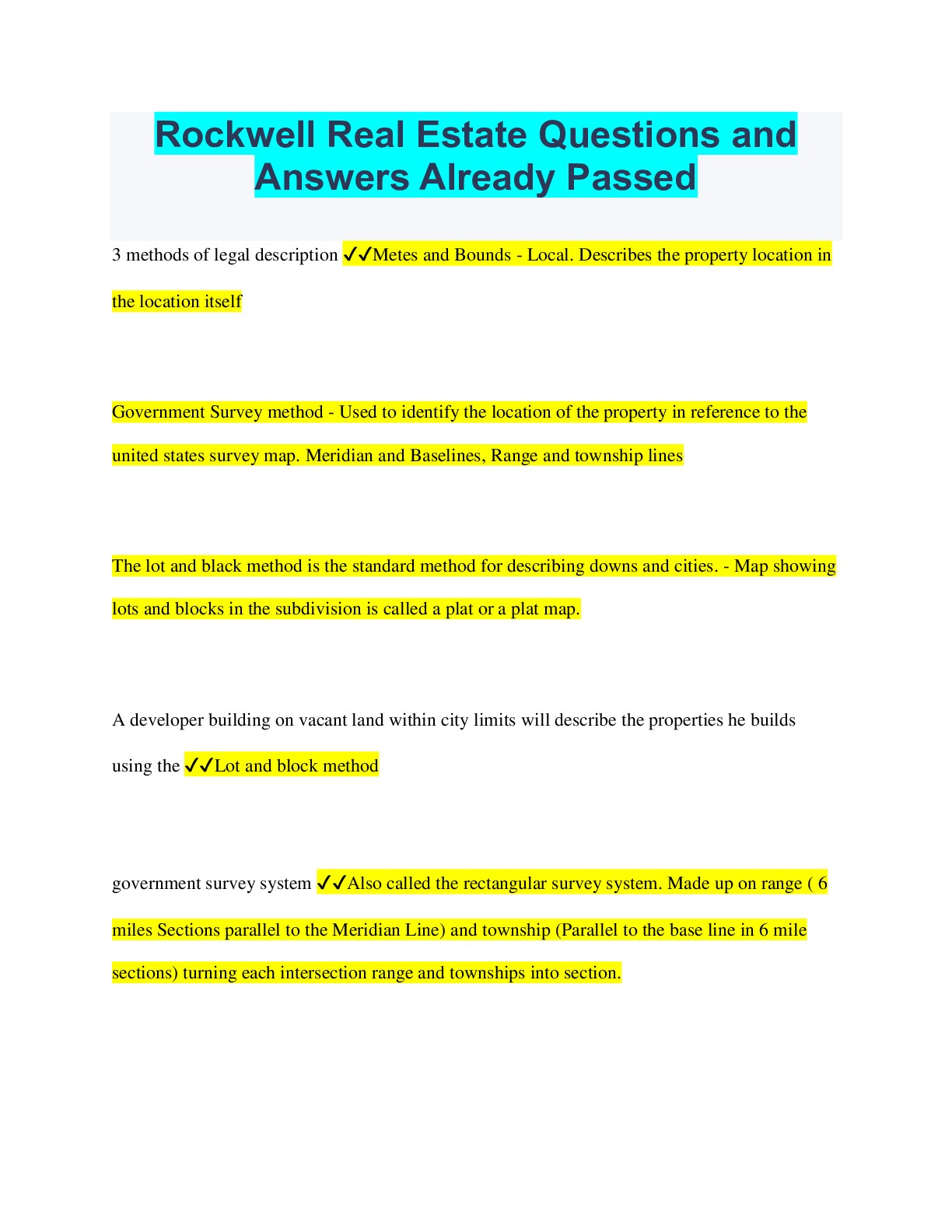
3 methods of legal description ✔✔Metes and Bounds - Local. Describes the property location in
the location itself
Government Survey method - Used to identify
...
Rockwell Real Estate Questions and
Answers Already Passed
3 methods of legal description ✔✔Metes and Bounds - Local. Describes the property location in
the location itself
Government Survey method - Used to identify the location of the property in reference to the
united states survey map. Meridian and Baselines, Range and township lines
The lot and black method is the standard method for describing downs and cities. - Map showing
lots and blocks in the subdivision is called a plat or a plat map.
A developer building on vacant land within city limits will describe the properties he builds
using the ✔✔Lot and block method
government survey system ✔✔Also called the rectangular survey system. Made up on range ( 6
miles Sections parallel to the Meridian Line) and township (Parallel to the base line in 6 mile
sections) turning each intersection range and townships into section.
Subjacent Support ✔✔The support that the surface of a piece of land receives from the land
beneath it.
Lateral Support ✔✔The support that piece of land receives from the land adjacent to it. Compare
Subjacent Support.
Personalty ✔✔Personal, movable property
Chattels ✔✔Personal Property other than real estate
Appurtences ✔✔Air rights
Water rights
Mineral rights
Support rights
emblements ✔✔In the common law, emblements are annual crops produced by cultivation
legally belonging to the tenant with the implied right for its harvest, and are treated as the
tenant's property.
4 Tests in determining whether something is attached to the property or not in the court of law
✔✔Method of attachment test
Adaptation test
Intention test
Relationship test
Method of attachment test ✔✔The first test of whether or not an item is a fixture is the method
of attachment test. Is the item attached to the realty in some way, and if so, how?
Adaptation test ✔✔With the adaptation test, the question is whether the item has been specially
adapted to the realty in some way, or was specially designed for it.
Such as the pews in the church will be considered as fixtures even thought they are not attached
to the floor in anyway
Intention test ✔✔The intention test carries a lot of weight in a lawsuit.
It refers to the original intention of the person who installed the item that's now in dispute.
The judge will look for evidence indicating whether the item was installed with the intention of
making it a permanent part of the structure.
If so, the judge will usually rule that the item is a fixture.
Relationship test ✔✔The relationship test can be seen as another way of establishing the
intention of the person who installed the item, or arranged to have it installed. It refers to that
person's relationship to the real property at the time of the installation.
Did he own the property, or was he just a tenant?
Under the relationship test, it's assumed that tenants intend to take their belongings with them
when they move, even if the items were attached to the realty during the tenancy.
trade fixtures ✔✔Equipment and other items that a commercial tenant installs to carry on a
business
But even though they're called fixtures, trade fixtures aren't considered part of the real property,
no matter how they're attached.
Fixtures vs Personal Property ✔✔In a real estate transaction, items that are legally considered
fixtures—part of the real property—will pass to the buyer by deed, unless the parties specifically
agree to exclude them from the sale.
The items that are legally classified as personal property aren't part of the real estate, so the deed
won't automatically transfer their ownership to the buyer.
Fixtures ✔✔In a real estate transaction, items that are legally considered fixtures—part of the
real property—will pass to the buyer by deed, unless the parties specifically agree to exclude
them from the sale.
Personal Property ✔✔The items that are legally classified as personal property aren't part of the
real estate, so the deed won't automatically transfer their ownership to the buyer.
estate ✔✔An estate (a possessory interest) is the right to possess and have exclusive use of real
property, either now or in the future. If someone's interest in a piece of real property doesn't
allow exclusive use and possession of the property, it's not an estate.
interest ✔✔in real property, is a right concerning the property or a claim against it.
lien ✔✔(such as a mortgage) is an interest in property, but it's not an estate.
Two Types of Estates ✔✔Freehold and Leasehold
Two types of Freehold Estates ✔✔Fee Simple and Life
Littoral Property ✔✔Property bordering a lake or an ocean
Riparian Property ✔✔Property bordering a stream or a river
possessory interests ✔✔Include the right to exclusive use and possession of the property.
Possessory interests are also called estates.
fee simple absolute ✔✔new owner is free to do whatever he or she wishes with the property with
no special limitations
fee simple qualified, also known as a qualified fee estate, a fee simple defeasible, or a fee simple
conditional. ✔✔When a seller wants to control the future use of the land after selling or giving it
to someone else. In this case, they transfer the property with a condition or qualification attached
to the title.
The deed states that the new owner will own the property until or unless a specified act or event
takes place.
fee simple determinable ✔✔if the act or event prohibited in the deed occurs, title automatically
reverts to the person who imposed the limitation, or to his heirs. This is known as a possibility of
reverter.
fee simple subject to condition subsequent ✔✔if the prohibited act or event occurs, the person
who imposed the limitation (or his heirs) will regain title only if he takes legal action to do so.
Freehold estates ✔✔Include fee simple estates and life estates.
In contrast to someone with a leasehold estate, someone with a freehold estate has title to the
property.
The two main categories of freehold estates are fee simple estates and life estates.
fee simple estate ✔✔is the highest and most complete form of real property ownership.
It is perpetual, transferable, and inheritable.
A fee simple is classified either as a fee simple absolute or as a fee simple qualified.
Fee simple absolute ✔✔is fee title without conditions or qualifications of any kind.
Title is presumed to be conveyed in fee simple absolute unless the grantor makes it clear that she
intends otherwise.
fee simple qualified ✔✔includes all of the same rights of ownership as a fee simple absolute, but
it may terminate if a condition or event specified in the deed occurs.
At that point, title reverts to the original grantor or his heirs.
A fee simple qualified is either a fee simple determinable or a fee simple subject to condition
subsequent.
Estate Reversion vs Estate Remainder ✔✔If the future interest is held by the grantor or her heirs,
it's an estate in reversion. If it's held by someone else, it's an estate in remainder.
Life Tenant ✔✔The person entitled to possession of the property during the measuring life.
Remainder ✔✔In connection with a life estate, a future interest held by someone other than the
grantor.
Life Estate ✔✔A freehold estate that lasts only as long as a specified person lives. (Note:
Different from Life Tenant)
Reversion ✔✔In connection with a life estate, a future interest held by the grantor or her heirs.
Measuring Life ✔✔The lifetime that determines the duration of the life estate.
Leasehold Estate and its 4 Types ✔✔A leasehold estate gives a tenant exclusive possession and
use of the property for a limited period. The tenant does not have title.
1.Estate of Years
2. Periodic Estate
3. Estate At Will
4. Estate at Sufference
An Estate of Years is a type of Leasehold Estate which is also known as: ✔✔Term Tenancy
An estate for years is a lease for a fixed term, which ends automatically when the term is over.
The parties may mutually agree to end the tenancy sooner by surrender.
An estate for years is assignable to a third party.
3rd Type of Leasehold Estate is called an Estate Will also known as ✔✔Tenancy at Will
An estate at will has no specific term or rental interval.
Rent is not paid on a regular basis, or else it takes some form other than money.
A landlord has to give notice to terminate an estate at will.
4th Type of Leasehold, Estate at Sufferance is also called: ✔✔Holdover Tenant.
An estate at sufferance arises when a tenant who lawfully took possession of the property stays
on after the lease ends, without the permission of the landlord.
Periodic Estate ✔✔A periodic estate is not limited to a specific term, but automatically continues
from period to period until one party gives the other proper notice of termination.
` ✔✔
[Show More]