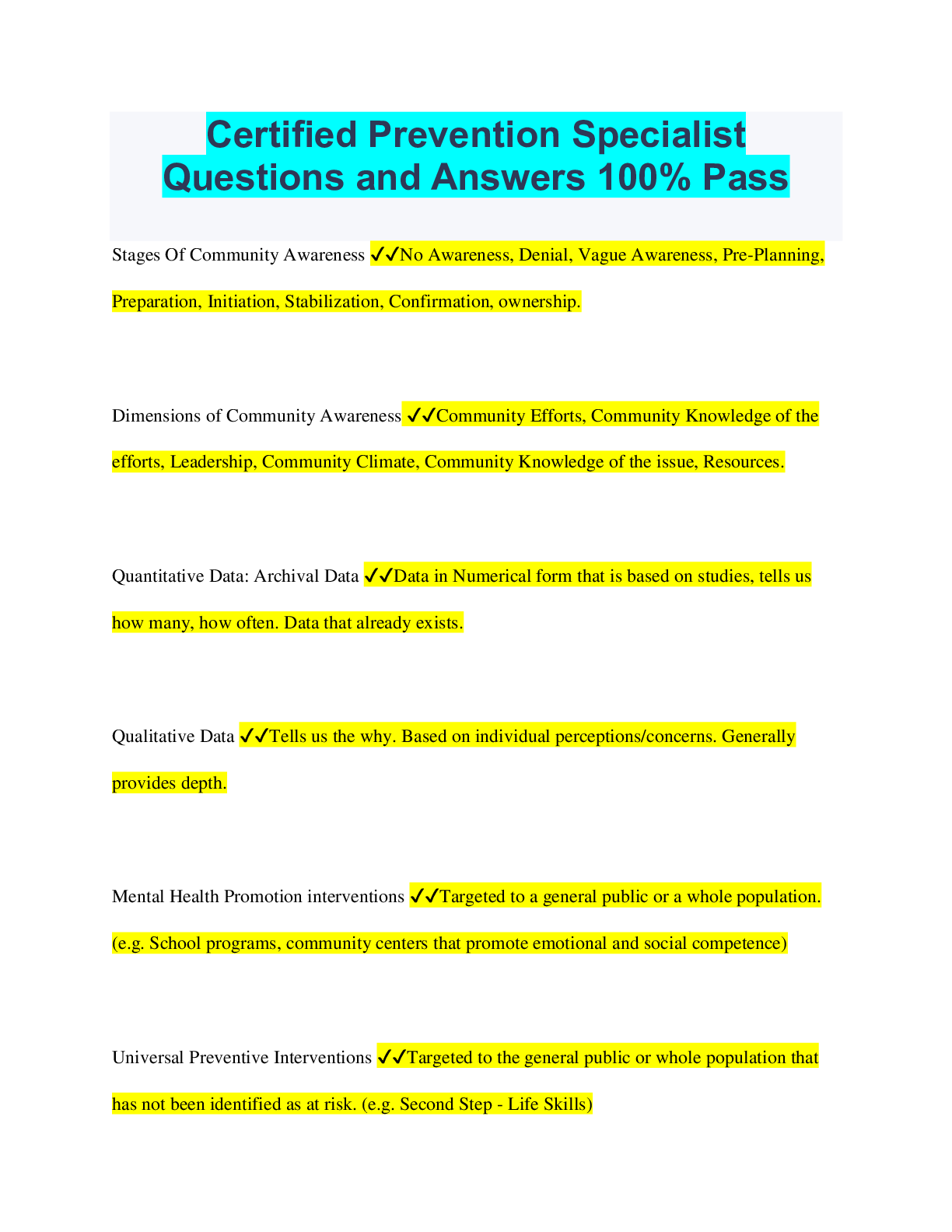
Certified Prevention Specialist
Questions and Answers 100% Pass
Stages Of Community Awareness ✔✔No Awareness, Denial, Vague Awareness, Pre-Planning,
Preparation, Initiation, Stabilization, Confirmation, ownership.
Di
...
Certified Prevention Specialist
Questions and Answers 100% Pass
Stages Of Community Awareness ✔✔No Awareness, Denial, Vague Awareness, Pre-Planning,
Preparation, Initiation, Stabilization, Confirmation, ownership.
Dimensions of Community Awareness ✔✔Community Efforts, Community Knowledge of the
efforts, Leadership, Community Climate, Community Knowledge of the issue, Resources.
Quantitative Data: Archival Data ✔✔Data in Numerical form that is based on studies, tells us
how many, how often. Data that already exists.
Qualitative Data ✔✔Tells us the why. Based on individual perceptions/concerns. Generally
provides depth.
Mental Health Promotion interventions ✔✔Targeted to a general public or a whole population.
(e.g. School programs, community centers that promote emotional and social competence)
Universal Preventive Interventions ✔✔Targeted to the general public or whole population that
has not been identified as at risk. (e.g. Second Step - Life Skills)
Selective Preventive interventions ✔✔Targeted to individuals or a population subgroup who
have been identified at risk
Indicated Preventive Interventions ✔✔Targeted to high risk individuals who are identified as
already engaging in the behavior.
Six CSAP Prevention Strategies ✔✔Information Dissemination, Prevention Education (Skill
Building), Alternatives (Positive Activities), Environmental Strategies, Community Based
Process, and Problem Identification and referral.
Information Dissemination ✔✔Increase the knowledge and change attitudes about substance use
and abuse through services such as classroom discussions and Media campaigns.
Prevention Education (Skills Building) ✔✔Teaches participants important social skills, such as
drug resistance and decision making.
Alternatives (Positive Activities) ✔✔Opportunities for participation in developmentally
appropriate drug-free activities to replace, reduce, or eliminate involvement in substance use
related activities.
Environmental Strategies ✔✔Prevention efforts aimed at changing or influencing community
conditions, standards, institutions, structures, systems and policies that shape behaviors.
Community-Based Process ✔✔expands community resources dedicated to preventing substance
use and abuse through services such as building coalitions.
Problems Identification and referral ✔✔recognize individuals who have used alcohol, tobacco,
or drugs.
Agent ✔✔Drug (alcohol, prescription, Illegal)
Host ✔✔Individual
Environment ✔✔Physical and social content
Context ✔✔places, settings, occasions and circumstances in which behaviors occur
Protective factors ✔✔Anything that decreases the probability of developing problematic
substance abuse.PR
Social Development Strategy ✔✔A research based model that organizes known protective
factors into a guiding framework for building positive futures for children.
S.M.A.R.T ✔✔Specific, Measurable, Achievable, Relevant, Timed
Strategic Prevention Framework (SPF) ✔✔Assessment, Capacity, Planning, Implementation,
And Evaluation all working around a sustainable and Cultural competent center.
Individual Strategy ✔✔Targets individuals - provides info, builds skills and provides support
Community Strategy ✔✔Changes in policies and laws that effect the whole community and the
norms, Regulations and availability of the risk factor
Individual outcomes ✔✔changes made on an individual level
Organizational outcomes ✔✔Changes made within an organization
System outcomes ✔✔Changes made in Multiple organizations - the whole thing is to be changed
Implementation of Evidence - Based Programs ✔✔Exploration, Installation, Initial
Implementation, Full Implementation and Program Sustainability
Communication ✔✔The action of conveying information, and/or the exchange of ides, feelings,
intentions, attitudes, expectations, perceptions or commands, through speech, gestures, writings,
behavior between two or more participants
Community organizers ✔✔bring people together to address whatever emerges as the people
priorities
Community Mobilizers ✔✔work with people in order to focus on a set of steps to get something
done.
Community Norms ✔✔shared beliefs and attitudes among most community members (what
people value, believe and do)
Communities of Place ✔✔Community of people who are bond together because of the common
physical space where they reside, work visit or spend lots of time.
Communities of interest ✔✔community of people who share a common passion, ideology, or
thoughts.
Communities of experience ✔✔community of people who share or have shared a common
encounter or ordeal.
Cultural Knowledge ✔✔knowledge of some cultural characteristics, history, values, beliefs and
behaviors of a different group
Cultural Awareness ✔✔Openness to the idea of changing cultural attitudes
Cultural Sensitivity ✔✔knowledge of cultural difference without assigning values to the
differences
cultural competence ✔✔Ability to bring together different behaviors, attitudes and policies and
work effectively in cross-cultural settings to produce better results
Collaboration ✔✔the action of working with someone to produce or create something
Levels of Collaboration ✔✔No Communication, Communication, Cooperation, Coordination,
Collaboration
Coalition ✔✔A formal, voluntary arrangement for collaboration among groups or sectors of a
community, in which each group retains its identity but all agree to work together toward the
common goal.
Strategic Alliance ✔✔a agreement between two or more parties to pursue a set of agreed upon
objectives needed while remaining independent organizations
Primary (Prevention) Prevention ✔✔aimed at the general population groups who as yet have no
substance abuse problems but who may have different levels of risk for substance abuse.
Secondary (Intervention) Prevention ✔✔is concerned with those (usually youth) who have only
recently begun to experiment with substances
Tertiary (Treatment) Prevention ✔✔concerned with those who have actually developed a
dependence on substances, and tries to arrest their dependency, to prevent it from worsening, and
for individuals who have completed treatment and are drug-free, to prevent relapse from
occurring.
Six Principles of Ethics ✔✔Non-Discrimination, Competence, Integrity, Nature of services,
Confidentiality, Ethical obligations for community and society.
Risk Factors ✔✔Anything within an individual or the individuals family, peers, or community
that increases the likelihood of developing a problem with substance abuse.
Program Fidelity ✔✔* The extent to which delivery of an intervention adheres to the protocol
(program model) as originally developed.
*Has significance for evaluation and treatment effectiveness research.
* Target audience is reached
Program, Practice and strategies are delivered with enough impact to change the local condition.
7 Styles of learning ✔✔Visual, Logical, verbal, physical, Aural, social, and solitary
[Show More]