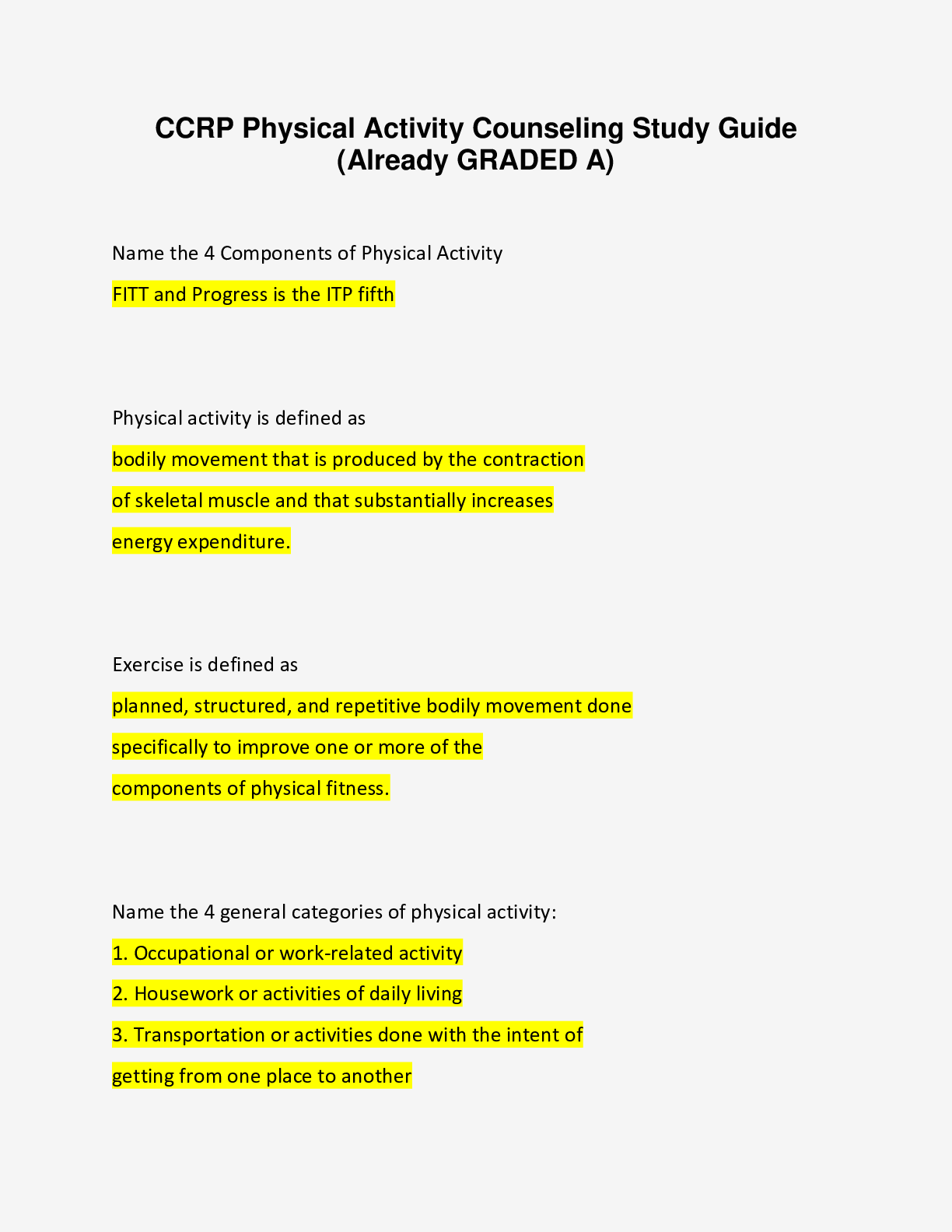
Name the 4 Components of Physical Activity
FITT and Progress is the ITP fifth
Physical activity is defined as
bodily movement that is produced by the contraction
of skeletal muscle and that substantially increase
...
Name the 4 Components of Physical Activity
FITT and Progress is the ITP fifth
Physical activity is defined as
bodily movement that is produced by the contraction
of skeletal muscle and that substantially increases
energy expenditure.
Exercise is defined as
planned, structured, and repetitive bodily movement done
specifically to improve one or more of the
components of physical fitness.
Name the 4 general categories of physical activity:
1. Occupational or work-related activity
2. Housework or activities of daily living
3. Transportation or activities done with the intent of
getting from one place to another
4. Leisure time pursuits including recreational
activities, hobbies and exercise
Guidelines for exercise from the American Heart Association and the American College of Cardiology Foundation recommend for secondary prevention of coronary heart disease:
"For all patients, the clinician should
encourage 30 minutes of moderate-intensity aerobic
activity at least 5 days and preferably 7 days per
week...".
Exercise recommendations from 2008 Physical
Activity Guidelines
• Inactivity should be avoided. Some physical
activity is better than none, and adults who
participate in any amount of physical activity gain
some health benefits.
• For substantial health benefits, adults should do
at least 150 minutes (2 hours and 30 minutes) a
week of moderate-intensity, or 75 minutes (1 hour
and 15 minutes) a week of vigorous-intensity
aerobic physical activity, or an equivalent
combination of moderate- and vigorous-intensity
aerobic activity. Aerobic activity should be
performed in episodes of at least 10 minutes, and
preferably, it should be spread throughout the
week.
• For additional and more extensive health benefits,
adults should increase their aerobic physical
activity to 300 minutes (5 hours) a week of
moderate intensity, or 150 minutes a week of
vigorous intensity aerobic physical activity, or an
equivalent combination of moderate- and
vigorous-intensity activity. Additional health
benefits are gained by engaging in physical
activity beyond this amount.
• When older adults cannot do 150 minutes of
moderate-intensity aerobic activity a week
because of chronic conditions, they should be as
physically active as their abilities and conditions
allow.
• Older adults should determine their level of effort
for physical activity relative to their level of
fitness.
• Older adults with chronic conditions should
understand whether and how their conditions
affect their ability to do regular physical activity safely
One MET represents the
approximate energy requirements expended while an
individual is quietly sitting. The metabolic demands
and an individual's oxygen consumption increase as
the intensity of the activity increases.
The MET
system allows for comparing
the energy demands of
disparate activities.
The MET system is useful for CR professionals because it can be used to
provide advice and counsel to CR participants
about returning to physical activities. It is possible to
determine an estimated MET level for the exercise
that an individual is able to do at CR. An exercise
MET levels can then be compared to estimates for
recreational, occupational, or domestic-related
physical activities.
What is a downfall of only considering METS when deciding when a patient is able to return to work?
the MET
system does not take into consideration job stress or
environmental factors such as air quality,
temperature and wind. Obviously, a number of
factors should be considered when counseling an
individual's return to work.
Compendium of Physical activity provides the
most extensive resource for the energy requirements
for a wide-range of activities in all 4 categories of
physical activity. The Compendium assigns a
measure of energy expenditure to a given activity. It
is then possible to compare the metabolic
requirements of different activities.
What kinds of assessments are the following:
30-Second Chair Stand, the Timed Up and Go,
Continuous Scale Physical Functional
Performance-10, and the Short Battery Physical
Performance.
Integrated assessment tests that attempt to assess
an individual's capacity to do everyday activities are
available.
During maximal efforts, individuals are able to
achieve total _______ work rates with leg activity as
compared to arm activity
During maximal efforts, individuals are able to
achieve total higher work rates with leg activity as
compared to arm activity
Arm activity is mechanically
inefficient. This stresses the musculoskeletal and the
cardiopulmonary system more than leg activity. What should be considered when writing an exercise prescription for arm exercises when the pre-rehab ETT is done walking.
Prescribing
intensity for arm-related activity based on the heart
rate derived from leg testing may result in an
inappropriately high target heart rate for arm
activities. The arm versus leg work discrepancy is
exacerbated because of upper-body weight
restrictions during the period of convalescence after
valve or coronary artery bypass surgeries. Cardiac
rehabilitation participants should be advised to
gradually return to arm-dominated activity as tolerated
At submax fixed levels of work what is higher with arm exercises compared to leg?
At fixed sub-maximal
levels of work, heart rate, blood pressure, breathing
rates, oxygen consumption, and blood lactate levels
are all higher with arm versus leg activity.
What theory of change is the following describing?
"process involving progress through a series of
stages." Studies have suggested that to most
effectively influence behavior change, the
intervention should match where a person reports to
be in their willingness to take action.
Transtheoretical Model of Behavior Change
Transtheoretical Model of Behavior Change: Pre-contemplation
Not ready to take action
(individual may or may not be aware that physical
inactivity is problematic). Encourage the individual to
become more aware of the negative health
consequences of sedentary behavior and the
benefits of being physically active.
Transtheoretical Model of Behavior Change: Contemplation
Getting ready to consider taking
action and individuals considering the consequences
of being physically inactive. Provide education
regarding the benefits of being physically active.
Transtheoretical Model of Behavior Change: Preparation
People are ready to take action
presently and may have begun to increase their
physical activity. Support should be provided for the
individual as they start to incorporate physical
activity into their daily routine. Encourage the person
to seek an environment to support their behavior
change. Prepare the individual that the challenge of
being physically active on a near-daily basis is
difficult. Help support the person from reverting to
sedentary behavior.
Transtheoretical Model of Behavior Change: Action
action - Individuals have modified their behavior and
Participants are incorporating physical activity into their
near-daily routine. People in this stage need to be
taught techniques for reinforcing their commitment
to being physically active and avoiding sedentary
behavior.
Transtheoretical Model of Behavior Change: Maintenance
Individuals have been successful at
incorporating physical activity into their daily routine
and are working to prevent a relapse of sedentary
behavior. Individuals should be provided with
support for continuing their commitments to being
physically active. Utilizing positive reinforcements
and rewards for continuing to pursue an active
lifestyle may be helpful.
Self-monitoring regarding physical activity
refers to
keeping track or recording activities
performed.
Describe SMART goal setting in terms of cardiac rehab exercise goals
• Specific: The physical activity should be clearly
defined incorporating the FITT principle of
frequency, intensity, time, and type.
• Measurable: Record the activity performed.
• adjustable: Make adjustments to FITT
components as indicated.
• Realistic: In establishing a goal it is important to
balance putting forth a challenge with making the
goal attainable.
• time Specific: There is a saying, "a goal without
a plan is a wish" or less likely to be achieved. It is
important to establish a timeframe within which
the goal will be completed.
Name some other important elements for encouraging physical activity: (hint: R&R, PS, CB, SS, AD)
Rewards & Reinforcement, Problem Solving, Confidence Building, Social Support, Avoid Drugery
Name the 10 most Common Barriers to Physical Activity
• Perceived lack of time
• Physical activity is "inconvenient"
• Lack of self-motivation
• Exercise is not enjoyable
• Find exercise boring
• Lack confidence in their ability to be physically
active (low self-efficacy)
• Fear injury
• Lack self-management skills, such as the ability
to set personal goals, monitor progress, or reward
progress toward such goals
• Lack encouragement, support, or companionship
from family and friends
• Do not have parks, sidewalks, bicycle trails, or
safe and pleasant walking paths convenient to
their homes or offices.
Describe some Special Considerations for Physical Activity:
Extreme Heat or Cold, High Altitude, Poor Air Quality, Comorbid Medical Considerations (how to exercise patients with disabilities or high risk/multiple diseases in a safe environment outside of CR)
Accelerometer sensors
are the next level of
sophistication for activity monitors and can often transfer data to computer or cell phone. Can track upper and lower body actvities, sleep, and multiple measures
[Show More]