ATI RN COMPREHENSIVE EXIT EXAM BANK, ALL QUESTIONS COMBINED & ANSWERED-- Anemia and thrombocytopenia occur secondary to bone marrow suppression (myelosuppression).
■
Nursing Actions for Anemia
☐
Monitor for fatigue,
...
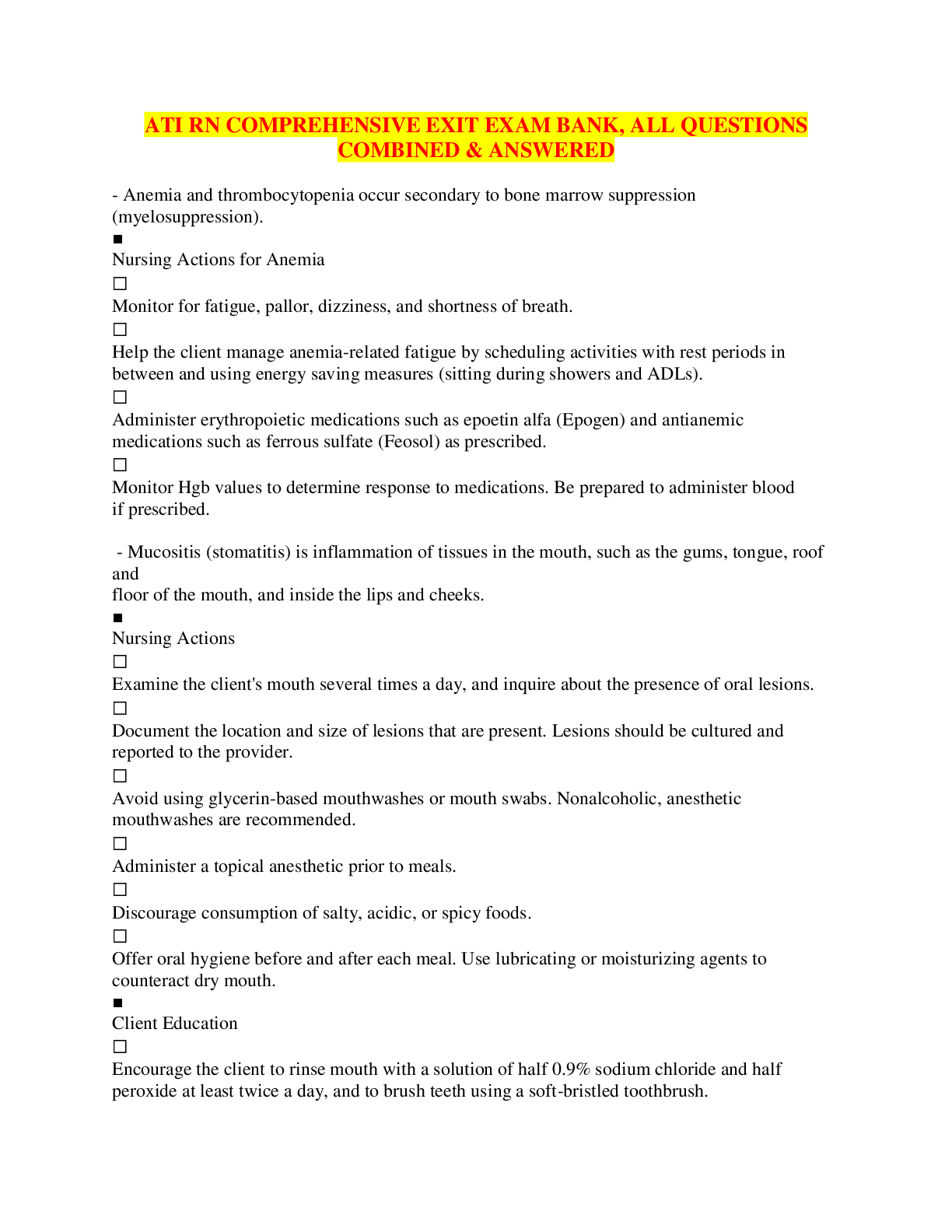
ATI RN COMPREHENSIVE EXIT EXAM BANK, ALL QUESTIONS COMBINED & ANSWERED-- Anemia and thrombocytopenia occur secondary to bone marrow suppression (myelosuppression).
■
Nursing Actions for Anemia
☐
Monitor for fatigue, pallor, dizziness, and shortness of breath.
☐
Help the client manage anemia-related fatigue by scheduling activities with rest periods in
between and using energy saving measures (sitting during showers and ADLs).
☐
Administer erythropoietic medications such as epoetin alfa (Epogen) and antianemic
medications such as ferrous sulfate (Feosol) as prescribed.
☐
Monitor Hgb values to determine response to medications. Be prepared to administer blood
if prescribed.
- Mucositis (stomatitis) is inflammation of tissues in the mouth, such as the gums, tongue, roof and
floor of the mouth, and inside the lips and cheeks.
■
Nursing Actions
☐
Examine the client's mouth several times a day, and inquire about the presence of oral lesions.
☐
Document the location and size of lesions that are present. Lesions should be cultured and
reported to the provider.
☐
Avoid using glycerin-based mouthwashes or mouth swabs. Nonalcoholic, anesthetic
mouthwashes are recommended.
☐
Administer a topical anesthetic prior to meals.
☐
Discourage consumption of salty, acidic, or spicy foods.
☐
Offer oral hygiene before and after each meal. Use lubricating or moisturizing agents to
counteract dry mouth.
■
Client Education
☐
Encourage the client to rinse mouth with a solution of half 0.9% sodium chloride and half
peroxide at least twice a day, and to brush teeth using a soft-bristled toothbrush.
☐
Instruct client to take medications to control infection as prescribed (nystatin [Mycostatin],
acyclovir [Zovirax]).
☐
Encourage the client to eat soft, bland foods and supplements that are high in calories
(mashed potatoes, scrambled eggs, cooked cereal, milk shakes, ice cream, frozen yogurt,
bananas, and breakfast mixes)
- Nausea and vomiting/anorexia
■
Many of the medications used for chemotherapy are emetogenic (induce vomiting) or cause
anorexia as well as an altered taste in the mouth.
■
Serotonin blockers, such as ondansetron (Zofran), have been found to be effective and are often
administered with corticosteroids, phenothiazines, and antihistamines.
■
Nursing Actions
☐
Administer antiemetic medications at times that are appropriate for a chemotherapeutic agent
(prior to treatment, during treatment, after treatment).
☐
Administer antiemetic medications for several days after each treatment as needed.
☐
Remove vomiting cues, such as odor and supplies associated with nausea.
☐
Implement nonpharmacological methods to reduce nausea (visual imagery, relaxation,
acupuncture, distraction).
☐
Perform calorie counts to determine intake. Provide liquid nutritional supplements as
needed. Add protein powders to food or tube feedings.
☐
Administer megestrol (Megace) to increase the appetite if prescribed.
☐
Assess for findings of dehydration or fluid and electrolyte imbalance.
☐
Perform mouth care prior to serving meals to enhance the client's appetite
Encourage the use of plastic eating utensils, sucking on hard candy, and avoiding red meats
to prevent or reduce the sensation of metallic taste
- Nursing Actions for Thrombocytopenia
☐
Monitor for petechiae, ecchymosis, bleeding of the gums, nosebleeds, and occult or frank
blood in stools, urine, or vomitus.
☐
Institute bleeding precautions (avoid IVs and injections, apply pressure for approximately
10 min after blood is obtained, handle client gently and avoid trauma).
☐
Administer thrombopoietic medications such as oprelvekin (Interleukin 11, Neumega)
to stimulate platelet production. Monitor platelet count, and be prepared to administer
platelets if the count falls below 30,000/mm
3
.
■
Client Education
☐
Instruct the client and family how to manage active bleeding.
☐
Instruct the client about measures to prevent bleeding (use electric razor and soft-bristled
toothbrush, avoid blowing nose vigorously, ensure that dentures fit appropriately).
☐
Instruct the client to avoid the use of NSAIDs.
☐
Teach the client to prevent injury when ambulating (wear closed-toes shoes, remove
tripping hazards in the home) and apply cold if injury occurs
- Nursing Considerations
☐ Always ask clients whether they are allergic to sulfa. Acetazolamide is a sulfa-based medication
___ lung expansion with age - decreased
_____ seconds is/are measured in each large box on ECG graph paper? - 0.20
__precautions with hsv - contact
◯ Client Education:
■ Avoid UV and sun exposure.
■ Use mild protein shampoo and avoid harsh hair treatments.
■ Use steroid creams for skin rash.
■ Report peripheral and periorbital edema promptly / signs of infection related to immunosuppression. - Avoid crowds and individuals who are sick, because illness can precipitate an exacerbation.
■ Educate client of childbearing age regarding risks of pregnancy with lupus and
treatment medications.
1 cup - 8 oz
1 g (gram) - 1000 mg
1 kg - 2.2 lbs
1 oz - 30 mL
1 pint - 2 cups
1 quart - 2 pints
1 tsp - 5 mL
1st Degree Heart Block Causes - May be normal variant; inferior wall MI; drugs: verapamil or digoxin
1st Degree Heart Block Treatment - Monitor; Observe for symptoms
2 - Hyperglycemia
Administer sliding scale insulin or
plan for insulin to be added to the
TPN solution.
Monitor blood glucose - 3 - Hypoglycemia
Inform the provider and plan to give
additional dextrose.
Monitor frequent blood glucose.
2nd Degree Heart Block Causes - organic heart disease, MI, Dig Toxicity, Beta and Calcium Blockers
2nd Degree Heart Block Treatment - Monitor HR, Atropine, Temp Pacemaker, Avoid meds that decrease conductivity
3-4 cups of milk a day for a child? - NO too much milk can reduce the intake of other nutrients especially iron. Watch for ANEMIA
3rd Degree Heart Block - Regularity: Regular
Rate: 40-60 bpm if junctional; 20-40 bpm
[Show More]