N1012 Midterm Exam 2 - Questions and Answers The cells and tissues that recognize and attack foreign substances in the body; more of a functional system rather than an organ system Immune System Include being the body'
...
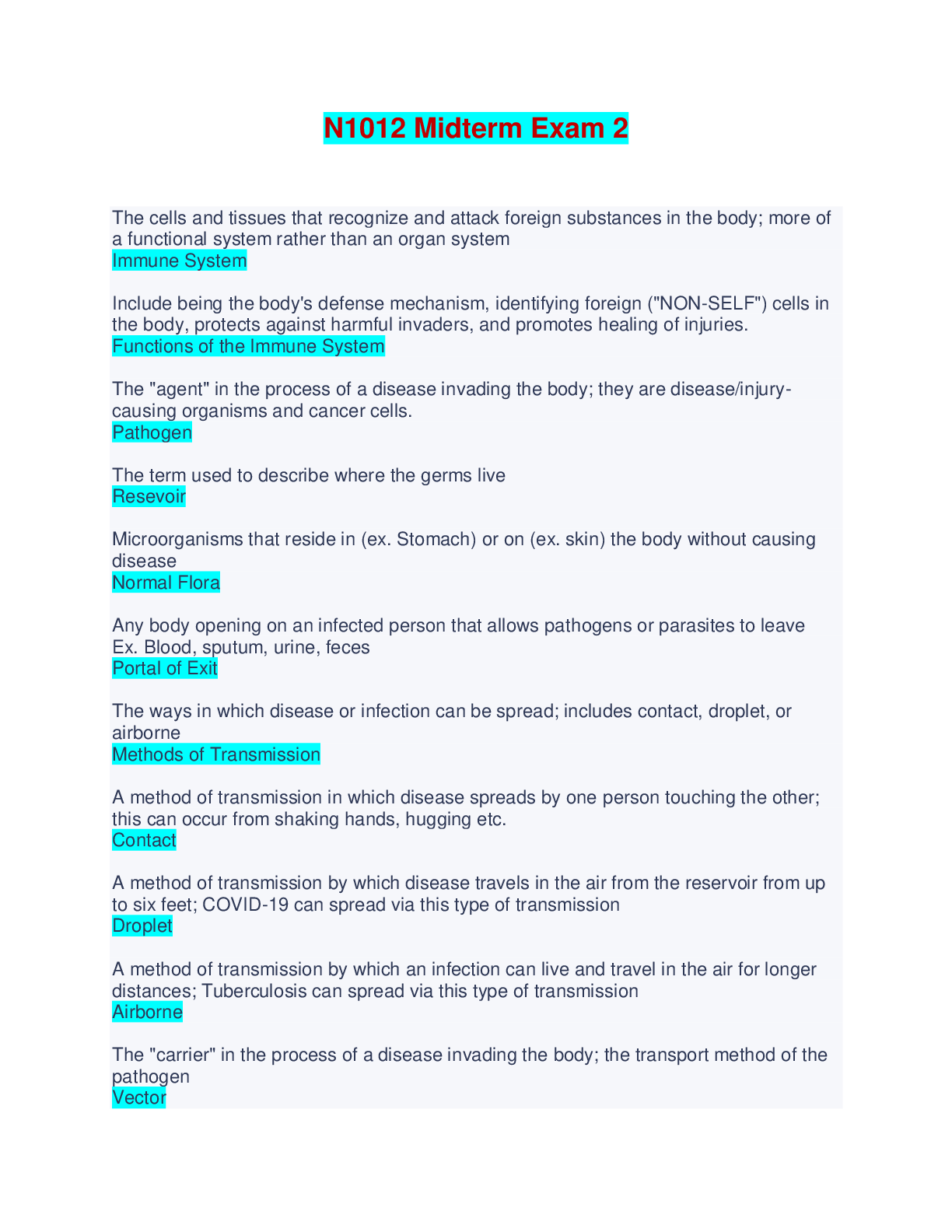
N1012 Midterm Exam 2 - Questions and Answers The cells and tissues that recognize and attack foreign substances in the body; more of a functional system rather than an organ system Immune System Include being the body's defense mechanism, identifying foreign ("NON-SELF") cells in the body, protects against harmful invaders, and promotes healing of injuries. Functions of the Immune System The "agent" in the process of a disease invading the body; they are disease/injury-causing organisms and cancer cells. Pathogen The term used to describe where the germs live Resevoir Microorganisms that reside in (ex. Stomach) or on (ex. skin) the body without causing disease Normal Flora Any body opening on an infected person that allows pathogens or parasites to leave Ex. Blood, sputum, urine, feces Portal of Exit The ways in which disease or infection can be spread; includes contact, droplet, or airborne Methods of Transmission A method of transmission in which disease spreads by one person touching the other; this can occur from shaking hands, hugging etc. Contact A method of transmission by which disease travels in the air from the reservoir from up to six feet; COVID-19 can spread via this type of transmission Droplet A method of transmission by which an infection can live and travel in the air for longer distances; Tuberculosis can spread via this type of transmission Airborne The "carrier" in the process of a disease invading the body; the transport method of the pathogen Vector Sites through which pathogens enter the body Ex. Cut on the skin, ingestions, inhalation, exchange of body fluids, mucous membranes of the eyes Portals of Entry The person likely to get an infection or disease in the process of pathogen invasion Susceptible Host The systems the immune system has in place to protect us from disease; includes innate and adaptive Defense Mechanisms Inborn, fast-acting, 1st and 2nd line of defense that the immune system has in place Innate Defense The slower, 3rd line of defense that the immune system has in place which develops over time as it acquires the tools and skills required to mount a more effective defense Adaptive Defense A type of innate defense that encompasses the mechanical barriers that keep disease out of the body. 1st Line of Defense The physical barriers that keep disease out of the body which include the skin and mucous membranes. Mechanical Barriers Used by the mucous membranes in the first line of innate defense to keep disease out of the body; includes specific chemical barriers, enzymes, mucin and defensing that are exposed to the outside if the body Protective Chemicals A system used by the mucous membranes in the first line of innate defense; includes acids on the skin, vagina, and stomach secretions as well as sebum and sweat Chemical Barriers A system used by the mucous membranes in the first line of innate defense; includes the saliva, ____________________ in the respiratory tract and tears Enzymes A system used by the mucous membranes in the first line of innate defense; lines the digestive and respiratory tact's to trap pathogens before they enter the body (e.g. in the nose) Mucin A system used by the mucous membranes in the first line of innate defense; they include mucous membranes and the skin (antimicrobial) Defensing A type of innate defense that encompasses the internal defenses against disease once it enters the body Ex. Phagocytes, natural killer cells, inflammation, etc. 2nd Line of Defense Blood cells that perform the function of destroying disease-causing microorganisms; aka leukocytes White Blood Cells A white blood cell associated with allergic reactions; engulfs bacteria, fungi, and viruses Eosinophil White blood cell containing granules that stain blue; associated with release of histamine and heparin Basophil A type of white blood cell that ingests invading microbes Phagocytes A type of phagocytic white blood cell that engulfs bacteria in the body; the most abundant phagocyte in the body that die fighting Neutrophils A type of phagocytic white blood cell that engulfs parasites in the body Eosinophils Found within the lymph nodes, they are phagocytes that destroy bacteria, cancer cells, and other foreign matter in the lymphatic stream Macrophages An agranular leukocyte that is able to migrate into tissues and transform into a macrophage Monocytes Specialized white blood cells that patrol the body searching for antigens that produce infections Dendritic Cells White blood cells that are the “police” of blood and lymph; they can kill cancer and virus-infected cells before. The adaptive immune system is activated; they kill by inducing apoptosis and secret potent chemicals to enhance inflammatory response Natural Killer Cells A localized response to an injury or to the destruction of tissues; a mechanism of the second line of defense The signs include pain, heat, swelling, redness and loss on function Inflammation An elevated body temperature that acts a second line of defense against disease Fever Play a central role in triggering immune response; they detect invaders and sound the "alarm" that initiates the immune response Toll-like Receptors (TRLs) A type of endocytosis in which a cell engulfs large particles or whole cells Phagocytosis TRUE OR FALSE: Phagocytes must use the receptors on their cell walls to be able to stick to and trap a pathogen before it can be engulfed True The capsule created when a phagocyte catches, swallows, and destroys a pathogen Phagosome Formed by fusion of phagosome and lysosome; it is a toxic compound that destroys bacterium and all indigestible material is expelled via excytosis Phagolysosome Vesicles that contain hydrolytic enzymes that can break down many kinds of biomolecules Lysosome Proteins that attach to antigens, keeping them from harming the body Antibodies Proteins in blood that help destroy pathogens by coating or puncturing them Complement Proteins The coating of an antigen applied by compliment proteins that makes the pathogen "tasty" and speeds up the phagocytosis of the pathogen Opsonization Which of the following is NOT a function of inflammation?
[Show More]