NSG 6001 Midterm Exam Questions
A 1. Chronic non-communicable diseases account for a disproportionate costs to the healthcare system. According to the world health organization, what percent of preventable deaths and di
...
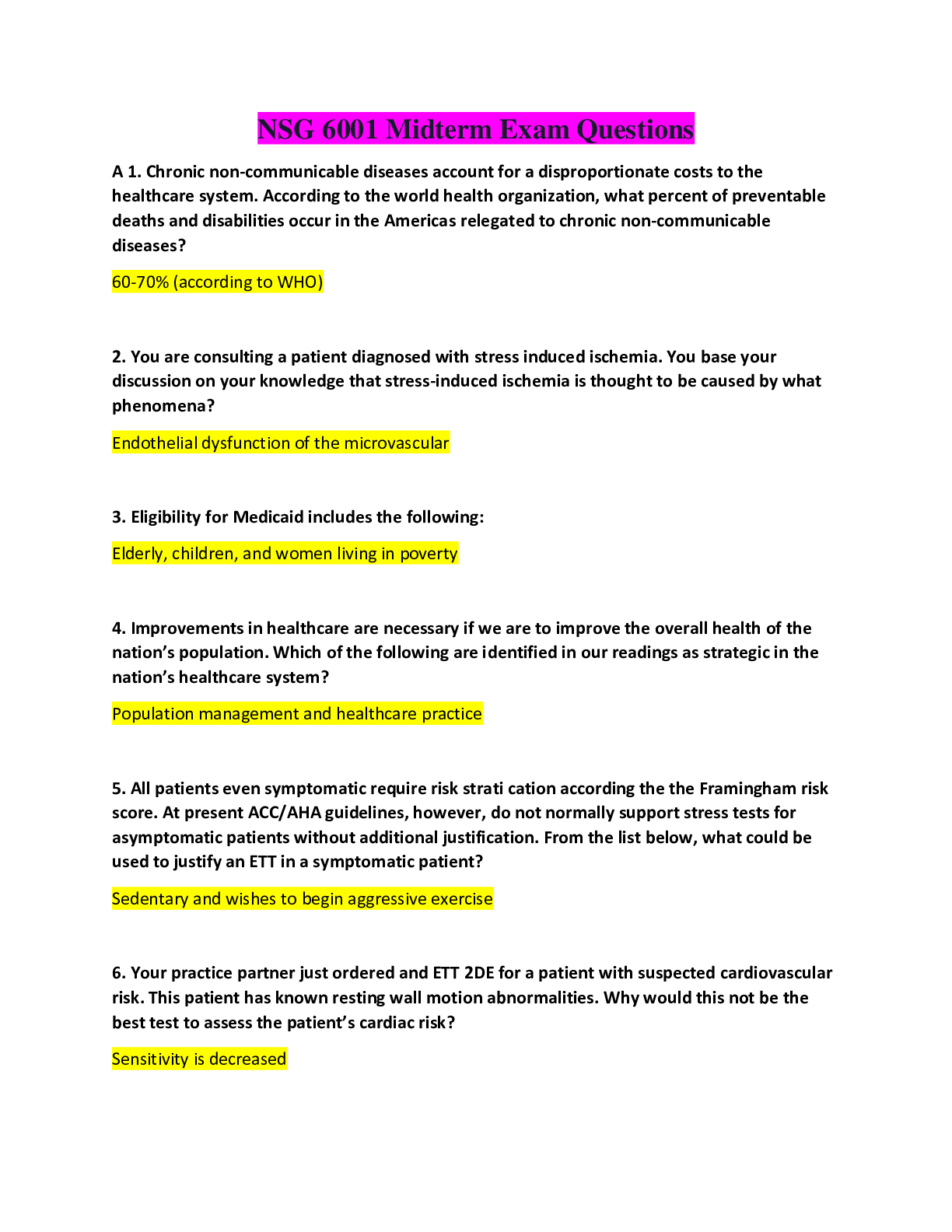
NSG 6001 Midterm Exam Questions
A 1. Chronic non-communicable diseases account for a disproportionate costs to the healthcare system. According to the world health organization, what percent of preventable deaths and disabilities occur in the Americas relegated to chronic non-communicable diseases?
2. You are consulting a patient diagnosed with stress induced ischemia. You base your discussion on your knowledge that stress-induced ischemia is thought to be caused by what phenomena?
3. Eligibility for Medicaid includes the following:
4. Improvements in healthcare are necessary if we are to improve the overall health of the nation’s population. Which of the following are identified in our readings as strategic in the nation’s healthcare system?
5. All patients even symptomatic require risk strati cation according the the Framingham risk score. At present ACC/AHA guidelines, however, do not normally support stress tests for asymptomatic patients without additional justification. From the list below, what could be used to justify an ETT in a symptomatic patient?
6. Your practice partner just ordered and ETT 2DE for a patient with suspected cardiovascular risk. This patient has known resting wall motion abnormalities. Why would this not be the best test to assess the patient’s cardiac risk?
7. In women you need to know the limitations of certain tests for CAD. For example, single – /technically limited in women for two reasons. From the following, choosing the best possible answer?
8. Your patient has a maximum age predicted heart rate of 180. During the exercise he reaches a heart rate of 140 and then states he can no longer exercise. You see evidence of ischemic changes on the ECG. This would be predictive of what condition?
9. What purpose does the principle of fidelity serve in the provider/patient relationship?
10. Your patient has a maximum age predicted hearth rate of 180. During the exercise, he reaches a heart rate of 140 and then states he can no longer excursive. You see no evidence of ischemia on the ECG. This would be diagnostic for whet condition.
11. A 47 year old female with general compliments of fatigue and shortness of breath shows up in clinical as referral form another nurse practitioner. Several blood tests and chest x rays have been completed without any diagnosis for outstanding abnormalities. You have decided to order an ETT despite the fact the recent ECG does not show any abnormities. From the answers below, which would be the best answer to support your decision?
12. What do you know regarding ischemia that is confined to only the poster and or lateral segments of the left ventricle?
13. What Three conditions definitely alter the result of echocardiography in determining CAD?
14. The sensitivity of a routine ETT is effort dependent. What physiological changes occur during effort dependent? What physiological changes occur during effort in routine ETT?
15. You are considered adding an adjunctive form of testing to detect wall motion abnormalities during the ETT. You select Echocardiography as the added testing. You choose this test because you know that echocardiography does what when added to a standard ETT?
16. What is considered that first-line initial approach to test for CAD?
17. Your patient is morbidly obese and cannot sit on a bicycle or walk a treadmill. She also has marked and severe emphysema. You need to make assessment of the risk of significant CAD and your patients family says that their relative had their diagnosis based on an ultrasound echocardiography. What facts would influence your decision regarding the family request for echo assessment?
18. We all know that collaboration is integral to becoming a successful nurse practitioner. Among collaborations, however, only one can be considered as most important. While each example below is important, which is the most important collaboration? The one that occurs:
19. The leads on the EC showing ischemic changes during or immediately after an ETT can correlate roughly to the culprit artery or arteries with significant CAD. Is this true or false?
20. Why would inability to exercise reduce the specificity of the routine ETT?
21. Changes in Medicare are a method the government uses to make changes to reimbursed schedules for healthcare. Currently, Medicare reimburses nurse practitioners for all services, even those deemed to be exclusive to nursing?
22. Of the following, which is the best answer when asked for an advantage of echocardiogram exercise testing over thallium stress testing?
23. Encouragement of patients to take effective actions in their own healthcare refers to the concept of:
24. By standard criteria, how is a positive stress test defined?
25. What are tow of the most common forms of Exercise Stress Tests used today?
26. You are in the clinic with your mentor observing the Echocardiogram exercise test of a 45 year old male that has been experiencing slight chest pressure almost daily during exercise. While observing your patient, your mentor points out that the left ventricle wall is thinning and there is some hyperkinesia of the ventricular wall. From your time in the clinic, you know that this test will be considered to be what type of result?
27. Ischemic changes on the ECG during ETT is highly predictive of CAD. What is another important strong predictor of CAD that you might see during an ETT?
28. The diagnostic accuracy of stress testing is decreased among women compared to men for what reasons?
29. Your mentor says that you should be prepared to know how to determine the maximum heart rate for your patient during the ETT. How the age is predicated maximum heart rate during an ETT determined?
30. As patients that entrust our care to another individual, we always expect honesty to avoid leading us down a deceptive pathway in our healthcare decisions. Adherence to which principle compels providers to be truthful?
[Show More]