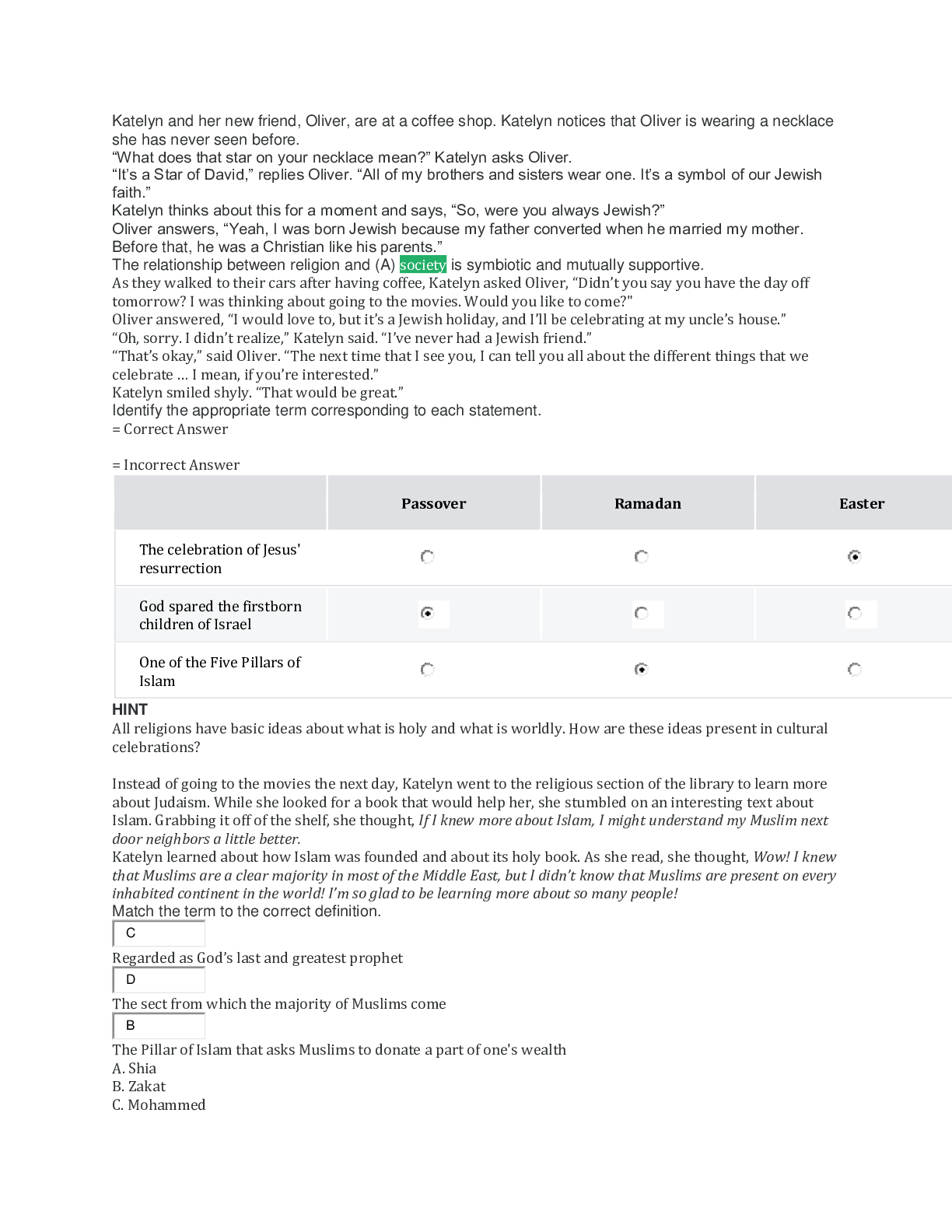
Katelyn and her new friend, Oliver, are at a coffee shop. Katelyn notices that Oliver is wearing a necklace
she has never seen before.
“What does that star on your necklace mean?” Katelyn asks Oliver.
“It’s a Star of
...
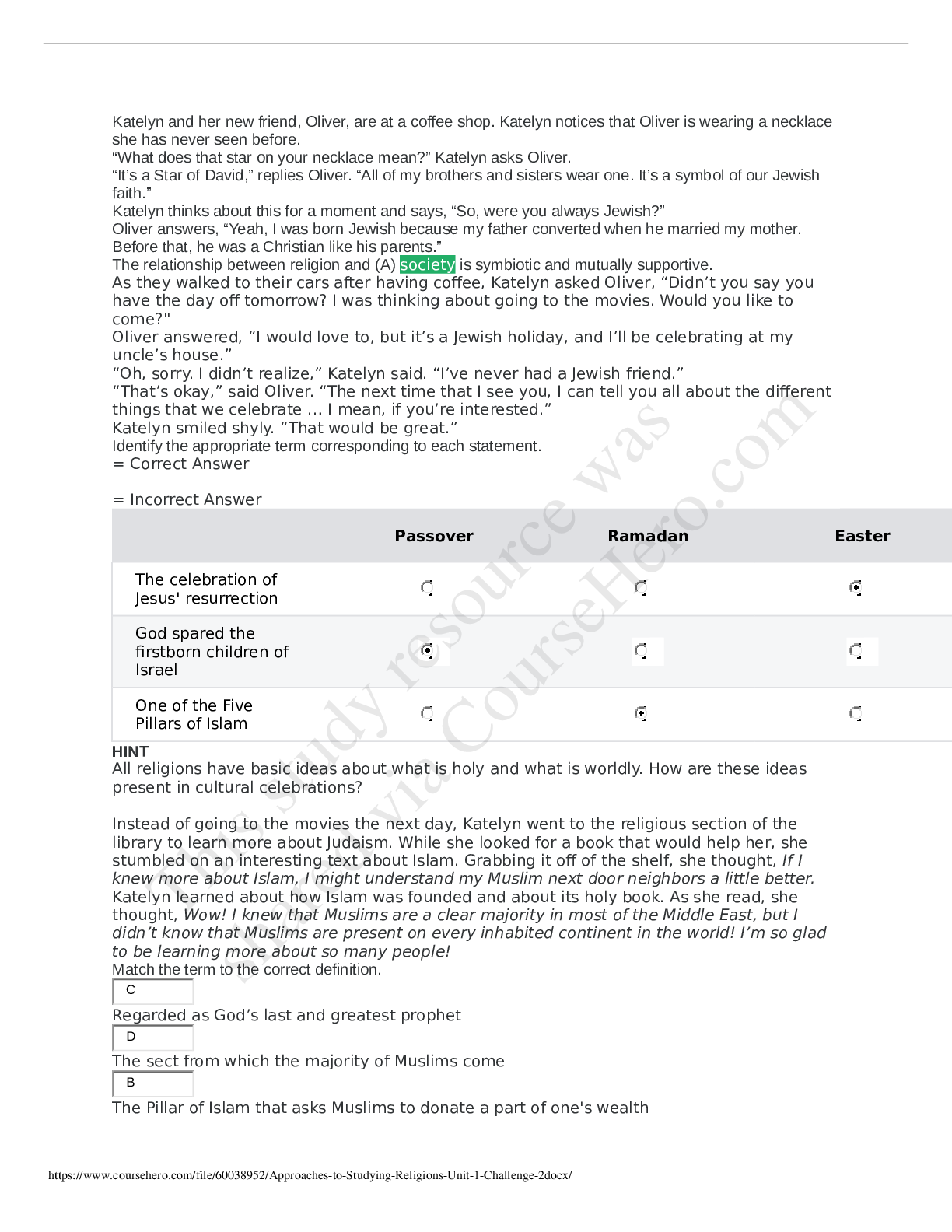
Katelyn and her new friend, Oliver, are at a coffee shop. Katelyn notices that Oliver is wearing a necklace
she has never seen before.
“What does that star on your necklace mean?” Katelyn asks Oliver.
“It’s a Star of David,” replies Oliver. “All of my brothers and sisters wear one. It’s a symbol of our Jewish
faith.”
Katelyn thinks about this for a moment and says, “So, were you always Jewish?”
Oliver answers, “Yeah, I was born Jewish because my father converted when he married my mother.
Before that, he was a Christian like his parents.”
The relationship between religion and (A) society is symbiotic and mutually supportive.
As they walked to their cars after having coffee, Katelyn asked Oliver, “Didn’t you say you have the day off
tomorrow? I was thinking about going to the movies. Would you like to come?"
Oliver answered, “I would love to, but it’s a Jewish holiday, and I’ll be celebrating at my uncle’s house.”
“Oh, sorry. I didn’t realize,” Katelyn said. “I’ve never had a Jewish friend.”
“That’s okay,” said Oliver. “The next time that I see you, I can tell you all about the different things that we
celebrate ... I mean, if you’re interested.”
Katelyn smiled shyly. “That would be great.”
Identify the appropriate term corresponding to each statement.
= Correct Answer
= Incorrect Answer
Passover Ramadan Easter
The celebration of Jesus'
resurrection
God spared the firstborn
children of Israel
One of the Five Pillars of
Islam
HINT
All religions have basic ideas about what is holy and what is worldly. How are these ideas present in cultural
celebrations?
Instead of going to the movies the next day, Katelyn went to the religious section of the library to learn more
about Judaism. While she looked for a book that would help her, she stumbled on an interesting text about
Islam. Grabbing it off of the shelf, she thought, If I knew more about Islam, I might understand my Muslim next
door neighbors a little better.
Katelyn learned about how Islam was founded and about its holy book. As she read, she thought, Wow! I knew
that Muslims are a clear majority in most of the Middle East, but I didn’t know that Muslims are present on every
inhabited continent in the world! I’m so glad to be learning more about so many people!
Match the term to the correct definition.
C
Regarded as God’s last and greatest prophet
D
The sect from which the majority of Muslims come
B
The Pillar of Islam that asks Muslims to donate a part of one's wealth
A. Shia
B. Zakat
C. Mohammed
D. Sunni
A few days after her trip to the library, Katelyn met Oliver at a local park. “The other day, I spent several
hours reading books about religion. I learned all about several different approaches to religion. I never even
knew they existed!” she blurted out instead of greeting him.
“Well, hello to you, too,” Oliver said, smiling.
Blushing, Katelyn said, “Oh, sorry. I have just been so excited to tell you. Anyway, how was your holiday?”
“Rosh Hashanah was great,” Oliver replied. “And, please, don’t be embarrassed. I think it’s really wonderful
that you’re taking such an interest in learning about religions other than your own.”
Categorize the following comparative religions.
= Correct Answer
= Incorrect Answer
Abrahamic Indian Taoic
Hinduism
Taoism
Islam
Oliver took a science test the day following his outing with Katelyn. To his surprise, the exam had some of
the very same terms of measurement that Katelyn had mentioned while discussing religion at the park.
Thinking of his new friend, Oliver opined, “We sure are learning a lot from each other."
Sociology of religion is the application of the (A) quantitative and qualitative tools of the social sciences to
the study of religion.
On the same day as Oliver’s science test, Katelyn had a meeting with Dr. Anderson, her academic
advisor. While catching up with Dr. Anderson, Katelyn revealed that she was having doubts about her
decision to major in psychology.
Dr. Anderson told her, “Well, as a freshman, you are still able to change your major without getting off
track. Is there anything else in which you are interested?”
Frustrated, Katelyn replied, “I’m really fascinated with religion, but I don’t think that will really help me pick
a major.”
Excitedly, Dr. Anderson circled something on a piece of paper and handed it to Katelyn. “This is a list of
majors from which you may choose. See anything you like?” Dr. Anderson asked, eyes twinkling.
Quickly, Katelyn caught on. “You can actually major in the philosophy of religion?” she asked. “I had no
idea!”
“That’s why you have an academic advisor,” Dr. Anderson joked.
The philosophy of religion is an academic discipline that considers religious questions from a
broad, (A) scholarly standpoint.
[Show More]