Katelyn and her new friend, Oliver, are at a coffee shop. Katelyn notices that Oliver is wearing a necklace
she has never seen before.
“What does that star on your necklace mean?” Katelyn asks Oliver.
“It’s a Star of
...
Katelyn and her new friend, Oliver, are at a coffee shop. Katelyn notices that Oliver is wearing a necklace
she has never seen before.
“What does that star on your necklace mean?” Katelyn asks Oliver.
“It’s a Star of David,” replies Oliver. “All of my brothers and sisters wear one. It’s a symbol of our Jewish
faith.”
Katelyn thinks about this for a moment and says, “So, were you always Jewish?”
Oliver answers, “Yeah, I was born Jewish because my father converted when he married my mother.
Before that, he was a Christian like his parents.”
The relationship between religion and (A) society is symbiotic and mutually supportive.
As they walked to their cars after having coffee, Katelyn asked Oliver, “Didn’t you say you
have the day off tomorrow? I was thinking about going to the movies. Would you like to
come?"
Oliver answered, “I would love to, but it’s a Jewish holiday, and I’ll be celebrating at my
uncle’s house.”
“Oh, sorry. I didn’t realize,” Katelyn said. “I’ve never had a Jewish friend.”
“That’s okay,” said Oliver. “The next time that I see you, I can tell you all about the different
things that we celebrate … I mean, if you’re interested.”
Katelyn smiled shyly. “That would be great.”
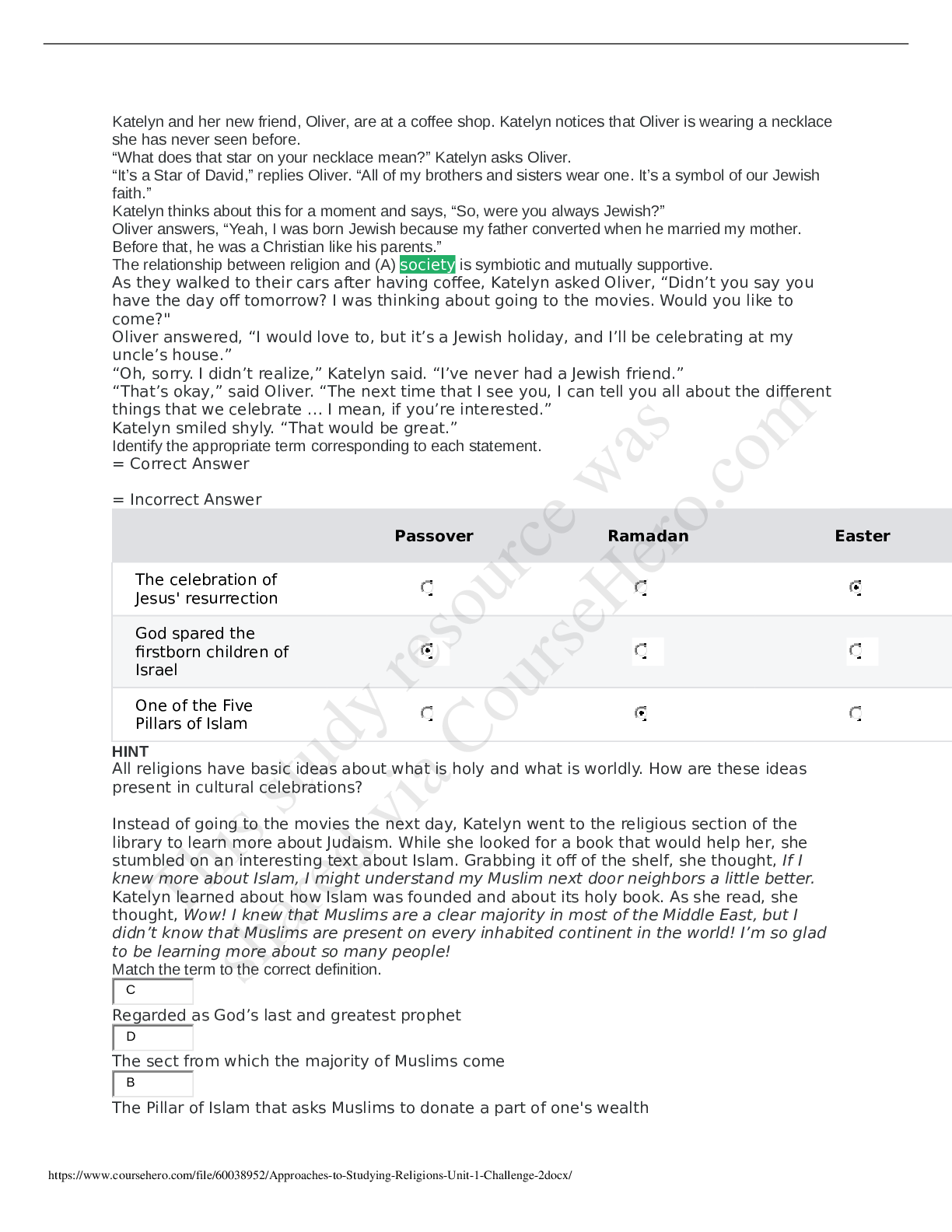
Identify the appropriate term corresponding to each statement.
= Correct Answer
= Incorrect Answer
Passover Ramadan Easter
The celebration of
Jesus' resurrection
God spared the
firstborn children of
Israel
One of the Five
Pillars of Islam
HINT
All religions have basic ideas about what is holy and what is worldly. How are these ideas
present in cultural celebrations?
Instead of going to the movies the next day, Katelyn went to the religious section of the
library to learn more about Judaism. While she looked for a book that would help her, she
stumbled on an interesting text about Islam. Grabbing it off of the shelf, she thought, If I
knew more about Islam, I might understand my Muslim next door neighbors a little better.
Katelyn learned about how Islam was founded and about its holy book. As she read, she
thought, Wow! I knew that Muslims are a clear majority in most of the Middle East, but I
didn’t know that Muslims are present on every inhabited continent in the world! I’m so glad
to be learning more about so many people!
Match the term to the correct definition.
Regarded as God’s last and greatest prophet
The sect from which the majority of Muslims come
The Pillar of Islam that asks Muslims to donate a part of one's wealth
C D B
https://www.coursehero.com/file/60038952/Approaches-to-Studying-Religions-Unit-1-Challenge-2docx/
This study resource was
shared via CourseHero.comA. Shia
B. Zakat
C. Mohammed
D. Sunni
A few days after her trip to the library, Katelyn met Oliver at a local park. “The other day, I
spent several hours reading books about religion. I learned all about several different
approaches to religion. I never even knew they existed!” she blurted out instead of greeting
him.
“Well, hello to you, too,” Oliver said, smiling.
Blushing, Katelyn said, “Oh, sorry. I have just been so excited to tell you. Anyway, how was
your holiday?”
“Rosh Hashanah was great,” Oliver replied. “And, please, don’t be embarrassed. I think it’s
really wonderful that you’re taking such an interest in learning about religions other than
your own.”
Categorize the following comparative religions.
= Correct Answer
= Incorrect Answer
Abrahamic Indian Taoic
Hinduism
Taoism
Islam
Oliver took a science test the day following his outing with Katelyn. To his surprise, the exam had some of
the very same terms of measurement that Katelyn had mentioned while discussing religion at the park.
Thinking of his new friend, Oliver opined, “We sure are learning a lot from each other."
Sociology of religion is the application of the (A) quantitative and qualitative tools of the social sciences
to the study of religion.
On the same day as Oliver’s science test, Katelyn had a meeting with Dr. Anderson, her academic
advisor. While catching up with Dr. Anderson, Katelyn revealed that she was having doubts about her
decision to major in psychology.
Dr. Anderson told her, “Well, as a freshman, you are still able to change your major without getting off
track. Is there anything else in which you are interested?”
Frustrated, Katelyn replied, “I’m really fascinated with religion, but I don’t think that will really help me pick
a major.”
Excitedly, Dr. Anderson circled something on a piece of paper and handed it to Katelyn. “This is a list of
majors from which you may choose. See anything you like?” Dr. Anderson asked, eyes twinkling.
Quickly, Katelyn caught on. “You can actually major in the philosophy of religion?” she asked. “I had no
idea!”
“That’s why you have an academic advisor,” Dr. Anderson joked.
The philosophy of religion is an academic discipline that considers religious questions from a
broad, (A) scholarly standpoint.
After her meeting with Dr. Anderson, Katelyn called Oliver to see how he did on his science
test. After he told her that he aced it, Katelyn said, “I have some exciting news, too. I just
decided to switch my major to Philosophy of Religion! I’ll be taking two religion courses next
https://www.coursehero.com/file/60038952/Approaches-to-Studying-Religions-Unit-1-Challenge-2docx/
This study resource was
shared via CourseHero.comsemester. One is called ‘Phenomenology of Religion,’ while the other is a course on the
history of religion.”
“What’s the difference between the two?” asked Oliver.
Laughing, Katelyn admitted, “To be honest, I’m not exactly sure. I’ll look it up and get back
to you.”
Select the two statements below that are true of the phenomenological and historical approaches to
studying religion.
The historical-critical study of the Bible emerged in 17th century Europe.
The phenomenological approach attempts to answer larger and ultimately unanswerable questions.
The phenomenological approach uses a typology/categorization method.
An advantage of the phenomenological approach is that one can track changes to religion over time.
The history of a religion can only be studied effectively by its followers.
Historical studies of Christianity have until recently focused on its development in Europe.
Later that night, Oliver and Katelyn met for dinner. Oliver had something on his mind.
“In thinking of how much interest you’ve shown in learning other religions, I realized that I
haven’t shown much interest in learning about yours. You’re Christian, right?” asked Oliver.
Katelyn nodded and Oliver continued, “I know that you celebrate Christmas and Easter, but
I’m not exactly sure why. I’m embarrassed to say that I’ve never asked my paternal
grandparents, even though they’re Christian.”
Katelyn smiled encouragingly and told Oliver, “You told me all about Judaism; I’d be happy to
tell you about Christianity.”
Which two of the following statements are not true of Christianity?
Founded in the first century B.C./B.C.E.
Roman Catholicism is the largest Christian sect in South America.
Jesus of Nazareth is the central figure.
“Immanuel” means “God with Us.”
The Russian Orthodox Church is the major form of eastern Christianity.
Is divided into “western” and “eastern” branches.
https://www.coursehero.com/file/60038952/Approaches-to-Studying-Religions-Unit-1-Challenge-2docx/
This study resource was
shared via CourseHero.comAfter Katelyn told Oliver about Christianity, she mentioned that she was looking forward to
learning about even more religions in her studies at school.
“I found an online copy of the syllabus for that Phenomenology of Religion course. We’re
going to be discussing religions I’ve never even heard of!” said Katelyn.
“Really?” asked Oliver. “Which ones?”
“In addition to discussing Taoism, which I learned about in the library, we’re covering three
other eastern religions: Jainism, Sikhism, and Shinto,” answered Katelyn.
“I’ve never heard of those, either,” Oliver admitted. “Maybe I should take that course as an
elective.”
Identify which statement belongs with which religion.
= Correct Answer
= Incorrect Answer
Shinto Sikhism Jainism
teaches complete
non violence
a monotheistic
religion
the name means
"path of the gods"
On the first day of “Phenomenology of Religion,” Katelyn and Oliver sat next to each other.
The professor said, "Our first unit covers Hinduism and Islam. Your first test on these two
religions--their main aspects as well as some minor elements--is in two weeks." Katelyn
looked over at Oliver and could tell that he was a little overwhelmed.
After class, she told him, “I wouldn’t have found my interest in this if you hadn’t introduced
me to religions outside my own. I’d be more than happy to study with you for that test. I
wanted to be prepared for this class, so I read a lot over the break.”
Oliver replied, “Thanks. That would be great! Before we get started, though, would you like
to attend your first Jewish wedding this weekend?”
“That sounds like a date,” Katelyn teased.
“It’s only a date if you say yes,” he teased back, and the two walk hand in hand toward their
favorite coffee shop.
Choose the most appropriate answer for each element shown below.
= Correct Answer
= Incorrect Answer
Hinduism Islam
Has multiple gods and
godesses.
Adherants seek liberation
from from samsara.
Believes in many prophets.
[Show More]