Shira, a college freshman, was excited to begin her life on campus. When moving into her dorm, she met
her new roommate, Piper. Shira knew from previous conversations that Piper practices Christianity. Shira,
who is Je
...
Shira, a college freshman, was excited to begin her life on campus. When moving into her dorm, she met
her new roommate, Piper. Shira knew from previous conversations that Piper practices Christianity. Shira,
who is Jewish, was surprised when Piper hung a copy of The Golden Rule above her desk.
“I studied that in Temple,” said Shira. “Where did you learn it?”
“In Sunday School at my church,” replied Piper. “As a little girl, I learned all about living as God would
have us live.”
The girls smiled and continued unpacking.
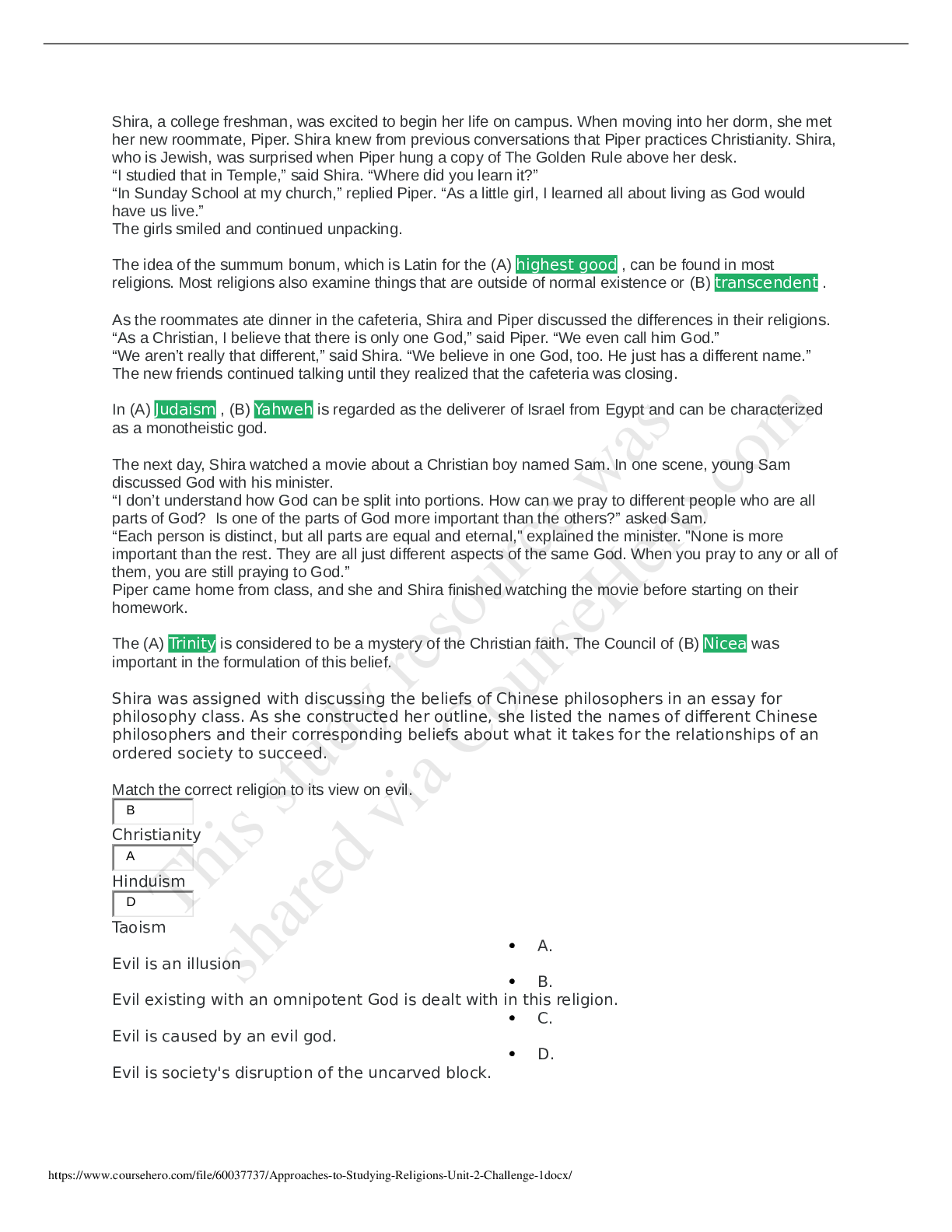
The idea of the summum bonum, which is Latin for the (A) highest good , can be found in most
religions. Most religions also examine things that are outside of normal existence or (B) transcendent .
As the roommates ate dinner in the cafeteria, Shira and Piper discussed the differences in their religions.
“As a Christian, I believe that there is only one God,” said Piper. “We even call him God.”
“We aren’t really that different,” said Shira. “We believe in one God, too. He just has a different name.”
The new friends continued talking until they realized that the cafeteria was closing.
In (A) Judaism , (B) Yahweh is regarded as the deliverer of Israel from Egypt and can be characterized
as a monotheistic god.
The next day, Shira watched a movie about a Christian boy named Sam. In one scene, young Sam
discussed God with his minister.
“I don’t understand how God can be split into portions. How can we pray to different people who are all
parts of God? Is one of the parts of God more important than the others?” asked Sam.
“Each person is distinct, but all parts are equal and eternal," explained the minister. "None is more
important than the rest. They are all just different aspects of the same God. When you pray to any or all of
them, you are still praying to God.”
Piper came home from class, and she and Shira finished watching the movie before starting on their
homework.
The (A) Trinity is considered to be a mystery of the Christian faith. The Council of (B) Nicea was
important in the formulation of this belief.
Shira was assigned with discussing the beliefs of Chinese philosophers in an essay for
philosophy class. As she constructed her outline, she listed the names of different Chinese
philosophers and their corresponding beliefs about what it takes for the relationships of an
ordered society to succeed.
Match the correct religion to its view on evil.
Christianity
Hinduism
Taoism
A.
Evil is an illusion
B.
Evil existing with an omnipotent God is dealt with in this religion.
C.
Evil is caused by an evil god.
D.
Evil is society's disruption of the uncarved block.
B A D
https://www.coursehero.com/file/60037737/Approaches-to-Studying-Religions-Unit-2-Challenge-1docx/
This study resource was
shared via CourseHero.comWhen Piper woke up the following morning, she asked Shira, “How did your philosophy essay
turn out?”
“Great, but I was up really late. How did your homework turn out?” answered Shira.
“I still have a lot to do. I am going to the library to study for my exam on Islam. Did you
know that Muslims have one God who has many different names? It’s a lot to remember,”
Piper complained as she got dressed.
“Well, you’d better get going if you want to do well on the test. See you later,” said Shira.
With that, Piper was on her way.
Which two of the following apply to Allah, according to Islam?
Effortless action
Omnipotent
Trinity of Gods
The path to lead the way
The Great Spirit
Creator of the universe
HINT
Think about what you have learned regarding Islam’s view of Allah. What are some of the
key characteristics and attributes of Allah?
“Oh, hi!” said Eleanor. “I didn’t even see you. I’m poring over my notes on the Bhagavad Gita. I have to
write a term paper on the Notion of God in Hinduism.”
“Good luck,” Piper responded. “I’m off to study for an exam on Islam. See you around.”
In Hinduism (A) Brahman is the spirit that binds together the universe, and (B) Atman is the individual
self.
After acing her exam on Islam, Piper turned to the rest of her homework. She opened her Religion book
and began to read a chapter about Daoism (the "modern" spelling for Taoism). When she was just one
paragraph in, she realized that she didn’t even know what the word “Taoism” really means. After finishing
the chapter and looking up the word in the dictionary, she still found herself confused.
“Dr. Cambridge, what exactly is Taoism?” Piper asked her professor the next day.
“Well, Piper, that’s a complicated question. Taoism is very difficult to define. Today, we’re going to discuss
the definition of the root word, ‘Tao,’ as well as many of the values and concepts associated with the
religion,” Dr. Cambridge answered.
Eager to understand, Piper took out her pen and began taking notes.
Taoism was founded by (A) Lao Tzu and means (B) "the way" .
As Dr. Cambridge and Piper continued their discussion of Taoism, the conversation inevitably turned to
the question of origins.
“Where did Taoism come from, Dr. Cambridge? How and when did it emerge?”
“Well, Piper, that’s another good question. Unlike some eastern religions, Taoism has a central figure who
can be regarded as a founder of sorts, and by analyzing his life and writings, we can learn a great deal
about what he helped to create.”
In Taoism, the concept of (A) Wu wei , or "effortless action," is important. The Tao is difficult to express in
words, and therefore can only (B) be experienced .
The following weekend, Shira and Piper decided to take a trip to some Native American ruins near
campus. When they arrived at the site, they noticed a plaque intended to educate visitors about the tribes
who used to live in the region.
https://www.coursehero.com/file/60037737/Approaches-to-Studying-Religions-Unit-2-Challenge-1docx/
This study resource was
shared via CourseHero.com“I always knew that nature was important to many Native Americans,” said Shira, “but I didn’t know that
nature held religious significance for some.”
“I didn’t know that, either,” responded Piper. “I’m so glad we came here.”
The two friends walked around the ruins until it came time to go get lunch.
In the spiritual beliefs of the Sioux, Wakan Tanka is also called the (A) Great Spirit . In the primal
consciousness, God is nature, which is also known as (B) pantheism .
At the end of the semester, Shira and Piper prepared to leave school for the winter break. As
they reminisced on their first months as college students, they found themselves again
discussing religion.
“It’s interesting that so many religions that seem very different address so many of the
same issues,” offered Shira.
“I know,” said Piper. “It seems as though we are all trying to find answers to the same big
questions.”
“Who would have thought that so many seemingly dissimilar people would have so very
much in common,” mused Shira as she thought back on all of the different religions she and
Piper discussed during the semester.
“See you next month. Have a great Hannukah!” said Piper.
“And you have a wonderful Christmas,” smiled Shira.
Which two of the following are among the “big questions” that religion seeks to answer, as discussed in
this pathway?
“How many gods/goddesses are there?”
“Are human beings the only intelligent life in the universe?”
“Is God male or female?”
“Is there life after death?”
“Why do people suffer?”
“Why be moral?”
[Show More]