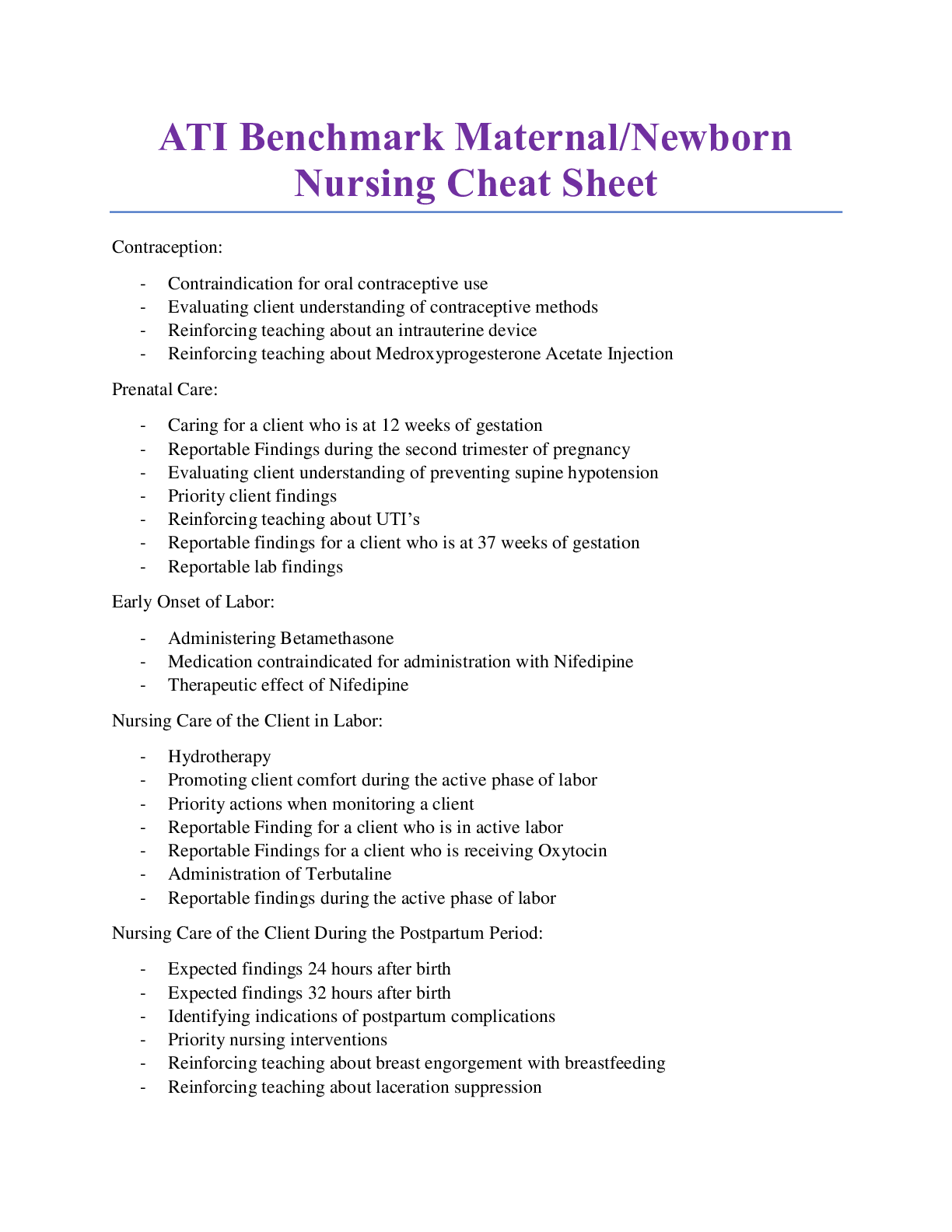
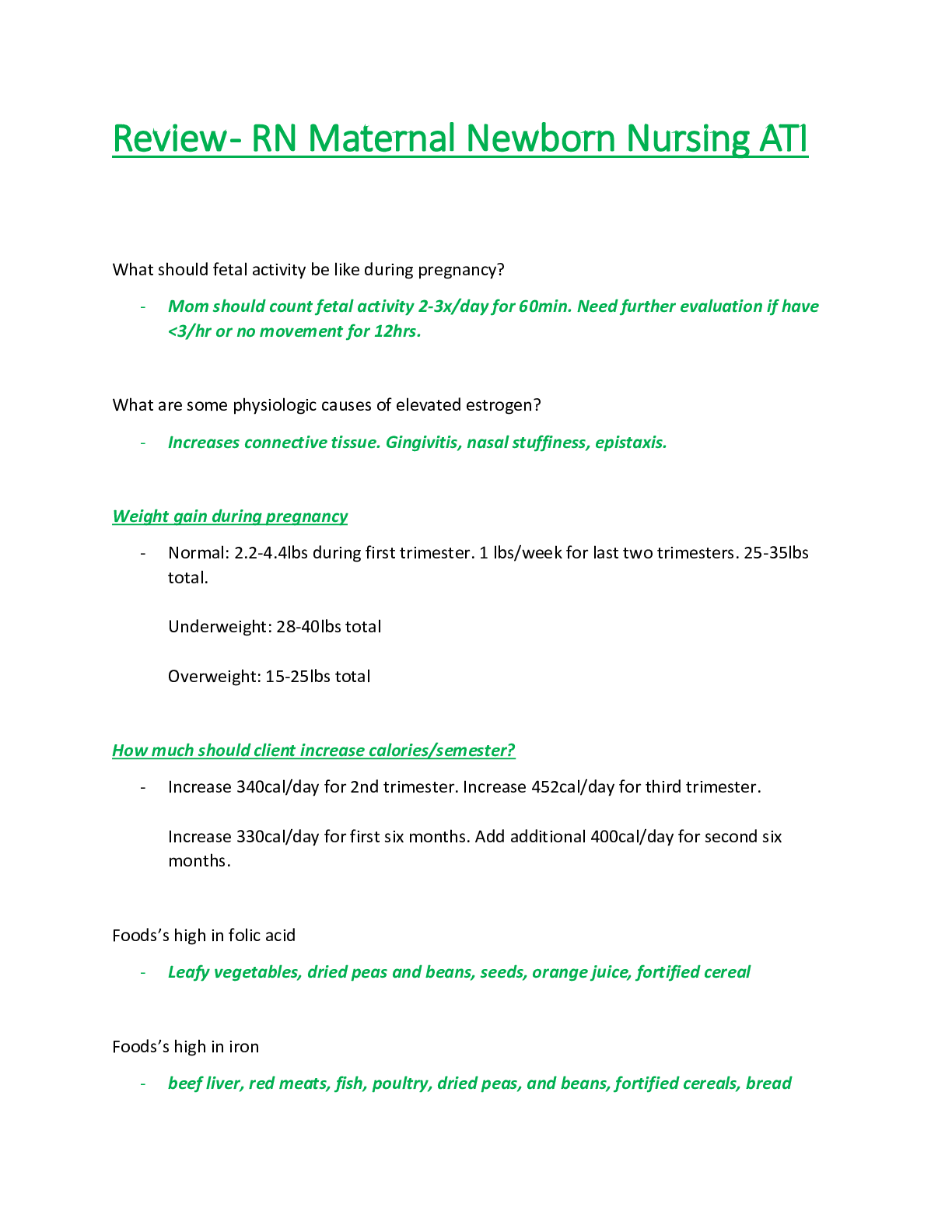
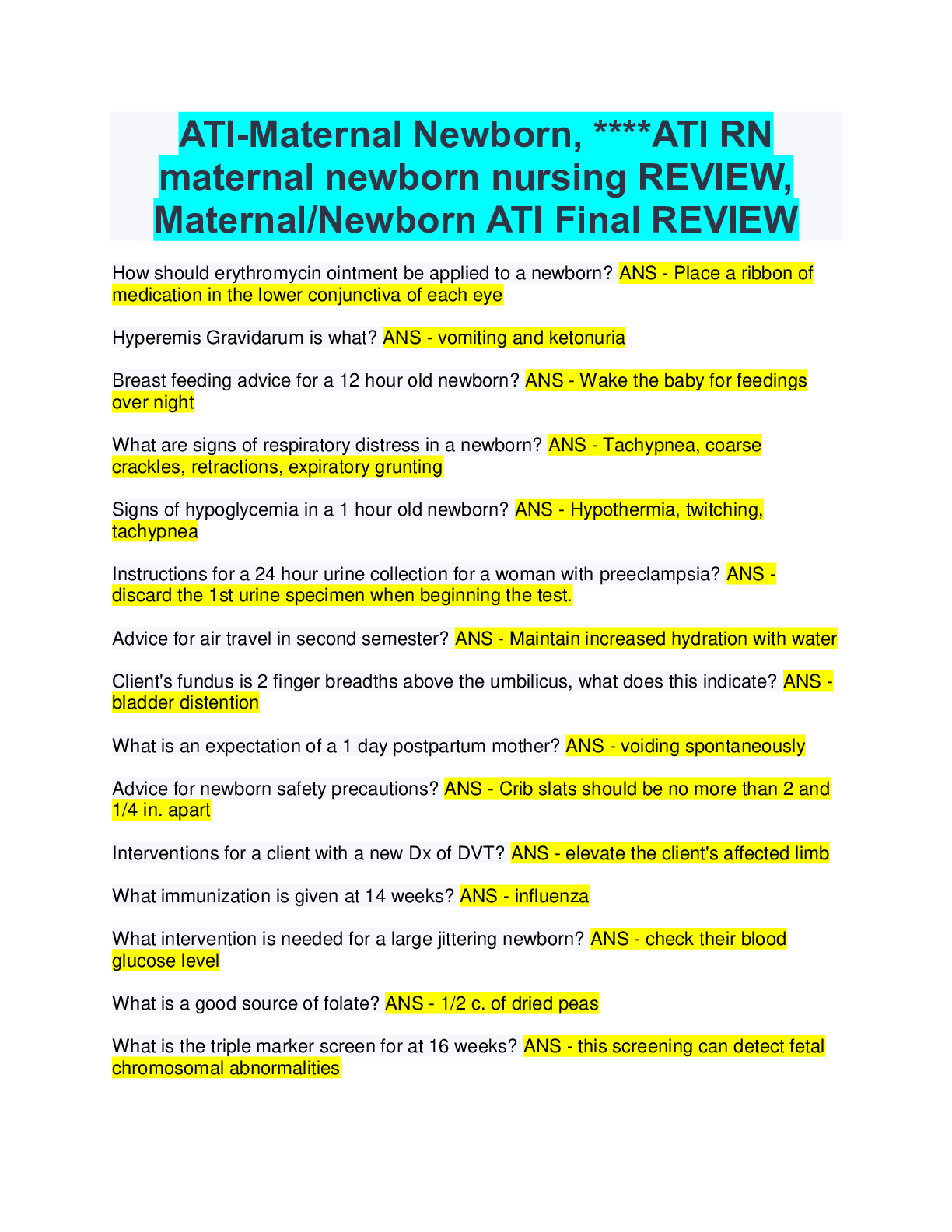
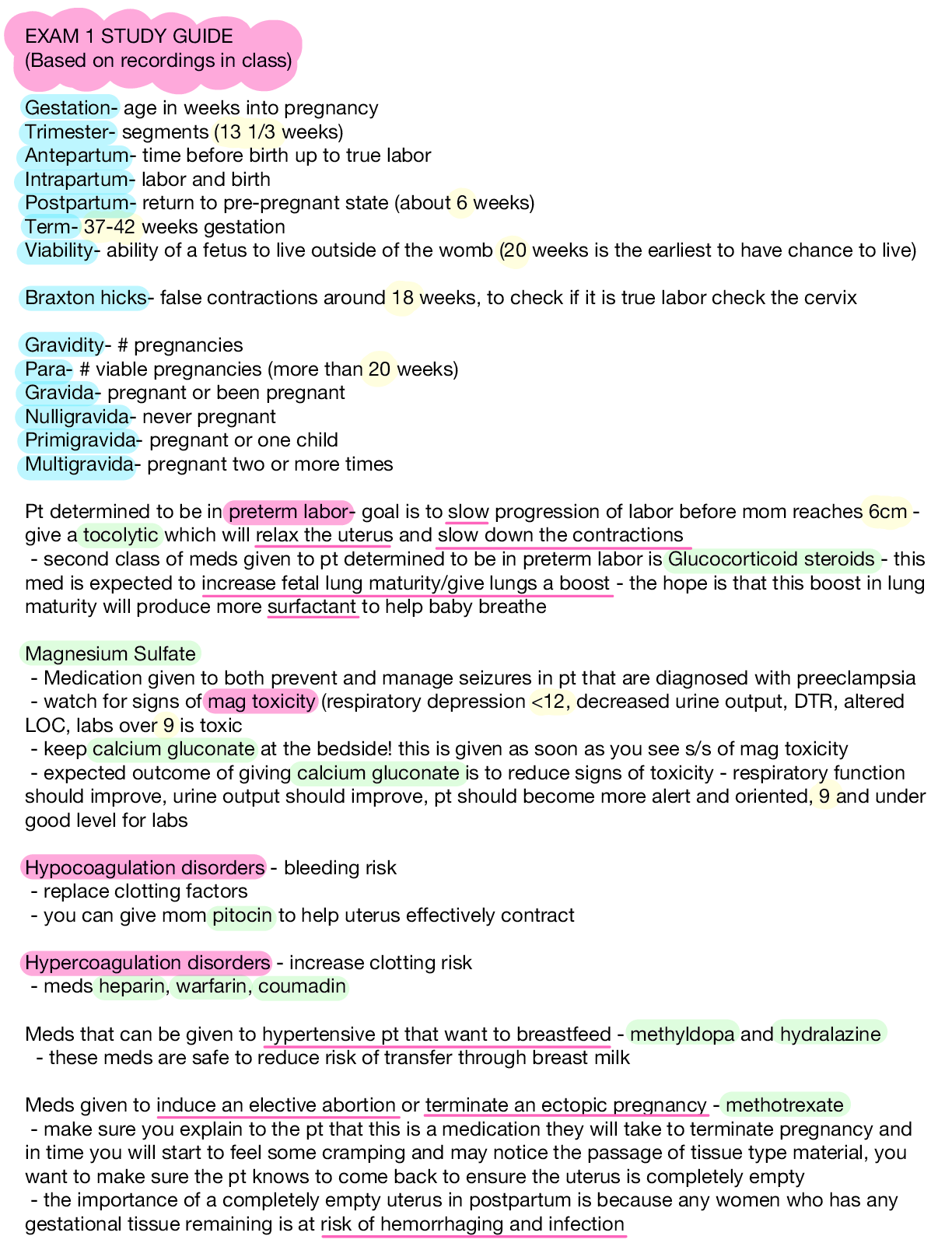
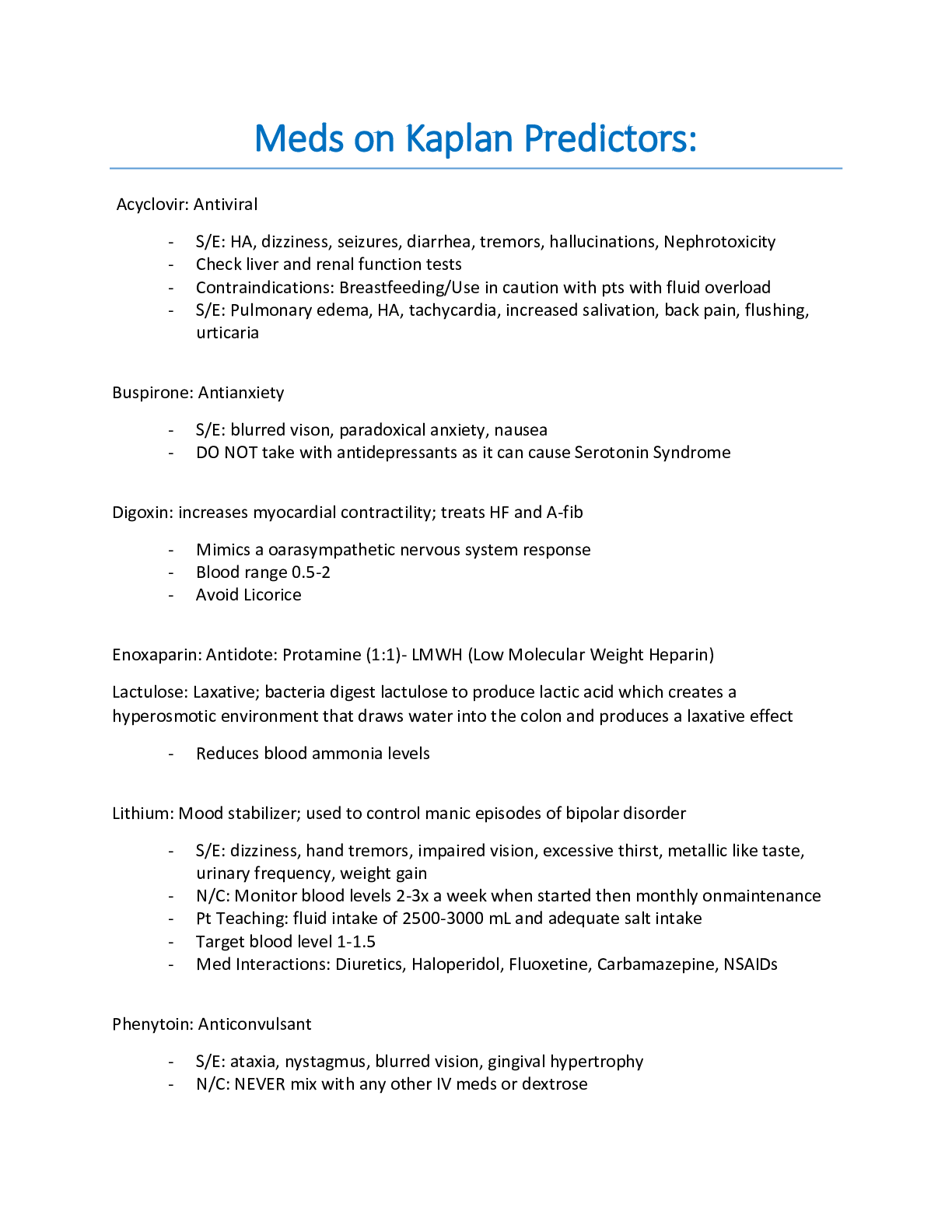
ATI Benchmark Maternal/Newborn Nursing Cheat Sheet
Contraception:
- Contraindication for oral contraceptive use
- Evaluating client understanding of contraceptive methods
Prenatal Care:
- Caring for a client who i
...
ATI Benchmark Maternal/Newborn Nursing Cheat Sheet
Contraception:
- Contraindication for oral contraceptive use
- Evaluating client understanding of contraceptive methods
Prenatal Care:
- Caring for a client who is at 12 weeks of gestation
- Reportable Findings during the second trimester of pregnancy
Early Onset of Labor:
- Administering Betamethasone
Nursing Care of the Client in Labor:
- Hydrotherapy
- Promoting client comfort during the active phase of labor
Nursing Care of the Client During the Postpartum Period:
- Expected findings 24 hours after birth
Complications of the Postpartum Period:
- Actions for a client who has a 4th degree perineal laceration
- Priority for postpartum hemorrhage
- Reportable findings
Nursing Care of (the) Newborn(s):
- Administering Phytonadione
- Breastfeeding instructions
- Reinforcing Teaching about bottle feeding formula
- Identifying the route for medical administration
- Blood glucose monitoring
- Evaluating (parent) understanding about preventing newborn abduction
- Hospital safety
- Reducing risk for newborn abduction
- Reinforcing Safety precautions
- Safety at home
Complications of the Newborn:
- Manifestations of respiratory distress
- Reportable findings
Medical Conditions:
- Reinforcing teaching with a client who has diabetes mellitus and is obese
- Identifying risk factors for preeclampsia
- Reportable findings during the third trimester
- Reinforcing teaching about Ferrous Sulfate
Baby-Friendly Care:
- Promoting parent-newborn attachment
Determination of Fetal Well-Being:
Expected Physiological Changes During Pregnancy
- Evaluating understanding
- Findings to report to a provider
GI Disorders:
- Reinforcing teaching to reduce nausea/vomiting.
Health Promotion of Infants (2 days to 1 year):
- Evaluating understanding of car seat safety
Infections:
- Bacterial Vaginosis
- Caring for a patient who has a positive Hepatitis B screening
Newborn Data Collection:
- Identifying Primitive Reflexes
- Reportable Findings
Nursing Across the Lifespan:
-
Nutrition During Pregnancy:
-
Opioids Agonists and Antagonists:
-
Sources of Nutrition:
- folate
-
Volume/Time – IV Drop Rate Questions
Given a certain amount of liquid, a time, and a drop factor (gtts/mL), what is the necessary IV flow rate in gtts/min? Measurement used when IV is regulated manually. Because it is not possible to give a patient a fraction of a drop, it is typical to round answers for these problems up or down to the nearest whole number.
Formula:
Volume (mL)
Time (min)
x Drop Factor (gtts/mL) = Y (Flow Rate in gtts/min)
Example: Calculate the IV flow rate for 1200 mL of NS to be infused in 6 hours. The infusion set is calibrated for a drop factor of 15 gtts/mL.
Volume (mL)
Time (min)
x Drop Factor (gtts/mL) = Y (Flow Rate in gtts/min)
Convert 6 hours to minutes.
min ← hr ( x by 60 )
6 hr x 60 = 360 min
1200 mL
360 min
x 15 gtts/mL = 50 gtts/min
Example: Calculate the IV flow rate for 200 mL of 0.9% NaCl IV over 120 minutes. Infusion set has drop factor of 20 gtts/mL.
Volume (mL)
Time (min)
x Drop Factor (gtts/mL) = Y (Flow Rate in gtts/min)
200 mL
120 min
x 20 gtts/mL = 33 gtts/min
[Show More]