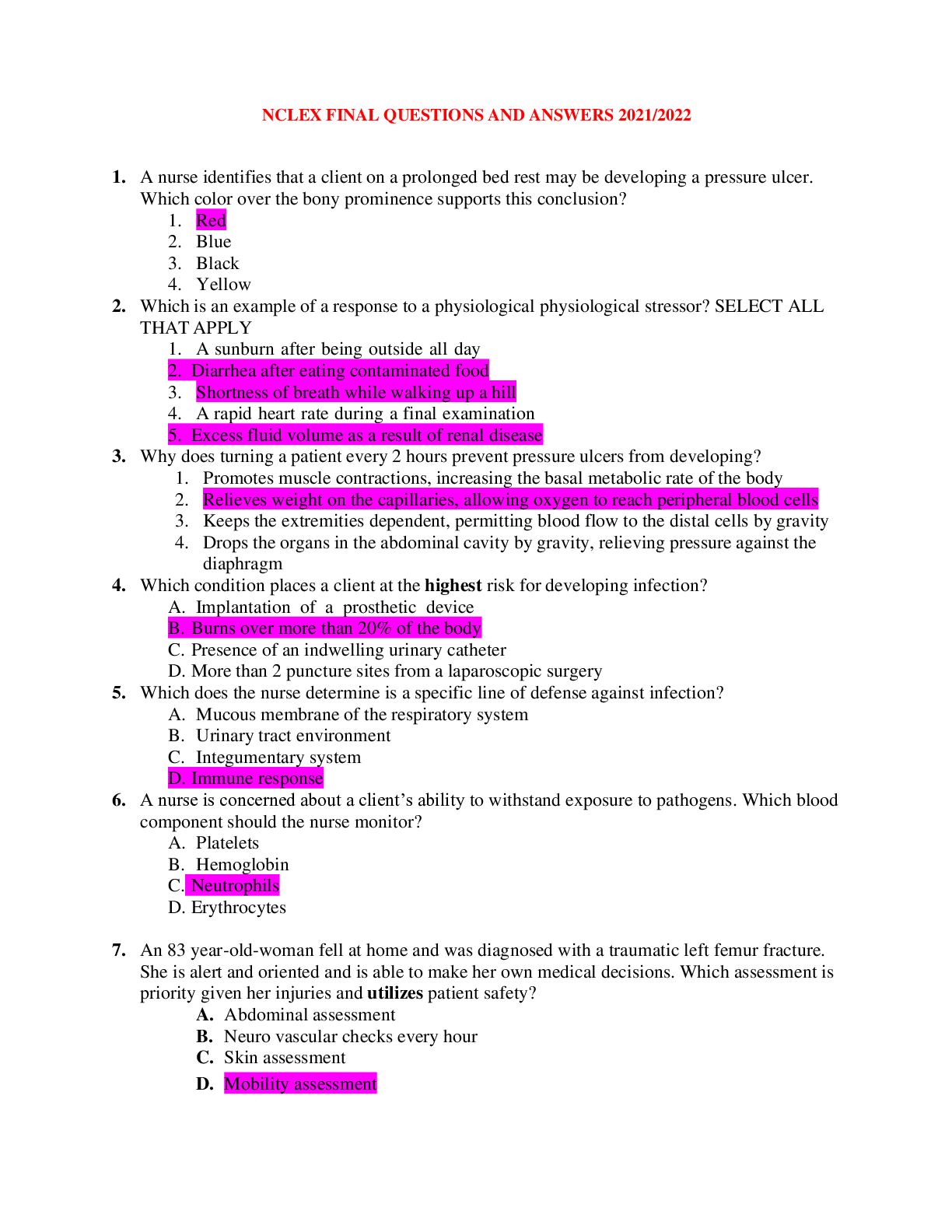
NCLEX FINAL QUESTIONS AND ANSWERS 2022/2023
*NURSING > STUDY GUIDE > BASIC EKG Interpretation | Contains the Essential info in high graphical representations and and ea (All)
Basic EKG InterpretationsCourse Objectives • To recognize the normal rhythm of the heart - “Normal Sinus Rhythm.” • To recognize the 13 most common rhythm disturbances.The HeartChambers o ... f the HeartCardiac Cycle Ventricular systole - isovolumic contraction - ejection Ventricular diastole - isovolumic relaxation - rapid filling - atrial contraction4) Ventricular Filling 5) Atrial Contraction 1) Isovolumic Ventricular Contraction 2) Ventricular Ejection 3) Isovolumic Ventricular RelaxationCan the heart beat by itself ?Autorhythm The heart can beat on its own without the need for exogenous commands.Skeletal muscle Motor nerve Conclusion ? The heart generates electricity.TERMINOLOGY Excitation - definition: generation of action potentials - different from contraction Contraction - definition: shortening of muscle cells - triggered by excitationExcitation-Contraction coupling Excitation [ Ca++ ]i Contraction (Action Potentials) (shortening)Sinus-Atrial node (SA node) Atria Atrial-ventricular node (AV node) Bundle of His Bundle Branches Left and Right Ventricles Sequence of excitationSA node - located in the right atrial wall, just inferior to the entrance of the superior vena cava. Original Impulses from S-A Node The electrical impulses are normally generated by a group of specialized pacemaker cells at sinoatrial (SA) node.Conduction of Electrical Impulses in the HeartConduction of Action Potentials from Cell to Cell through gap junctions in intercalated discs (electrical synapses)Conduction in Atria The electrical impulses from SA node spread through the entire right and left atrial muscle mass, triggering contraction of the right and left atrium.Delay at A-V Node - The impulses from S-A node travel to atrioventricular (A-V) node. - A-V node is located in lower end of the interatrial septum near the tricuspid valve. A-V nodeDelay at A-V Node - A-V node is the only normal route that impulses from SA node are transmitted into ventricles. - Conduction speed in A-V node is slow (delay). - This delay allows time for the atria to finish contraction and empty their contents into the ventricles before ventricles start to contract.From AV node to Ventricles His bundle - left branch (anterior/posterior division) - right branch His bundle1) Purkinje fibers - located in the subendocardial layer - fastest conduction (4 m/s) 2) Ordinary ventricular myocardial cells able to conduct AP at a slower speed After the delay at A-V node, the impulses rapidly spread to the ventricles via specialized fibers, Purkinje fibers. Rapid Conduction in VentriclesRapid conduction in the ventricles simultaneous excitation of the ventricles functional syncytium is a network of cardiac muscle cells connected by intercalated discs that lends to the coordinated contractionNote: - Each electrical impulse can trigger cardiac muscle contraction normally only once. - A normal heart generates 60 to 100 impulses in 1 minute at resting state. 1 1Excitation [ Ca++ ]i Contraction (Action Potentials) (shortening) Properties of Cardiac Muscle Excitation of the heart is triggered by electrical impulse rather than neural transmitters. Contraction of the heart is triggered by elevation of intracellular calcium influx.Properties of Cardiac Muscle - Myocytes depend heavily on oxygen and blood supply. - Not fatigue - Excitability Cycle The myocytes have Long refractory period during which they do not respond to any electrical impulses.Role of a Long Refractory Period – 1 prevent ventricles from contracting at too high rates so that enough time is allowed for refill of the ventriclesRole of Long refractory period - 2 Prevent retrograde excitationELECTROCARDIOGRAPHY (ECG)EELECTROCARDIOGRAPHY ((ECG) the recording of electrical activities of the heart via electrodes placed on body surface. QRS: potential changes during depolarization of ventriclesApplications of ECG 1) measure automaticity HR, rhythmicity, pacemaker 2) measure conductivity pathway, reentry, block 3) reveal hypertrophy 4) reveal ischemic damages location, size, and progressWaves and Intervals of ECG P wave: atrial depolarization QRS complex: ventricular depolarization T wave: ventricular repolarizationDisorders of the Cardiac Conduction System ---- Arrhythmias - refers to abnormal initiation or conduction of electrical impulses in the heart. - caused by ischemia, fibrosis, inflammation, or drugs.Pacemakers of the Heart • SA Node - Dominant pacemaker with an intrinsic rate of 60 - 100 beats/minute. • AV Node - Back-up pacemaker with an intrinsic rate of 40 - 60 beats/minute. • Ventricular cells - Back-up pacemaker with an intrinsic rate of 20 - 40 bpm.Bradycardia slow heart rate ( < 60 beats/min) Tachycardia fast heart rate ( > 100 beats/min)The ECG Paper • Horizontally • One small box - 0.04 s • One large box - 0.20 s • Vertically • One large box - 0.5 mVEKG TracingThe ECG Paper (cont) • Every 3 seconds (15 large boxes) is marked by a vertical line. • This helps when calculating the heart rate. NOTE: the following strips are not marked but all are 6 seconds long. 3 sec 3 secECG Rhythm Interpretation How to Analyze a RhythmRhythm Analysis • Step 1: Calculate rate. • Step 2: Determine regularity. • Step 3: Assess the P waves. • Step 4: Determine PR interval. • Step 5: Determine QRS duration.Step 1: Calculate Rate • Option 1 • Count the # of R waves in a 6 second rhythm strip, then multiply by 10. • Reminder: all rhythm strips in the Modules are 6 seconds in length. Interpretation? 3 sec 3 sec 9 x 10 = 90 bpm ∨ ∨ ∨ ∨ ∨ ∨ ∨ ∨ ∨Step 1: Calculate Rate • Option 2 • Find a R wave that lands on a bold line. • Count the # of large boxes to the next R wave. If the second R wave is 1 large box away the rate is 300, 2 boxes - 150, 3 boxes - 100, 4 boxes - 75, etc. (cont) R waveStep 1: Calculate Rate • Option 2 (cont) • Memorize the sequence: 300 - 150 - 100 - 75 - 60 - 50 Interpretation? 300 150 100 75 60 50 Approx. 1 box less than 100 = 95 bpmStep 2: Determine regularity • Look at the R-R distances (using a caliper or markings on a pen or paper). • Regular (are they equidistant apart)? Occasionally irregular? Regularly irregular? Irregularly irregular? Interpretation? Regular R RStep 3: Assess the P waves • Are there P waves? • Do the P waves all look alike? • Do the P waves occur at a regular rate? • Is there one P wave before each QRS? Interpretation? Normal P waves with 1 P wave for every QRSPR IntervalStep 4: Determine PR interval •Normal: 0.12 - 0.20 seconds. (3 – 5 sml boxes) Interpretation? 0.16 secondsStep 5: QRS duration • Normal: 0.04 - 0.12 seconds. (1 – 3 sml boxes) Interpretation? 0.12 secondsRhythm Summary • Rate 90-95 bpm • Regularity regular • P waves normal • PR interval 0.12 s • QRS duration 0.08 s Interpretation? Normal Sinus RhythmNormal Sinus Rhythm (NSR) • Etiology: the electrical impulse is formed in the SA node and conducted normally. • This is the normal rhythm of the heart; other rhythms that do not conduct via the typical pathway are called arrhythmias.NSR Parameters • Rate 60 - 100 bpm • Regularity regular • P waves normal • PR interval 0.12 - 0.20 s • QRS duration 0.04 - 0.12 s Any deviation from above is sinus tachycardia, sinus bradycardia or an arrhythmiaArrhythmia Formation Arrhythmias can arise from problems in the: • Sinus node • Atrial cells • AV junction • Ventricular cellsSA Node Problems The SA Node can: • fire too slow • fire too fast Sinus Bradycardia Sinus Tachycardia Sinus Tachycardia may be an appropriate response to stress.Atrial Cell Problems Atrial cells can: • fire occasionally from a focus • fire continuously due to a looping reentrant circuit Premature Atrial Contractions (PACs) Atrial FlutterTeaching Moment • A re-entrant pathway occurs when an impulse loops and results in self-perpetuating impulse formation.Atrial Cell Problems Atrial cells can also: • fire continuously from multiple foci or fire continuously due to multiple micro re-entrant “wavelets” Atrial Fibrillation Atrial FibrillationTeaching Moment Multiple micro reentrant “wavelets” refers to wandering small areas of activation which generate fine chaotic impulses. Colliding wavelets can, in turn, generate new foci of activation. Atrial tissueAV Junctional Problems The AV junction can: • fire continuously due to a looping reentrant circuit • block impulses coming from the SA Node Paroxysmal Supraventricular Tachycardia AV Junctional BlocksVentricular Cell Problems Ventricular cells can: • fire occasionally from 1 or more foci • fire continuously from multiple foci • fire continuously due to a looping reentrant circuit Premature Ventricular Contractions (PVCs) Ventricular Fibrillation Ventricular TachycardiaSinus Rhythms and Premature BeatsSinus Rhythms • Sinus Bradycardia • Sinus TachycardiaRhythm #1 • Rate? 30 bpm • Regularity? regular normal 0.10 s • P • waves? PR interval? 0.12 s • QRS duration? Interpretation?Sinus BradycardiaSinus Bradycardia • Deviation from NSR - Rate < 60 bpmSinus Bradycardia • Etiology: SA node is depolarizing slower than normal, impulse is conducted normally (i.e. normal PR and QRS interval).Rhythm #2 • Rate? 130 bpm • Regularity? regular normal 0.08 s • P • waves? PR interval? 0.16 s • QRS Interpretation? duration? Sinus TachycardiaSinus Tachycardia • Deviation from NSR - Rate > 100 bpmSinus Tachycardia • Etiology: SA node is depolarizing faster than normal, impulse is conducted normally. • Remember: sinus tachycardia is a response to physical or psychological stress, not a primary arrhythmia.Premature Beats • Premature Atrial Contractions (PACs) • Premature Ventricular Contractions (PVCs)Rhythm #3 • Rate?70 bpm • Regularity? occasionally irreg. 2/7 different contour 0.08 s • P • waves? PR interval?0.14 s (except 2/7) • QRS Interpretation? duration? NSR with Premature Atrial ContractionsPremature Atrial Contractions • Deviation from NSR • These ectopic beats originate in the atria (but not in the SA node), therefore the contour of the P wave, the PR interval, and the timing are different than a normally generated pulse from the SA node.Premature Atrial Contractions • Etiology: Excitation of an atrial cell forms an impulse that is then conducted normally through the AV node and ventricles.Teaching Moment • When an impulse originates anywhere in the atria (SA node, atrial cells, AV node, Bundle of His) and then is conducted normally through the ventricles, the QRS will be narrow (0.04 - 0.12 s).Rhythm #4 • Rate? 60 bpm • Regularity? occasionally irreg. none for 7th QRS 0.08 s (7th wide) • P • waves? PR interval? 0.14 s • QRS Interpretation? duration? Sinus Rhythm with 1 PVCPVCs • Deviation from NSR • Ectopic beats originate in the ventricles resulting in wide and bizarre QRS complexes. • When there are more than 1 premature beats and look alike, they are called “uniform”. When they look different, they are called “multiform”.PVCs • Etiology: One or more ventricular cells are depolarizing and the impulses are abnormally conducting through the ventricles. • AKA = multifocal PVCs ∨ ∨Teaching Moment • When an impulse originates in a ventricle, conduction through the ventricles will be inefficient and the QRS will be wide and bizarre.Ventricular Conduction Normal Signal moves rapidly through the ventricles Abnormal Signal moves slowly through the ventricles- contract uncoordinatedly and extremely rapidly. - Ventricular fibrillation is lethal. Atrial or Ventricular Flutter and FibrillationSupraventricular Arrhythmias • Atrial Fibrillation • Atrial Flutter • Paroxysmal Supraventricular TachycardiaRhythm #5 • Rate? 100 bpm • Regularity?irregularly irregular none 0.06 s • P • waves? PR interval?none • QRS Interpretation? duration? Atrial FibrillationAtrial Fibrillation • Deviation from NSR • No organized atrial depolarization, so no normal P waves (impulses are not originating from the sinus node). • Atrial activity is chaotic (resulting in an irregularly irregular rate). • Common, affects 2-4%, up to 5-10% if > 80 years oldAtrial Fibrillation • Etiology: Recent theories suggest that it is due to multiple re-entrant wavelets conducted between the R & L atria. Either way, impulses are formed in a totally unpredictable fashion. The AV node allows some of the impulses to pass through at variable intervals (so rhythm is irregularly irregular).Rhythm #6 • Rate?70 bpm • Regularity? regular flutter waves 0.06 s • P • waves? PR interval?none • QRS Interpretation? duration? Atrial FlutterAtrial Flutter • Deviation from NSR • No P waves. Instead flutter waves (note “sawtooth” pattern) are formed at a rate of 250 - 350 bpm. • Only some impulses conduct through the AV node (usually every other impulse).Atrial Flutter • Etiology: Reentrant pathway in the right atrium with every 2nd, 3rd or 4th impulse generating a QRS (others are blocked in the AV node as the ********************************** CONTINUED IN THE ATTACHMENT *********************************** [Show More]
Last updated: 1 year ago
Preview 10 out of 165 pages

Loading document previews ...
Buy this document to get the full access instantly
Instant Download Access after purchase
Buy NowInstant download
We Accept:

Can't find what you want? Try our AI powered Search
Connected school, study & course
About the document
Uploaded On
Apr 02, 2021
Number of pages
165
Written in
All
This document has been written for:
Uploaded
Apr 02, 2021
Downloads
0
Views
136
Scholarfriends.com Online Platform by Browsegrades Inc. 651N South Broad St, Middletown DE. United States.
We're available through e-mail, Twitter, Facebook, and live chat.
FAQ
Questions? Leave a message!
Copyright © Scholarfriends · High quality services·

.png)