ETOH Withdrawal/Pneumonia
UNFOLDING Reasoning Case Study
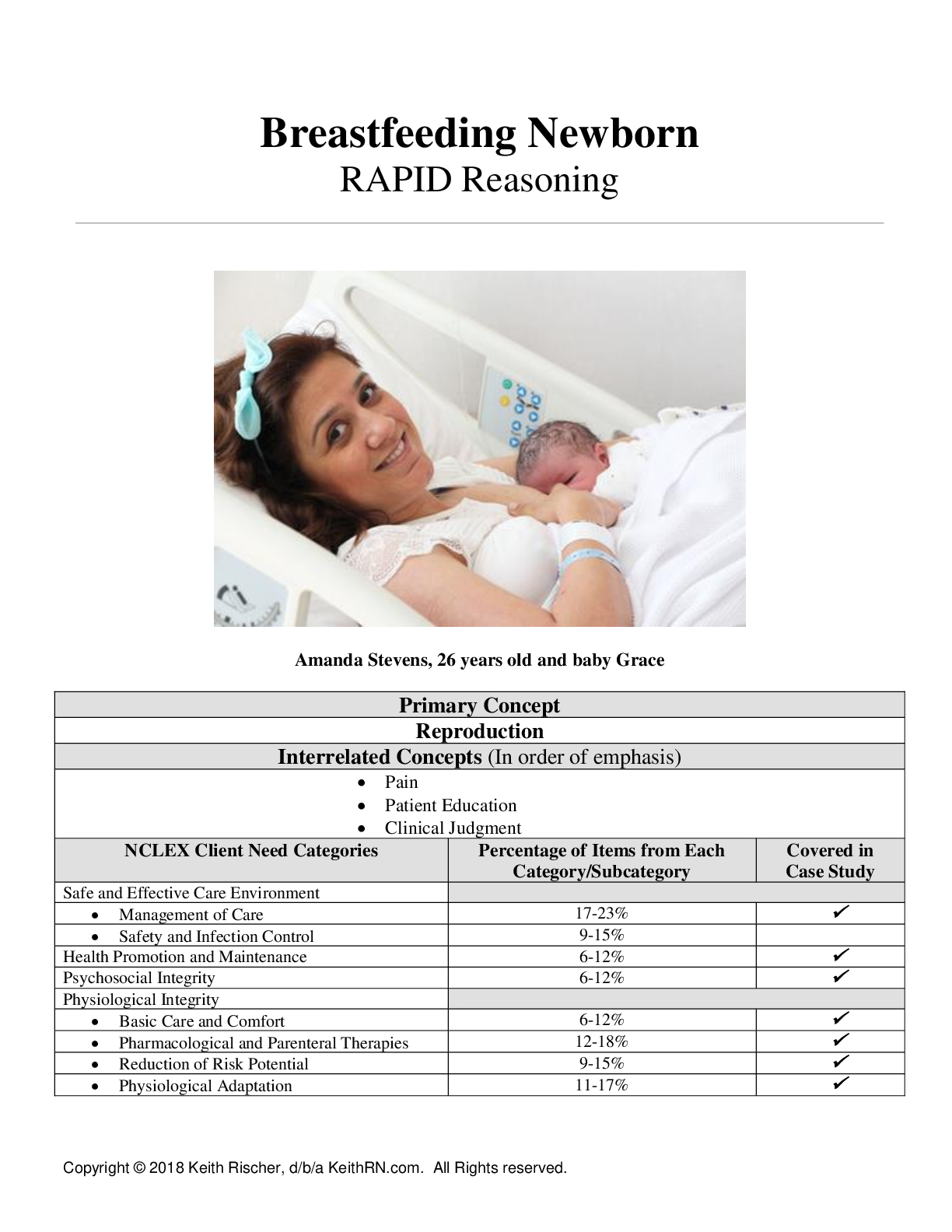
Elena Acosta, 54 years old
Primary Concept
Addiction
Interrelated Concepts (In order of emphasis)
• Infection
• Intracranial Regulation
• Patient Education
...
ETOH Withdrawal/Pneumonia
UNFOLDING Reasoning Case Study
Elena Acosta, 54 years old
Primary Concept
Addiction
Interrelated Concepts (In order of emphasis)
• Infection
• Intracranial Regulation
• Patient Education
• Communication
• Collaboration
NCLEX Client Need Categories Percentage of Items from Each
Category/Subcategory
Covered in
Case Study
Safe and Effective Care Environment
• Management of Care 17-23% ✓
• Safety and Infection Control 9-15% ✓
Health Promotion and Maintenance 6-12% ✓
Psychosocial Integrity 6-12% ✓
Physiological Integrity
• Basic Care and Comfort 6-12% ✓
• Pharmacological and Parenteral Therapies 12-18% ✓
• Reduction of Risk Potential 9-15% ✓
• Physiological Adaptation 11-17% ✓Copyright © 2019 Keith Rischer, d/b/a KeithRN.com. All Rights reserved.
History of Present Problem:
Elena Acosta is a 54-yr. old Hispanic woman with hypertension managed with hydrochlorothiazide. She is 63” (160.2
cm) and weighs 175 pounds (79.3 kg-BMI 31.0). She felt “crummy” and weaker the last 24 hours and called 911 when
she began to have mid-sternal chest pain that increased with coughing and developed a harsh productive cough with
green phlegm with difficulty breathing.
Initial lab results: WBC 14.5, neutrophils 92%, Hgb 12.9, potassium 3.5, creatinine 1.1, total bili 0.9, ALT 42, chest
x-ray revealed RLL infiltrate consistent with pneumonia, blood and sputum cultures collected and pending. Smell of
ETOH present on her breath. Blood alcohol level 0.04, urine drug screen negative. She is admitted to the medical unit
with a diagnosis of pneumonia. You are the nurse responsible for her care.
Personal/Social History:
Ms. Acosta works in a mid-level management position for a corporate finance company. She describes her job as quite
stressful. She drinks 4-5 cups of coffee every day and to least 1-2 alcoholic drinks most days. She states that she
shouldn’t smoke and has cut down to about ½ a pack per day. She reports drinking more and sleeping poorly following
her father’s death over a year ago. She takes alprazolam as needed for sleep or when she feels more anxious. She is
hesitant to be admitted because she has a high deductible insurance plan and doesn’t know how she will be able to afford
it.
What data from the histories are RELEVANT and have clinical significance to the nurse? (Reduction of Risk Potential)
RELEVANT Data from Present Problem: Clinical Significance:
RELEVANT Data from Social History: Clinical Significance:
Patient Care Begins: Initial Assessment Medical Unit
What VS data are RELEVANT and must be interpreted as clinically significant by the nurse?
(Reduction of Risk Potential/Health Promotion and Maintenance)
RELEVANT VS Data: Clinical Significance:
Current VS: P-Q-R-S-T Pain Assessment:
T: 101.2 F/38.4 C (oral) Provoking/Palliative: nothing
P: 96 (regular) Quality: ache
R: 28 (regular) Region/Radiation: Denies chest pain currently/Headache-global
BP: 138/88 Severity: 5/10
O2 sat: 92% room air Timing: constantCopyright © 2019 Keith Rischer, d/b/a KeithRN.com. All Rights reserved.
What assessment data is RELEVANT and must be interpreted as clinically significant by the nurse?
(Reduction of Risk Potential/Health Promotion & Maintenance)
RELEVANT Assessment Data: Clinical Significance:
Clinical Reasoning Begins…
1. Interpreting relevant clinical data, what is the primary problem? What primary health related concepts does this
primary problem represent? (Management of Care/Physiologic Adaptation)
Problem: Pathophysiology of Problem in OWN Words: Primary Concept:
Current Assessment:
GENERAL SURVEY: Looks older than stated age, alert, oriented, pleasant, in no acute distress, calm, body
relaxed, no grimacing, appears to be resting comfortably.
NEUROLOGICAL: Alert & oriented to person, place, and situation (x3), knew year, but wrong day of week,
feels fatigued with chills, weak, no focal deficits
HEENT: Head normocephalic with symmetry of all facial features. PERRLA, sclera white
bilaterally, conjunctival sac pink bilaterally. Lips, tongue, and oral mucosa pink and
moist.
RESPIRATORY: Breath sounds bibasilar crackles posteriorly, diminished aeration R>L bases, nonlabored
respiratory effort on room air, productive cough with moderate amount thick
yellow/brown tinged sputum
CARDIAC: Pink, warm & dry, no edema, heart sounds regular, pulses strong, equal with palpation at
radial/pedal/post-tibial landmarks, brisk cap refill. Heart tones audible and regular, S1 and
S2 noted over A-P-E-T-M cardiac landmarks with no abnormal beats or murmurs. No
JVD noted at 30-45 degrees.
ABDOMEN: Abdomen round, soft, and nontender. BS + in all 4 quadrants
GU: Voiding without difficulty, urine clear/yellow
INTEGUMENTARY: Skin warm, dry, intact, normal color for ethnicity. No clubbing of nails, cap refill <3
seconds, Hair soft-distribution normal for age and gender. Skin integrity intact, skin
turgor elastic, no tenting present.Copyright © 2019 Keith Rischer, d/b/a KeithRN.com. All Rights reserved.
2. Collaborative Care: Medical Management (Pharmacologic and Parenteral Therapies)
Care Provider Orders: Rationale: Expected Outcome:
Supplemental O2 per nasal cannula at
2 L/min. for O2 sat <93 %
VS every 4 hours and as needed
Levofloxacin 500 mg IV in Sodium
chloride 0.9% solution to infuse over
60 minutes
Hydrochlorothiazide 50 mg PO daily
Acetaminophen 325-650 mg PO every
4 hr PRN pain/temp >101; not to
exceed 4000 mg/day
Collaborative Care: Nursing
3. What nursing priority (ies) will guide your plan of care? (Management of Care)
Nursing PRIORITY:
PRIORITY Nursing Interventions: Rationale: Expected Outcome:
4. What body system(s) will you assess most thoroughly based on the primary/priority concern?
(Reduction of Risk Potential/Physiologic Adaptation)
-
-
-
Continued
[Show More]