Dementia/Physical Aggression
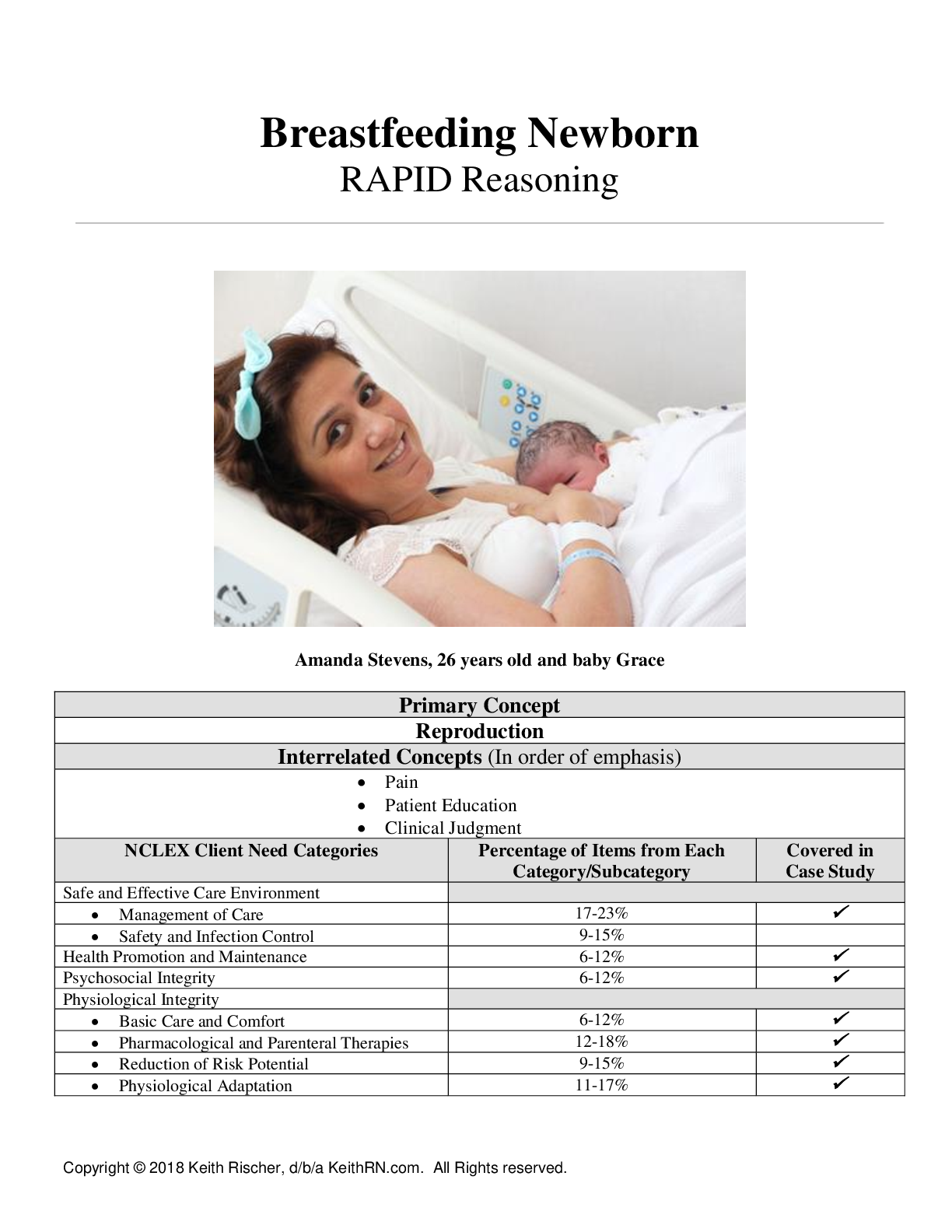
Ron Jackson, 87 years old
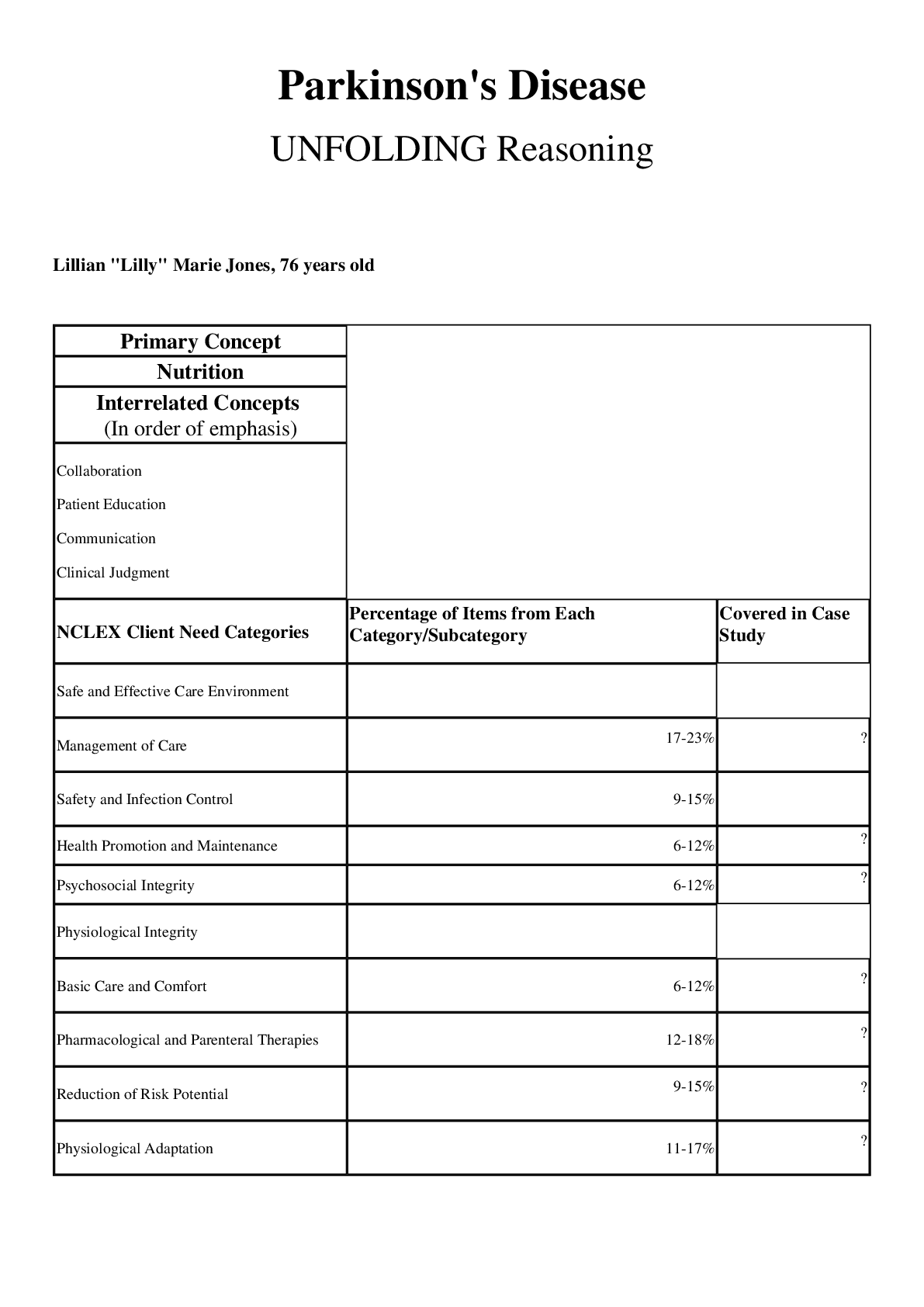
Primary Concept
COGNITION
Interrelated Concepts (In order of emphasis)
• Psychosis
• Mood and Affect
• Coping
• Clinical Judgmen
...
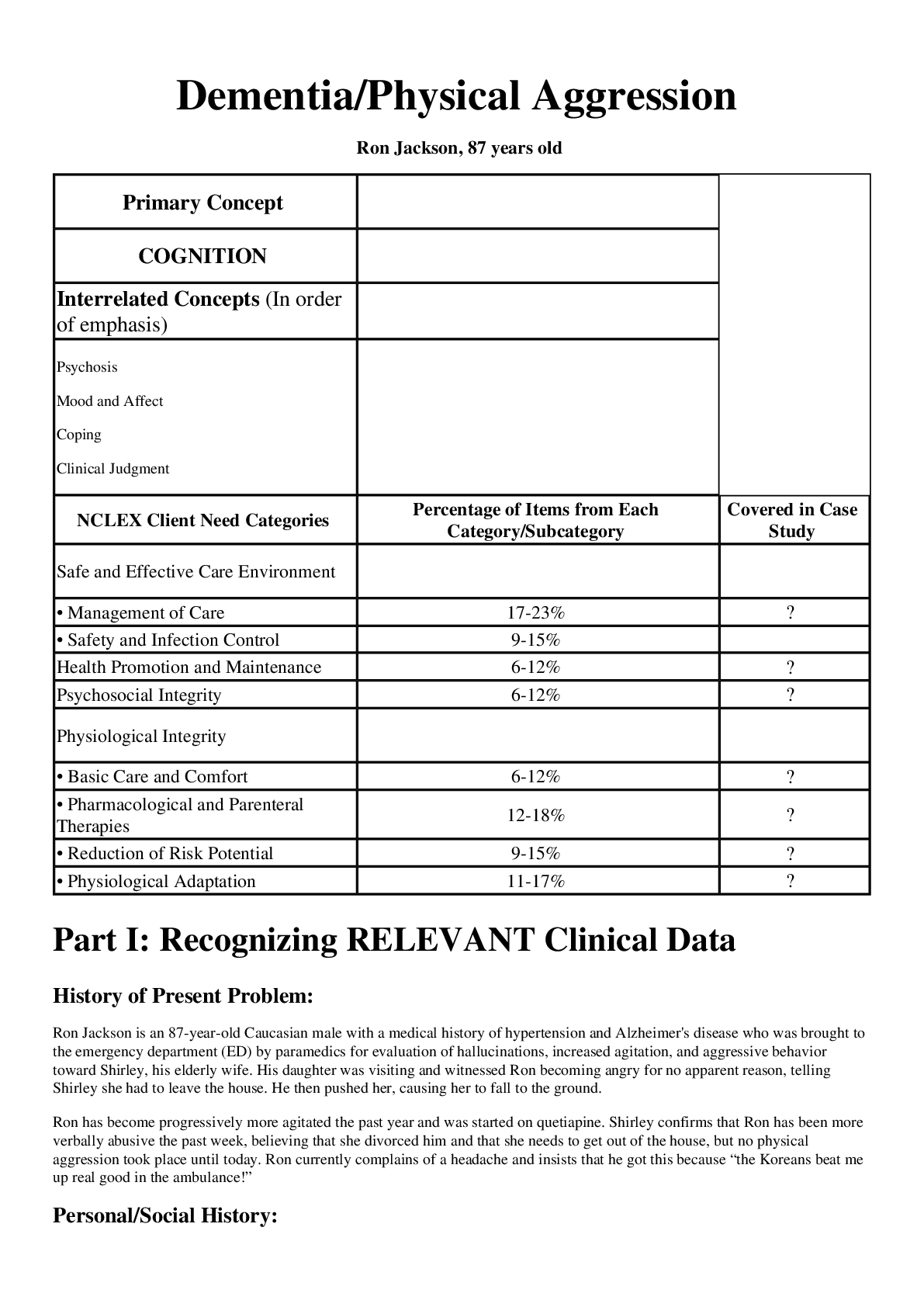
Dementia/Physical Aggression
Ron Jackson, 87 years old
Primary Concept
COGNITION
Interrelated Concepts (In order of emphasis)
• Psychosis
• Mood and Affect
• Coping
• Clinical Judgment
NCLEX Client Need Categories Percentage of Items from Each Category/Subcategory Covered in Case Study
Safe and Effective Care Environment
• Management of Care 17-23% ✓
• Safety and Infection Control 9-15%
Health Promotion and Maintenance 6-12% ✓
Psychosocial Integrity 6-12% ✓
Physiological Integrity
• Basic Care and Comfort 6-12% ✓
• Pharmacological and Parenteral Therapies 12-18% ✓
• Reduction of Risk Potential 9-15% ✓
• Physiological Adaptation 11-17% ✓
Part I: Recognizing RELEVANT Clinical Data
History of Present Problem:
Ron Jackson is an 87-year-old Caucasian male with a medical history of hypertension and Alzheimer's disease who was brought to the emergency department (ED) by paramedics for evaluation of hallucinations, increased agitation, and aggressive behavior toward Shirley, his elderly wife. His daughter was visiting and witnessed Ron becoming angry for no apparent reason, telling Shirley she had to leave the house. He then pushed her, causing her to fall to the ground.
Ron has become progressively more agitated the past year and was started on quetiapine. Shirley confirms that Ron has been more verbally abusive the past week, believing that she divorced him and that she needs to get out of the house, but no physical aggression took place until today. Ron currently complains of a headache and insists that he got this because “the Koreans beat me up real good in the ambulance!”
Personal/Social History:
Ron lives at home with Shirley, his wife of 62 years and has three children. Ron is a Korean War veteran who saw active duty and is a retired salesman. Because his wife has been struggling to care for him, his family is in the process of making arrangements for him to reside at a local memory care unit.
What data from the histories are RELEVANT and must be interpreted as clinically significant by the nurse?
(Reduction of Risk Potential)
RELEVANT Data from Present Problem: Clinical Significance:
History of Hypertension
Alzheimer’s
Hallucinations
Increased Agitation
Medication is Quetiapine
Complains of a headache
Hypertension medication has side effects
He is cognitively impaired
Hallucinations can cause agitation and anxiety
Need to know what is causing the agitation
Is this medication appropriate? What are the side effects?
What is causing the headache? (we know it wasn’t the Koreans)
RELEVANT Data from Social History: Clinical Significance:
War veteran that saw active duty
Wife has been struggling to care for him
Making arrangements for him to go to a memory care unit
Retired salesman
Possible PTSD symptoms
Shows has been increasingly getting worse
Consult social work and start looking for options
Useful to know when it comes time for therapeutic communication
1. Identify the relationship between the PMH and home medications. Which medication treats which condition? Draw a line to connect the PMH to the correct medication.
Past Medical History (PMH): Home Meds:
Hyperlipidemia
Hypertension
Alzheimer's disease
Agitation/Delusions
(Color matched) Donepezil 10 mg PO at HS
Aspirin 325 mg PO daily
Memantine 10 mg PO BID
Simvastatin 20 mg PO HS
Triamterene-HCTZ 75-50 mg PO daily
Quetiapine 50 mg PO BID
2. Is there a relationship between any problem in his past medical history and the present problem? If so, describe. Yes, Alzheimer’s causes alterations in ones perceptions. Agitation/Delusions is what he is experiencing this time. Hypertension and his BP is slightly elevated today. Medication Simvastatin can cause headaches.
Patient Care Begins:
Current VS: P-Q-R-S-T Pain Assessment:
T: 98.0 F/36.7 C (oral) Provoking/Palliative: “Those Koreans banged my head in the ambulance.”
P: 78 (regular) Quality: “That’s a stupid question!”
R: 18 (regular) Region/Radiation: “My head hurts all over!”
BP: 148/90 Severity: “It just hurts!”
O2 sat: 98% room air Timing: “All the time.”
What VS data are RELEVANT and must be interpreted as clinically significant by the nurse? (Reduction of Risk Potential/Health Promotion and Maintenance)
RELEVANT VS Data: Clinical Significance:
BP is slightly elevated
“my head hurts all over”
Can be due to overstimulation, or it he needs his hypertension meds
Headache pain can cause agitation making his episode worse
Current Assessment:
GENERAL APPEARANCE: Thin elderly male, appears stated age, sitting upright on stretcher, appears tense
RESP: Breath sounds clear with equal aeration bilaterally ant/post, non-labored respiratory effort
CARDIAC: Pink, warm & dry, no edema, heart sounds regular with no abnormal beats, pulses strong, equal to palpation at radial/pedal/post-tibial landmarks, brisk capillary refill
NEURO: Oriented to person only, denies hallucinations
GI: Abdomen flat, soft/non-tender, bowel sounds audible per auscultation in all four quadrants
GU: Voiding without difficulty, urine clear/yellow
SKIN: Skin integrity intact, skin turgor elastic, no tenting present
Mental Status Examination (MSE):
APPEARANCE: Disheveled appearance; cooperative at times, other times irritable
MOTOR BEHAVIOR: Variable; at times pacing and agitated; at other times sits quietly
SPEECH: Able to understand what the patient is saying
MOOD: Variable; quiet and calm with sudden episodes of anger, anxiety, and irritability
AFFECT: Variable: looks calm, then may suddenly appear angry
THOUGHT PROCESS: Able to understand what the patient is saying
THOUGHT CONTENT: Paranoid and persecutory delusions/ideation; “Koreans” are harming him; delusions “believes wife divorced him”
PERCEPTION: Denies hallucinations
INSIGHT: Grossly impaired; attributes H/A to an attack by “Koreans”; not aware of illness or reason for ER visit
JUDGMENT: Grossly impaired
COGNITION: Oriented to person only. Significant short- and long-term memory deficits
SUICIDAL/HOMICIDAL: High risk for physical aggression toward others; recently assaultive toward wife; unable to assess suicide ideation at this time
What assessment data are RELEVANT and must be interpreted as clinically significant by the nurse? (Reduction of Risk Potential/Health Promotion & Maintenance)
RELEVANT Assessment Data: Clinical Significance:
Appears tense
Only oriented to person
Note that Resp, cardiac, GI, GU, and skin are all standard
Know to approach him in a calm, slow manner
Be sure to properly introduce yourself
No signs of underlying issues in those areas
RELEVANT Mental Status Exam Data: Clinical Significance:
Disheveled appearance
Motor behavior, mood, and affect are all variable
Thought content:Paranoid
Insight: grossly impaired
Suicidal/homicidal: high risk
Appearance often displays the patients grasp on reality
Patient is not cognitively aware of his actions
A detailed MSE is important to determine onset, time course, and progression of symptoms.
This is the number one safety issue with mental health patients assess and reassess
-
-
-
-
-
-
-
--
Continued
[Show More]






.png)